



Premium File
225 Q&A
$76.99$69.99
Huawei H12-221 Exam Questions & Answers, Accurate & Verified By IT Experts
Instant Download, Free Fast Updates, 99.6% Pass Rate
225 Questions & Answers
Last Update: Nov 04, 2026
$69.99
Huawei H12-221 Exam Screenshots
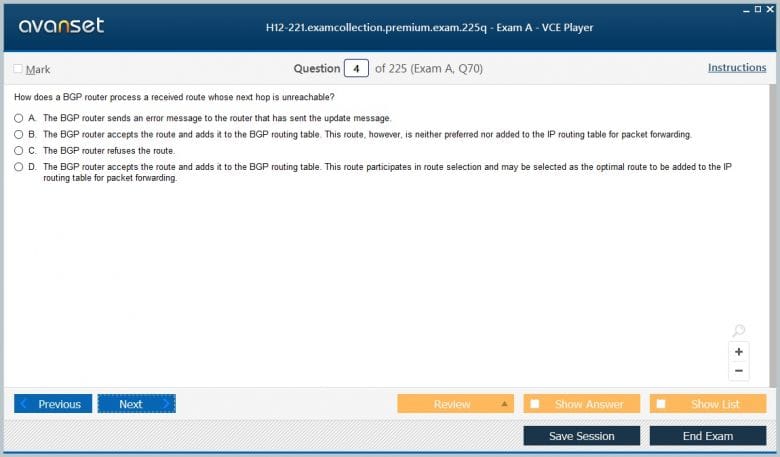
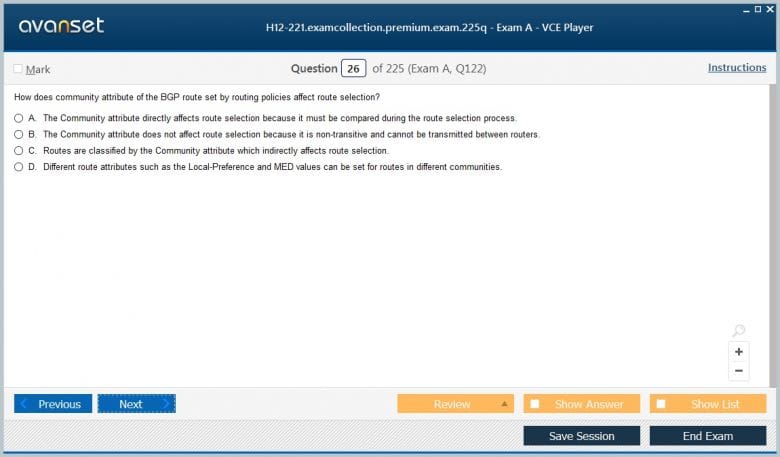
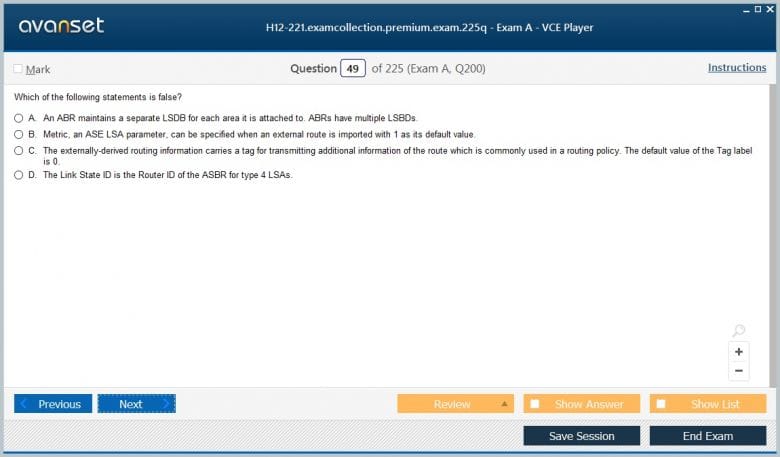
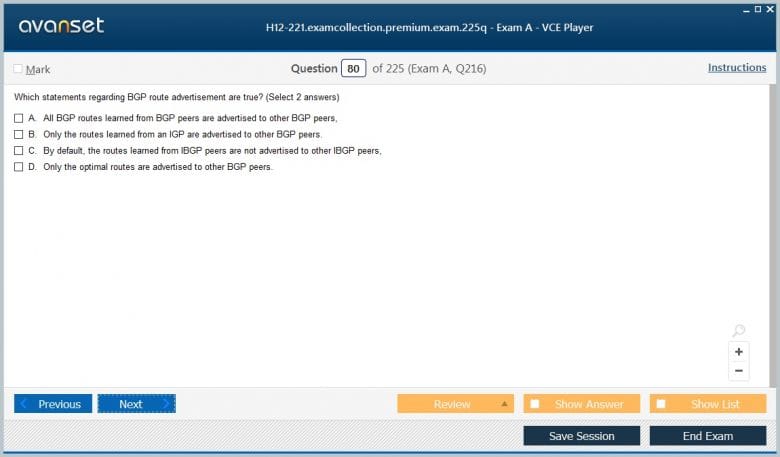
Huawei H12-221 Practice Test Questions in VCE Format
| File | Votes | Size | Date |
|---|---|---|---|
File Huawei.questionspaper.H12-221.v2026-10-05.by.luca.135q.vce |
Votes 1 |
Size 380.07 KB |
Date Oct 05, 2026 |
File Huawei.Test4prep.H12-221.v2019-02-25.by.Aurora.134q.vce |
Votes 6 |
Size 366.9 KB |
Date Feb 26, 2019 |
File Huawei.Passit4sure.H12-221.v2015-05-09.by.William.160q.vce |
Votes 11 |
Size 135.66 KB |
Date May 09, 2015 |
Huawei H12-221 Practice Test Questions, Exam Dumps
Huawei H12-221 (HCNP-R&S-IERN (Huawei Certified Network Professional-Implementing Enterprise Routing Network)) exam dumps vce, practice test questions, study guide & video training course to study and pass quickly and easily. Huawei H12-221 HCNP-R&S-IERN (Huawei Certified Network Professional-Implementing Enterprise Routing Network) exam dumps & practice test questions and answers. You need avanset vce exam simulator in order to study the Huawei H12-221 certification exam dumps & Huawei H12-221 practice test questions in vce format.
H12-221 belonged to Huawei’s historical HCIP/HCNP Routing & Switching professional path and was associated with implementing enterprise routing networks. It pushed beyond associate configuration into OSPF detail, BGP, route policy, multicast, reliability, and the design choices that control how traffic moves through a larger enterprise. In the old certification structure it was one of several exams used to build professional-level R&S competence.
Huawei’s Datacom program has replaced that old Routing & Switching family. The closest current professional foundation in the approved inventory is H12-821 HCIP-Datacom Core Technology, with H12-831 Advanced Routing & Switching Technology providing deeper routing-and-switching specialization. H12-221 is therefore a legacy page, but its routing discipline remains highly relevant to the current path.
At associate level, a route can be treated as an entry that forwards traffic. At professional level, the engineer needs to understand why the route exists, which protocol produced it, how its attributes were chosen, what policy modified it, and how the network will react when the path changes. This is the difference between configuring routing and operating a routing system.
Candidates should practice explaining the control plane before looking at the forwarding table. Which neighbors should form? Which prefixes should be originated? Where should summarization occur? Which backup path should become active after a failure? If those expectations are explicit, verification becomes much easier because the routing table can be compared with a known design rather than judged in isolation.
Professional OSPF study includes area design, LSA behavior, route types, summarization, network types, authentication, convergence, and route preference. The important skill is connecting those features to operational outcomes. An area boundary can limit topology information; summarization can reduce churn but hide detail; authentication protects adjacency formation; tuning timers can accelerate convergence but also increase sensitivity to transient loss.
Failure exercises should include more than shutting one interface. Change an area assignment, alter a cost, remove a network advertisement, break authentication, or create a mismatched network type. Observe the neighbor state and LSDB, then explain why the route changed. This develops the ability to diagnose partial routing failures where some destinations still work.
BGP is not simply “the Internet routing protocol.” In enterprise and service-edge designs it gives engineers a rich policy framework for controlling route exchange. Candidates should understand neighbor relationships, route attributes, route selection, filtering, aggregation, and the difference between reachability and preference. A route can exist in BGP yet never become the active forwarding choice.
Policy should be tested from both directions. What routes are accepted from a peer? What attributes are changed? What is advertised back? How does the local router prefer one exit over another? A strong lab uses small prefix sets and route policies so candidates can predict the outcome before checking the table. This is more valuable than memorizing attribute order without seeing its effect.
Prefix lists, ACL-based matching, route policies, metrics, and preferences allow fine control but also create failure modes that are harder to see than a down interface. A single overly broad deny can remove an entire set of routes while every adjacency remains established. Professional engineers therefore need change discipline and verification around policy.
Before modifying routing policy, document the intended prefix set and expected attribute change. After the change, confirm what was matched and what was exported. Include rollback criteria. This habit is directly transferable to current Datacom work because modern networks still depend on routing policy to express business intent across WAN, campus, cloud, and data-center boundaries.
Multicast introduces receivers, group membership, distribution trees, rendezvous behavior, and reverse-path checks. A unicast routing table may look healthy while multicast traffic still fails. Candidates should understand the roles of IGMP, PIM modes, RPF, and source/group state well enough to follow a stream from source to receiver.
Troubleshooting should ask whether receivers joined, whether routers built the expected multicast state, whether the RPF path is correct, and whether policy or TTL prevents forwarding. These questions show why professional routing study cannot be reduced to OSPF and BGP alone. Enterprise services such as video distribution may rely on multicast behavior that has its own operational model.
Fast convergence features, link aggregation, first-hop redundancy, and redundant routing peers all improve availability, but only if the surviving path has adequate capacity and dependencies. A design can survive a router failure and still lose service because the backup path lacks bandwidth or because both routers depend on one upstream circuit.
Professional candidates should create failure matrices. For each component or link, record the expected new path, convergence time, capacity, and monitoring signal. Then test selected failures. This turns “we have redundancy” into an evidence-based statement. It also builds the mindset needed for current Datacom solution planning.
H12-221 sat beside other legacy exams such as H12-222 and H12-223, which distributed switching, performance, and project-oriented material across the professional track. That historical structure is useful context because old training notes often assume candidates are moving among those companion exams.
Current Datacom organizes the knowledge differently. Core technology is consolidated under H12-821, while advanced directions branch into specialized exams. Candidates converting old notes should therefore label the concept rather than the exam code: OSPF, BGP, switching, multicast, reliability, security, automation, or solution design. That makes the material portable into the current blueprint.
Routing expertise today is increasingly combined with controller-based operations, telemetry, APIs, intent, and automation. Huawei’s Datacom program reflects that expansion. A senior engineer is expected not only to tune protocol behavior but also to understand how networks are managed at scale and how routing fits within campus, WAN, SD-WAN, and other solution architectures.
The current expert destination H12-891 HCIE-Datacom makes that progression visible. Advanced routing remains central, but it sits beside campus, WAN, automation, and cross-domain design. Candidates using H12-221 as a study source should deliberately add those newer dimensions rather than stopping at the classic R&S boundary.
A strong professional routing lab begins with a diagram and a statement of intent. Configure OSPF, introduce BGP, apply a route policy, add a redundant path, and verify multicast or other services. Before each change, predict the routing table and traffic path. After the change, compare the result with the prediction and investigate every difference.
Then inject faults that do not drop the interface: mismatched authentication, incorrect prefix filtering, altered preference, wrong area type, broken RPF path, or missing return route. These failures force candidates to use control-plane evidence instead of relying on link status. The same method remains valuable in the current Datacom track because complex networks fail more often through incorrect state than through obviously dead hardware.
The historical H12-221 exam is no longer the current professional route, but it still represents a durable stage in Huawei networking education. Candidates should preserve its focus on control-plane reasoning, policy, convergence, and troubleshooting while moving their scheduling and blueprint work to H12-821, H12-831, and the broader Huawei certification portfolio.
Route summarization is a useful professional design exercise because it forces candidates to balance scale against visibility. A summary can reduce table size and contain instability, but it can also attract traffic toward a region that no longer has the more specific destination. Engineers should know where discard routes or careful failure behavior are needed so a summary does not create a black hole during partial outages.
Authentication and control-plane protection should be integrated into routing labs. OSPF or BGP adjacencies are critical infrastructure and should not accept arbitrary peers. Candidates should understand the purpose of authentication, peer filtering, management-plane restrictions, and resource protection without assuming that one mechanism solves every threat. Secure routing still requires correct topology and policy.
Operationally, routing teams need change comparison. Capture neighbor state, route counts, critical prefixes, and preferred exits before a maintenance window, then compare them after the change. A large table can hide a single missing prefix that affects an important application. Defining a small set of high-value validation routes makes professional verification faster and more reliable.
When old H12-221 material is moved into a current study plan, candidates should also add telemetry and automation. The protocols may be familiar, but modern operations expect engineers to detect state drift across many devices and to use structured data where possible. That extension is one of the clearest differences between classic professional R&S study and current Datacom practice.
Professional routing preparation should include policy validation as well as protocol establishment. Build a topology with two internal paths and more than one external or boundary route, then write down which prefixes should be preferred under normal conditions and which path should take over after a failure. Change a metric, route policy, redistribution rule, or advertised prefix and compare the resulting control-plane state with that written intent. The important step is to inspect not only whether neighbors remain up, but also which routes are accepted, selected, installed, and advertised onward. A session can be healthy while the routing outcome is wrong. Repeating the test after a link failure develops a clearer understanding of convergence and backup behavior. This style of lab turns legacy H12-221 topics into durable professional skills and gives candidates a better base for the current Datacom professional exams, where routing knowledge is expected to support broader operational decisions.
Professional routing knowledge should also include ownership boundaries. An enterprise may control the campus and edge while a provider controls part of the WAN, or a cloud platform may inject routes through a managed gateway. Engineers must know which evidence they can collect directly, which assumptions require provider confirmation, and how to describe a fault precisely enough that another team can act without repeating the entire investigation.
Go to testing centre with ease on our mind when you use Huawei H12-221 vce exam dumps, practice test questions and answers. Huawei H12-221 HCNP-R&S-IERN (Huawei Certified Network Professional-Implementing Enterprise Routing Network) certification practice test questions and answers, study guide, exam dumps and video training course in vce format to help you study with ease. Prepare with confidence and study using Huawei H12-221 exam dumps & practice test questions and answers vce from ExamCollection.
Purchase Individually
Top Huawei Certification Exams
Site Search:

SPECIAL OFFER: GET 10% OFF

Pass your Exam with ExamCollection's PREMIUM files!
SPECIAL OFFER: GET 10% OFF
Use Discount Code:
MIN10OFF
A confirmation link was sent to your e-mail.
Please check your mailbox for a message from support@examcollection.com and follow the directions.

Download Free Demo of VCE Exam Simulator
Experience Avanset VCE Exam Simulator for yourself.
Simply submit your e-mail address below to get started with our interactive software demo of your free trial.
Anyone can validate this is valid or accurate?
Do yo have valid the exam h12-221 huawei?