



Premium File
413 Q&A
$76.99$69.99
Huawei H12-211 Exam Questions & Answers, Accurate & Verified By IT Experts
Instant Download, Free Fast Updates, 99.6% Pass Rate

H12-211 Premium File: 413 Questions & Answers
Last Update: Nov 05, 2026
H12-211 Training Course: 27 Video Lectures
$74.99
Huawei H12-211 Exam Screenshots
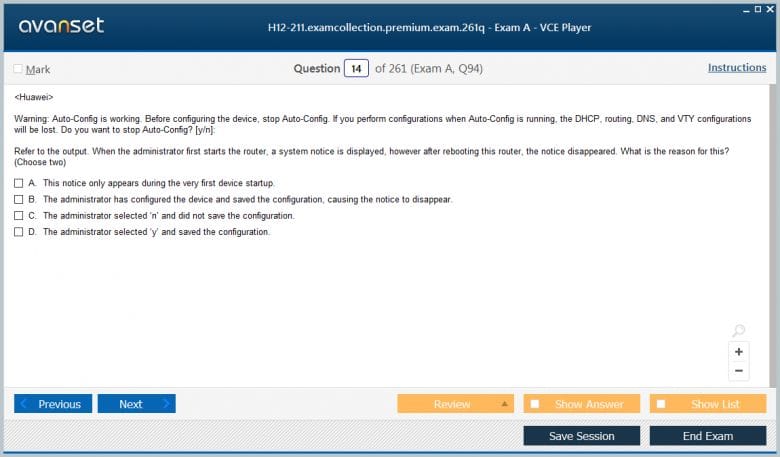
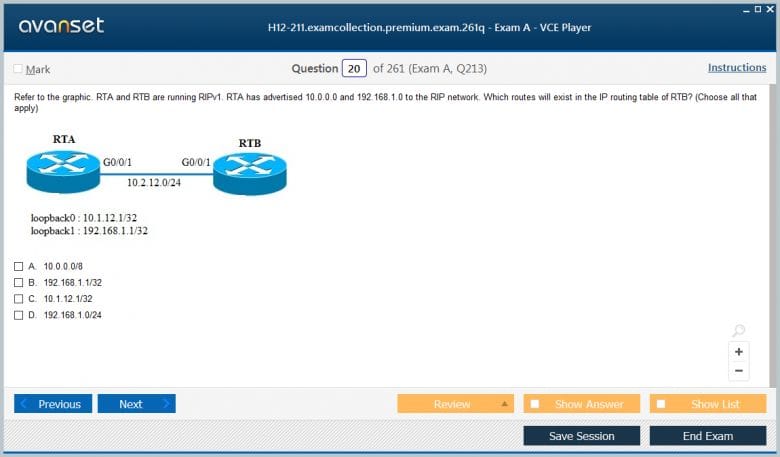
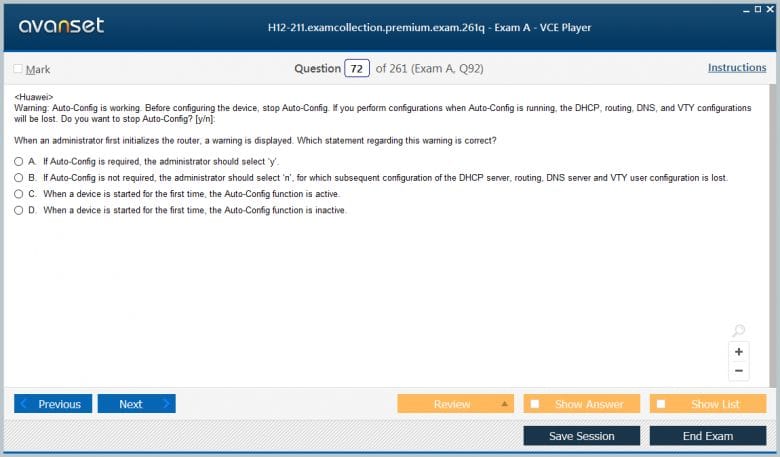
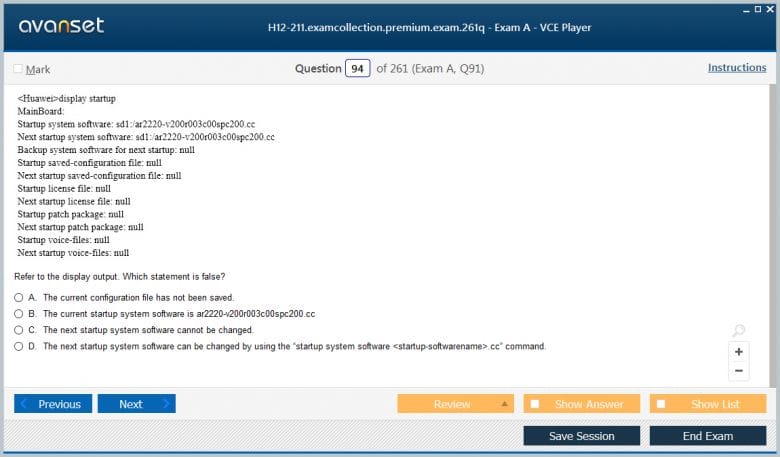
Huawei H12-211 Practice Test Questions in VCE Format
| File | Votes | Size | Date |
|---|---|---|---|
File Huawei.prep4sure.H12-211.v2026-09-24.by.jude.227q.vce |
Votes 1 |
Size 2.37 MB |
Date Sep 24, 2026 |
File Huawei.test4prep.H12-211.v2020-02-13.by.erin.184q.vce |
Votes 3 |
Size 1.77 MB |
Date Feb 13, 2020 |
File Huawei.Prepaway.H12-211.v2019-02-19.by.Amelia.140q.vce |
Votes 7 |
Size 704.5 KB |
Date Feb 21, 2019 |
File Huawei.Certkey.H12-211.v2018-11-19.by.Julian.127q.vce |
Votes 12 |
Size 579.6 KB |
Date Nov 26, 2018 |
File Huawei.Testkings.H12-211.v2018-05-15.by.Nick.120q.vce |
Votes 10 |
Size 485.06 KB |
Date May 15, 2018 |
File Huawei.Realtests.H12-211.v2015-01-21.by.Connor.233q.vce |
Votes 85 |
Size 271.63 KB |
Date Jan 21, 2015 |
Huawei H12-211 Practice Test Questions, Exam Dumps
Huawei H12-211 (HCIA Routing&Switching) exam dumps vce, practice test questions, study guide & video training course to study and pass quickly and easily. Huawei H12-211 HCIA Routing&Switching exam dumps & practice test questions and answers. You need avanset vce exam simulator in order to study the Huawei H12-211 certification exam dumps & Huawei H12-211 practice test questions in vce format.
H12-211 is the historical HCIA Routing & Switching exam in Huawei’s older certification structure. It covered the fundamentals an entry-level network engineer needed to build and operate small and medium enterprise networks: Ethernet switching, VLANs, spanning tree, IPv4 and IPv6, static and dynamic routing, DHCP, NAT, ACLs, basic network security, device management, and troubleshooting on Huawei routers and switches.
The status distinction is essential. Huawei announced that its Datacom certification program would completely replace the Routing & Switching family, and the current associate path is represented by H12-811 HCIA-Datacom. That does not make H12-211 concepts useless. It means the page should be used as legacy foundations while current candidates map those skills into the broader Datacom blueprint, which adds WLAN, SDN, automation, and newer operational context.
IPv4 subnetting is often treated as an arithmetic exercise, but a network engineer uses addressing to predict forwarding behavior. A candidate should be able to look at an interface address and mask, determine the local network, identify valid host ranges, recognize overlapping subnets, and explain when a router needs a route instead of an ARP entry. These decisions are the basis of almost every later routing and troubleshooting task.
IPv6 adds new address forms and neighbor-discovery behavior, but the same engineering discipline applies. Understand how hosts determine whether a destination is local, how default gateways are used, and how routers select a path. A strong lab deliberately introduces an incorrect prefix length or missing route and asks the candidate to prove the failure from the routing table, interface state, and packet path rather than guessing.
Switching fundamentals begin with MAC learning and forwarding, but enterprise networks quickly add VLAN boundaries, trunks, link aggregation, and spanning tree. Candidates should understand why a switch floods unknown traffic, how a MAC table is populated, and how VLAN membership changes the broadcast domain. Without that mental model, commands become difficult to troubleshoot because the engineer cannot predict what the switch should do.
Loop prevention deserves special attention. Redundant Layer 2 links improve availability but can create catastrophic loops if spanning tree does not block the right path. Study root-bridge election, port roles, path cost, topology changes, and the operational consequences of an unstable Layer 2 design. The goal is not to memorize a single topology; it is to reason about why one link forwards while another waits as a backup.
Static routes, direct routes, default routes, and dynamic protocols all produce entries in a routing table. The practical skill is route selection: determine which prefix matches a destination most specifically, which next hop is chosen, and which outgoing interface will carry the packet. Then verify that the return path exists. Many “routing problems” are actually asymmetric paths or missing reverse routes.
OSPF introduces a link-state model in which routers build a topology view and calculate best paths. At H12-211 level, candidates should understand neighbor formation, areas, basic cost, designated-router behavior on multiaccess segments, and why advertisements may not appear as expected. Current Datacom study deepens these topics, but the legacy associate page still provides the conceptual base.
DHCP, DNS reachability, NAT, and basic management services can make an otherwise correct routed network usable. DHCP problems should be traced through client state, relay or server reachability, address pools, and gateway information. NAT should be understood as translation state and policy, not simply as a command that “gives Internet access.” Engineers need to know which inside address became which outside address and whether the return traffic can match the translation.
AAA and remote management are equally operational. Shared device passwords may be convenient in a lab, but production networks require accountable user identities and controlled privilege. H12-211-era study often introduced local AAA and Telnet/SSH management. Modern practice should emphasize secure protocols, restricted management reachability, role separation, and logging that can show who changed what.
Access control lists teach candidates to think precisely about source, destination, protocol, order, and implicit behavior. A rule that is syntactically correct can still block legitimate management, prevent routing adjacencies, or expose services accidentally if it is placed in the wrong direction. The best preparation is to predict which packets match before applying the policy.
ACL troubleshooting should therefore include hit counters, interface direction, rule order, and test traffic. Add one rule at a time and observe the result. This disciplined approach scales into firewalls, route policies, security groups, and other policy systems because the underlying skill is the same: define the intended traffic set, express it accurately, and verify the actual match behavior.
When a user says “the network is down,” the engineer needs a sequence. Verify physical and link state, confirm VLAN membership, validate addressing, test the local gateway, inspect ARP or neighbor information, check the routing table, then test the next hop. That order prevents time being wasted on BGP or DNS when the access port is simply in the wrong VLAN.
Huawei CLI practice should reinforce that sequence. Commands matter because they expose evidence: interface counters, MAC tables, ARP entries, routing tables, OSPF neighbors, ACL matches, and logs. Candidates should build the habit of asking what each command proves. A screen full of output is not useful unless it narrows the fault domain.
Huawei’s current H12-811 V2.0 page reflects the continuing evolution of the Datacom associate track. The transition from H12-211 is not merely a code change. Current network engineers are expected to recognize WLAN, management, SDN, and automation concepts alongside classic IP routing and switching. That broader scope mirrors how enterprise networks are actually operated.
The professional progression is also different from the old three-exam R&S structure. Current candidates move toward H12-821 HCIP-Datacom Core Technology and, for advanced routing and switching depth, H12-831. Historical notes from H12-211 should therefore be reorganized by concept rather than kept as an old exam checklist.
A good H12-211 lab still teaches durable skills. Build two or three routers and switches, create VLANs, establish trunks, configure inter-VLAN routing, run OSPF, provide DHCP, add a default route and NAT, then apply an ACL. Break each layer deliberately. The exercise forces candidates to trace traffic from host to destination and explain every forwarding decision.
Then repeat the topology with modern Datacom objectives in mind. Add IPv6, monitoring, WLAN context, or a simple automation task. This shows which foundations remain unchanged and which expectations have expanded. It also prevents candidates from believing that “legacy” means “irrelevant.” Ethernet, IP forwarding, route selection, and evidence-based troubleshooting remain central to networking.
Within Huawei certifications, H12-211 is best treated as the historical on-ramp to the networking skills now organized under Datacom. Current candidates should schedule against the live Datacom track, but they can still use H12-211 material to strengthen subnetting, switching, routing, services, security basics, and troubleshooting—the fundamentals on which the newer certification depends.
Interface counters deserve deliberate practice because they reveal problems that routing tables cannot. Errors, drops, duplex or negotiation issues, queue discards, and rapidly changing link state can explain intermittent performance even when every route is correct. Candidates should learn what a healthy interface looks like, then create controlled faults and observe which counters move. This builds the habit of checking physical and data-link evidence before blaming higher-layer protocols.
Addressing plans should also be treated as operational assets. Consistent subnet sizes, summarized blocks, documented gateway conventions, and reserved infrastructure ranges make routing and troubleshooting easier. Poorly planned address space creates overlapping networks, excessive routes, and migrations that are harder than necessary. Even at associate level, candidates should see subnetting as part of network design rather than a standalone math test.
Modernizing an H12-211 lab can include a simple automation step such as collecting interface or routing information from several devices and comparing it with an expected state. The automation itself can be basic; the important lesson is that network operations increasingly rely on repeatable validation. This helps connect the legacy command-line foundation with the management and programmability expectations that appear in Datacom.
Documentation is the final layer. Record topology, addresses, VLANs, routing processes, and the reason for every non-default policy. When a lab is broken a week later, good documentation should let another person predict the intended state before touching the devices. That is the same discipline production teams need when the engineer who built the network is not available.
Foundation routing-and-switching practice becomes much stronger when every exercise includes a complete packet walk. Begin with a host sending traffic outside its local subnet and identify the Layer 2 decision, default-gateway resolution, switch forwarding, router lookup, next-hop selection, and return path. Then repeat the exercise after changing one variable such as a VLAN assignment, subnet mask, gateway, interface state, or route. The candidate should predict where forwarding stops before checking device output. This connects addressing, Ethernet, switching, and routing instead of treating them as unrelated chapters. It also exposes asymmetric problems that a one-direction ping can hide. When IPv6 is included, the same exercise can be used to compare the role of neighbor discovery and IPv6 routing with the familiar IPv4 workflow. These packet-walk habits remain useful in the modern Datacom path because later automation and controller features still depend on correct underlying forwarding behavior.
One final exercise is to narrate a packet journey from a user host to a remote subnet and back. Identify the source MAC and IP, default gateway decision, switching path, route lookup, next-hop resolution, NAT or ACL processing if present, and the return route. If a candidate can explain that journey without relying on a memorized command sequence, the H12-211 foundations are genuinely understood and ready to carry into Datacom.
Go to testing centre with ease on our mind when you use Huawei H12-211 vce exam dumps, practice test questions and answers. Huawei H12-211 HCIA Routing&Switching certification practice test questions and answers, study guide, exam dumps and video training course in vce format to help you study with ease. Prepare with confidence and study using Huawei H12-211 exam dumps & practice test questions and answers vce from ExamCollection.
Purchase Individually

Huawei H12-211 Video Course

Top Huawei Certification Exams
Site Search:

SPECIAL OFFER: GET 10% OFF

Pass your Exam with ExamCollection's PREMIUM files!
SPECIAL OFFER: GET 10% OFF
Use Discount Code:
MIN10OFF
A confirmation link was sent to your e-mail.
Please check your mailbox for a message from support@examcollection.com and follow the directions.

Download Free Demo of VCE Exam Simulator
Experience Avanset VCE Exam Simulator for yourself.
Simply submit your e-mail address below to get started with our interactive software demo of your free trial.
this 174q from Marcus, is it for the v2.5 exam?
my name tienthanh daklak can you show me which dump is correct, and how much percent is the same. many thanks
Can any one help with latest dump please
Plz guide me which dumps r good for HCNA H12-211
any one have idea about dumps hcia ,if the exam are changed or still valid
thank you
today passed HCNA exam 870 out of 1000
i used latest File HCNA, HCNP with VCE player
Just is good the premium file vce
never believed in magic. I still don’t hwver, h12-211 practice tests sure work. thank you all. I really owe you, for once I walked in the exam courageously and walked out with the same bravado. if you are looking for questions that I met in the exam. feel free to ask. I will surely answer. Thanks a million!!
walked out of an exam room with a smile.(dsnt happen as often). Tested my knowledge using h12-211 premium files. thnks to u all guys 4 ur advice and directions. Yes we can!!.
I wish I had invested in H12-211 exam dumps earlier. in my first trial, I wasn’t prepared well for the exam, and was ambushed by several new questions. however, after trying some dumps provided there, the score was nothing less of satisfactory. id advice you comrades to use the dumps as well.
how valid are the certbest hcna exam simulators?
@bien, hcna certification exams are no joke. if you walk into the exam room poorly prepared, trust me, you will have a rough cruise. however, try some hcna practice tests to check your preparation level and true to the word, the score will be nothing short of excellent. thank me latter.
are hcna exam questions as hard as pips have told me?
after successfully attaining an optimal score in my first trial of hcna cert exam, I can attest that this website is the go to platform for valid dumps. these are updated dumps aimed to cover the most recent content an individual is expected to meet in the exam. however, I wld advise that one doesn’t rush to the dumps without completely covering the exam topics using other sources.
would you direct me on valid hcna dumps?