



Premium File
267 Q&A
$76.99$69.99
Huawei H11-851 Exam Questions & Answers, Accurate & Verified By IT Experts
Instant Download, Free Fast Updates, 99.6% Pass Rate
267 Questions & Answers
Last Update: Oct 21, 2026
$69.99
Huawei H11-851 Exam Screenshots
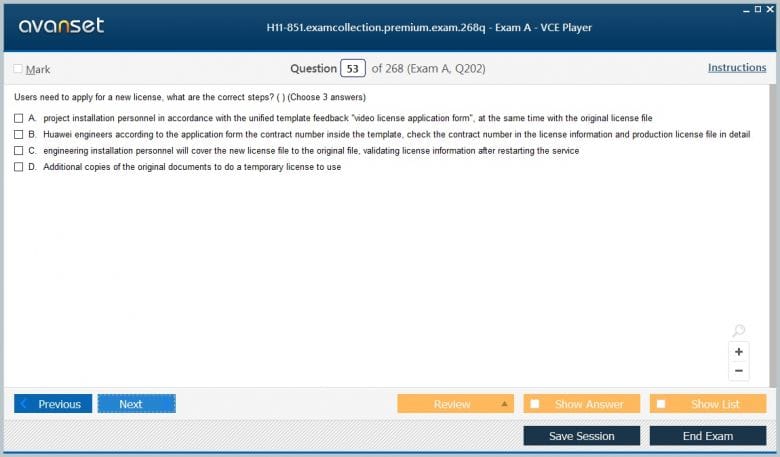
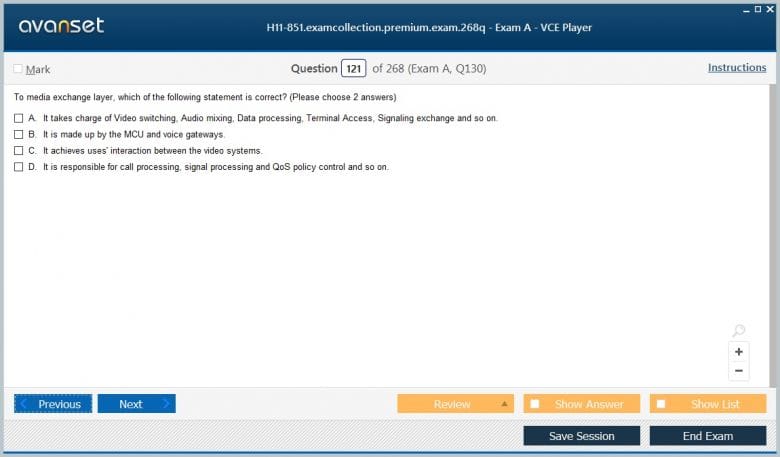
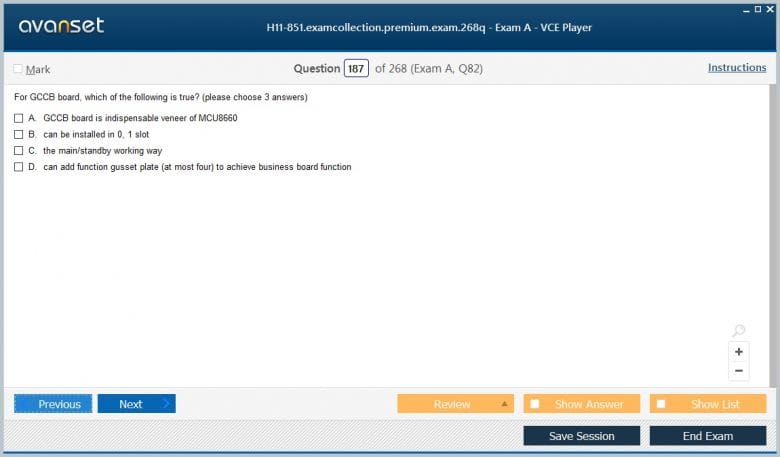
Huawei H11-851 Practice Test Questions in VCE Format
| File | Votes | Size | Date |
|---|---|---|---|
File Huawei.prep4sure.H11-851.v2026-08-01.by.aiden.147q.vce |
Votes 1 |
Size 101.02 KB |
Date Aug 01, 2026 |
File Huawei.Braindumps.H11-851.v2015-03-24.by.Mckinley.244q.vce |
Votes 7 |
Size 147.1 KB |
Date Mar 24, 2015 |
Huawei H11-851 Practice Test Questions, Exam Dumps
Huawei H11-851 (HCNA-VC (Huawei Certified Network Associate - Video Conference)) exam dumps vce, practice test questions, study guide & video training course to study and pass quickly and easily. Huawei H11-851 HCNA-VC (Huawei Certified Network Associate - Video Conference) exam dumps & practice test questions and answers. You need avanset vce exam simulator in order to study the Huawei H11-851 certification exam dumps & Huawei H11-851 practice test questions in vce format.
H11-851 belongs to Huawei’s associate-level collaboration lineage. Huawei’s accessible V3.0 outline used the code for HCIA-Video Conference and covered the practical building blocks of enterprise video systems: endpoints, IdeaHub devices, multipoint control, service management, signaling protocols, recording, streaming, and day-to-day operations. That historical scope still explains why the code appears in certification inventories even though the collaboration program has continued to evolve.
The important preparation decision is therefore not to treat an old exam page as proof that an old syllabus is still the live scheduling target. Huawei states that certification content is updated irregularly, and the approved ExamCollection inventory also contains the newer H11-851 V4.0 page. The older H11-851 page is most useful as a map of the associate-level skills that carried forward: understanding media, signaling, device roles, conference topology, service management, and operational troubleshooting.
A conference room device is only the visible edge of a much larger service. A working collaboration environment depends on cameras and microphones, audio and video codecs, packet transport, call signaling, address resolution, firewall traversal, conference control, identity, management, recording, and sometimes integration with external meeting platforms. Associate-level study becomes much stronger when each component is placed in that end-to-end chain rather than memorized as a separate product.
That systems view also changes troubleshooting. Poor video can be caused by endpoint settings, congestion, loss, jitter, codec negotiation, bandwidth policy, or an upstream path. A failed call can originate in registration, addressing, signaling, traversal, permissions, or media establishment. Candidates should practice moving from symptom to layer: first decide whether the failure is local, signaling-related, media-related, management-related, or network-related, then collect the evidence that distinguishes those possibilities.
One of the most useful habits in collaboration engineering is separating call control from media transport. H.323 and SIP can both participate in call establishment, capability exchange, addressing, and session control, while RTP and RTCP handle the media stream and feedback around it. A call can signal successfully and still have one-way or missing media; it can also fail before any media packets are exchanged. Those are different failure classes and should lead to different diagnostic questions.
For H11-851-era material, the goal is not to memorize every message in a protocol trace. It is to recognize the purpose of the major exchanges and understand what a device is trying to achieve. When registration succeeds, what has been learned? When setup reaches the remote side, what still has to happen before users see and hear one another? When NAT or firewall traversal is involved, which addresses and ports are being translated? These questions create durable knowledge that survives product and syllabus revisions.
Real-time media is unusually sensitive to the behavior of an IP network. File transfers can recover from delay by retransmitting data; conversation cannot simply pause every time a packet arrives late. Collaboration engineers therefore need practical intuition about latency, jitter, packet loss, burst loss, available bandwidth, queueing, and path asymmetry. The objective is not to become a service-provider engineer but to understand when the network is the limiting factor and how to prove it.
Codec choice also interacts with those conditions. Compression reduces bandwidth but can increase processing requirements and change how quality degrades under loss. Resolution and frame rate raise the demand on endpoints and links. Screen sharing has different visual priorities from a face-to-face conversation. A sound study approach compares scenarios: a boardroom on a managed campus, a branch office across a constrained WAN, and a remote participant crossing the public Internet should not be expected to behave identically.
Endpoint study should go beyond identifying ports and menu options. Candidates should understand how devices are provisioned, registered, updated, monitored, and placed into meeting workflows. They should also know which faults can be isolated locally before escalating to the control or network layer. Camera selection, microphone pickup, display configuration, peripheral behavior, and room acoustics all affect the user experience even when the IP path is healthy.
Interactive collaboration devices such as IdeaHub add another dimension because they combine conferencing with presentation and workspace functions. In practice, the administrator has to think about user workflows as well as transport. A technically correct deployment can still fail adoption if meeting join behavior is confusing, content sharing is unreliable, or room controls are inconsistent. That is why associate-level competence should connect configuration choices with the experience of the people using the room.
Multipoint conferences introduce decisions that do not appear in a simple point-to-point call. A multipoint control unit can coordinate or process media for several participants, while a service-management platform can handle resources, scheduling, devices, users, and operational visibility. Candidates should know why these roles exist and what information each layer needs to perform its job. When a conference fails for every participant, the likely fault domain is different from a problem affecting one endpoint.
Resource planning also matters. A system may have enough registered devices but insufficient conference capacity for a particular combination of resolution, layout, recording, or concurrent sessions. Engineers should learn to separate signaling capacity, media-processing capacity, network bandwidth, and service-management limits. These are related but not interchangeable, and a design that ignores one of them can appear healthy until usage grows.
Recording and streaming services extend the life of a meeting beyond the live session. They introduce storage, access control, retention, network distribution, and sometimes content-governance considerations. From a technical perspective, the engineer should understand where media is captured, how streams are delivered, and what dependencies are created if the recording platform is unavailable. From an operational perspective, authorized access and predictable retention matter as much as the recording button itself.
This is a good example of why collaboration roles overlap with general infrastructure responsibilities. DNS, routing, firewall policy, certificates, authentication, time synchronization, and storage can all affect the service. The associate does not need expert depth in every supporting technology, but should know enough to recognize a dependency and communicate a precise problem to the team that owns it.
Because the ExamCollection inventory contains a distinct V4.0 page, candidates using the historical H11-851 material should deliberately compare it with the current-version context. The point is not to discard the older fundamentals; it is to avoid spending disproportionate time on product generations or workflows that no longer dominate the current track. Version changes often preserve the conceptual core while shifting emphasis toward newer endpoints, management, integration, and operational practices.
The natural next level is the professional collaboration track represented by H11-861 V4.0. Associate preparation should make that progression easier by building reliable mental models first. If a candidate cannot explain how a call is established, where media flows, how endpoints register, and how management fits into the service, advanced design and troubleshooting will remain guesswork.
A productive lab does not need to reproduce every product in an old exam blueprint. It can focus on repeatable reasoning: verify addressing and reachability, confirm registration, inspect signaling, check media paths, introduce packet loss or a policy change, and observe how the symptom changes. Document what evidence proved each failure domain. That method develops skills that remain useful across versions because collaboration systems still depend on layered interactions.
When reading legacy material, also label every fact by type: protocol principle, product behavior, historical interface, or current scheduling detail. Protocol principles tend to remain valuable. Product screens and exact exam logistics age much faster. This simple classification prevents candidates from confusing enduring engineering knowledge with an old configuration path or an obsolete version number.
Within Huawei certifications, H11-851 is best understood as part of the history of enterprise collaboration training rather than an isolated code to memorize. Its lasting value is the associate-level discipline it represents: understand the whole service, separate signaling from media, know the purpose of the major platforms, and troubleshoot with evidence. Current candidates should carry those fundamentals forward while using the V4.0 page and Huawei’s live certification system to confirm the version they actually intend to schedule.
Another useful legacy exercise is to separate endpoint health from room readiness. A device can be registered and reachable while the room still fails because of microphone selection, display routing, camera control, acoustic feedback, or a peripheral that did not enumerate correctly. A professional support process should therefore include a short room-validation checklist after software or cabling changes. This creates a bridge between network evidence and the physical meeting experience, which is where users judge whether the service works.
Version transitions also create inventory problems. Organizations may run several endpoint generations, software branches, or room types at once, and not every device can move to a new release on the same day. Candidates should think about compatibility matrices, staged upgrades, rollback images, and the support burden of mixed versions. These are not merely project-management details: a protocol or capability difference can appear only when two particular generations communicate.
Finally, collaboration engineers benefit from maintaining a small set of known-good test calls. One internal point-to-point call, one multipoint call, one external call, one content-share test, and one recording test can quickly show whether a change affected a specific service layer. Building those repeatable tests around H11-851 concepts makes the historical material operationally useful while keeping current scheduling decisions tied to the V4.0 track.
Go to testing centre with ease on our mind when you use Huawei H11-851 vce exam dumps, practice test questions and answers. Huawei H11-851 HCNA-VC (Huawei Certified Network Associate - Video Conference) certification practice test questions and answers, study guide, exam dumps and video training course in vce format to help you study with ease. Prepare with confidence and study using Huawei H11-851 exam dumps & practice test questions and answers vce from ExamCollection.
Purchase Individually
Top Huawei Certification Exams
Site Search:

SPECIAL OFFER: GET 10% OFF

Pass your Exam with ExamCollection's PREMIUM files!
SPECIAL OFFER: GET 10% OFF
Use Discount Code:
MIN10OFF
A confirmation link was sent to your e-mail.
Please check your mailbox for a message from support@examcollection.com and follow the directions.

Download Free Demo of VCE Exam Simulator
Experience Avanset VCE Exam Simulator for yourself.
Simply submit your e-mail address below to get started with our interactive software demo of your free trial.