



Premium File
443 Q&A
$76.99$69.99
Huawei H13-611 Exam Questions & Answers, Accurate & Verified By IT Experts
Instant Download, Free Fast Updates, 99.6% Pass Rate
443 Questions & Answers
Last Update: Oct 29, 2026
$69.99
Huawei H13-611 Exam Screenshots
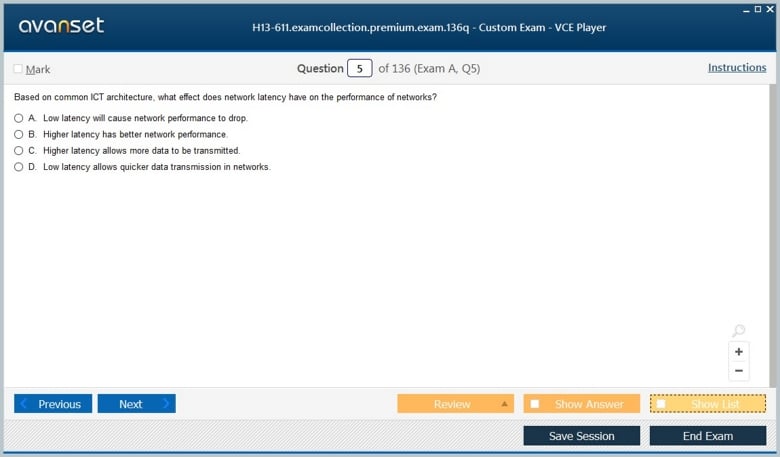
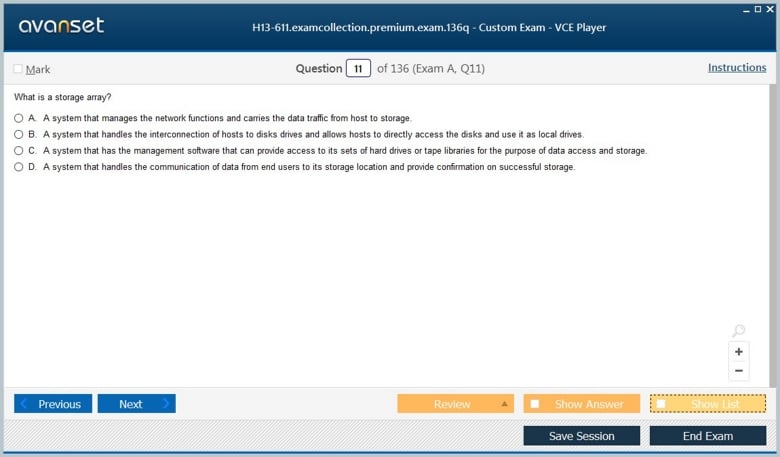
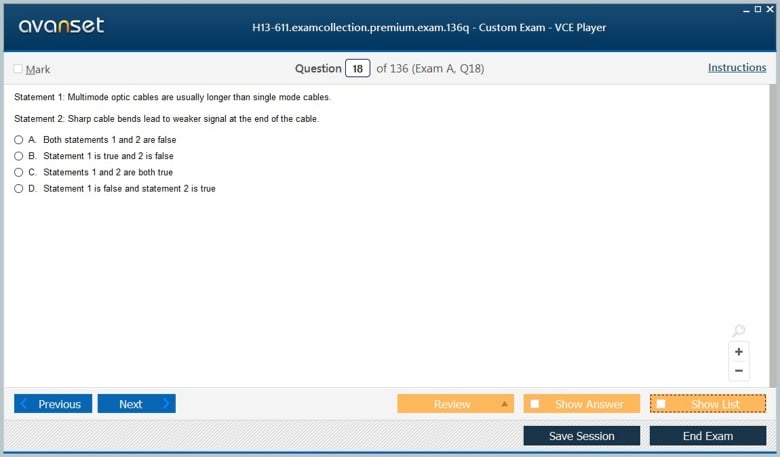
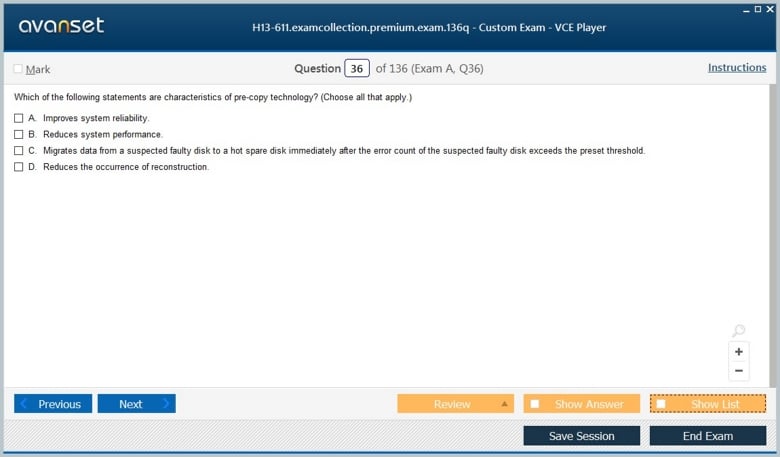
Huawei H13-611 Practice Test Questions in VCE Format
| File | Votes | Size | Date |
|---|---|---|---|
File Huawei.selftestengine.H13-611.v2026-09-03.by.austin.85q.vce |
Votes 1 |
Size 81.6 KB |
Date Sep 03, 2026 |
File Huawei.train4sure.H13-611.v2020-05-22.by.wangli.84q.vce |
Votes 2 |
Size 75.41 KB |
Date May 22, 2020 |
Huawei H13-611 Practice Test Questions, Exam Dumps
Huawei H13-611 (HCIA-Storage) exam dumps vce, practice test questions, study guide & video training course to study and pass quickly and easily. Huawei H13-611 HCIA-Storage exam dumps & practice test questions and answers. You need avanset vce exam simulator in order to study the Huawei H13-611 certification exam dumps & Huawei H13-611 practice test questions in vce format.
H13-611 is the approved ExamCollection destination for Huawei HCIA-Storage. Huawei's V5.0 outline uses the same exam code and organizes the knowledge into storage technology trends, basic storage technologies, Huawei intelligent storage products and features, and storage O&M. That structure is a useful reminder that entry-level storage is not just “learn RAID.” Candidates need to understand the complete path from physical media to logical resources, host connectivity, data protection, and operational management.
The best way to study HCIA-Storage is to follow data through the system. Start with where a block or file is created, then trace how it is protected, placed on media, exposed through a protocol, mapped to a host, monitored, and recovered. This turns storage vocabulary into one coherent service. It also prepares the candidate for later professional material, where the same components must be designed and troubleshot under performance, scale, and availability constraints.
A disk offers raw capacity, but an enterprise storage service adds controllers, caching, redundancy, protocols, management, protection, and availability behavior around that media. Candidates should distinguish HDD and SSD characteristics, understand why latency and endurance matter, and recognize that the advertised capacity of drives is not the same as the usable capacity delivered to applications after protection and system overhead.
Build a simple capacity worksheet. Start with a set of drives, apply a protection layout, reserve spare or system capacity, and calculate what remains. Then ask what happens when one device fails and a rebuild begins. The exercise teaches that storage design always contains trade-offs among usable space, fault tolerance, performance, and recovery time. Those trade-offs are more important than memorizing a product's maximum drive count.
RAID levels are often learned as a table of minimum disks and fault tolerance. A better approach is to model how reads and writes are distributed and what the array must do when a member is lost. Mirroring, parity, striping, and reconstruction create different performance and risk profiles. Rebuild pressure can expose a system to a second failure or reduce application performance even when data remains available.
Create four small scenarios: sequential backup, random database writes, read-heavy virtualization, and a capacity-focused archive. Choose a protection approach for each and explain the compromise. Then simulate a disk failure conceptually and identify the remaining fault tolerance. This builds the reasoning needed later for professional storage design and makes RAID a behavior model rather than a memorization exercise.
Storage networks become easier when the candidate separates the logical service from the transport. Block access may use protocols such as iSCSI or Fibre Channel; file access exposes shared namespaces; object access changes the interface again. The host still needs a complete path through adapters, switches, network configuration, authentication or zoning, target interfaces, and the storage resource itself.
Draw one block path from application to LUN and one file path from application to shared file system. Label every component that can fail. Then write a check for each layer: interface state, addressing, VLAN or fabric membership, initiator and target identity, mapping, multipathing, and permissions. This gives the candidate a disciplined troubleshooting order instead of encouraging random configuration changes.
Snapshots, replication, backup, and redundancy are not interchangeable. RAID can protect against some device failures but not an accidental deletion propagated to healthy disks. A snapshot can create a fast recovery point but may depend on the same storage system. Replication can protect site failure while also copying corruption. Backup introduces an independent recovery copy but creates retention and restore-time questions.
The broader discussion of data protection and backup is useful for reinforcing this distinction even though the implementation is not Huawei-specific. For each protection method, write the event it handles, the state it preserves, and the recovery action it requires. If those three fields are unclear, the protection design is probably being described too vaguely.
Huawei's HCIA outline reserves explicit space for O&M because storage problems are often detected through change from normal behavior. Capacity growth, latency, controller load, port errors, hardware alarms, and path state all need context. A single metric is rarely meaningful without knowing its expected range and whether the workload itself changed.
Create a daily baseline for a small lab or hypothetical array: capacity consumed, IOPS, latency, throughput, active paths, health status, and recent alarms. Then inject one change, such as a disconnected path or rapidly growing workload, and identify what would move first. The goal is to learn how evidence accumulates. Good storage troubleshooting begins by comparing intended state, previous state, and observed state.
The inventory also contains H13-612, the older HCNA-Storage BSSN exam. Its topics—storage components, RAID, SAN, NAS, backup, disaster recovery, and basic Huawei storage configuration—show the historical roots of the modern associate curriculum. Candidates should use it only as legacy context because the current represented HCIA path is H13-611 V5.0, not the older HCNA naming and structure.
This distinction matters when studying old notes or question banks. A technically correct explanation of SCSI, RAID, or iSCSI can remain useful, while a product interface, terminology label, or certification requirement can age out. Mark every legacy source with two columns: durable concept and version-specific detail. Keep the first when it matches the live outline; verify or discard the second.
The next represented step is HCIP-Storage V5.5. Its scope moves deeper into flash and distributed storage technologies, deployment, performance tuning, operations, and troubleshooting. HCIA candidates do not need expert depth yet, but they should build foundations that scale: clean diagrams, accurate terminology, disciplined change records, and the habit of explaining why a configuration works.
When practicing a basic LUN or file-service workflow, do not stop when the host can access data. Record the protection layout, path redundancy, expected performance, monitoring points, and recovery method. That extra step turns a configuration exercise into the beginning of professional engineering. It also makes later troubleshooting easier because the intended state is documented rather than reconstructed after failure.
Storage often holds the most durable copy of business data, so access control, encryption, administrative separation, audit records, and secure deletion deserve attention even at associate level. The data-storage security discussion provides broader context for confidentiality and integrity. Apply those ideas to storage administration by separating host access from management access and by limiting privileged actions to the operators who actually require them.
Practice explaining what an attacker or accidental administrator could do at each layer: application, host, storage network, array, backup repository, and management plane. Then identify the control that reduces the risk. This reinforces a core storage lesson: availability without integrity is not success. A system that responds quickly while serving corrupted or unauthorized data is still a failed storage service.
A strong HCIA plan uses labs to connect the layers. Finish preparation with short labs that combine several objectives. Present a host with storage, verify multipathing, create a protected copy, change capacity, observe monitoring, and document the recovery process. If physical Huawei hardware is unavailable, the same reasoning can be practiced with diagrams and generic storage labs as long as product-specific claims are checked against current Huawei material.
When this exam is placed within Huawei certifications, H13-611 should be treated as the current represented HCIA-Storage foundation, while later levels add much greater solution and troubleshooting depth. The eventual HCIE-Storage H13-629 path is a useful reminder of where the fundamentals lead: data protection, migration, operations, and resilient design. Learn each associate topic as part of that larger data lifecycle, and the transition from definitions to engineering becomes much smoother.
Thin provisioning and resource tuning provide another useful bridge from basic storage to real operations. Logical capacity can exceed the physical space currently consumed, which improves utilization but creates a responsibility to monitor growth. In a study model, allocate more logical space than exists physically, then calculate how quickly the pool would fill under several growth rates. Define warning and critical thresholds and the action associated with each. The lesson is that virtualization of capacity improves flexibility only when the operator also manages the risk of exhaustion.
Host-side evidence should be part of associate troubleshooting. If an application reports a missing or slow disk, confirm whether the operating system can see the device, whether all expected paths are active, and whether the filesystem or volume manager is healthy before assuming the array is at fault. Conversely, array alarms should be correlated with host symptoms. Learning to collect evidence from both sides of the storage connection prevents the candidate from viewing the storage system as an isolated appliance.
Data lifecycle decisions also affect capacity and security. Test data, abandoned snapshots, old virtual-machine disks, and orphaned file shares can consume resources long after their business purpose ends. Define ownership and deletion criteria when a resource is created, then review them during routine O&M. Safe decommissioning should verify that the data is no longer required, that dependent applications are removed, and that any retention obligation has been satisfied before capacity is reclaimed.
Finally, practice explaining a complete service in plain language. Describe how a user request reaches an application, how the host accesses its storage, how the data is protected, what happens if one path fails, and how an operator would recover a deleted file. If that explanation is coherent, many individual exam topics have already been connected into one mental model.
Go to testing centre with ease on our mind when you use Huawei H13-611 vce exam dumps, practice test questions and answers. Huawei H13-611 HCIA-Storage certification practice test questions and answers, study guide, exam dumps and video training course in vce format to help you study with ease. Prepare with confidence and study using Huawei H13-611 exam dumps & practice test questions and answers vce from ExamCollection.
Purchase Individually
Top Huawei Certification Exams
Site Search:

SPECIAL OFFER: GET 10% OFF

Pass your Exam with ExamCollection's PREMIUM files!
SPECIAL OFFER: GET 10% OFF
Use Discount Code:
MIN10OFF
A confirmation link was sent to your e-mail.
Please check your mailbox for a message from support@examcollection.com and follow the directions.

Download Free Demo of VCE Exam Simulator
Experience Avanset VCE Exam Simulator for yourself.
Simply submit your e-mail address below to get started with our interactive software demo of your free trial.