



Premium File
508 Q&A
$76.99$69.99
Huawei H19-301 Exam Questions & Answers, Accurate & Verified By IT Experts
Instant Download, Free Fast Updates, 99.6% Pass Rate
508 Questions & Answers
Last Update: Sep 08, 2026
$69.99
Huawei H19-301 Exam Screenshots
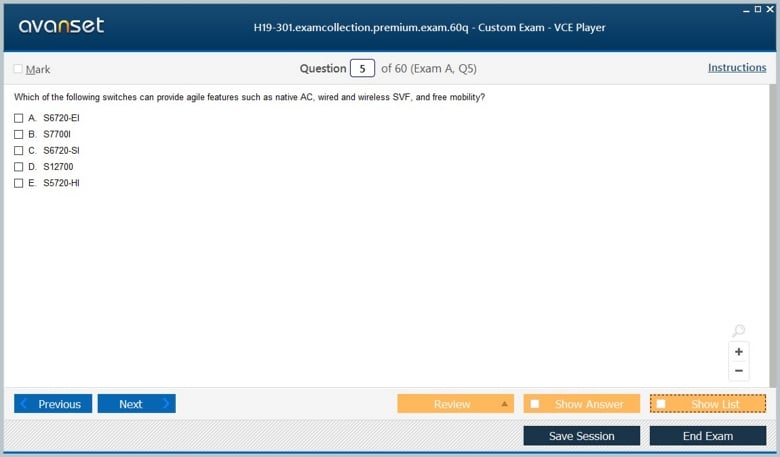
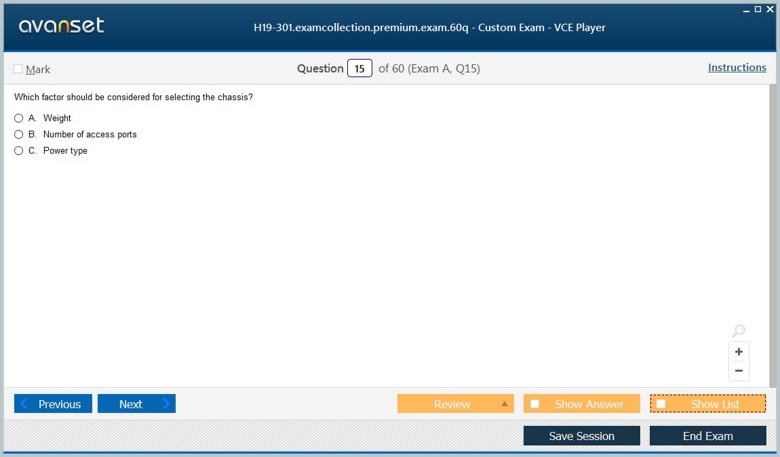
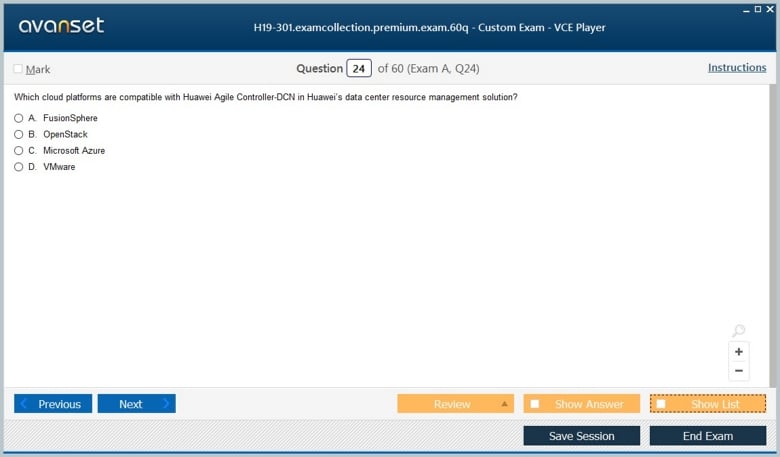
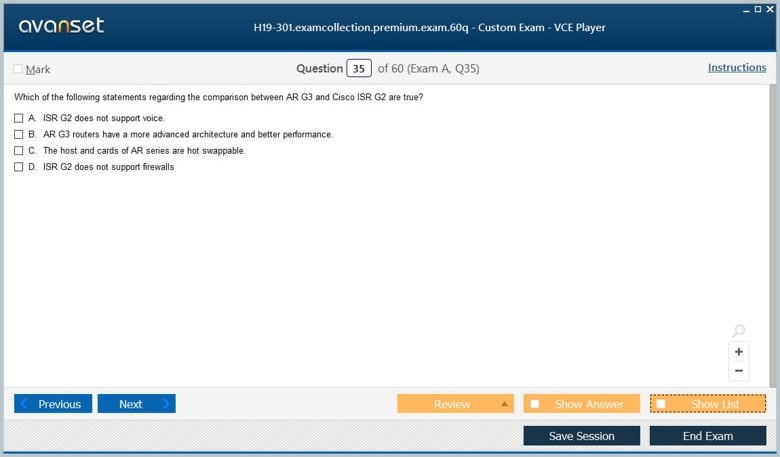
Huawei H19-301 Practice Test Questions in VCE Format
| File | Votes | Size | Date |
|---|---|---|---|
File Huawei.pass4sure.H19-301.v2026-09-05.by.hanna.61q.vce |
Votes 1 |
Size 46.9 KB |
Date Sep 05, 2026 |
File Huawei.pass4sure.H19-301.v2020-06-23.by.william.31q.vce |
Votes 2 |
Size 24.18 KB |
Date Jun 23, 2020 |
File Huawei.Test-king.H19-301.v2019-09-10.by.Muhammad.29q.vce |
Votes 4 |
Size 24.06 KB |
Date Sep 12, 2019 |
Huawei H19-301 Practice Test Questions, Exam Dumps
Huawei H19-301 (Huawei Certified Pre-sales Associate-IP Network(Datacom)-ENU) exam dumps vce, practice test questions, study guide & video training course to study and pass quickly and easily. Huawei H19-301 Huawei Certified Pre-sales Associate-IP Network(Datacom)-ENU exam dumps & practice test questions and answers. You need avanset vce exam simulator in order to study the Huawei H19-301 certification exam dumps & Huawei H19-301 practice test questions in vce format.
H19-301 appears in Huawei’s historical HCS/HCPA presales IP Network (Datacom) training. An official Huawei training-days document for the code covers enterprise IP positioning, data-center switches, campus switches, enterprise routers, WLAN, security, solution design, competitive analysis, and application cases. Current external certification listings show newer versioned presales IP Network exams, so the unversioned H19-301 page should be treated as legacy context rather than as proof of the newest blueprint.
That does not make the page useless. It captures the durable presales task: translate customer requirements into a coherent campus, data-center, WAN, wireless, and security solution. The safest study method is to retain those architectural and discovery principles while checking present-day product families and current exam versions in Huawei’s official catalog before making version-sensitive claims.
Presales professionals need deeper technical context than pure sales roles because they help shape topology, product families, capacity, interoperability, and solution feasibility. They still are not replacing specialist engineering teams for every configuration. Their value is to turn an opportunity into a technically credible proposal with clear assumptions and boundaries.
Compare this with HCSA-Sales-IP Network V6.0. Sales focuses more heavily on opportunity identification and value; presales must validate how the solution can be assembled. A good handoff keeps the customer’s business requirement intact while adding the technical detail needed for design.
Campus networks support employees, guests, phones, cameras, IoT devices, printers, and wireless clients. Presales should identify user density, building layout, segmentation, uplink requirements, redundancy, management model, authentication, and application sensitivity. Those inputs determine whether a design is simple access switching or a broader policy and operations transformation.
Use a building-by-building worksheet rather than one total user count. A lecture hall, executive floor, warehouse, and office area may have different port density, wireless demand, resilience, and device types. Good presales design exposes those differences before a bill of materials is created.
Data centers carry server-to-server, storage, virtualization, and service-chain traffic at high scale. Presales needs to understand why east-west traffic, uplink oversubscription, low latency, resiliency, and automation can matter more than the user-access patterns common in campuses. The architecture should follow workload growth and failure domains.
Create an application-flow map showing web, application, database, storage, management, and security paths. Then identify which flows cross switches, firewalls, load balancers, or external links. This reveals where bandwidth and policy are actually required and prevents a design from being sized only by counting server ports.
Enterprise routers connect branches, headquarters, data centers, service providers, and internet paths. Presales should know site count, circuit types, application criticality, routing requirements, failover expectations, QoS needs, cloud access, and management constraints. Small branches and large hubs may justify different designs even inside the same organization.
The concepts in WAN architecture are useful background for long-distance connectivity and provider dependencies. In a Huawei proposal, turn those concepts into topology and resilience decisions and verify detailed feature support in current product documentation.
Access-point count cannot be chosen from floor area alone. Client density, walls, interference, application mix, roaming, authentication, channel use, and wired uplinks all affect the design. Presales should know when a predictive survey is only a starting point and when on-site validation is needed before final deployment.
Wi-Fi 6 provides useful context for dense wireless efficiency, but the standard does not remove RF design. A newer access point cannot fix poor placement, interference, or insufficient backhaul. Strong proposals connect wireless capability to the specific environment.
Legacy presales material included security because networks are not complete without policy enforcement. Map internet edges, user segments, server zones, management networks, partner connections, and remote access. Then define which flows are allowed and where inspection or authentication is required. This produces a security architecture rather than an after-the-fact firewall purchase.
The broad patterns in network security threats and controls can strengthen risk reasoning. Presales should use them selectively: identify the customer’s exposure, choose a control layer, and confirm performance and manageability requirements before finalizing the design.
Port count, throughput, wireless clients, routes, tunnels, policies, and management scale all grow. A design that works at day-one average load may fail during peak periods or after a component outage. Presales should model normal, peak, growth, and degraded states so capacity recommendations have an engineering basis.
Write assumptions explicitly: expected traffic growth, oversubscription, redundancy, feature use, and software version. If the customer changes an assumption, revisit the relevant design elements. This is one of the most important professional habits because it prevents an old sizing decision from surviving after the requirement that justified it has changed.
Historical Huawei material includes competition and selling points, but presales credibility suffers when comparisons cherry-pick one specification. A better method compares the customer’s required outcome: performance under the intended feature set, availability, management effort, migration risk, lifecycle support, integration, and total cost. Every comparison should use equivalent configurations and documented assumptions.
If a competitor has a stronger feature in one area, acknowledge it and evaluate whether that feature matters to the customer. Presales exists to design a solution that works, not to win a spreadsheet contest. Transparent trade-offs build more trust than absolute claims.
Treat the old code as a bridge to current Datacom presales practice. The legacy H19-101 V5.0 and current V6.0 sales pages show how Huawei’s IP networking story has continued to evolve. H19-301 adds historical presales depth across campus, data-center, router, WLAN, and security solution design. Use that lineage to understand role and architecture, not to assert that an old product family is still current.
Across the wider Huawei certifications portfolio, version control is part of good editorial and technical practice. Keep H19-301 useful for readers who search the historical code, state clearly that newer versioned presales IP Network exams exist externally, and verify all present-day product claims in the current Huawei catalog. The durable lesson is presales reasoning: requirements first, architecture second, products third.
Interoperability is a core presales concern in brownfield networks. Customers may have third-party switches, routing protocols, authentication systems, monitoring tools, IP phones, firewalls, wireless clients, and automation platforms that cannot all be replaced at once. Document the interfaces that must remain compatible and identify where standards, feature differences, or software versions need lab validation. Migration risk often matters more than theoretical feature advantage.
Operations should shape the architecture as strongly as hardware capability. Ask how configurations are deployed, how changes are approved, how faults are monitored, what telemetry is available, and how many engineers support the environment. A highly capable design can become a burden if the team cannot operate it consistently. Presales should be prepared to discuss management and automation alongside topology.
Proof-of-concept planning is useful when a requirement is critical or a claim is uncertain. Define success criteria before testing: throughput under the intended feature set, failover behavior, roaming quality, policy enforcement, interoperability, or management workflow. A proof of concept should answer a customer decision question, not become an open-ended technology demonstration with no acceptance threshold.
Documentation is part of the presales deliverable. A useful proposal includes topology, assumptions, addressing or segmentation approach, redundancy model, major dependencies, migration sequence, and items that require detailed implementation design. Clear documentation protects both customer and vendor because later changes can be evaluated against the original design basis.
End preparation by designing one midsize enterprise from edge to data center. Include campus wired and wireless access, branch WAN, internet security, data-center fabric, management, and resilience. Then explain which requirements drive each choice and which details still need specialist validation. That integrated exercise captures the original spirit of H19-301 while keeping the reasoning relevant to modern Datacom practice.
Change management should be explicit in network proposals. Existing networks support live business services, so migrations need maintenance windows, rollback points, configuration control, user communication, and post-change validation. A technically correct design can still fail as a project if the cutover sequence is unsafe. Presales should help define how the target architecture will be reached, not merely what the final topology looks like.
Keep a version ledger when studying H19-301. Record which facts come from the historical training document, which concepts remain vendor-neutral, and which current product claims require fresh Huawei verification. This prevents accidental blending of old and new portfolios. It also models the same discipline presales engineers need in the field when inherited documentation, running software, and current support guidance do not all describe the same release.
Presales governance improves when design decisions are recorded with rationale. For each major choice, note the requirement, alternatives considered, selected option, and dependency that could force reevaluation. This is especially useful during long sales cycles where personnel, budgets, or application plans change. A decision log keeps the architecture tied to current requirements and prevents a choice made early in discovery from becoming permanent merely because nobody remembers why it was made.
A final historical-awareness check is useful whenever old product names appear in H19-301 notes. Ask whether the name represents a current portfolio item, an earlier generation, or merely the category that later products replaced. Preserve the architectural lesson, but verify modern equivalents before using the terminology in a current proposal.
When uncertain, favor a current architecture diagram and vendor documentation over an old model table. That simple habit keeps the historical page useful without letting obsolete details drive a modern recommendation, and it mirrors the evidence discipline expected from professional presales work.
Go to testing centre with ease on our mind when you use Huawei H19-301 vce exam dumps, practice test questions and answers. Huawei H19-301 Huawei Certified Pre-sales Associate-IP Network(Datacom)-ENU certification practice test questions and answers, study guide, exam dumps and video training course in vce format to help you study with ease. Prepare with confidence and study using Huawei H19-301 exam dumps & practice test questions and answers vce from ExamCollection.
Purchase Individually
Top Huawei Certification Exams
Site Search:

SPECIAL OFFER: GET 10% OFF

Pass your Exam with ExamCollection's PREMIUM files!
SPECIAL OFFER: GET 10% OFF
Use Discount Code:
MIN10OFF
A confirmation link was sent to your e-mail.
Please check your mailbox for a message from support@examcollection.com and follow the directions.

Download Free Demo of VCE Exam Simulator
Experience Avanset VCE Exam Simulator for yourself.
Simply submit your e-mail address below to get started with our interactive software demo of your free trial.