



Premium File
60 Q&A
$76.99$69.99
Huawei H12-223 Exam Questions & Answers, Accurate & Verified By IT Experts
Instant Download, Free Fast Updates, 99.6% Pass Rate
60 Questions & Answers
Last Update: Oct 21, 2026
$69.99
Huawei H12-223 Exam Screenshots
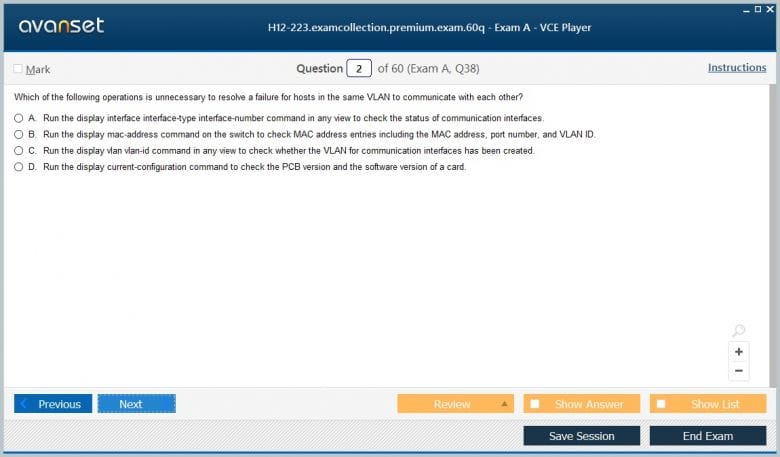
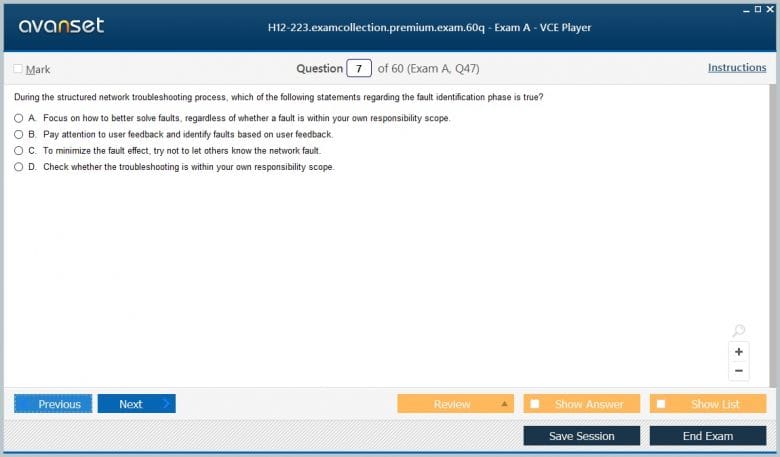
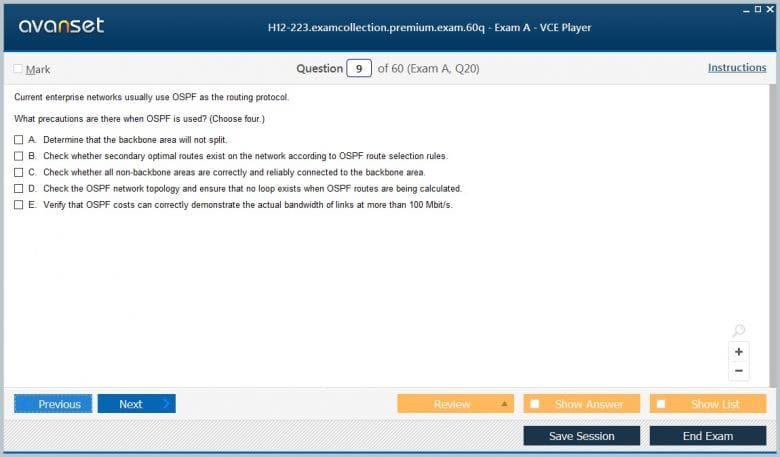
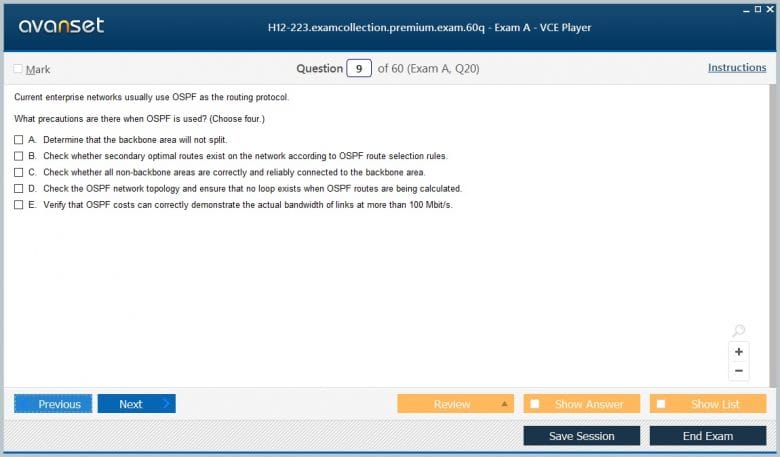
Huawei H12-223 Practice Test Questions in VCE Format
| File | Votes | Size | Date |
|---|---|---|---|
File Huawei.passguide.H12-223.v2026-07-15.by.theodore.27q.vce |
Votes 1 |
Size 31.49 KB |
Date Jul 15, 2026 |
Huawei H12-223 Practice Test Questions, Exam Dumps
Huawei H12-223 (HCNP-R&S-IENP (Huawei Certified Network Professional-Improving Enterprise Network Performance)) exam dumps vce, practice test questions, study guide & video training course to study and pass quickly and easily. Huawei H12-223 HCNP-R&S-IENP (Huawei Certified Network Professional-Improving Enterprise Network Performance) exam dumps & practice test questions and answers. You need avanset vce exam simulator in order to study the Huawei H12-223 certification exam dumps & Huawei H12-223 practice test questions in vce format.
H12-223 is part of Huawei’s historical professional Routing & Switching path. Across older HCNP/HCIP material, the code has been associated with advanced enterprise networking, performance, troubleshooting, and project-oriented implementation. The exact naming varied across generations, but the enduring professional theme is clear: engineers were expected to take routing and switching knowledge and apply it to a complete enterprise change rather than to isolated device configuration.
Huawei has since replaced the old Routing & Switching family with Datacom. Current professional candidates should work from H12-821 HCIP-Datacom Core Technology and the relevant specialization, including H12-831 Advanced Routing & Switching Technology. H12-223 is therefore best used as legacy project and troubleshooting context.
Before changing a network, the engineer needs to know what actually exists. Diagrams, inventories, addressing plans, route tables, VLAN lists, software versions, WAN circuits, security boundaries, and monitoring systems should be reconciled with live devices. Project risk increases when the implementation plan is based on documentation that no longer matches production.
Discovery should also identify application dependencies and business windows. A routing change that looks safe on a topology diagram can interrupt a legacy system that depends on a specific source address or path. Professional candidates should practice asking what traffic uses the network, when it is critical, and what evidence will prove that it still works after the change.
Statements such as “improve resilience” or “increase performance” are not sufficient for an implementation plan. Resilience should identify which failures must be tolerated and how quickly service should recover. Performance should identify traffic classes, expected throughput, latency sensitivity, and measurement points. Security should identify segmentation and management requirements.
Once requirements are measurable, design and implementation can be tested objectively. The engineer can choose routing policy, redundancy, VLAN boundaries, QoS, or WAN changes because they satisfy stated conditions rather than because they are familiar. This discipline is one of the strongest professional lessons preserved by project-oriented legacy material.
Changing OSPF areas, BGP policy, route summarization, metrics, or redistribution can produce effects far beyond the device being edited. Engineers should predict the routing state before the change and define the state that would trigger rollback. They should also know how long the control plane is expected to converge and what temporary path changes may occur.
Route redistribution deserves special caution because it can create feedback, suboptimal routing, or unexpected preference. A project plan should define exactly which prefixes cross the boundary and how loops are prevented. Verification should include both the control plane and actual traffic paths. A route in a table is necessary but not sufficient proof that the service works end to end.
VLAN moves, spanning-tree root changes, trunk modifications, and link aggregation changes may appear simple but can affect many users at once. The implementation sequence matters. A new trunk should carry the intended VLANs before access ports move. A new root placement should be modeled so traffic does not traverse unexpected links. Redundant paths should be verified before the old path is removed.
Professional engineers also plan for configuration propagation and human error. If several switches must receive matching MST or VLAN settings, automate or standardize the change where possible and verify each stage. A partially completed Layer 2 migration can be more dangerous than the old design because it introduces inconsistencies that are difficult to see from one device.
Network performance complaints can originate in congestion, loss, interface errors, routing changes, application behavior, server load, or wireless conditions. A project should begin with a baseline and a clear measurement method. Otherwise the team cannot demonstrate that the change improved anything or identify whether a new problem was introduced.
QoS should be applied only after traffic is classified accurately. Marking, policing, shaping, queueing, and scheduling each solve different problems. Applying a high-priority queue to poorly identified traffic can starve other services. Historical professional exams often emphasized this kind of tradeoff because enterprise performance depends on policy behavior under load, not simply on link capacity.
A good change plan states what will be checked at each stage: interface state, adjacencies, route counts, key prefixes, gateway redundancy, client services, application reachability, and monitoring. It also identifies the logs and commands that will be used if a check fails. Troubleshooting is faster when the team has already defined the evidence it expects to see.
This is especially important during multi-step projects. If ten changes are made before the first validation, the fault domain includes all ten. Stage gates keep the search space small. Validate, document, and only then proceed. That process may appear slower on paper but usually reduces outage time because errors are found near the step that created them.
H12-223 historically sat beside routing and switching exams such as H12-221 and H12-222. Those pages cover the protocol and switching mechanisms that project work depends on. The project-oriented page is valuable because it adds sequence, validation, risk, and handover around those mechanisms.
Current Datacom combines the knowledge in a different way and adds automation, solution architecture, and broader operational expectations. Candidates should not try to reconstruct the old certification by taking old exam names literally. Instead, extract durable project practices and map the technical subjects into the current H12-821 and H12-831 objectives.
A network change is not complete when packets start flowing. Operations teams need updated diagrams, configuration records, monitoring thresholds, known dependencies, rollback history, and troubleshooting notes. If a design depends on a subtle route policy or special VLAN behavior, document why. Future engineers should not have to reverse-engineer intent during an incident.
Post-change review should also compare outcomes with the original requirements. Did convergence improve? Did path utilization change as expected? Did the new design eliminate a single point of failure? Are there new alarms or capacity constraints? This closes the engineering loop and turns one project into better input for the next.
A useful H12-223 exercise starts with an imperfect enterprise network and a business request: add a site, migrate a VLAN, introduce a second WAN path, or improve convergence. Produce a current-state diagram, requirements, implementation sequence, validation plan, rollback plan, and handover document. Then execute the change in a lab and deliberately introduce one unexpected condition.
The unexpected condition is where the learning becomes professional. Perhaps a route filter removes one prefix, a trunk omits a VLAN, a backup path lacks return routing, or a QoS policy matches the wrong traffic. Diagnose it using the checkpoints defined in the plan. That process develops the project discipline expected in modern Huawei Datacom roles even though H12-223 itself is legacy.
The lasting value of H12-223 is therefore integration. Routing, switching, performance, change control, and troubleshooting have to work together. Current candidates should schedule against the Datacom program, but they can still use this page to practice the engineering behaviors that separate a successful network change from a collection of technically correct commands.
Risk assessment should be explicit. A change that touches a single access switch during a maintenance window carries a different risk from a routing-policy change at a shared core. Professional engineers should evaluate blast radius, reversibility, dependency knowledge, and the quality of available monitoring before deciding how much testing and approval a change needs. This makes process proportional to technical risk instead of equally heavy for every task.
Capacity is another project constraint that can be overlooked during logical redesign. A new backup path may exist but be undersized; a consolidated trunk may carry all required VLANs but not the combined peak load. Implementation plans should include interface utilization and failure-state capacity so redundancy is proven under the conditions in which it will actually be needed.
Configuration templates can reduce error, but only when their variables and assumptions are clear. A reused template that silently carries an old VLAN, route policy, or management ACL can create a consistent mistake across many devices. Professional candidates should validate both the template and the site-specific inputs, then compare the resulting state with the design intent.
After a major project, teams should remove temporary configuration. Transitional static routes, permissive ACLs, duplicate monitoring, temporary trunks, and migration-specific policy often remain because the service is working and attention moves elsewhere. These remnants increase future complexity. A formal cleanup step is therefore part of project completion, not optional housekeeping.
A professional implementation plan should define acceptance evidence before the maintenance window begins. For a routing or switching change, that evidence might include expected adjacencies, route counts, selected paths, gateway state, application reachability, latency or loss measurements, and monitoring alarms that should clear. Capture the baseline in the same form that will be used after the change so the comparison is meaningful. During the implementation, validate after each stage rather than waiting until the end of a long sequence. If the result diverges from the acceptance criteria, stop and identify whether the fault was introduced by the current step or exposed by an earlier dependency. This makes rollback decisions faster and prevents a team from declaring success simply because a few pings work. It also turns H12-223's project-oriented legacy into a practical engineering habit that remains relevant in the Datacom era: planned change must be observable, reversible, and provably aligned with the original requirement.
Communication during a change is also technical work. Stakeholders need to know the expected impact, validation milestones, rollback trigger, and who owns each decision. During an incident, concise updates should distinguish confirmed facts from hypotheses. This prevents pressure from driving random configuration changes and helps the implementation team preserve the evidence needed to find the actual cause.
Go to testing centre with ease on our mind when you use Huawei H12-223 vce exam dumps, practice test questions and answers. Huawei H12-223 HCNP-R&S-IENP (Huawei Certified Network Professional-Improving Enterprise Network Performance) certification practice test questions and answers, study guide, exam dumps and video training course in vce format to help you study with ease. Prepare with confidence and study using Huawei H12-223 exam dumps & practice test questions and answers vce from ExamCollection.
Purchase Individually
Top Huawei Certification Exams
Site Search:

SPECIAL OFFER: GET 10% OFF

Pass your Exam with ExamCollection's PREMIUM files!
SPECIAL OFFER: GET 10% OFF
Use Discount Code:
MIN10OFF
A confirmation link was sent to your e-mail.
Please check your mailbox for a message from support@examcollection.com and follow the directions.

Download Free Demo of VCE Exam Simulator
Experience Avanset VCE Exam Simulator for yourself.
Simply submit your e-mail address below to get started with our interactive software demo of your free trial.