Premium File
642 Q&A
$76.99$69.99
Test Prep GRE Test Test Questions & Answers, Accurate & Verified By IT Experts
Instant Download, Free Fast Updates, 99.6% Pass Rate

GRE Test Premium File: 642 Questions & Answers
Last Update: Sep 21, 2026
GRE Test Training Course: 35 Video Lectures
GRE Test PDF Study Guide: 1763 Pages
$79.99
Test Prep GRE Test Exam Screenshots
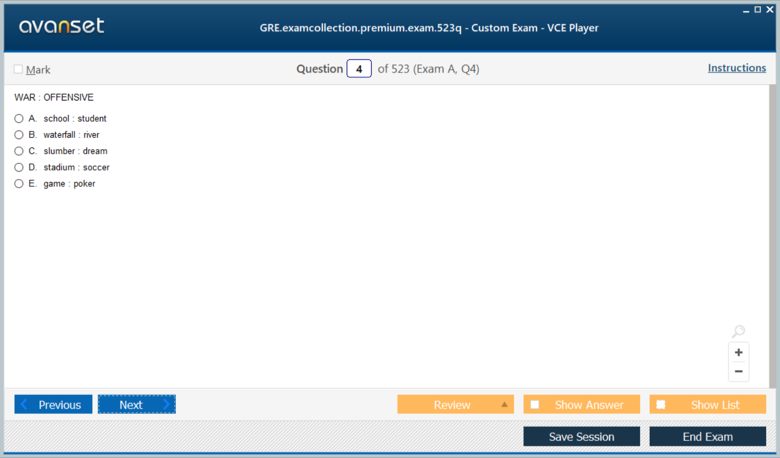
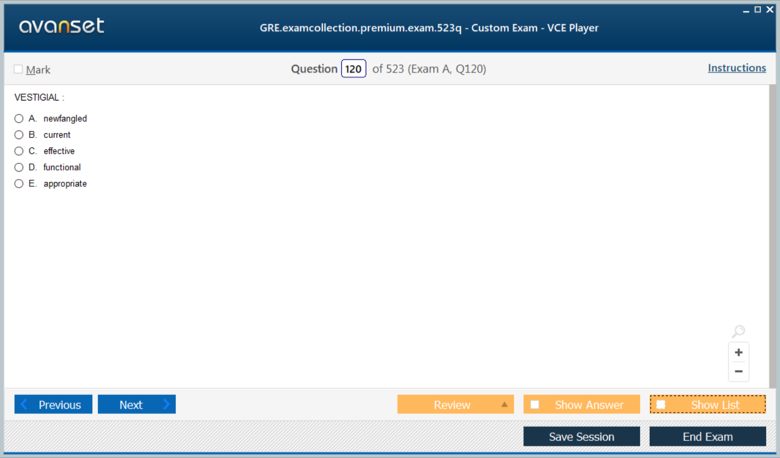
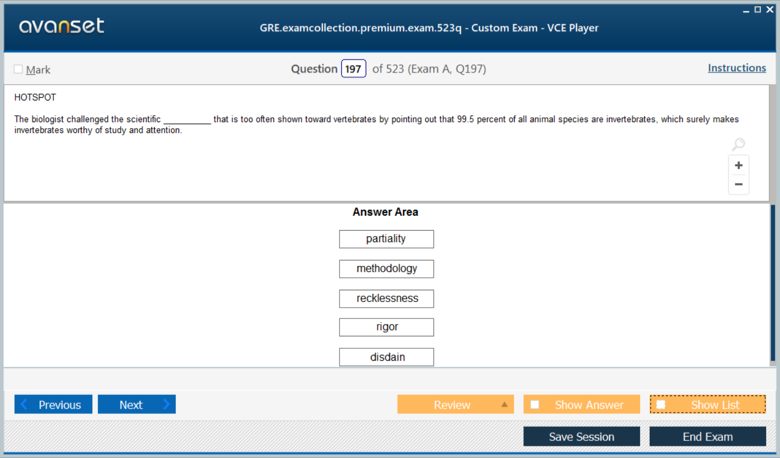
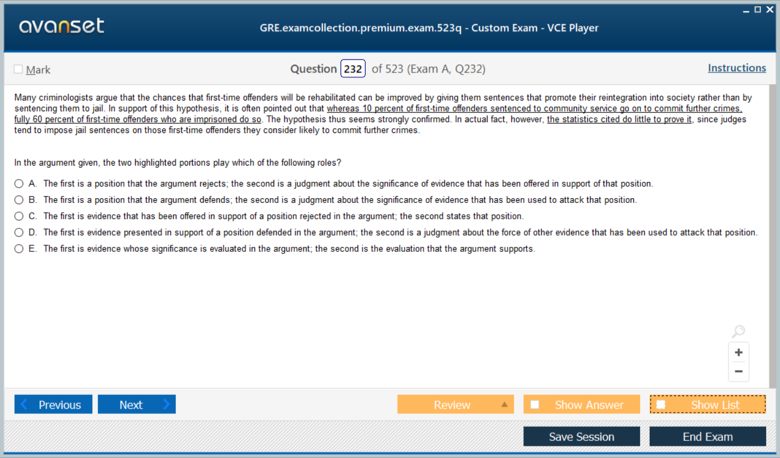
Test Prep GRE Test Practice Test Questions in VCE Format
| File | Votes | Size | Date |
|---|---|---|---|
File Test Prep.questionpaper.GRE Test.v2026-08-30.by.elizabeth.221q.vce |
Votes 1 |
Size 1.89 MB |
Date Aug 30, 2026 |
File Test Prep.examanswers.GRE Test.v2020-09-21.by.wangchao.214q.vce |
Votes 2 |
Size 1.8 MB |
Date Sep 21, 2020 |
File GRE.Actualtests.GRE.v2015-03-20.by.Howard.650q.vce |
Votes 7 |
Size 2.9 MB |
Date Mar 20, 2015 |
File GRE.Braindumps.GRE.v2015-03-20.by.Louise.700q.vce |
Votes 6 |
Size 3.08 MB |
Date Mar 20, 2015 |
Test Prep GRE Test Practice Test Questions, Exam Dumps
Test Prep GRE Test (Graduate Record Examination Test: Verbal, Quantitative, Analytical Writing) exam dumps vce, practice test questions, study guide & video training course to study and pass quickly and easily. Test Prep GRE Test Graduate Record Examination Test: Verbal, Quantitative, Analytical Writing exam dumps & practice test questions and answers. You need avanset vce exam simulator in order to study the Test Prep GRE Test certification exam dumps & Test Prep GRE Test practice test questions in vce format.
The GRE General Test is a compact graduate-admissions exam built around Analytical Writing, Verbal Reasoning, and Quantitative Reasoning. The current version takes just under two hours. It begins with one 30-minute “Analyze an Issue” writing task, followed by two Verbal sections and two Quantitative sections. The shorter format introduced in 2023 removed the separate “Analyze an Argument” essay and reduced the number of scored verbal and quantitative questions.
Shorter does not mean easier. With fewer questions, candidates have less room to recover from repeated mistakes, and the test still demands rapid shifts among argument analysis, dense reading, vocabulary in context, algebra, arithmetic, geometry, and data interpretation. Preparation works best when it treats the GRE as a reasoning exam with distinct section conventions rather than as a general review of college knowledge.
The GRE is accepted by a broad range of graduate and professional programs, but applicants should verify the current policy of every program they plan to target. Test-optional or test-flexible policies also vary. A score has value when it serves a specific admissions strategy, not simply because graduate applicants have traditionally taken the exam.
The current GRE includes one Analytical Writing task, then two Verbal and two Quantitative sections. The first Verbal section has 12 questions in 18 minutes and the second has 15 questions in 23 minutes. The first Quantitative section has 12 questions in 21 minutes and the second has 15 questions in 26 minutes. Together, that is 54 verbal and quantitative questions plus the writing task.
Those time limits make pacing a major part of the test. Candidates cannot spend the same amount of time on every question. A dense Reading Comprehension item may legitimately need more time than a straightforward vocabulary question; a complicated quantitative comparison may be better revisited after faster items are secured. Preparation should establish practical checkpoints without turning them into a rigid metronome.
One useful approach is to record not only whether an answer was correct but how long it took and how confident the candidate felt. Correct-but-slow questions are important because they can create downstream time pressure. Fast wrong answers reveal a different problem: the candidate may be reading too aggressively or choosing a familiar-looking method before understanding the task.
The Analytical Writing section now contains a single “Analyze an Issue” task. Candidates are asked to develop a position on an issue and support it with reasons and examples. The strongest response is not the one with the most sophisticated opinion; it is the one that presents a clear position, develops it logically, addresses complexity where relevant, and communicates with control.
Planning is worth a few minutes because a coherent essay is easier to write and revise than a stream of ideas discovered sentence by sentence. Candidates should identify the central claim, choose two or three strong lines of support, consider a limitation or counterpoint, and then write paragraphs with clear logical roles. Examples should illuminate the reasoning rather than become long stories.
Practice should also include editing under time. A brief final review can catch missing words, sentence-boundary problems, contradictions, and unclear pronoun references. Minor errors do not automatically destroy a response, but recurring language problems can make reasoning harder to follow. The goal is clarity under constraint, which is a useful graduate-school skill beyond the exam itself.
GRE vocabulary has a reputation for difficulty, but memorizing definitions is only part of preparation. Text Completion and Sentence Equivalence questions require candidates to understand how the sentence is structured before inserting vocabulary. Contrast words, cause-and-effect language, tone, and logical direction can eliminate choices even when every word is not perfectly familiar.
Vocabulary study is strongest when words are learned with usage, connotation, and relationships. Pairing a word with synonyms, opposites, roots, and an original sentence gives the memory more than one retrieval path. Spaced review is more reliable than trying to absorb hundreds of words in a few long sessions.
Reading Comprehension asks for disciplined evidence. Candidates may need to identify the main point, infer an author's view, explain a paragraph's function, or judge what follows from the passage. The trap is often an answer that is generally reasonable but not supported by the text. A useful review habit is to identify exactly which sentence or structural feature supports the chosen answer.
GRE Quantitative Reasoning draws on arithmetic, algebra, geometry, and data analysis rather than advanced university mathematics. Candidates should be fluent with fractions, ratios, percentages, exponents, roots, equations, inequalities, functions, coordinate geometry, common geometric relationships, descriptive statistics, probability, and interpretation of tables and graphs.
The hard part is often representation. A word problem must be translated into quantities and relationships before it can be solved. A graph question may require careful attention to axes, units, or percent versus percentage-point change. Quantitative Comparison questions may be solved more efficiently by testing boundary cases than by performing a long algebraic derivation.
Calculator use should be deliberate. The on-screen calculator is useful for cumbersome arithmetic, but entering expressions creates its own error risk and can be slower than estimation or mental calculation. Candidates should decide whether the calculator reduces cognitive load or merely replaces a simple operation with extra clicks.
The Verbal and Quantitative measures use section-level adaptation. Performance on the first section of a measure influences the difficulty of the second section for that measure. Candidates do not need to calculate the adaptive algorithm, but they should understand the strategic implication: every question deserves attention, and deliberately sacrificing an early section is not a sensible pacing plan.
At the same time, adaptation should not create panic. A candidate cannot reliably infer performance from how hard the next section feels. Difficulty is subjective, especially under stress, and test takers often misjudge whether an item is objectively easy or difficult. The safest approach is to work the question in front of them and leave score estimation until the official result.
Good GRE practice should reproduce this sustained decision-making rather than consist only of untimed topic drills. Content drills build skill, but periodic timed section work and full simulations are necessary to reveal pacing, endurance, and transition problems.
Applicants to business or management programs may have a choice between the GRE and the GMAT. The tests overlap in measuring verbal and quantitative reasoning, but the current GMAT also has a major Data Insights component and uses different question formats and scoring. The GRE retains an analytical writing task and has its own vocabulary-heavy verbal conventions.
A candidate should compare both the admissions policies and personal fit. Someone applying across business, public policy, social science, and other graduate programs may value the GRE's broad acceptance. Someone focused entirely on management programs may prefer the GMAT's design or may find that target schools provide useful guidance about test choice.
The decision should be made early enough to avoid duplicated preparation. Taking a diagnostic from each format can be informative, but once a direction is chosen, depth is usually more valuable than continuing to split study hours. Broader planning around postgraduate study can also help applicants decide whether testing is central, optional, or unnecessary for the programs they actually want.
Vocabulary lists are useful because the GRE can use words that are uncommon in everyday conversation. The danger is treating word study as the whole verbal section. A candidate can know definitions and still miss a sentence because the blank requires a contrast, because two choices are not equivalent in tone, or because the passage uses the word in a less familiar sense.
Reading high-quality nonfiction helps with both vocabulary and structure. Essays, science writing, history, economics, and long-form journalism expose candidates to argument, qualification, dense syntax, and transitions. The point is not to predict GRE topics; it is to become comfortable reading material in which the relationship among claims matters.
A focused GRE foundation plan should therefore mix word review with actual sentence and passage work. New vocabulary becomes more durable when it is repeatedly encountered in meaning-rich contexts.
Many candidates keep an error log but record only the question number and correct answer. That produces a history, not a diagnosis. A useful log identifies the cause: concept gap, vocabulary gap, missed contrast, unsupported inference, algebra setup error, careless arithmetic, ignored constraint, inefficient method, or time-pressure decision.
The next step is to write the prevention rule in plain language. For example: “Before solving a percent-change problem, identify the original base,” or “For inference questions, reject answers that require an extra assumption.” These rules become a personalized checklist of recurring vulnerabilities.
Reviewing old misses several days later is especially valuable. If the candidate can solve the problem only because the explanation is still fresh, the learning is not stable. Delayed reattempts show whether the underlying reasoning has actually changed.
A full practice test consumes significant time and is valuable mainly because it combines pacing, section transitions, endurance, and score-level feedback. Taking one every day leaves little time to repair what it reveals. Most candidates benefit from alternating targeted learning with periodic full simulations.
Before a simulation, reproduce the intended test-day routine as closely as practical. Use the same start time, follow official break rules, remove distractions, and avoid checking answers between sections. Afterward, review every uncertain question, including correct guesses. The smart use of GRE practice tests is to convert the result into the next study priorities rather than simply celebrating or fearing the score.
Score trends should be read over several attempts. One strong or weak day can reflect sleep, stress, topic mix, or ordinary variation. Stable performance across multiple conditions is a better basis for deciding whether the candidate is ready to test.
No candidate will feel equally comfortable with every GRE topic. Readiness is better defined as the ability to execute reliable processes across the exam: understand the writing prompt, read for structure and evidence, interpret vocabulary through logic, translate quantitative relationships, choose efficient methods, and manage the section clock without panic.
The shorter GRE increases the value of precision because there are fewer questions through which performance is measured. That makes disciplined review especially important. Candidates should know why their common wrong answers are wrong and what cue should trigger a better choice next time.
The final preparation phase should protect sleep, routine, and confidence in practiced methods. New tricks and large volumes of unfamiliar material are less useful than consolidating what already works. The GRE rewards flexible reasoning, but flexibility is built from stable foundations.
Go to testing centre with ease on our mind when you use Test Prep GRE Test vce exam dumps, practice test questions and answers. Test Prep GRE Test Graduate Record Examination Test: Verbal, Quantitative, Analytical Writing certification practice test questions and answers, study guide, exam dumps and video training course in vce format to help you study with ease. Prepare with confidence and study using Test Prep GRE Test exam dumps & practice test questions and answers vce from ExamCollection.
Purchase Individually


Test Prep GRE Test Video Course
Top Test Prep Certifications


































Top Test Prep Certification Exams
Site Search:

SPECIAL OFFER: GET 10% OFF

Pass your Exam with ExamCollection's PREMIUM files!
SPECIAL OFFER: GET 10% OFF
Use Discount Code:
MIN10OFF
A confirmation link was sent to your e-mail.
Please check your mailbox for a message from support@examcollection.com and follow the directions.

Download Free Demo of VCE Exam Simulator
Experience Avanset VCE Exam Simulator for yourself.
Simply submit your e-mail address below to get started with our interactive software demo of your free trial.