



Premium File
252 Q&A
$76.99$69.99
Test Prep CDL Test Questions & Answers, Accurate & Verified By IT Experts
Instant Download, Free Fast Updates, 99.6% Pass Rate

CDL Premium File: 252 Questions & Answers
Last Update: Oct 30, 2026
CDL Training Course: 14 Video Lectures
CDL PDF Study Guide: 391 Pages
$79.99
Test Prep CDL Exam Screenshots
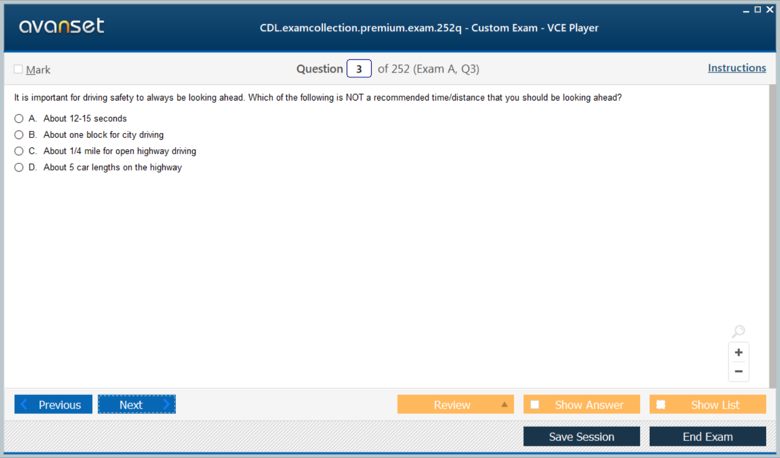
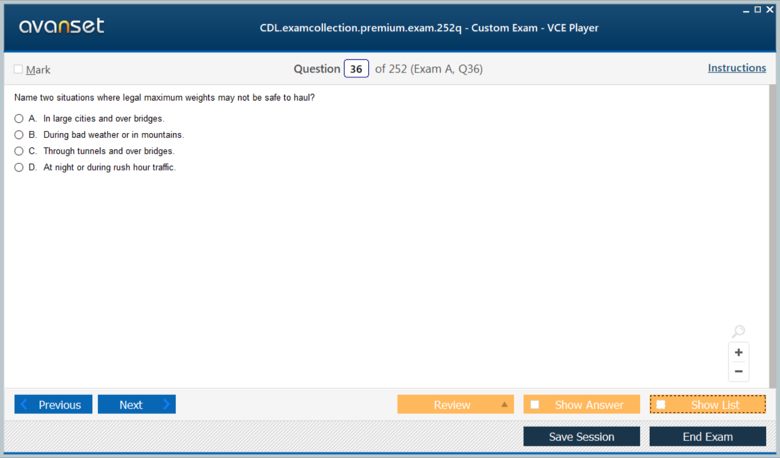
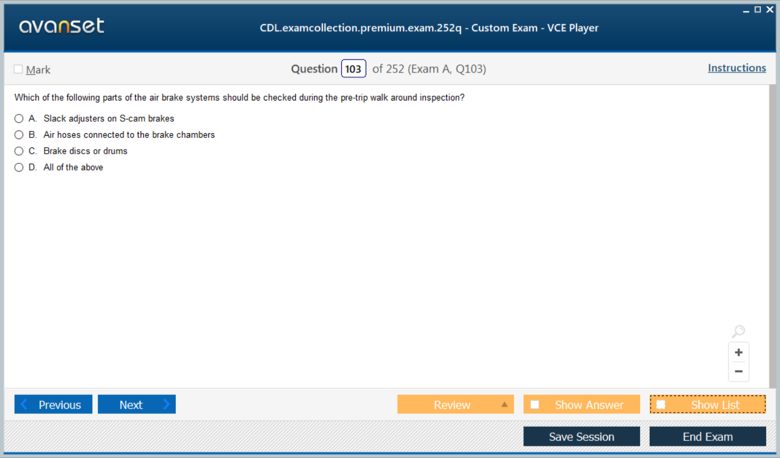
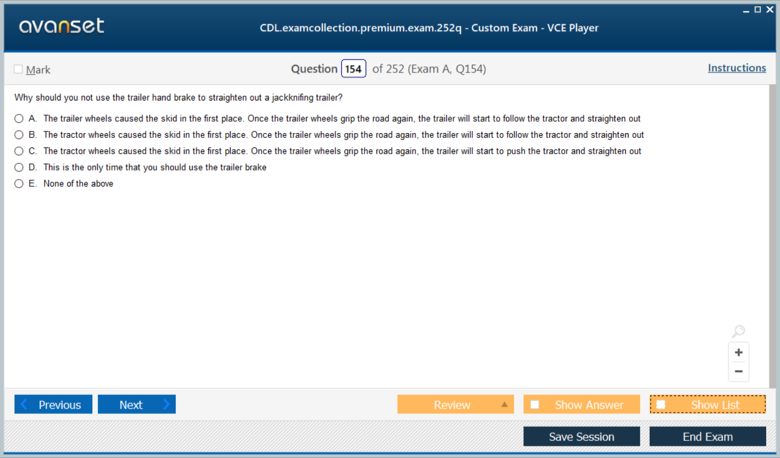
Test Prep CDL Practice Test Questions in VCE Format
| File | Votes | Size | Date |
|---|---|---|---|
File Test Prep.pass4sure.CDL.v2026-09-09.by.liam.120q.vce |
Votes 1 |
Size 135.31 KB |
Date Sep 09, 2026 |
Test Prep CDL Practice Test Questions, Exam Dumps
Test Prep CDL (Commercial Drivers Licence) exam dumps vce, practice test questions, study guide & video training course to study and pass quickly and easily. Test Prep CDL Commercial Drivers Licence exam dumps & practice test questions and answers. You need avanset vce exam simulator in order to study the Test Prep CDL certification exam dumps & Test Prep CDL practice test questions in vce format.
A Commercial Driver’s License (CDL) is issued by a state, but the licensing framework is shaped by federal standards that apply to commercial motor vehicle operators across the United States. Candidates preparing for a Class A or Class B license have to understand both layers: federal rules establish baseline requirements, while the state licensing agency controls the actual permit, knowledge testing, skills testing, fees, documentation, and any additional state-specific procedures.
The biggest modern preparation change is the Entry-Level Driver Training (ELDT) framework. Since February 7, 2022, many first-time Class A and Class B applicants, Class B-to-A upgrades, and first-time passenger, school-bus, or hazardous-material endorsement applicants must complete applicable training with a provider listed in the federal Training Provider Registry before they can take the relevant skills or knowledge test. Studying a manual is essential, but for covered applicants it does not replace required ELDT completion.
Class A generally applies to combination vehicles meeting the federal weight thresholds, while Class B generally covers certain heavy single vehicles and combinations below the Class A trailer threshold. Class C can apply to vehicles that do not meet Class A or B definitions but are used in ways that trigger commercial licensing, such as transporting hazardous materials or qualifying numbers of passengers. Exact classification should always be checked against the state manual and federal definitions.
Candidates should learn the class logic rather than memorizing examples only. A tractor-trailer, large straight truck, bus, and smaller hazardous-material vehicle can fall into different licensing categories because the combination, gross vehicle weight ratings, passenger capacity, and cargo matter. Understanding why a vehicle belongs to a class makes endorsement and restriction rules much easier to follow.
Most new applicants first earn a commercial learner’s permit (CLP) by meeting eligibility and knowledge-testing requirements. The CLP allows practice under required supervision before the skills test. Federal rules generally require the permit to be held for at least 14 days before the CDL skills test, although states can impose additional conditions.
That waiting period should be used for deliberate vehicle practice rather than passive observation. Pre-trip inspection, backing, turning, lane positioning, shifting when applicable, speed control, mirror use, railroad crossings, and hazard recognition all improve through repetition. A candidate who passes the written test but has not built consistent vehicle-control habits is not ready for the practical examination.
Federal ELDT rules apply to first-time Class A and Class B applicants, Class B holders upgrading to Class A, and first-time applicants for school-bus, passenger, or hazardous-material endorsements, subject to listed exceptions. Training must come from a registered provider. For Class A and B, both theory and behind-the-wheel components are required before the skills test; the hazardous-material endorsement has a theory requirement tied to the knowledge test.
The rule is about training completion, not a federally prescribed minimum number of driving hours. Providers must meet curriculum and proficiency standards, while states can add their own requirements. Candidates should verify their record in the Training Provider Registry and understand exactly which training event must be complete before scheduling the next licensing step.
The general knowledge material covers topics such as vehicle inspection, basic control, communication, speed and space management, hazards, emergencies, railroad crossings, mountain driving, cargo considerations, alcohol and drug rules, fatigue, and other commercial-driving responsibilities. Additional tests apply to endorsements and certain vehicle systems, such as air brakes.
The best study method is to connect rules to driving decisions. Instead of memorizing that following distance matters, practice asking how weight, speed, grade, weather, traffic, and stopping distance change the safe gap. Instead of memorizing inspection vocabulary, identify which defect could place the vehicle out of service or create a failure under load. Scenario reasoning is more durable than isolated fact recall.
The pre-trip portion of a skills test evaluates whether the candidate can inspect the assigned vehicle and explain the condition of safety-critical components. Strong performance comes from a consistent inspection sequence that reduces omissions. Candidates should know what they are checking, what defect they are looking for, and why that defect matters.
Rote scripts can be fragile if the examiner uses a different vehicle or asks a follow-up question. A better method groups components by system: steering, suspension, brakes, tires and wheels, lights, coupling, fluid leaks, emergency equipment, and in-cab checks. That structure helps the driver adapt to the actual test vehicle while still covering required inspection points.
Backing maneuvers and controlled low-speed positioning reveal whether the driver can place a large vehicle accurately while managing mirrors, reference points, steering input, and pull-ups. The challenge is not speed. It is maintaining control without allowing one correction to create a larger problem somewhere else on the vehicle.
Practice should use repeatable visual references but avoid dependence on one training yard. A candidate needs to understand trailer response, pivot behavior, off-tracking, and how small steering changes develop over distance. Stopping to reassess can be better than continuing a bad line. The test rewards safe, controlled correction more than hurried movement.
On-road testing brings together observation, signaling, lane use, turns, intersections, grades, railroad crossings, speed selection, following distance, and general traffic interaction. Examiners are looking for safe commercial-driving habits, not a theatrical demonstration. Smoothness matters because abrupt actions can indicate poor planning or weak space management.
Candidates should verbalize less and observe more during practice. Mirror checks, forward scanning, speed adjustment, and lane planning need to become habits rather than actions remembered only when an instructor prompts them. Driving a commercial vehicle safely requires managing events before they become emergencies, which is why hazard perception is a recurring theme in CDL manuals.
Passenger, school bus, hazardous materials, tank, and double/triple-trailer operations introduce additional knowledge or skills requirements. Air-brake restrictions can also affect which vehicles a driver is authorized to operate. Candidates should build the test plan around the vehicle and work they actually intend to perform rather than assuming a basic CDL automatically covers every commercial role.
The broader DMV context is useful here because state licensing agencies remain the operational point of contact even when federal standards apply. The state manual controls local testing details, approved documents, scheduling, and state-specific rules. Federal guidance explains the national baseline, but the candidate ultimately tests through the state system.
Medical qualification is another part of the professional framework for many interstate commercial drivers. Depending on the type of commerce and operation, a driver may need to meet federal physical qualification requirements and maintain the appropriate medical certification status with the state licensing agency. Candidates should determine which self-certification category applies to their work rather than assuming every CDL holder follows the same medical-document path.
Hazardous-material work adds a particularly important distinction: obtaining the endorsement involves more than studying another chapter in the state manual. Federal security and eligibility requirements also apply, and ELDT theory training is required for first-time H endorsement applicants before the knowledge test. A driver who plans tanker, passenger, school-bus, or hazmat work should map every endorsement requirement before scheduling tests so that training, background steps, and vehicle access occur in the right order.
Vehicle choice matters for the skills test because testing in a vehicle without certain equipment can create restrictions on the resulting license. Candidates should understand how transmission type, air-brake configuration, and vehicle class affect authorization. Training on a vehicle that does not match the intended job can produce a license that technically passes the exam yet still prevents the driver from operating the equipment an employer expects.
Finally, state manuals should be reread after training rather than only before it. Behind-the-wheel practice makes written rules more concrete: following-distance guidance, downgrade control, railroad procedures, coupling checks, and inspection terms begin to connect to actual vehicle behavior. That second reading often reveals details that were easy to overlook when they were still abstract.
Commercial driving exposes the public to the consequences of vehicle weight, stopping distance, fatigue, cargo movement, visibility limits, and mechanical failure. The licensing process is therefore not just an academic hurdle. Knowledge tests, ELDT, inspection demonstrations, control exercises, and road testing are different checks on whether the applicant can manage those risks consistently.
A strong preparation plan begins with the current state CDL manual, confirms ELDT applicability, completes required registered-provider training, builds a reliable inspection routine, and accumulates supervised practice on the correct vehicle class. Practice questions can reveal knowledge gaps, but the final standard is operational: the candidate must be able to inspect, control, and drive a commercial vehicle safely under real testing conditions.
Employer onboarding does not replace licensing either. A carrier may add road tests, safety orientation, electronic logging procedures, cargo-specific training, or company policies after a driver earns the CDL. Those requirements reflect the equipment and operation of the business. Candidates should view the state skills test as the threshold for legal qualification, not the end of professional development. Safe commercial driving continues to depend on recurrent training, inspection habits, and compliance with the rules governing the operation actually performed.
Commercial licensing is therefore best approached as a sequence of verified requirements rather than one exam date: eligibility, permit, required training, supervised practice, vehicle-specific testing, endorsements, and ongoing compliance.
Go to testing centre with ease on our mind when you use Test Prep CDL vce exam dumps, practice test questions and answers. Test Prep CDL Commercial Drivers Licence certification practice test questions and answers, study guide, exam dumps and video training course in vce format to help you study with ease. Prepare with confidence and study using Test Prep CDL exam dumps & practice test questions and answers vce from ExamCollection.
Purchase Individually


Test Prep CDL Video Course

Top Test Prep Certifications


































Top Test Prep Certification Exams
Site Search:

SPECIAL OFFER: GET 10% OFF

Pass your Exam with ExamCollection's PREMIUM files!
SPECIAL OFFER: GET 10% OFF
Use Discount Code:
MIN10OFF
A confirmation link was sent to your e-mail.
Please check your mailbox for a message from support@examcollection.com and follow the directions.

Download Free Demo of VCE Exam Simulator
Experience Avanset VCE Exam Simulator for yourself.
Simply submit your e-mail address below to get started with our interactive software demo of your free trial.