



Premium File
60 Q&A
$76.99$69.99
LPI 303-200 Exam Questions & Answers, Accurate & Verified By IT Experts
Instant Download, Free Fast Updates, 99.6% Pass Rate
60 Questions & Answers
Last Update: Oct 21, 2026
$69.99
LPI 303-200 Exam Screenshots
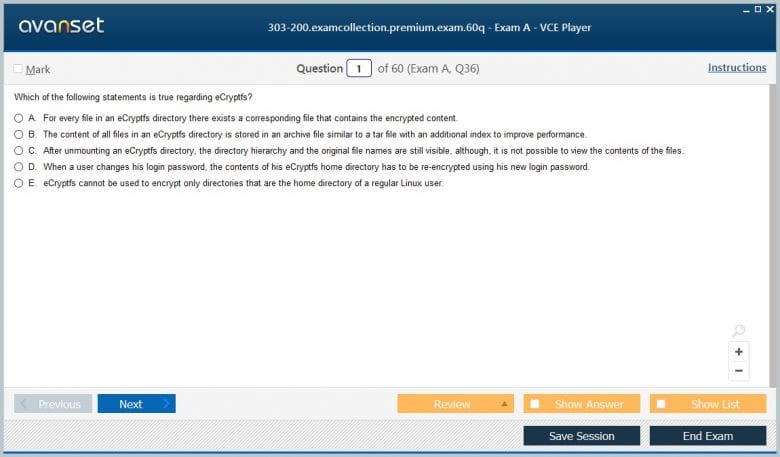
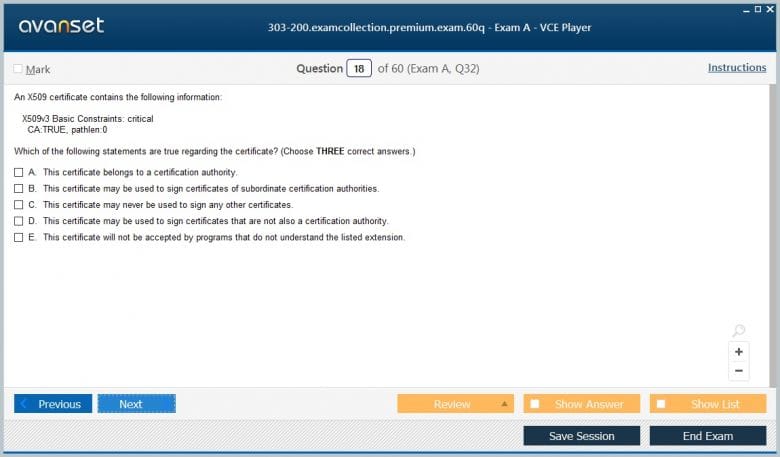
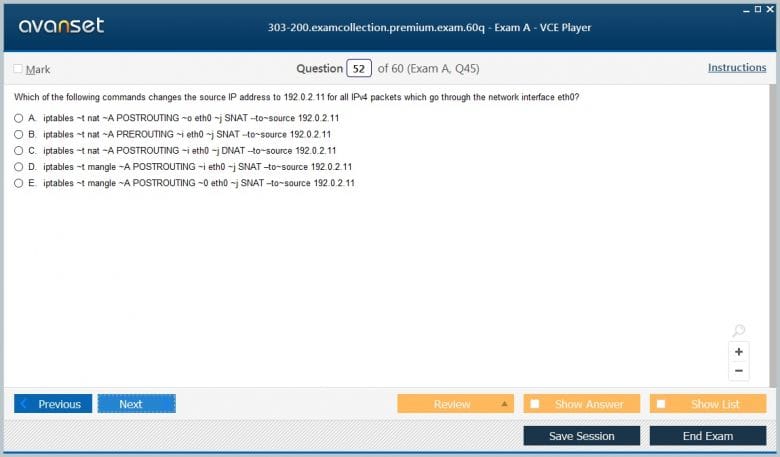
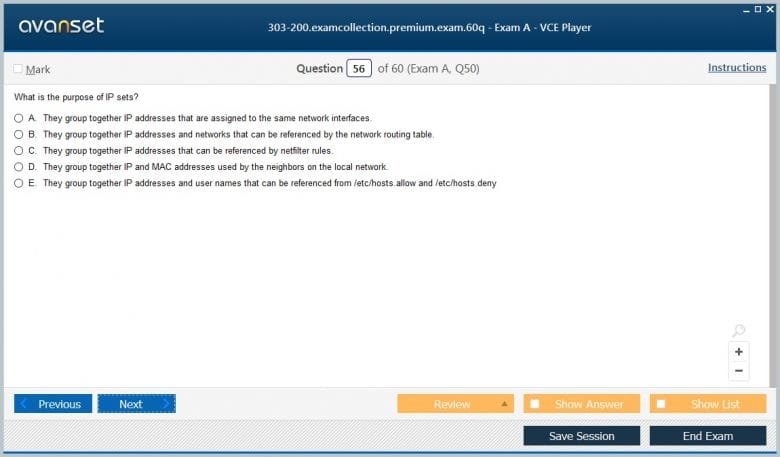
LPI 303-200 Practice Test Questions in VCE Format
| File | Votes | Size | Date |
|---|---|---|---|
File LPI.pass4sureexam.303-200.v2026-08-19.by.maya.30q.vce |
Votes 1 |
Size 43.78 KB |
Date Aug 19, 2026 |
File LPI.Selftesttraining.303-200.v2019-03-26.by.Benjamin.36q.vce |
Votes 2 |
Size 52.5 KB |
Date Mar 30, 2019 |
File LPI.Pass4sure.303-200.v2016-11-30.by.Ethan.29q.vce |
Votes 8 |
Size 36.76 KB |
Date Nov 30, 2016 |
LPI 303-200 Practice Test Questions, Exam Dumps
LPI 303-200 (Security) exam dumps vce, practice test questions, study guide & video training course to study and pass quickly and easily. LPI 303-200 Security exam dumps & practice test questions and answers. You need avanset vce exam simulator in order to study the LPI 303-200 certification exam dumps & LPI 303-200 practice test questions in vce format.
LPIC-3 exam 303-200 is the retired version 2.0 Security exam from Linux Professional Institute. LPI lists 303-200 as the previous version of the Security specialty and states that it was available until April 4, 2022. The current exam is 303-300, version 3.0. Candidates pursuing the certification today should therefore use the current blueprint, while 303-200 is best treated as a historical map of enterprise Linux security practice.
That map is still substantial. Version 2.0 covered public-key infrastructure, TLS, encrypted storage, DNSSEC, host hardening, intrusion detection, identity and authentication, FreeIPA, discretionary and mandatory access controls, network hardening, intrusion detection, packet filtering, VPNs, security threats, and penetration-testing concepts. It expected an experienced Linux administrator to understand how controls reinforce one another across host, identity, data, and network layers.
The 303-200 objectives required candidates to understand X.509 certificate fields, extensions, chains of trust, public and private keys, certificate authorities, certificate signing requests, revocation, CRLs, and OCSP. OpenSSL was not merely a command to display a certificate. Candidates were expected to create and operate a small certification authority, issue certificates, and manage their lifecycle.
The durable lesson is that certificate problems are usually trust-path problems, name problems, time problems, or key-management problems before they are application problems. A useful lab creates a root and intermediate CA, issues server and client certificates, revokes one, and verifies behavior from a client. The PKI and digital-certificate fundamentals become far easier to reason about when the trust chain is built and broken deliberately.
The exam connected certificates to Apache HTTP Server through TLS, server authentication, optional client-certificate authentication, SNI, HSTS, and OCSP stapling. It also covered storage encryption through dm-crypt and LUKS, with awareness of other encrypted-filesystem approaches. That pairing forced candidates to think about encryption both in transit and at rest.
Operationally, encryption only works when key custody and recovery are understood. A web certificate can be valid yet deployed with the wrong key or missing intermediate chain. An encrypted volume can protect data from offline access yet become a business risk if the only unlock material is lost. Good preparation therefore includes documenting where keys live, who can use them, how renewal works, and how recovery is tested.
Version 2.0 placed significant weight on DNSSEC and DANE. Candidates had to understand signed zones, validating resolvers, key-signing and zone-signing keys, rollover, re-signing, DS and DNSKEY records, RRSIG, NSEC and NSEC3, TSIG, and publication of certificate information through DANE. The objective tied DNS administration directly to cryptographic operations.
A small authoritative zone is enough to make the concepts tangible. Sign it, validate it from a recursive resolver, rotate a key in a controlled sequence, and compare ordinary lookup failures with validation failures. The same defensive mindset appears in DNS zone-transfer security: name service should be treated as infrastructure with explicit trust and exposure decisions.
The host-security section covered GRUB security, disabling unneeded services, resource limits, sysctl hardening, chroot environments, Linux capabilities, and awareness of virtualization as an isolation tool. The exam expected candidates to reduce privilege and exposed functionality instead of relying on a single security product.
A sound hardening exercise starts from service requirements. Disable a daemon because it is unnecessary, not because a checklist says so. Drop capabilities because the process can still perform its job without them. Apply a kernel setting only after understanding the behavior it changes. Security is strongest when every restriction is connected to an explicit threat and every exception is documented.
303-200 included the Linux Audit system, AIDE, chkrootkit, rkhunter, Linux Malware Detect, automated scans, and awareness of OpenSCAP. These tools answer different questions. Audit records show security-relevant events; file-integrity systems detect unexpected change; rootkit and malware scanners look for known indicators; configuration assessment compares the system with a policy.
Do not collapse those functions into a single idea of 'scanning.' Configure audit rules around a small set of sensitive files and actions, build an AIDE baseline, make controlled changes, and compare what each system reports. This teaches the limits of each evidence source and makes it easier to decide whether an alert reflects authorized change, misconfiguration, or suspicious activity.
The retired objectives covered password policy, account lockout, NSS, PAM, SSSD, Kerberos ticket handling, and authentication against Active Directory, IPA, LDAP, Kerberos, or local sources. FreeIPA extended that into an integrated identity platform with directory, Kerberos, certificates, and trust relationships. Identity security was therefore treated as infrastructure, not simply as local password files.
A useful lab follows one identity end to end: directory lookup, authentication, ticket acquisition, group resolution, service authorization, and account policy. Break the DNS name, time synchronization, or keytab and observe how symptoms differ. This trains the diagnostic habit that prevents administrators from treating every login failure as a bad password.
303-200 included ownership, mode bits, setuid and setgid, POSIX ACLs, extended attributes, and mandatory access control. SELinux received the deepest treatment, including enforcement state, booleans, contexts, policy tools, troubleshooting, and audit analysis. Awareness of other MAC systems kept the objective broader than one implementation.
The key conceptual distinction is between discretionary access control, where object owners participate in permission decisions, and mandatory policy enforced by the system. A service can have correct Unix permissions and still be blocked by SELinux because its process type is not allowed to access the target context. Practice diagnosing that mismatch rather than disabling enforcement.
The network section included traffic analysis, wireless concepts, FreeRADIUS, Wireshark, tcpdump, Snort, OpenVAS, bandwidth monitoring, netfilter, iptables, ip6tables, connection tracking, NAT, IP sets, and awareness of newer or adjacent filtering tools. The scope reflects a security engineer who must see traffic, restrict it, and detect patterns that bypass or abuse permitted flows.
Firewall exercises should start from traffic policy and connection state. The iptables foundations are most useful when rules are tested from multiple paths and correlated with packet captures. Intrusion-detection practice should likewise begin with known traffic so that alerts can be explained instead of accepted as mysterious scores.
The final objectives asked candidates to recognize threats against nodes, networks, applications, and credentials, and to understand penetration-testing phases and tools. Nmap was the practical scanning tool, with awareness of frameworks such as Metasploit and security-focused distributions. The goal was to understand how weaknesses are discovered and validated, not to turn the certification into an offensive-security credential.
The current 303-300 exam retains the enterprise-security mission but updates the technology set and structure. Anyone supporting systems from the 303-200 era can still use its objectives as a historical checklist, while certification candidates should move to the current exam. The active LPIC-2 prerequisite also remains a useful reminder: LPIC-3 security assumes the administrator already understands Linux operations deeply enough to know what a security control may disrupt.
For historical study, build one defensive lab rather than a set of disconnected command exercises. Protect a TLS service with your own CA, sign a DNS zone, encrypt a data volume, centralize authentication, enforce SELinux, collect audit evidence, filter traffic, and scan the result with Nmap from a controlled test host. The value of 303-200 lies in seeing how those layers interact even though the exam code itself is no longer current.
Version 2.0 also treated VPNs and secure remote connectivity as part of network security. Even when a modern environment uses different products, the core questions remain: how are peers authenticated, which routes are created, what traffic is protected, how are keys rotated, and what happens if a tunnel comes up without carrying the intended networks? Those questions turn VPN troubleshooting into verifiable network behavior.
A useful incident exercise is to combine audit and network evidence. Generate a failed privileged action from a remote test host, then correlate authentication logs, audit records, firewall counters, and packet captures. If the clocks are synchronized, the evidence can be assembled into a timeline. That habit is more important than any single scanner because investigations depend on knowing what happened first.
Another durable part of 303-200 is the separation between preventive and detective controls. SELinux, permissions, firewall rules, and TLS attempt to prevent or constrain unwanted actions. Audit, integrity monitoring, IDS, and vulnerability assessment provide evidence about what occurred or what could occur. A mature design expects both; prevention without visibility leaves operators blind, while detection without restriction leaves the system unnecessarily exposed.
When studying legacy objectives, avoid copying historical hardening commands directly onto current production machines. Package names, defaults, kernel mitigations, and firewall frameworks have evolved. Reproduce them only in a lab that matches the period, then translate the security principle to the platform actually being operated.
Certificate and DNS key rotation are especially useful historical exercises because they teach planned change under trust. Replace one key while keeping service available, validate the new chain, and then remove the old material only after clients have converged. The same discipline applies to firewall and authentication changes: introduce the new path, verify it, and retire the old path deliberately.
Legacy security material should also be evaluated through today's threat model. A control that was adequate for a small internal network may be insufficient for internet-exposed infrastructure or automated cloud workloads. Preserve the principle—least privilege, verified identity, protected transport, trustworthy logs—but re-evaluate implementation and defaults on the platform actually deployed.
Go to testing centre with ease on our mind when you use LPI 303-200 vce exam dumps, practice test questions and answers. LPI 303-200 Security certification practice test questions and answers, study guide, exam dumps and video training course in vce format to help you study with ease. Prepare with confidence and study using LPI 303-200 exam dumps & practice test questions and answers vce from ExamCollection.
Purchase Individually
Top LPI Certifications




Top LPI Certification Exams
Site Search:

SPECIAL OFFER: GET 10% OFF

Pass your Exam with ExamCollection's PREMIUM files!
SPECIAL OFFER: GET 10% OFF
Use Discount Code:
MIN10OFF
A confirmation link was sent to your e-mail.
Please check your mailbox for a message from support@examcollection.com and follow the directions.

Download Free Demo of VCE Exam Simulator
Experience Avanset VCE Exam Simulator for yourself.
Simply submit your e-mail address below to get started with our interactive software demo of your free trial.
HI , Is the premium dump valid?