



Premium File
93 Q&A
$76.99$69.99
Juniper JN0-348 Exam Questions & Answers, Accurate & Verified By IT Experts
Instant Download, Free Fast Updates, 99.6% Pass Rate

JN0-348 Premium File: 93 Questions & Answers
Last Update: Sep 27, 2026
JN0-348 Training Course: 19 Video Lectures
$74.99
Juniper JN0-348 Exam Screenshots
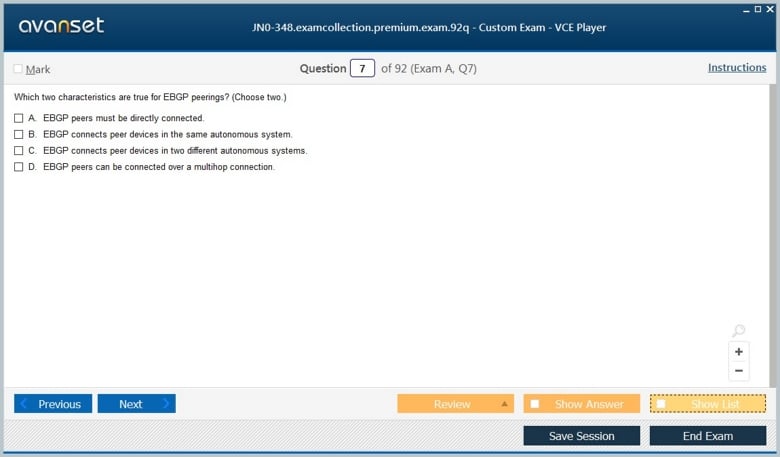
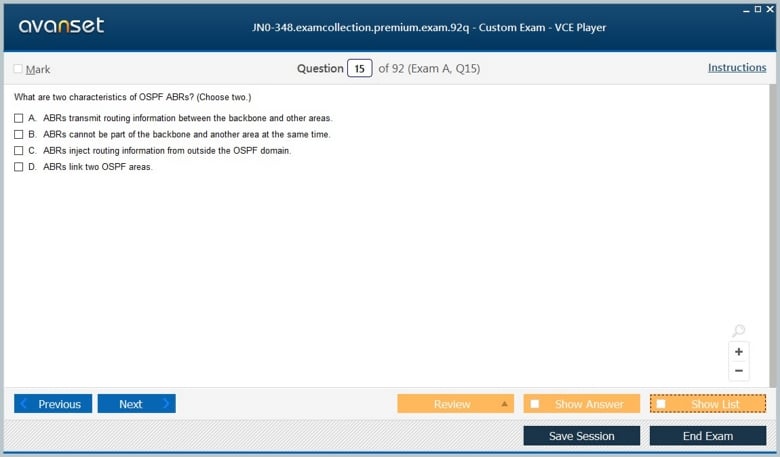
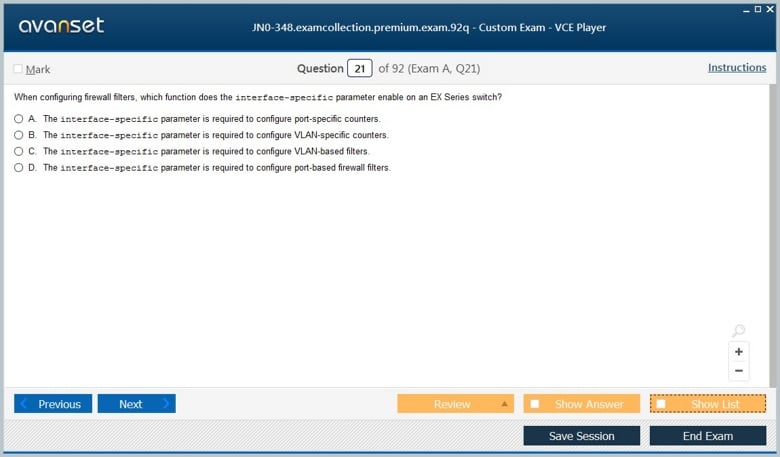

Juniper JN0-348 Practice Test Questions in VCE Format
| File | Votes | Size | Date |
|---|---|---|---|
File Juniper.test-king.JN0-348.v2026-08-21.by.millie.51q.vce |
Votes 1 |
Size 2.67 MB |
Date Aug 21, 2026 |
File Juniper.Test-king.JN0-348.v2019-11-12.by.Gary.45q.vce |
Votes 3 |
Size 2.3 MB |
Date Nov 14, 2019 |
File Juniper.Pass4sure.JN0-348.v2019-10-09.by.Bobby.32q.vce |
Votes 4 |
Size 827.19 KB |
Date Oct 09, 2019 |
File Juniper.Prep4sure.JN0-348.v2019-09-16.by.Adrian.19q.vce |
Votes 3 |
Size 29.48 KB |
Date Sep 19, 2019 |
Juniper JN0-348 Practice Test Questions, Exam Dumps
Juniper JN0-348 (Enterprise Routing and Switching, Specialist) exam dumps vce, practice test questions, study guide & video training course to study and pass quickly and easily. Juniper JN0-348 Enterprise Routing and Switching, Specialist exam dumps & practice test questions and answers. You need avanset vce exam simulator in order to study the Juniper JN0-348 certification exam dumps & Juniper JN0-348 practice test questions in vce format.
JN0-348 was a Juniper Networks Certified Specialist, Enterprise Routing and Switching exam introduced in 2019. It was replaced by JN0-349 in September 2021. JN0-349 was later replaced by JN0-351 in 2023, and the live JNCIS-ENT exam is now JN0-352. Candidates preparing now should therefore verify the JN0-352 objectives directly with Juniper rather than treat the older JN0-348 blueprint as current.
The historical exam remains useful because its core routing and switching subjects still define the specialist role: Layer 2 switching, VLANs, spanning tree, Layer 2 security, protocol-independent routing, OSPF, IS-IS, BGP, tunnels, and high availability. Those topics also appear in the current certification, although objective details and software assumptions have evolved. The JNCIS-ENT certification remains the relevant path for readers planning the active credential.
Specialist-level switching starts with how Ethernet frames are learned and forwarded, then extends into VLAN design, port modes, tagging, native VLAN behavior, and inter-VLAN routing. Candidates should be able to look at a topology and explain which frames remain inside one broadcast domain, which cross a routed boundary, and how an incorrect port mode or tag can create a failure that looks like a routing problem.
Troubleshooting should proceed from the local segment outward. Verify interface state, VLAN membership, MAC learning, and expected tagging before changing Layer 3 protocols. That sequence is simple, but it prevents the common error of blaming OSPF or BGP for traffic that never leaves the access layer correctly.
Layer 2 design should also consider broadcast and failure scope. Large flat VLANs can make simple connectivity easy while increasing the impact of loops, storms, or misconfiguration. Routed boundaries can reduce that scope at the cost of additional Layer 3 design. Specialist candidates should understand the tradeoff instead of assuming one topology is universally superior.
Redundant Layer 2 paths can create loops, so spanning tree protocols choose an active topology and block selected paths until they are needed. A specialist should understand port roles, states, BPDUs, root selection, and reconvergence well enough to explain why a particular path is forwarding or blocked. Fast recovery is useful only when the network does not introduce a loop during the transition.
Layer 2 protection features such as BPDU protection, root protection, DHCP snooping, Dynamic ARP Inspection, MAC limiting, storm control, and firewall filters address different edge risks. The exam rewards candidates who match the control to the threat. A feature that blocks rogue DHCP behavior is not interchangeable with one designed to prevent an unexpected spanning-tree root.
Spanning-tree protection is strongest when the operator understands the expected topology. Root protection is useful only when the network knows where the root should be, and BPDU protection is meaningful on ports where BPDUs are not expected. Security features derive their value from a design assumption; without that assumption, enabling them can create unnecessary outages.
Static, aggregate, and generated routes, routing instances, RIB groups, load balancing, and filter-based forwarding allow the operator to influence routing without depending on one dynamic protocol. These features matter in enterprise networks because not every destination or policy belongs inside OSPF or BGP. Management networks, defaults, special services, and traffic-steering requirements may need more direct control.
The candidate should understand the tradeoff between simplicity and adaptability. A static route is explicit but does not learn changes automatically. Aggregation reduces advertisements but can hide more-specific failures if the design is careless. Routing instances create separation, while filter-based forwarding can steer selected traffic into a different path or table.
Routing-policy tools also interact with troubleshooting. A route may exist in a protocol database but be rejected from the active table, or it may be active locally but never exported to a neighbor. Specialists should learn to ask where in the route lifecycle the prefix disappeared. That question is more precise than saying “routing is broken” and points directly to the relevant evidence.
JN0-348 included both OSPF and IS-IS, which forces candidates to understand link-state routing beyond one vendor-specific configuration. Both protocols build a topology database and run a shortest-path calculation, but they use different packet structures, hierarchy terminology, and operational conventions. The specialist needs to understand adjacencies, areas or levels, designated roles, metrics, and the way routing policy interacts with the protocols.
A useful lab introduces one fault at a time: mismatched area settings, incorrect level configuration, authentication differences, or a broken interface. Then inspect neighbor state and protocol databases before changing routes. If an adjacency never forms, the route-selection process is not yet the problem.
OSPF and IS-IS both reward a database-first troubleshooting mindset. If the topology database contains the expected information but the route is absent, the problem is different from an adjacency that never formed. Candidates should inspect protocol state, database contents, and route installation as separate stages. That decomposition scales well into larger enterprise networks.
BGP is central to enterprise edge and larger routing designs because it carries reachability together with attributes that influence path choice and policy. Candidates should understand message types, attributes, IBGP and EBGP relationships, next-hop behavior, and the route-selection process. The practical goal is being able to explain why one path was selected and why another was not advertised or installed.
BGP troubleshooting should be layered: confirm transport and peering, verify received routes, evaluate policy, inspect attributes, and then check installation in the routing and forwarding tables. That approach prevents route policy from becoming a catch-all explanation for every missing prefix.
BGP policy is especially important because a small configuration can affect many routes. Prefix filters, communities, local preference, MED, and import or export policy can alter traffic flow without changing physical connectivity. Even where the exact attribute set changes by exam version, the durable skill is predicting how policy transforms route selection and advertisement.
GRE and IP-in-IP tunneling allow one packet to be carried inside another transport. The concept is straightforward, but the operational details matter: tunnel endpoints need reachability, the inner traffic needs routes, MTU can become a concern, and policy or filtering can affect the encapsulated packets. A tunnel is therefore another dependency chain rather than an isolated virtual wire.
Candidates should be able to state what problem the tunnel solves and what it does not solve. GRE, for example, does not automatically provide confidentiality. If security is required, a different control or protected design may be necessary. Matching the technology to the requirement is more important than memorizing encapsulation syntax.
Tunnel troubleshooting should also account for path MTU. Encapsulation adds overhead, so a packet that fit before tunneling may fragment or fail when carried inside another header. This is a useful example of how a logically correct design can still have data-plane problems. Specialists should know to consider packet size when only some applications or larger transfers fail.
The JNCIS-ENT track includes technologies such as link aggregation, redundant trunk groups, Virtual Chassis, graceful restart, GRES, NSR, NSB, BFD, VRRP, and ISSU. These mechanisms address different parts of availability: link redundancy, control-plane continuity, first-hop redundancy, fast failure detection, and software maintenance. Candidates should know which layer each mechanism protects.
The best way to study availability is with failure scenarios. Remove a link, restart a routing process, fail a routing engine, or move the VRRP master role, then observe what users experience and which state survives. This teaches why a network can be “redundant” on paper yet still suffer a long outage if convergence or state preservation is poor.
Availability mechanisms should be evaluated for interaction. Fast BFD detection is useful only if the routing or redundancy process responds appropriately, and an ISSU goal depends on platform support and configuration state. The network recovers through a chain of mechanisms. Candidates who understand that chain are better prepared than those who memorize each acronym in isolation.
JN0-348 moved to JN0-349, then to JN0-351, and the active exam is now JN0-352. Candidates planning the current track should also be comfortable with the associate foundation represented by JN0-106 JNCIA-Junos and can look ahead to the professional step represented by JN0-650 JNCIP-ENT. The old JNCIS-ENT exam transition history is useful context for how frequently the code can change while the role persists.
Legacy JN0-348 material remains valuable when it teaches switching, routing, policy, tunneling, and availability from first principles. It becomes unsafe when it is used as proof of a current exam detail. The practical rule is to preserve the engineering model, verify every live objective against current Juniper sources, and use Junos Associate fundamentals to close any basic Junos gaps before attempting specialist scenarios.
The modern JNCIS-ENT blueprint has evolved, but the historical JN0-348 topics remain a strong lab sequence. Build switching first, add IGPs, introduce BGP policy, create a tunnel, then test failures and recovery. Each layer should be working and observable before the next is added. That progression mirrors real network engineering and keeps the retired exam valuable as structured practice.
Go to testing centre with ease on our mind when you use Juniper JN0-348 vce exam dumps, practice test questions and answers. Juniper JN0-348 Enterprise Routing and Switching, Specialist certification practice test questions and answers, study guide, exam dumps and video training course in vce format to help you study with ease. Prepare with confidence and study using Juniper JN0-348 exam dumps & practice test questions and answers vce from ExamCollection.
Purchase Individually

Juniper JN0-348 Video Course

Top Juniper Certifications




Top Juniper Certification Exams
Site Search:

SPECIAL OFFER: GET 10% OFF

Pass your Exam with ExamCollection's PREMIUM files!
SPECIAL OFFER: GET 10% OFF
Use Discount Code:
MIN10OFF
A confirmation link was sent to your e-mail.
Please check your mailbox for a message from support@examcollection.com and follow the directions.

Download Free Demo of VCE Exam Simulator
Experience Avanset VCE Exam Simulator for yourself.
Simply submit your e-mail address below to get started with our interactive software demo of your free trial.
Dump still valid?