Pass Your Juniper JNCIS-ENT Certification Easy!
Juniper JNCIS-ENT Certification Exams Questions & Answers, Accurate & Verified By IT Experts
Instant Download, Free Fast Updates, 99.6% Pass Rate.
Juniper JNCIS-ENT Certification Exams Screenshots
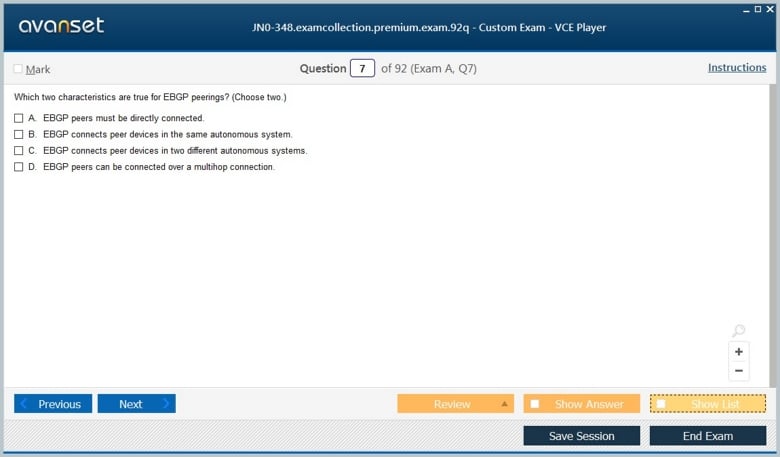
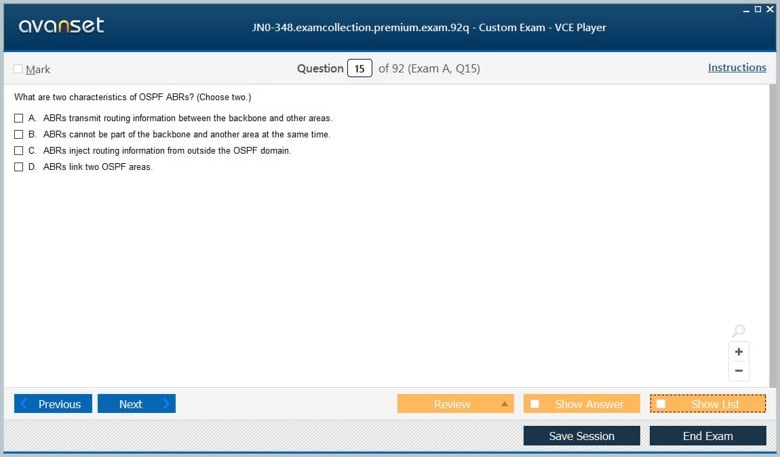
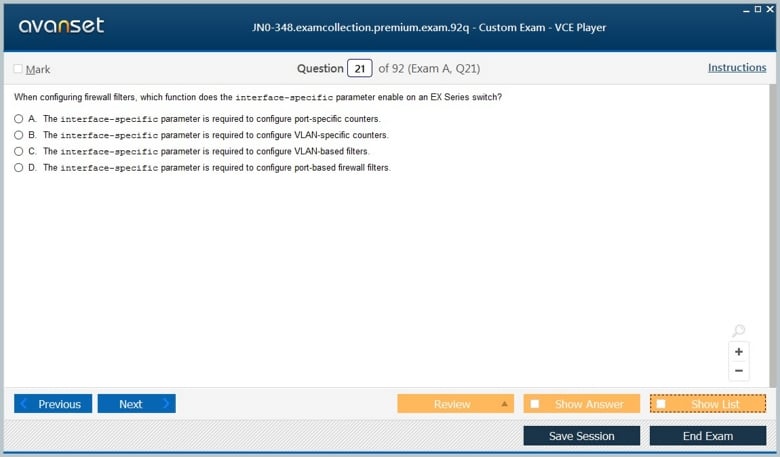
JNCIS-ENT Product Reviews
Download Free JNCIS-ENT Practice Test Questions VCE Files
| Exam | Title | Files |
|---|---|---|
Exam JN0-348 |
Title Enterprise Routing and Switching, Specialist |
Files 4 |
Exam JN0-349 |
Title Enterprise Routing and Switching, Specialist (JNCIS-ENT) |
Files 1 |
Exam JN0-351 |
Title Enterprise Routing and Switching, Specialist (JNCIS-ENT) |
Files 1 |
Juniper JNCIS-ENT Certification Exam Dumps & Practice Test Questions
Prepare with top-notch Juniper JNCIS-ENT certification practice test questions and answers, vce exam dumps, study guide, video training course from ExamCollection. All Juniper JNCIS-ENT certification exam dumps & practice test questions and answers are uploaded by users who have passed the exam themselves and formatted them into vce file format.
JNCIS-ENT in 2026: The JN0-352 Specialist Path
JNCIS-ENT is Juniper’s specialist-level enterprise routing and switching certification, positioned between JNCIA-Junos and JNCIP-ENT. Juniper introduced JN0-352 on June 8, 2026 as the current specialist exam, replacing the older JN0-351 exam. JN0-352 requires JNCIA-Junos, is delivered through Pearson VUE, uses a 90-minute, 65-question multiple-choice format, and is aligned with Junos 23.1. Historical JN0-351 preparation material can still teach durable networking concepts, but candidates should not mistake it for the current blueprint.
The credential remains part of the Juniper certifications family by name, while the overall program has carried the HPE Networking Certification Program name since September 15, 2026. JNCIS-ENT still requires JNCIA-Junos and continues to focus on enterprise routing, switching, tunnels, high availability, policy, and troubleshooting. It is the point where candidates move from basic Junos operation into technologies that resemble real enterprise design and support work.
JNCIA-Junos knowledge should already be automatic
Before starting specialist study, candidates should be comfortable with Junos configuration hierarchy, commits and rollback, interfaces, routing tables, route preference, policy basics, firewall filters, and operational monitoring. The JNCIA-Junos credential exists to establish that baseline. Specialist study becomes unnecessarily difficult if every advanced topic is interrupted by uncertainty about basic platform behavior.
A useful readiness test is whether you can configure and troubleshoot a small routed and switched topology without following a step-by-step guide. If basic Junos operations still require constant reference material, spend a few days strengthening the associate foundation before adding specialist complexity.
Enterprise routing requires more than static reachability
JNCIS-ENT moves into dynamic routing behavior, policy, and troubleshooting. Candidates should understand how OSPF and other routing mechanisms form adjacencies, advertise information, select paths, and respond to failures. They should also be able to use routing policy deliberately rather than treating it as an advanced optional feature.
Build labs where routes are redistributed, filtered, or modified and then verify the effect in routing tables. The key is to connect configuration intent with operational state. A route that exists in one table but not another is evidence; the candidate should be able to explain which control-plane decision produced that result.
Layer 2 switching becomes operationally significant
Specialist switching study goes beyond identifying VLAN tags. Candidates need to understand bridging, VLAN membership, spanning-tree behavior, link aggregation, trunking, and the operational consequences of loops or inconsistent configuration. Enterprise failures often cross Layer 2 and Layer 3 boundaries, so troubleshooting should not assume the problem belongs to one protocol family.
Use small redundant topologies and observe what changes when a link fails. Inspect MAC learning, spanning-tree state, aggregated interfaces, and routing reachability together. This helps build the holistic troubleshooting skill needed later at the professional level.
Tunnels introduce encapsulation and reachability dependencies
The specialist blueprint includes IP tunneling concepts such as GRE and IP-in-IP. The configuration is usually straightforward, but the reasoning can be subtle because the tunnel depends on underlying reachability. A tunnel interface may be logically configured while the outer transport path is broken.
Study each tunnel as two networks at once: the overlay being created and the underlay carrying the encapsulated packets. When troubleshooting, verify the outer source and destination first, then the tunnel state and inner routing. This habit becomes valuable later when working with more complex overlays such as EVPN and VXLAN.
High availability is about state during change
Junos enterprise networks use several mechanisms to keep traffic flowing during component or topology failures. Candidates should understand link aggregation, redundant trunk groups, virtual chassis concepts, graceful restart, GRES, nonstop routing or bridging where applicable, BFD, VRRP, and in-service upgrade concepts at the level described by the current objectives.
Do not study these as a vocabulary list. Ask what failure each mechanism protects against, what state must be synchronized, and what traffic impact remains during failover. High-availability technologies become easier to differentiate when tied to their failure domain.
Troubleshooting tools are part of the objective, not an afterthought
Juniper’s specialist scope explicitly emphasizes troubleshooting. Ping, traceroute, traceoptions, logging, operational show commands, and protocol-specific state should be used to test hypotheses. A strong candidate knows which evidence would prove or disprove a suspected problem.
Practice from symptoms rather than from a known bad line of configuration. Have someone change a policy, interface, VLAN, routing adjacency, or tunnel, then diagnose without looking at the answer. That simulates the reasoning the certification is trying to validate.
The 2026 JN0-352 transition matters
Juniper launched JN0-352 on June 8, 2026, making it the current Enterprise Routing and Switching Specialist exam. The earlier enterprise routing and switching transition still provides historical context, but candidates should compare legacy JN0-351 resources directly with the current objectives and treat changed or newly emphasized topics as priority gaps. Juniper’s own 2026 news item contains an inconsistent year in the stated JN0-351 retirement date, so the live JN0-352 certification page is the safer source for current exam scope.
This version awareness is especially important because the next certification, JNCIP-ENT, is itself on the newer JN0-650 blueprint. A clean current foundation makes professional-level progression smoother.
Build the specialist-to-professional bridge intentionally
The jump from specialist to professional is not simply “more commands.” Professional study adds deeper protocol behavior, class of service, access-control complexity, voice-support features, EVPN, and more demanding troubleshooting. JNCIS-ENT should therefore be used to create reliable mental models rather than exam-only memory.
After each specialist topic, ask how it might fail at larger scale or interact with another feature. That question prepares candidates for professional scenarios and helps identify where more lab time is needed before moving forward.
A practical study sequence reduces rework
Start with Junos fundamentals and switching, then dynamic routing and policy, then tunnels and high availability, and finally integrate the topics through troubleshooting. This order follows dependency: advanced resilience is easier to understand once the underlying Layer 2 and Layer 3 behavior is clear.
Use the objective list as a coverage matrix and mark each topic as concept understood, configured, verified, and troubleshot. A topic should not be considered complete just because a definition is familiar. Specialist certification is intended to represent working knowledge.
A JNCIS-ENT holder should be able to support and configure enterprise Junos networks beyond the associate level. The credential should indicate confidence with dynamic routing, enterprise switching, policy, tunnels, high availability, and evidence-based troubleshooting.
That makes it relevant to network operations, enterprise engineering, implementation, and support roles. It is also one of the most logical stepping stones to JNCIP-ENT because the technologies and troubleshooting habits carry directly into the professional blueprint.
Enterprise networks rarely run one routing protocol in isolation. Static routes, OSPF, direct routes, and other sources often need to be controlled as they enter or leave a protocol. Junos routing policy provides that control through ordered terms, match conditions, and actions.
Candidates should practice small policy changes and observe exactly which routes move. This makes later professional BGP and redistribution work far easier because the underlying policy language is already familiar.
Features such as BFD, VRRP, graceful restart, and chassis or control-plane redundancy all exist to reduce outage impact, but each protects a different failure. A fast failure detector cannot fix a bad routing policy, and a redundant gateway does not help if both paths depend on the same failed upstream link.
Study availability by pairing every feature with the failure it detects or mitigates. That prevents the common exam mistake of selecting the most advanced-sounding redundancy feature instead of the one that actually addresses the scenario.
Even when JNCIS-ENT is not an automation certification, modern enterprise operations increasingly rely on templates, structured configuration, APIs, and repeatable change processes. A specialist who understands consistent configuration and verification habits is better prepared for those environments.
This does not mean the exam requires deep programming. It means candidates should appreciate why predictable configuration, staged validation, and observable state matter when the same change may eventually be applied across dozens or hundreds of devices.
Juniper certifications are valid for three years, so specialist knowledge should be maintained rather than treated as permanent. Engineers who plan to progress to professional level usually benefit from doing so while routing, switching, tunnel, and high-availability concepts are still fresh.
The certification ladder is most useful when each level represents a real increase in operating capability. JNCIA builds platform fluency, JNCIS develops enterprise implementation and troubleshooting, and JNCIP adds deeper design and protocol reasoning.
Before booking, compare your study resources with the current JN0-352 objective list and make sure you have labbed the technologies that changed or received new emphasis. Older JN0-351 material can still teach durable enterprise concepts, but the exam code change means scope control matters. A candidate should be able to explain every current objective in plain language and identify at least one operational command or lab exercise that demonstrates it.
Also verify the prerequisite status and certification account details before test day. Administrative surprises are avoidable; technical preparation should be the hard part.
For every topic, ask what evidence would prove normal operation and what symptom would appear if the feature failed. That single habit turns switching, routing, tunnels, and redundancy into a coherent troubleshooting discipline and gives the certification more practical value than simple objective memorization.
A final review should include one integrated lab that combines switching, routing, policy, a tunnel, and a redundancy feature. The purpose is not complexity for its own sake; it is to confirm that the candidate can move between layers without losing the overall service objective.
ExamCollection provides the complete prep materials in vce files format which include Juniper JNCIS-ENT certification exam dumps, practice test questions and answers, video training course and study guide which help the exam candidates to pass the exams quickly. Fast updates to Juniper JNCIS-ENT certification exam dumps, practice test questions and accurate answers vce verified by industry experts are taken from the latest pool of questions.


Juniper JNCIS-ENT Video Courses


Top Juniper Certifications




Top Juniper Certification Exams
Site Search: