
Pass Your Juniper JNCIP-SP Certification Easy!
Juniper JNCIP-SP Certification Exams Questions & Answers, Accurate & Verified By IT Experts
Instant Download, Free Fast Updates, 99.6% Pass Rate.

Service Provider Routing and Switching, Professional (JNCIP-SP)
Includes 96 Questions & Answers
$69.99
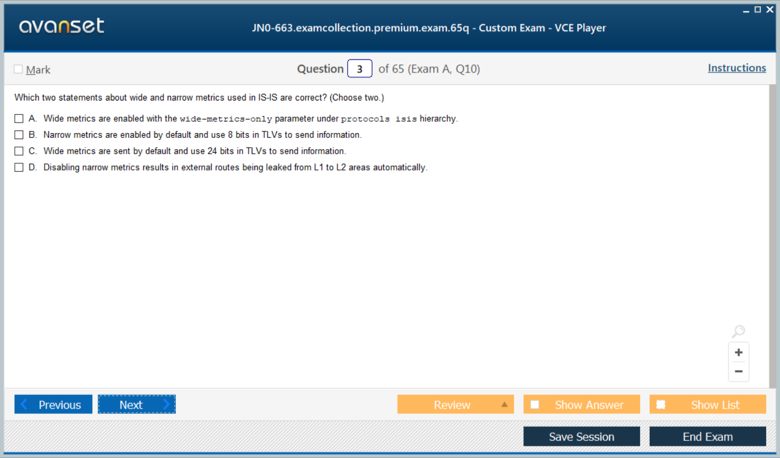
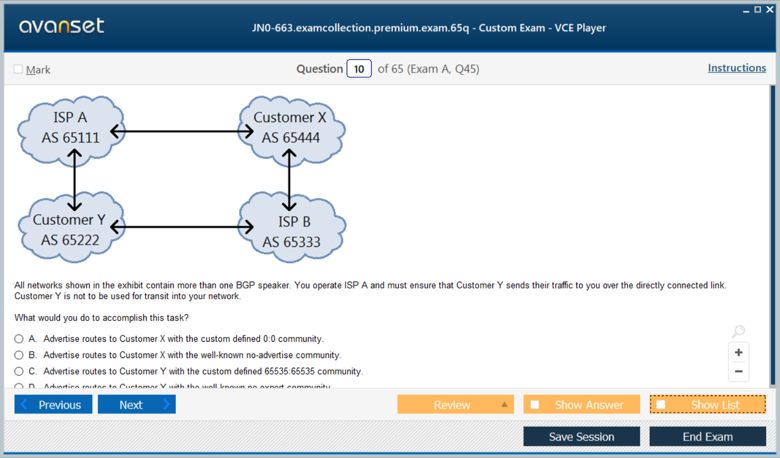
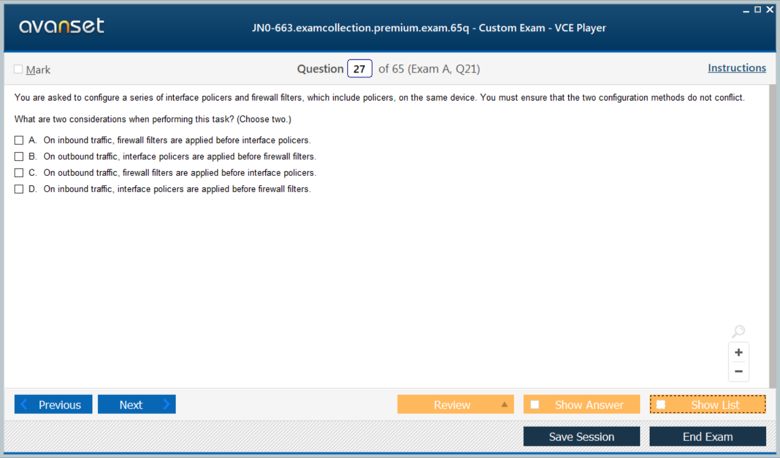
Juniper JNCIP-SP Certification Exams Screenshots

JNCIP-SP Product Reviews
Download Free JNCIP-SP Practice Test Questions VCE Files
| Exam | Title | Files |
|---|---|---|
Exam JN0-663 |
Title Service Provider Routing and Switching, Professional (JNCIP-SP) |
Files 1 |
Exam JN0-664 |
Title Service Provider Routing and Switching, Professional (JNCIP-SP) |
Files 1 |
Juniper JNCIP-SP Certification Exam Dumps & Practice Test Questions
Prepare with top-notch Juniper JNCIP-SP certification practice test questions and answers, vce exam dumps, study guide, video training course from ExamCollection. All Juniper JNCIP-SP certification exam dumps & practice test questions and answers are uploaded by users who have passed the exam themselves and formatted them into vce file format.
JNCIP-SP: Advanced Service Provider Junos in 2026
JNCIP-SP is Juniper’s professional-level credential for engineers working in service-provider routing and switching environments. The current JN0-664 exam replaced the older JN0-663, which Juniper retired in December 2022. JN0-664 requires JNCIS-SP, is delivered through Pearson VUE, and uses a 90-minute, 65-question multiple-choice format. The current blueprint is aligned with Junos OS 22.3. The blueprint expects advanced understanding of routing protocols, MPLS, Layer 2 and Layer 3 VPN technologies, traffic engineering, and operational troubleshooting rather than superficial familiarity with carrier-network terminology.
Within the Juniper certifications family, JNCIP-SP sits above the service-provider specialist level and below the expert lab. HPE renamed the overall Juniper Networks Certification Program to the HPE Networking Certification Program on September 15, 2026, but the JNCIP-SP credential and JN0-664 exam remain the active service-provider professional path. Candidates should approach the exam as a professional networking assessment, combining protocol theory with Junos implementation because service-provider questions often depend on both control-plane behavior and platform-specific verification.
The specialist layer is the prerequisite for a reason
JNCIP-SP assumes candidates already understand service-provider routing and switching at specialist depth and have the Junos foundation normally built from JNCIA-Junos upward. In 2026 the current specialist exam is JN0-364, and the JN0-364 exam, aligned with Junos OS 25.2, is the current foundation beneath professional study. OSPF, IS-IS, BGP, MPLS fundamentals, routing policy, and service-provider operational concepts should already feel familiar before candidates begin professional-level work.
Trying to skip that foundation creates a predictable problem: advanced VPN and traffic-engineering configurations become memorized sequences rather than understandable systems. When the topology changes, the memorized sequence stops helping. Professional candidates need to know how labels are distributed, how reachability is exchanged, how policies influence advertisements, and what state should be present at each device.
OSPF and IS-IS need protocol-level fluency
Both OSPF and IS-IS remain important service-provider IGPs. Candidates should understand adjacency formation, area or level behavior, flooding, shortest-path calculation, metrics, route summarization, and the consequences of topology changes. The professional level is not satisfied with “OSPF is link state.” It expects the candidate to reason about why one route appears, why another does not, and how changes in topology or policy affect convergence.
The best preparation uses multi-area or multi-level labs and deliberate failures. Break an adjacency, alter a metric, change a summarization boundary, and inspect the resulting database and routing table. This builds a practical understanding of control-plane state that transfers directly into MPLS and VPN troubleshooting.
BGP is the policy engine of the provider network
BGP knowledge is central because service-provider networks use it not only for Internet routing but also as a signaling system for VPN services. Candidates should be comfortable with route selection, next-hop handling, communities, regular expressions, policy, multipath behavior, route reflection concepts, and multiprotocol extensions. They should also understand how BGP interacts with an IGP rather than treating the protocols as separate islands.
Routing policy becomes especially important. A professional engineer should be able to predict what attributes or communities a route carries after each policy step and how that affects downstream decisions. Practice by tracing one route across several routers and writing down the attributes at each point before checking the device output.
MPLS labels only make sense when the forwarding story is clear
MPLS is often over-memorized because candidates focus on label terminology before understanding the forwarding purpose. Start with the basic problem: a provider needs scalable forwarding and service separation across a core. Labels let devices forward based on a short identifier associated with a forwarding equivalence class rather than repeating a full IP lookup at every step.
From there, study label distribution, label-switched paths, penultimate-hop behavior, RSVP or LDP concepts where applicable, and how MPLS underpins VPN services. In a lab, inspect both the routing table and label information so that control-plane reachability and data-plane forwarding remain connected in your mental model.
Layer 3 VPNs combine BGP, MPLS, and policy
Layer 3 VPNs are a classic professional-level topic because several technologies converge at once. Candidates should understand provider edge and customer edge roles, VRFs or routing instances, route distinguishers, route targets, MP-BGP exchange, label allocation, and how import/export policy controls which customer routes become visible in each VPN.
A useful study method is to follow one customer prefix end to end. Identify how it enters a PE, how it is placed into a VPN routing table, what extended information is attached, how it is advertised through the provider core, and how the remote PE decides whether to import it. If any step is unclear, the configuration will feel arbitrary.
Layer 2 VPNs and EVPN demand service-model clarity
The JN0-664 scope includes technologies such as BGP Layer 2 VPNs, LDP Layer 2 circuits, VPLS, and EVPN. These all provide forms of Layer 2 service, but their control planes and scaling characteristics differ. Candidates should understand what the customer sees, how the provider identifies the service, how endpoints or MAC addresses are learned, and how redundancy is achieved.
EVPN is particularly important because it replaces some flood-and-learn behavior with control-plane distribution and supports sophisticated multihoming. Study it by comparing service models rather than memorizing route-type labels in isolation. Ask what information must be distributed and why a particular EVPN route exists.
Traffic engineering is about predictable use of the core
Service-provider networks often need more control than shortest-path routing alone provides. Traffic engineering concepts help operators steer traffic, protect important paths, reserve or account for resources, and recover from failures. Candidates should understand the operational objective before studying the configuration mechanism.
This principle makes advanced topics easier to remember. A protection path, explicit route, or policy is not just an exam feature; it exists because operators need predictable behavior under normal and failure conditions. Lab exercises should therefore include link failure and path change so that the effect of the mechanism is visible.
The JN0-663 transition shows why current objectives matter
Juniper retired JN0-663 on December 11, 2022 and moved JNCIP-SP to JN0-664 the next day. The earlier service-provider routing and switching transition shows how the track has evolved, while legacy material can still teach durable BGP, MPLS, and VPN architecture concepts. The current JN0-664 blueprint should control study scope, especially where software assumptions or objective emphasis have changed.
This is especially important in service-provider networking because protocol standards evolve and vendors add new implementation options over time. Professional certification should measure current operational knowledge, not the ability to reproduce an outdated configuration.
Troubleshooting should move from service symptom to control plane
When a VPN customer loses reachability, do not immediately inspect random MPLS commands. First decide whether the problem is customer edge, PE routing, route import/export, BGP advertisement, label distribution, core transport, or data-plane forwarding. Each category suggests a different set of evidence. This hypothesis-driven approach is both faster and safer.
Practice troubleshooting with controlled faults: remove a route target, break an IGP adjacency, alter a BGP policy, disrupt label distribution, or misconfigure a Layer 2 circuit. The goal is to identify which state changed and why. That skill is more valuable than memorizing a long command list.
A JNCIP-SP holder should be able to reason through the architecture of a provider network, not just recognize protocol names. The credential should indicate advanced understanding of how IGPs, BGP, MPLS, VPN control planes, and Junos policy interact to deliver customer services.
That knowledge is most durable when tied to realistic labs or production experience. Service-provider networks are defined by scale, redundancy, and failure handling, so professional preparation should include the behavior of the network when something changes—not only the correct steady-state configuration.
Carrier networks are engineered around the assumption that links, interfaces, routing adjacencies, and devices will fail. Professional study should therefore include how the network constrains the blast radius of those failures. IGP hierarchy, route summarization, fast failure detection, protection paths, and control-plane policy all contribute to a design that can lose components without losing the service.
When reviewing a topology, identify the failure domains explicitly. Ask what happens if a PE fails, if a core link disappears, if a route reflector becomes unavailable, or if a customer-facing circuit flaps. That turns abstract resiliency features into concrete operational requirements.
VPN candidates often confuse route distinguishers with route targets because both appear in Layer 3 VPN configuration. Route distinguishers make overlapping customer prefixes unique in the VPN address family; route targets control import and export policy between VPN routing instances. One solves uniqueness, while the other expresses membership and policy.
Study them by tracing two customers that both use the same private prefix. The provider must keep those routes distinct in MP-BGP and then import each route only into the correct VPN. Once that logic is clear, the configuration becomes much less mysterious.
A professional troubleshooting workflow checks the service at multiple layers: customer route, PE routing instance, VPN advertisement, transport reachability, labels, and forwarding. Jumping directly to one protocol output can miss the actual dependency that failed.
Build a repeatable checklist for each service type. The exact commands may change across releases, but the sequence of questions remains stable: is the route present, is it advertised, is it imported, is the transport path valid, is a usable label or next hop installed, and does the data plane forward as expected?
ExamCollection provides the complete prep materials in vce files format which include Juniper JNCIP-SP certification exam dumps, practice test questions and answers, video training course and study guide which help the exam candidates to pass the exams quickly. Fast updates to Juniper JNCIP-SP certification exam dumps, practice test questions and accurate answers vce verified by industry experts are taken from the latest pool of questions.


Top Juniper Certifications



Top Juniper Certification Exams
Site Search:



