Premium File
683 Q&A
$76.99$69.99
Test Prep GMAT Test Test Questions & Answers, Accurate & Verified By IT Experts
Instant Download, Free Fast Updates, 99.6% Pass Rate

GMAT Test Premium File: 683 Questions & Answers
Last Update: Sep 27, 2026
GMAT Test Training Course: 242 Video Lectures
GMAT Test PDF Study Guide: 2297 Pages
$79.99
Test Prep GMAT Test Exam Screenshots
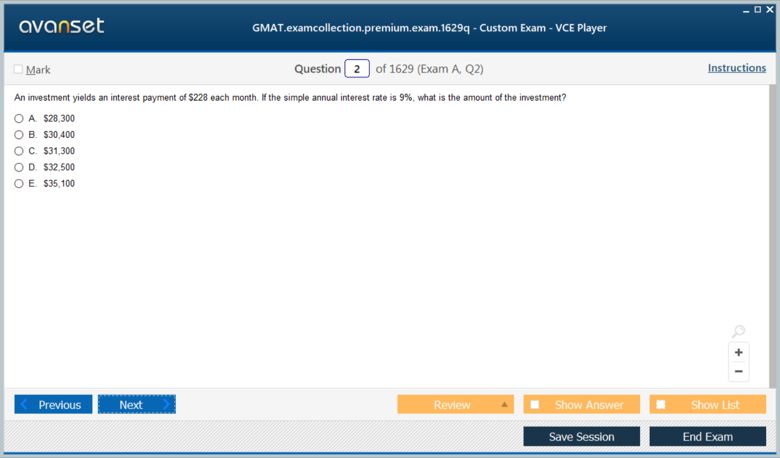
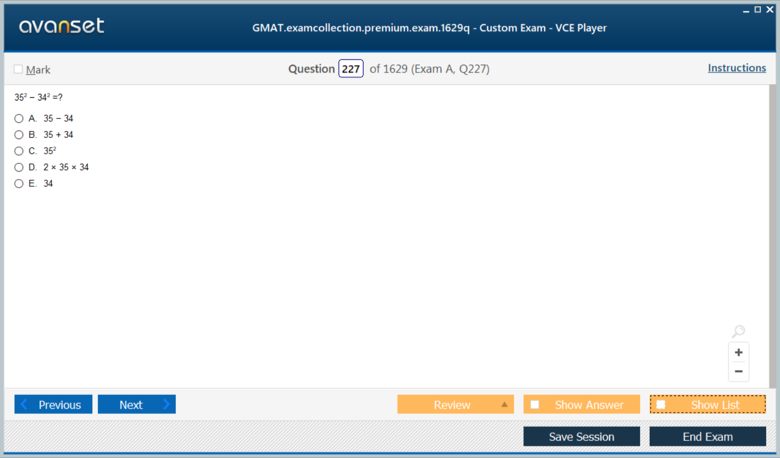
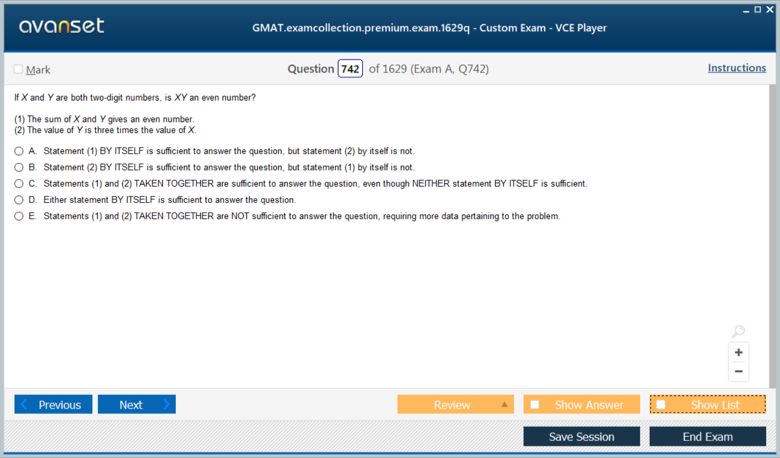
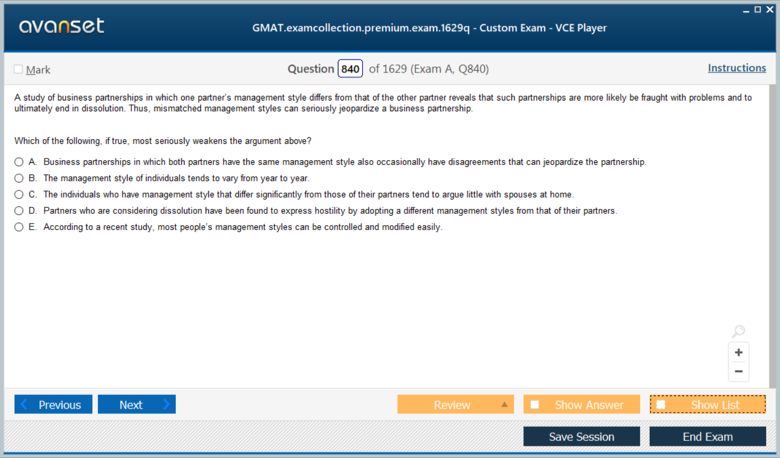
Test Prep GMAT Test Practice Test Questions in VCE Format
| File | Votes | Size | Date |
|---|---|---|---|
File Test Prep.braindumps.GMAT Test.v2026-08-25.by.dylan.577q.vce |
Votes 2 |
Size 1.73 MB |
Date Aug 25, 2026 |
Test Prep GMAT Test Practice Test Questions, Exam Dumps
Test Prep GMAT Test (Graduate Management Admission Test: Analytical Writing Assessment (AWA), Quantitative section, Verbal section) exam dumps vce, practice test questions, study guide & video training course to study and pass quickly and easily. Test Prep GMAT Test Graduate Management Admission Test: Analytical Writing Assessment (AWA), Quantitative section, Verbal section exam dumps & practice test questions and answers. You need avanset vce exam simulator in order to study the Test Prep GMAT Test certification exam dumps & Test Prep GMAT Test practice test questions in vce format.
The GMAT exam is built around three equally timed sections: Quantitative Reasoning, Verbal Reasoning, and Data Insights. The current exam lasts 2 hours and 15 minutes, contains 64 questions, and gives each section 45 minutes. Quantitative has 21 questions, Verbal has 23, and Data Insights has 20. Candidates may choose their section order and can take one optional 10-minute break after either the first or second section.
Those details matter because a large amount of older GMAT preparation material describes a different test. The current format no longer has a separate Analytical Writing Assessment or Integrated Reasoning section. Data interpretation has instead become one of the three central scored components, and the exam is shorter than the previous version. A study plan that has not been updated for that structure can waste time on retired tasks while underpreparing a candidate for Data Insights.
The GMAT is not a business-knowledge quiz. It is designed to test reasoning skills that graduate management programs value: understanding arguments, extracting meaning from dense text, working accurately with quantitative relationships, and making decisions from data presented in different forms. Effective preparation therefore combines content repair with disciplined reasoning and time management.
Because Quantitative Reasoning, Verbal Reasoning, and Data Insights each receive 45 minutes, no section can be treated as a minor add-on. A candidate who is strong in algebra but weak at interpreting charts, tables, and multi-source information can leave substantial points on the table. The same is true of a reader who understands prose well but loses precision when arguments depend on assumptions or quantitative evidence.
Quantitative Reasoning focuses on problem solving and numerical reasoning. The key challenge is rarely advanced mathematics. Candidates need fluency with arithmetic, algebraic relationships, ratios, rates, percentages, statistics, exponents, inequalities, word-problem translation, and other fundamentals, then must apply those tools efficiently. A problem that takes six minutes with an improvised solution method can become a pacing problem even when the final answer is correct.
Verbal Reasoning asks candidates to read closely and evaluate arguments. Reading Comprehension rewards control of main ideas, structure, inference, author purpose, and detail. Critical Reasoning requires a candidate to understand what an argument is claiming, what evidence supports it, what it assumes, and how new information would strengthen, weaken, explain, or otherwise affect the reasoning.
Data Insights brings together quantitative literacy, data interpretation, and decision-making. Candidates may work with tables, graphics, multiple sources, and problems in which determining whether the available information is sufficient matters as much as performing a calculation. This makes the section especially sensitive to careless reading: a candidate can have the mathematics to solve a problem but still answer the wrong question.
The current exam makes data literacy a core part of the score rather than a side component. That is a sensible reflection of modern management work, where decisions are often made from dashboards, financial summaries, survey results, operational metrics, and incomplete information. For test preparation, it means candidates should practice changing representation quickly: prose to equation, table to comparison, graph to trend, and multiple statements to a single decision.
Good Data Insights work begins by identifying what the problem is actually asking. Before calculating, determine the relevant variables, units, time period, comparison group, and decision rule. In a table, sorting mentally or using the provided interface efficiently can matter. In a graph, candidates should distinguish absolute values from percentages, levels from rates of change, and correlation from a claim of causation. In multi-source material, they should track which source establishes each fact rather than blending information prematurely.
Preparation should also include situations in which not all information is necessary. GMAT questions frequently reward the shortest valid path. A candidate who automatically performs every possible calculation increases both time cost and error risk. Reviewing how to use GMAT practice effectively can be useful when the goal is to turn each set into a diagnostic exercise rather than a score-chasing routine.
Many GMAT candidates respond to weak quantitative performance by memorizing more formulas. Some formulas are essential, but method choice is usually more important. A percentage-change problem may be easiest with a simple base of 100. A ratio problem may collapse after choosing compatible multiples. A difficult-looking algebra problem may become straightforward by testing answer choices or translating a relationship carefully before manipulating symbols.
Error analysis should therefore classify the failure. Was the underlying concept unknown? Was the equation set up incorrectly? Did arithmetic break down? Was a constraint ignored? Did the candidate choose a long method when a short one was available? These categories point to different fixes. Re-reading a chapter does little for a candidate whose main problem is rushing through signs and units, while endless timed sets do little for a candidate who never learned the underlying relationship.
High-quality GMAT practice should be reviewed more slowly than it was taken. For every missed or uncertain question, reconstruct a clean solution, identify the clue that should have triggered the method, and note whether another route would have been faster. Over time, this builds a library of recognizable problem structures rather than a pile of isolated answers.
Verbal Reasoning punishes both passive reading and over-interpretation. In Reading Comprehension, the answer must be supported by the passage, not by what a candidate already knows about the subject. In Critical Reasoning, the candidate must stay inside the logic of the argument and identify the exact role of the missing assumption, new evidence, or proposed explanation.
A practical reading method is to track function rather than trying to memorize every sentence. Ask what each paragraph is doing: introducing a problem, presenting evidence, challenging an earlier view, giving an example, or drawing a conclusion. That structure makes detail questions easier because the candidate knows where to return, and it makes inference questions safer because the passage's boundaries are clearer.
For arguments, separate conclusion from evidence before looking at answer choices. Then ask what must be true for the evidence to support that conclusion. Wrong answers are often attractive because they concern the same topic, but they do not affect the specific logical gap. This is one reason careful review of wrong choices is valuable: it teaches the recurring ways plausible language can fail to address the argument.
Each GMAT section creates sustained time pressure. The answer is not to move at one rigid speed. Some questions should take less than the average so that more difficult items can receive additional attention. What matters is preventing a few stubborn questions from consuming enough time to damage the end of the section.
The current exam's Question Review & Edit feature also changes strategy. After answering every question in a section, candidates can review questions and edit up to three answers if time remains. That does not make early guessing cost-free; there may be no review time left, and changing answers without a clear reason can introduce errors. It does, however, reward sensible bookmarking and the willingness to move on from a question that threatens the section clock.
Timed practice should record more than raw score. Track questions that were correct but slow, questions answered with low confidence, avoidable reading errors, and where pace changed sharply. A candidate whose accuracy collapses only in the final ten minutes has a pacing problem even if the content review looks strong. A candidate who finishes early with repeated careless errors has a different pacing problem.
Many graduate business programs accept more than one admissions test, so some applicants compare the GMAT with the GRE General Test. Both measure verbal and quantitative reasoning, but their structure, question styles, scoring systems, and emphasis differ. The better choice depends on the programs being targeted, the applicant's broader graduate-school plans, and which exam better fits the candidate's strengths.
Applicants should verify each school's current policy rather than assume that acceptance automatically means equal strategic value in every program. They should also avoid taking both simply because they cannot decide. A focused preparation cycle on one appropriate test is usually more productive than splitting attention across two formats with different conventions.
The test decision is only one part of the application. A strong score does not replace academic history, professional experience, recommendations, essays, interviews, or clarity about the value of the degree. Candidates considering business school can use a broader look at MBA program types and preparation to connect the testing decision with the larger admissions plan.
The current GMAT total score uses a 205-to-805 scale. Candidates should not translate that number mechanically into older GMAT scores because the exam and scale changed. Business schools receive the current score in the context of the current test, and percentile information can help candidates understand how performance compares with other test takers.
A target score should come from the programs a candidate is seriously considering, not from a generic statement that one number is “good.” Published class profiles can show the range of scores among enrolled students, but they are not guarantees or universal cutoffs. An applicant with a strong overall profile may be competitive below a school's median, while a candidate trying to offset weaker academic evidence may reasonably seek a higher result.
Because the exam is only one signal, preparation should have a stopping rule. Once practice performance is stable in a competitive range and the marginal gain from more testing becomes small, time may be better spent strengthening other parts of the application. The goal is not to make GMAT study an endless project; it is to produce a credible demonstration of readiness for graduate management work.
The opening stage should establish a baseline under realistic timing. That first result is not a verdict. Its purpose is to reveal the distribution of weakness: content gaps, reasoning mistakes, timing problems, or unfamiliar question formats. Candidates can then build focused blocks around the highest-value weaknesses instead of studying every topic equally.
During the middle stage, mixed sets become important. Learning one concept in isolation can create an illusion of mastery because the candidate already knows which method is expected. Mixed practice forces recognition. The test does not announce that the next problem is a rate question or that a passage requires an assumption analysis; the candidate must identify the structure independently.
Full-length simulations should become more frequent near the test date, with the chosen section order and break strategy kept consistent enough to make test day familiar. The best GMAT preparation mindset is analytical rather than emotional: a bad set is data, a good set is not permission to stop reviewing, and every practice session should tell the candidate what to do next.
The GMAT has changed enough that old advice can be actively misleading. Candidates should make sure their materials match the three-section, 64-question, 2-hour-15-minute exam. They should know how section ordering, the optional break, and the review-and-edit feature work before test day, and they should practice with the current Data Insights emphasis rather than treating it as an afterthought.
From there, the essentials are stable: read precisely, translate relationships accurately, choose efficient methods, manage time deliberately, and review mistakes for their cause. A well-prepared candidate is not someone who has seen every possible problem. It is someone who can recognize what a new problem is asking, choose a sound route, and execute that route under time pressure.
That is the most useful way to approach the GMAT in 2026. The exam is compact, but it is not shallow. Success comes from integrating quantitative reasoning, verbal judgment, data literacy, and pacing into one repeatable decision process.
Go to testing centre with ease on our mind when you use Test Prep GMAT Test vce exam dumps, practice test questions and answers. Test Prep GMAT Test Graduate Management Admission Test: Analytical Writing Assessment (AWA), Quantitative section, Verbal section certification practice test questions and answers, study guide, exam dumps and video training course in vce format to help you study with ease. Prepare with confidence and study using Test Prep GMAT Test exam dumps & practice test questions and answers vce from ExamCollection.
Purchase Individually


Test Prep GMAT Test Video Course
Top Test Prep Certifications

































Top Test Prep Certification Exams
Site Search:

SPECIAL OFFER: GET 10% OFF

Pass your Exam with ExamCollection's PREMIUM files!
SPECIAL OFFER: GET 10% OFF
Use Discount Code:
MIN10OFF
A confirmation link was sent to your e-mail.
Please check your mailbox for a message from support@examcollection.com and follow the directions.

Download Free Demo of VCE Exam Simulator
Experience Avanset VCE Exam Simulator for yourself.
Simply submit your e-mail address below to get started with our interactive software demo of your free trial.