



Premium File
65 Q&A
$76.99$69.99
Juniper JN0-681 Exam Questions & Answers, Accurate & Verified By IT Experts
Instant Download, Free Fast Updates, 99.6% Pass Rate
65 Questions & Answers
Last Update: Sep 27, 2026
$69.99
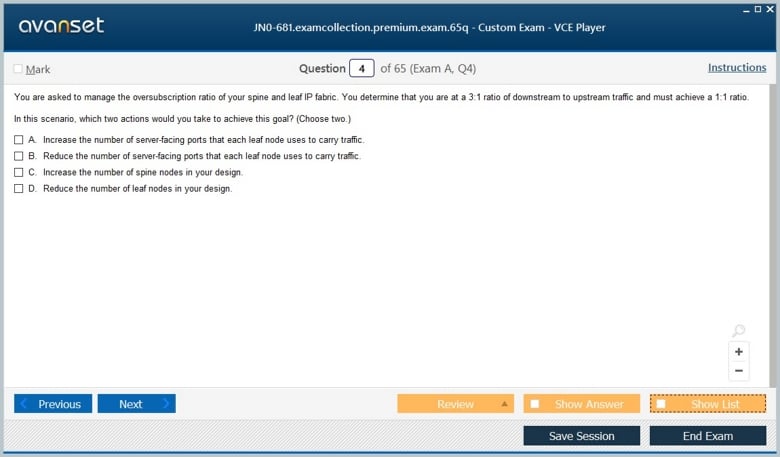
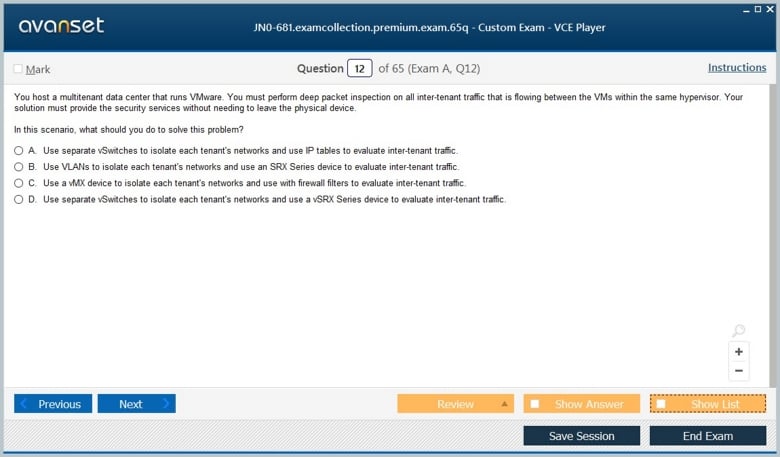
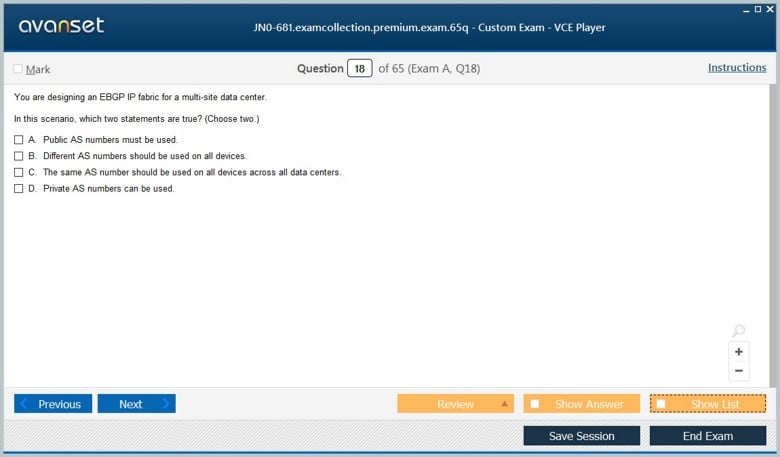
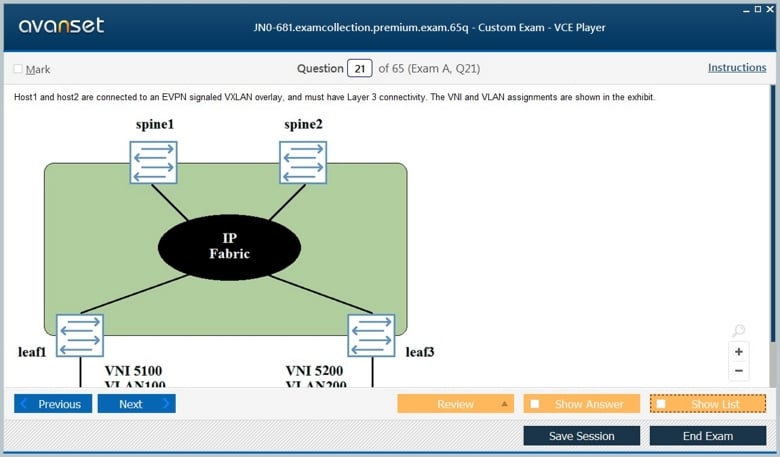
Juniper JN0-681 Exam Screenshots
Juniper JN0-681 Practice Test Questions in VCE Format
| File | Votes | Size | Date |
|---|---|---|---|
File Juniper.realtests.JN0-681.v2026-08-16.by.venla.30q.vce |
Votes 1 |
Size 1.23 MB |
Date Aug 16, 2026 |
File Juniper.Test-king.JN0-681.v2019-12-23.by.David.32q.vce |
Votes 2 |
Size 1.17 MB |
Date Dec 23, 2019 |
Juniper JN0-681 Practice Test Questions, Exam Dumps
Juniper JN0-681 (New Data Center, Professional) exam dumps vce, practice test questions, study guide & video training course to study and pass quickly and easily. Juniper JN0-681 New Data Center, Professional exam dumps & practice test questions and answers. You need avanset vce exam simulator in order to study the Juniper JN0-681 certification exam dumps & Juniper JN0-681 practice test questions in vce format.
JN0-681 was a Juniper Data Center, Professional exam for the JNCIP-DC certification. Juniper released it in April 2019 and retired it on February 6, 2022, replacing it with JN0-682. The data center track continued to evolve after that: JN0-682 was retired in July 2024 and JN0-683 became the current professional exam. JN0-681 is therefore two generations behind the active code, but it remains interesting because it captured an important transition in data center networking.
The exam arrived when EVPN-VXLAN and IP fabrics were becoming central to modern data center design while older Layer 2 fabric technologies, chassis concepts, and conventional routing still mattered. Study material from the JN0-681 period commonly emphasized data center deployment and management, Layer 3 fabrics, Layer 2 fabrics, EVPN-VXLAN signaling, security, high availability, and operational troubleshooting.
That mixture makes JN0-681 a useful historical reference. It should not be presented as an active credential, yet it helps explain how Juniper's data center certification moved from a broader mix of legacy and modern fabric technologies toward the more focused EVPN-VXLAN and automation-oriented objectives seen today.
Traditional data center networks often relied on large Layer 2 domains and tree-like topologies. Modern fabrics favor predictable east-west paths, routed underlays, and leaf-spine designs that scale horizontally. JN0-681 reflected that change by placing Layer 3 fabric concepts alongside more familiar switching technologies.
A spine-leaf fabric is powerful because every leaf has a consistent relationship to the spines. Equal-cost paths can be used efficiently, failures are easier to model, and the underlay can remain focused on reachability rather than tenant policy. The overlay then carries tenant-specific information without requiring the physical topology to mirror application segmentation.
Candidates studying the old exam should recognize that this architectural separation is still current. Underlay and overlay must be troubleshot independently. A failed EVPN route can occur on top of a healthy IP fabric, while an overlay problem may actually be caused by underlay reachability to a VTEP. The ability to prove each layer remains central to modern data center work.
Historical JN0-681 materials included technologies such as Virtual Chassis Fabric, Virtual Chassis, MC-LAG, and Layer 2 switching concepts. Those technologies represent a different way of scaling and operating the data center from a pure routed fabric with an overlay.
Understanding them is still useful because real environments are rarely rebuilt all at once. An organization may have an older Layer 2 domain connected to a newer EVPN fabric, or it may retain MC-LAG at a service boundary while moving server access to an overlay design. Engineers need to understand the operational assumptions on both sides of that transition.
The migration lesson is especially useful. Older Layer 2 fabric designs often hide reachability decisions inside topology and data-plane learning, while routed spine-leaf designs make IP reachability explicit and move tenant extension into an overlay. An engineer supporting both generations should ask where MAC state is learned, how loops are prevented, what the failure domain looks like, and which control plane advertises endpoint information. JN0-681 is valuable because it exposes that architectural handoff rather than presenting modern fabric design as if it appeared fully formed.
The earlier JN0-680 data center transition shows that the certification was already evolving before JN0-681. Data center architecture changes quickly enough that individual exam codes capture particular technology eras rather than permanent designs.
EVPN-VXLAN was one of the defining themes of JN0-681. VXLAN provides an overlay encapsulation that can carry Layer 2 segments across an IP network, while EVPN uses BGP to distribute reachability and support services such as multihoming. Together they reduce reliance on large, flood-heavy Layer 2 domains.
The key conceptual step is to separate the IP fabric from the tenant overlay. The underlay routes between VTEP addresses. EVPN distributes control-plane information. VXLAN carries tenant traffic. A server's MAC or IP identity can therefore be represented independently from the physical path between leaf switches.
That design also changes troubleshooting. The engineer must verify underlay routing, BGP EVPN state, route types, VNI mapping, MAC learning or advertisement, and encapsulated data-plane traffic. If those layers are mixed together mentally, a candidate can spend time fixing the wrong subsystem.
JN0-681-era objectives included zero-touch provisioning, DHCP-based onboarding concepts, monitoring, analytics, automation, and orchestration. These topics are important because a data center fabric can contain too many devices and repetitive configuration elements for manual provisioning to remain safe or efficient.
Automation changes the source of truth. In a manually configured network, an engineer may think of the device configuration as primary. In an automated environment, the authoritative intent may live in a controller, template system, or orchestration platform. Troubleshooting must therefore include the pipeline that generated configuration, not only the final lines on the device.
This is a durable lesson from JN0-681. Before correcting a configuration locally, determine whether automation will overwrite the change. Before assuming a device is inconsistent, check whether the intended state in the controller is itself wrong. Operational maturity comes from knowing where intent originates and how it reaches the network.
That also changes rollback thinking. In a manually managed switch, restoring a known configuration may be enough. In an automated fabric, the engineer must determine whether the bad state came from the local device, a template, inventory data, or controller intent; otherwise the same change can be redeployed minutes later. JN0-681's management topics remain relevant because they force troubleshooting to include the system that creates configuration, not just the box that receives it.
Data centers host many applications, teams, and sometimes customers on shared infrastructure. JN0-681 included security and segmentation concepts because the fabric has to isolate traffic while still preserving efficient routing and operations. The problem is not simply to create more VLANs; it is to build explicit boundaries that scale with workloads.
EVPN and routing instances provide tools for segmentation, but policy still has to match the application's trust model. Engineers need to know whether isolation is enforced by separate forwarding tables, filters, group-based policy, firewalls, or a combination. They also need to understand where traffic crosses between segments and which device becomes the policy enforcement point.
This is where data center networking and security engineering meet. A fabric can be perfectly converged and still violate the intended security architecture if routes or policies leak between tenants. Operational checks should therefore validate both reachability that should exist and reachability that should not.
Legacy data center designs often expressed resilience through paired switches, chassis redundancy, or MC-LAG. Fabric designs distribute resilience more broadly, using multiple equal-cost paths and independent devices. JN0-681's mixture of old and new technologies is useful because it reveals the difference between device redundancy and architectural redundancy.
A redundant pair can still be a common failure domain if both devices depend on the same control relationship or upstream path. A fabric can tolerate individual link or node failures if routing reconverges and the overlay maintains correct state. Engineers should ask what component can fail, how quickly traffic moves, and whether state must be synchronized for sessions or endpoints to remain reachable.
Testing failure is more valuable than reading a topology diagram. Shut a link, remove a leaf, break a BGP session, or withdraw a VTEP route and observe what changes. That exposes hidden dependencies that a static “redundant” label may conceal.
A useful follow-up is to look for common dependencies that make nominally redundant components fail together: a shared management path, one bad routing policy propagated everywhere, a single automation template, or capacity that is adequate only while every link is healthy. High availability is credible only when the remaining fabric can carry the required state and traffic after the failure. That systems view is one of the most transferable lessons in the retired JN0-681 material.
Juniper ended JN0-681 on February 6, 2022 and launched JN0-682 the following day. JN0-682 then reached end of life on July 14, 2024, with JN0-683 becoming the active professional exam on July 15.
The current blueprint is more focused around deployment and management, Layer 3 fabrics, VXLAN, EVPN-VXLAN signaling, data center interconnect, and multitenancy and security. The present certification path also has active lower levels: JN0-281 for Data Center Associate and JN0-481 for Data Center Specialist.
That progression matters when reusing old material. If a JN0-681 topic still appears in the current exam, it can be retained and updated. If it reflects an architecture that has moved out of the current blueprint, it may still be valuable operational knowledge but should not consume the same study time as live objectives.
JN0-681's lasting value is that it captures a data center industry in transition. Traditional switching, chassis and multi-chassis designs were still important, while routed fabrics, automation, and EVPN-VXLAN were becoming the dominant scalable model. Engineers supporting long-lived environments may encounter both generations at once.
For certification in 2026, JN0-683 is the correct professional target. For architecture study, JN0-681 can still help explain why the industry moved toward leaf-spine underlays and BGP-driven overlays. For operations, its legacy topics can be valuable when older infrastructure remains in service.
The right approach is therefore historical but practical: preserve the concepts that explain real networks, verify every feature against the deployed software, and use current Juniper objectives for any certification decision. That keeps JN0-681 useful without blurring the line between an important old exam and an active one.
Go to testing centre with ease on our mind when you use Juniper JN0-681 vce exam dumps, practice test questions and answers. Juniper JN0-681 New Data Center, Professional certification practice test questions and answers, study guide, exam dumps and video training course in vce format to help you study with ease. Prepare with confidence and study using Juniper JN0-681 exam dumps & practice test questions and answers vce from ExamCollection.
Purchase Individually
Top Juniper Certifications




Top Juniper Certification Exams
Site Search:

SPECIAL OFFER: GET 10% OFF

Pass your Exam with ExamCollection's PREMIUM files!
SPECIAL OFFER: GET 10% OFF
Use Discount Code:
MIN10OFF
A confirmation link was sent to your e-mail.
Please check your mailbox for a message from support@examcollection.com and follow the directions.

Download Free Demo of VCE Exam Simulator
Experience Avanset VCE Exam Simulator for yourself.
Simply submit your e-mail address below to get started with our interactive software demo of your free trial.