
Pass Your IIA CIA Certification Easy!
IIA CIA Certification Exams Questions & Answers, Accurate & Verified By IT Experts
Instant Download, Free Fast Updates, 99.6% Pass Rate.

Certified Internal Auditor - Part 2, Practice of Internal Auditing
Includes 956 Questions & Answers
Certified Internal Auditor - Part 3, Business Analysis and Information Technology
Includes 642 Questions & Answers
$188.97
Or Purchase IIA CIA Exams Individually
| IIA-CIA-Part1 | CIA Part 1 - Essentials of Internal Auditing | $69.99 | Add to cart |
| IIA-CIA-Part2 | Certified Internal Auditor - Part 2, Practice of Internal Auditing | $69.99 | Add to cart |
| IIA-CIA-Part3 | Certified Internal Auditor - Part 3, Business Analysis and Information Technology | $69.99 | Add to cart |
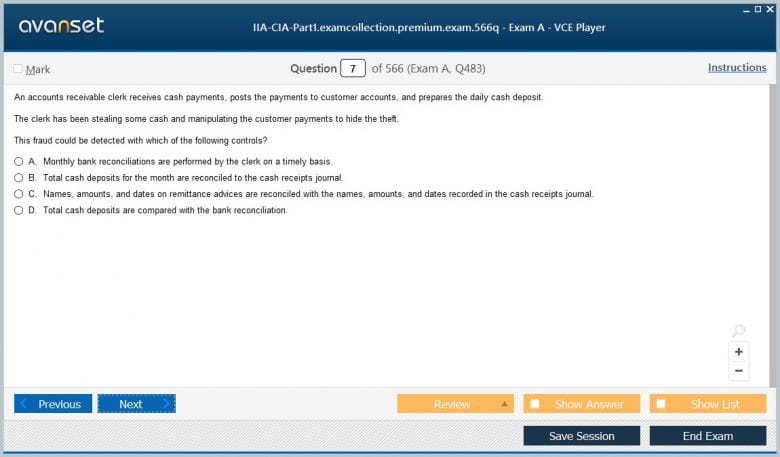
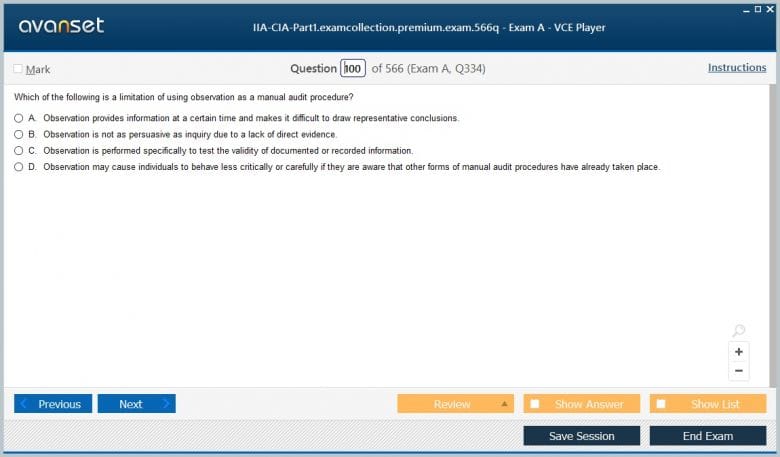
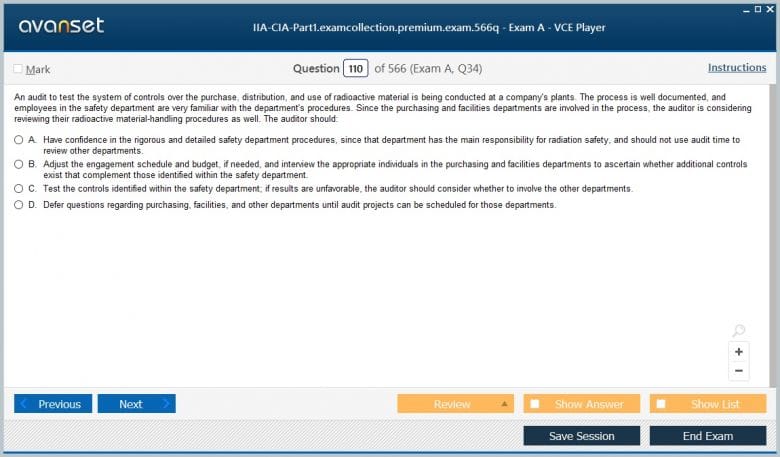
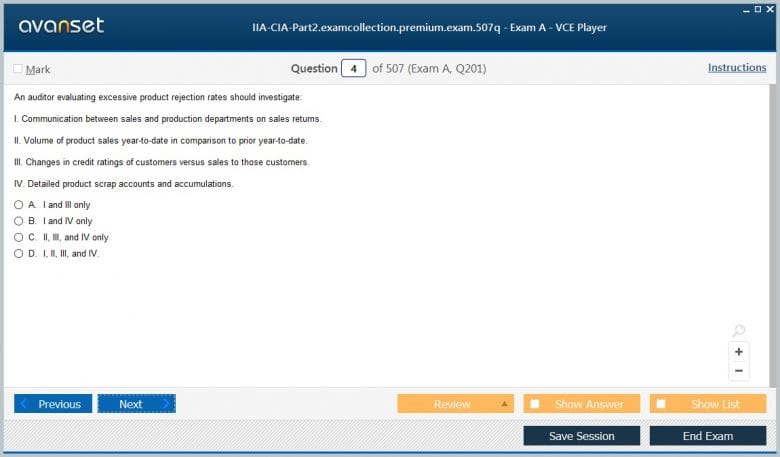
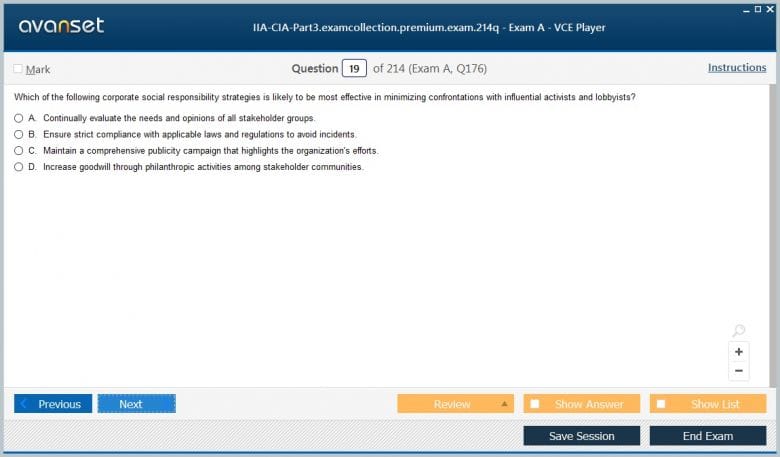
IIA CIA Certification Exams Screenshots
IIA CIA Product Reviews
Download Free IIA CIA Practice Test Questions VCE Files
| Exam | Title | Files |
|---|---|---|
Exam IIA-CIA-Part1 |
Title CIA Part 1 - Essentials of Internal Auditing |
Files 7 |
Exam IIA-CIA-Part2 |
Title Certified Internal Auditor - Part 2, Practice of Internal Auditing |
Files 6 |
Exam IIA-CIA-Part3 |
Title Certified Internal Auditor - Part 3, Business Analysis and Information Technology |
Files 7 |
IIA CIA Certification Exam Dumps & Practice Test Questions
Prepare with top-notch IIA CIA certification practice test questions and answers, vce exam dumps, study guide, video training course from ExamCollection. All IIA CIA certification exam dumps & practice test questions and answers are uploaded by users who have passed the exam themselves and formatted them into vce file format.
Certified Internal Auditor: What the CIA Now Demands from Modern Audit Professionals
The Certified Internal Auditor credential is built around a deceptively simple idea: a strong internal auditor must be able to understand an organization, evaluate risk and control, conduct disciplined engagements, and communicate results in a way that improves governance. The current CIA Part 1, CIA Part 2, and CIA Part 3 exams divide that work into three distinct lenses. Together they make the CIA less a test of isolated audit terminology than a structured assessment of how an internal audit function actually operates.
The credential belongs within the wider IIA certifications, and its 2025 syllabus is especially important for candidates preparing in 2026. The revised structure aligns the exam more closely with the current Global Internal Audit Standards and reduces overlap between the three parts. That means older study plans built around the previous 2019 emphasis can leave genuine gaps even if the underlying audit principles still look familiar.
The 2025 syllabus changed the center of gravity
Part 1 is now more clearly about the foundations of internal auditing: why the function exists, how independence and ethics shape its credibility, how governance and risk are evaluated, and how fraud risk fits into assurance work. Part 2 concentrates on the engagement itself, from planning through evidence collection, analysis, evaluation, supervision, and communication. Part 3 moves upward to the management of the internal audit function, including the audit plan, quality, engagement results, follow-up, and the operational discipline required to run the function well.
This matters because the old instinct to study CIA as a collection of definitions is increasingly weak. A candidate may know what risk appetite means yet still struggle with a scenario asking how an auditor should respond when management accepts exposure beyond an approved tolerance. Likewise, knowing the definition of independence is not enough if the question asks whether a reporting relationship, consulting assignment, or prior operational responsibility creates an impairment. The exam repeatedly rewards professional judgment anchored in standards rather than rote recall.
Part 1 establishes the auditor's professional frame
The first part is where candidates learn to think from the position of the internal audit activity. Governance, risk management, controls, ethics, objectivity, due professional care, and fraud are not separate boxes. They interact. An auditor assessing a process must understand the business objective, identify what could prevent that objective from being achieved, evaluate whether controls respond to those risks, and remain independent enough to communicate weaknesses without becoming the process owner.
Risk language therefore deserves careful study. Candidates should be comfortable distinguishing inherent risk from residual risk, identifying preventive versus detective controls, and understanding why control effectiveness depends on design as well as operation. Risk management in complex organizations reinforces the larger point: risk is not a static list of threats. It changes with strategy, technology, regulation, third parties, and business decisions.
Fraud is another area where context matters. Internal auditors are not expected to become criminal investigators simply because fraud indicators appear. They are expected to understand fraud risk, recognize red flags, evaluate whether controls are appropriate, and know when escalation or specialist involvement is required. That distinction between assurance responsibility and management responsibility is central to professional internal auditing.
Part 2 is about disciplined engagement execution
Part 2 shifts from the profession to the engagement. Planning starts with objectives and risks, not with a generic checklist. The auditor must understand the activity under review, establish engagement objectives and scope, identify relevant criteria, assess risk, and design procedures that will produce sufficient, reliable, relevant, and useful information. Good fieldwork is therefore a chain of reasoning: objective, risk, control, test, evidence, conclusion.
Sampling, analytics, interviews, walkthroughs, observation, document review, reperformance, and confirmation are tools rather than ends in themselves. The correct procedure depends on what the auditor needs to establish. A walkthrough may reveal how a process is supposed to operate, but it does not by itself prove consistent operation over time. A large data extract may be comprehensive, but it is useless if the source data is incomplete or the audit team cannot validate its integrity.
Communication is equally important. Findings should connect condition, criteria, cause, effect, and practical significance rather than simply announce that a policy was not followed. Strong internal audit work explains why the deviation matters, who or what is exposed, and what response is proportionate. This is also where the auditor's relationship with management becomes visible: persuasive reporting requires evidence and clarity without surrendering independence.
Part 3 tests whether you understand the audit function as a system
The third part can surprise candidates who expect it to be a miscellaneous business-knowledge exam. Under the current structure, it is much more directly tied to managing internal audit. The chief audit executive must translate organizational risk into an audit plan, allocate finite resources, monitor quality, communicate results to senior management and the board, and follow up on whether agreed actions actually address the issues identified.
This requires a portfolio view. A high-risk audit universe with limited resources cannot be covered by simply rotating through departments on a calendar. The plan should respond to changing risk, strategic priorities, regulatory pressure, major transformation, and emerging concerns. Candidates should be comfortable with the idea that a risk-based plan is dynamic and that changes may require board communication or approval depending on their significance.
Technology changes the evidence, not the audit logic
Modern internal audit increasingly encounters cloud services, automated workflows, AI systems, cybersecurity controls, and outsourced platforms. The CIA is not a specialist technology credential, but auditors still need enough technology fluency to ask the right questions. When access is automated, for example, the auditor may need to understand identity governance, privileged access, logging, and exception handling rather than reviewing a paper authorization form.
This is one reason the CIA can pair naturally with CISA for professionals whose audit work is heavily technology-focused. The overlap is not complete. CIA is grounded in the broader internal audit profession, while CISA concentrates on information systems audit, governance, operations, development, resilience, and protection of information assets. The combination can be useful because many current audits sit at the intersection of business process and technology control.
The CIA Challenge pathways are different from the standard three-part route
Experienced candidates should not assume every CIA applicant follows the same route. The IIA offers one-part CIA Challenge Exam pathways for approved accounting professionals and qualified CISA holders, while a 2026 professional pilot extends eligibility to people with at least ten years of internal audit or related experience. The professional-pilot application window runs from April 1 through September 30, 2026, with testing windows in June, September, and November. Beginning June 1, 2026, the Challenge program uses a unified 150-question, 180-minute exam aligned to the Global Internal Audit Standards rather than separate pathway-specific examinations.
That distinction matters for planning. A candidate who qualifies for a Challenge route should study the applicable Challenge syllabus and testing window rather than preparing three separate parts. A standard CIA candidate, by contrast, needs a sequencing strategy for Parts 1, 2, and 3. The IIA does not require the parts to be taken in numerical order, although many candidates still find Part 1 a sensible foundation.
How to study without reducing the exam to memorization
A productive CIA study plan has three layers. First, learn the standards, terminology, and core frameworks well enough to recognize what principle is being tested. Second, practice applying those principles to realistic scenarios. Third, review mistakes by asking why the preferred answer is professionally stronger than the alternatives. Simply recording that option C was correct does not build the judgment the exam is designed to test.
For Part 1, build fluency in governance, ethics, independence, risk, controls, and fraud. For Part 2, work through complete engagement scenarios from planning to reporting. For Part 3, think like the person responsible for the internal audit activity: planning, staffing, quality, reporting, follow-up, and alignment with organizational risk. This role-based approach is more durable than memorizing disconnected lists.
What the CIA signals in practice
The CIA is most meaningful when the holder can connect professional standards to difficult organizational situations. Internal audit frequently operates where responsibilities are contested, evidence is incomplete, and management wants a practical answer rather than a theoretical discussion. The credential's value therefore lies in disciplined judgment: knowing when to challenge, when to investigate further, how to document reasoning, and how to communicate risk without assuming management's role.
That is also why experienced auditors should resist treating certification as the end of professional development. Regulations change, technology changes, risk models evolve, and the expectations placed on boards and audit committees expand. The strongest CIA candidates prepare not only to pass three exams but to understand how a credible internal audit function earns trust while remaining willing to surface uncomfortable facts.
Internal audit plans increasingly include cybersecurity, cloud transformation, data governance, automated decision-making, and artificial intelligence. The CIA does not turn an auditor into a specialist in every technology, but it does require the professional discipline needed to decide when specialist knowledge is necessary, how expert work should be evaluated, and how technology risk connects to governance and business objectives. Auditors who work heavily in information systems may deepen that capability through CISA, while those moving into assurance over AI can later consider Advanced in AI Audit. The progression is sensible because emerging-technology audits still depend on familiar foundations: independence, evidence, risk-based scope, control evaluation, and clear reporting.
This also changes how candidates should read technology-heavy questions. The exam is rarely asking which product feature is fashionable. It is more likely to ask whether the audit activity has sufficient competence, whether scope reflects risk, whether evidence is reliable, or whether management rather than audit should own a control. Keeping professional responsibility at the center prevents technical detail from distracting from the audit principle being tested.
Exam logistics should shape the study plan
The standard CIA route remains three separate multiple-choice exams. Part 1 has 125 questions in 150 minutes, while Parts 2 and 3 each have 100 questions in 120 minutes. That creates a pace of roughly a little over a minute per question, so candidates need enough fluency to recognize the governing principle without repeatedly rebuilding basic definitions during the exam. Timed practice should therefore come after conceptual study, not replace it.
Language transitions also matter in 2026 because not every translated CIA exam moved to the 2025 syllabus at the same time. Arabic remains on the 2019 syllabus through December 27, 2026 and moves to the 2025 syllabus on December 28. Simplified Chinese remains on the 2019 syllabus until its transition during the December testing window. Candidates should therefore confirm the syllabus attached to the exact language and testing date rather than assuming an older local-language course is current.
ExamCollection provides the complete prep materials in vce files format which include IIA CIA certification exam dumps, practice test questions and answers, video training course and study guide which help the exam candidates to pass the exams quickly. Fast updates to IIA CIA certification exam dumps, practice test questions and accurate answers vce verified by industry experts are taken from the latest pool of questions.


IIA IIA CIA Video Courses



Top IIA Certifications

Top IIA Certification Exams
Site Search:



