



Premium File
1175 Q&A
$76.99$69.99
IIA IIA-CIA-Part1 Exam Questions & Answers, Accurate & Verified By IT Experts
Instant Download, Free Fast Updates, 99.6% Pass Rate

IIA-CIA-Part1 Premium File: 1175 Questions & Answers
Last Update: Nov 01, 2026
IIA-CIA-Part1 Training Course: 10 Video Lectures
IIA-CIA-Part1 PDF Study Guide: 372 Pages
$79.99
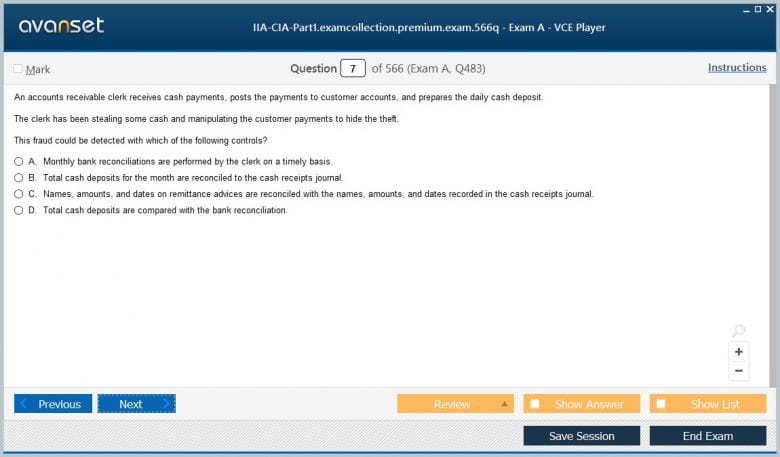
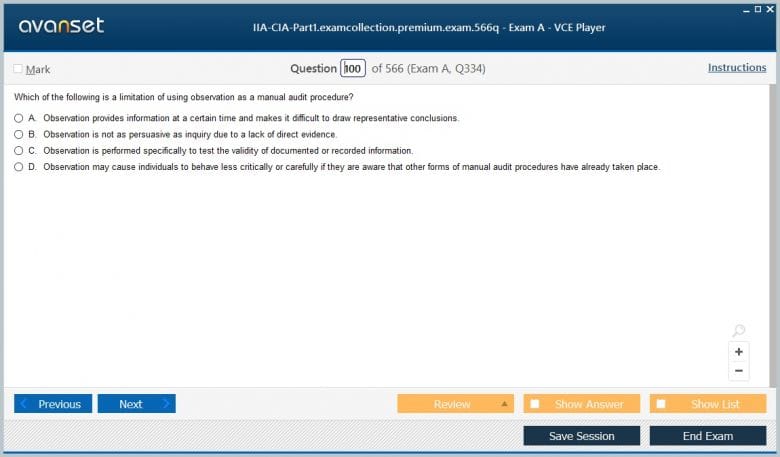
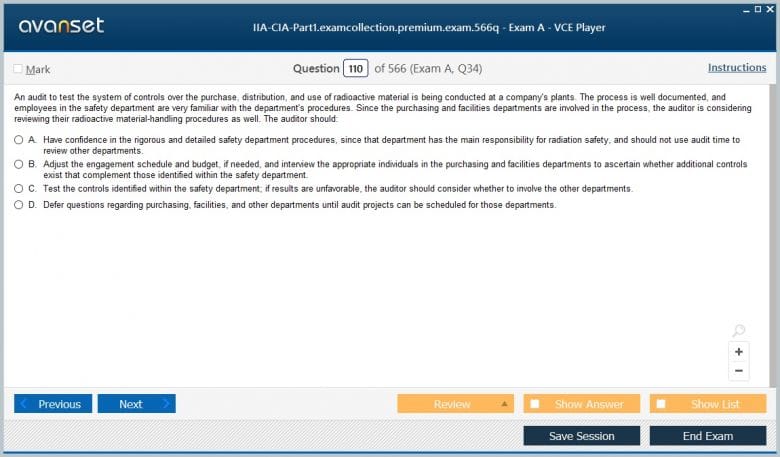
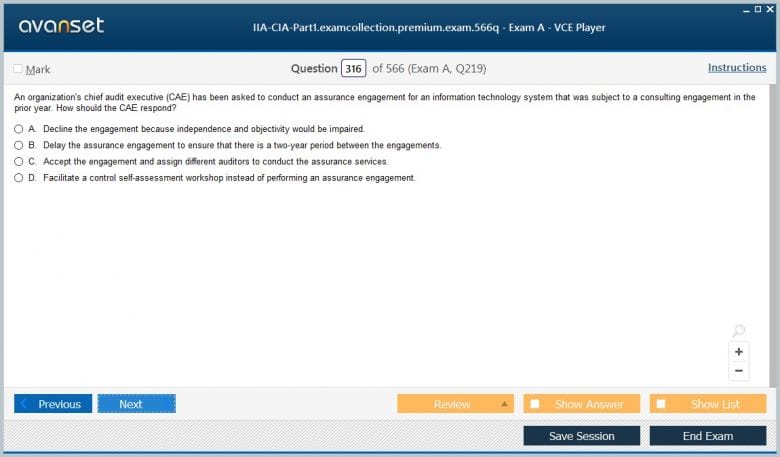
IIA IIA-CIA-Part1 Exam Screenshots
IIA IIA-CIA-Part1 Practice Test Questions in VCE Format
| File | Votes | Size | Date |
|---|---|---|---|
File IIA.pass4sure.IIA-CIA-Part1.v2026-03-27.by.harriet.333q.vce |
Votes 1 |
Size 606.61 KB |
Date Mar 27, 2026 |
File IIA.Train4sure.IIA-CIA-Part1.v2019-03-19.by.Lucy.325q.vce |
Votes 5 |
Size 589.17 KB |
Date Mar 24, 2019 |
File IIA.Testking.IIA-CIA-Part1.v2015-03-13.by.Leatha.566q.vce |
Votes 5 |
Size 784.73 KB |
Date Mar 13, 2015 |
IIA IIA-CIA-Part1 Practice Test Questions, Exam Dumps
IIA IIA-CIA-Part1 (CIA Part 1 - Essentials of Internal Auditing) exam dumps vce, practice test questions, study guide & video training course to study and pass quickly and easily. IIA IIA-CIA-Part1 CIA Part 1 - Essentials of Internal Auditing exam dumps & practice test questions and answers. You need avanset vce exam simulator in order to study the IIA IIA-CIA-Part1 certification exam dumps & IIA IIA-CIA-Part1 practice test questions in vce format.
IIA CIA Part 1 is best treated as a legacy and transition page for the earlier CIA Part 1 syllabus. The IIA began moving language versions from the 2019 syllabus to the redesigned 2025 CIA exam in May 2025. For most candidates, especially those testing in English, the current target is now CIA Part 1 2025, titled “Internal Audit Fundamentals.”
The distinction matters because many Part 1 concepts survived while their organization and emphasis changed. Independence, objectivity, due professional care, governance, risk management, control, and fraud remain central, but the 2025 blueprint aligns them explicitly to the Global Internal Audit Standards and gives ethics/professionalism and foundations a clearer structure. Candidates should not mix old weightings with the new exam plan.
The 2019-era Part 1 was commonly described as Essentials of Internal Auditing. It tested the mission and professional framework, independence and objectivity, proficiency and due professional care, quality concepts, governance, risk management, control, and fraud. Those topics explain why old study material can still feel relevant: the profession did not discard the underlying principles when the syllabus was redesigned.
What changed is the architecture around those principles. The 2025 Part 1 organizes the blueprint into foundations of internal auditing, ethics and professionalism, governance/risk/control, and fraud risks. That reorganization changes where some ideas are taught and how strongly they are weighted. A candidate who relies on an old domain map may spend too much time on one area and miss newer emphasis or terminology.
Older Part 1 preparation commonly centered on foundations of internal auditing, independence and objectivity, proficiency and due professional care, quality, governance, risk management, control, and fraud. Much of that reasoning remains valuable, which is why legacy questions can still feel familiar. The danger is assuming that familiar concepts imply an unchanged blueprint. The 2025 Part 1 explicitly organizes the exam into foundations, ethics and professionalism, governance/risk/control, and fraud risk, with different weighting and terminology aligned to the Global Internal Audit Standards.
The 2019 blueprint divided that foundation into six weighted domains: Foundations of Internal Auditing (15 percent), Independence and Objectivity (15 percent), Proficiency and Due Professional Care (18 percent), Quality Assurance and Improvement Program (7 percent), Governance, Risk Management, and Control (35 percent), and Fraud Risks (10 percent). The exam used 125 multiple-choice questions in 150 minutes. Those logistics remained the same in the 2025 redesign, but the content map was consolidated into four domains and aligned with the current Global Internal Audit Standards.
That comparison makes legacy questions easier to classify. Questions on independence, objectivity, risk, controls, fraud, due professional care, and the purpose of internal audit can remain useful when their reasoning is durable. Questions that depend on old standards numbers, the former Code of Ethics structure, an obsolete domain weighting, or a policy tied to the old IPPF need current-source verification. The goal is not to discard old material indiscriminately; it is to distinguish enduring professional judgment from superseded exam architecture.
The profession moved from the previous standards structure to the Global Internal Audit Standards, which became the central reference point for the 2025 CIA syllabus. Concepts such as the purpose of internal auditing, mandate, charter, board responsibilities, chief audit executive responsibilities, and quality are now expressed through the current standards framework. The substance of independence and professional care remains recognizable, but wording matters on a standards-based examination.
Candidates should therefore avoid memorizing old labels when the current IIA terminology has changed. Historical notes can help explain why a rule exists, but the exam answer should reflect the framework in force for the candidate’s test language and date. This is especially important during a multilingual transition period in which some language versions moved later than English.
The standards transition affects how candidates describe authority and responsibility. The modern framework gives greater emphasis to the internal audit mandate, board oversight, strategic planning for the function, quality, and demonstrated conformance. Even where an old question reaches a sensible conclusion, its terminology may not match the current standards. Preparation should therefore translate the underlying principle into current language. This is especially important for questions about the chief audit executive, independence safeguards, advisory services, and the distinction between management ownership and internal audit assurance.
One of the most reusable lessons from the older syllabus is the distinction between organizational independence and individual objectivity. The chief audit executive needs a reporting relationship and access that allow the function to perform without inappropriate interference. Individual auditors must avoid or manage conflicts, self-review, familiarity bias, gifts, and other circumstances that could impair impartial judgment.
The 2025 exam continues to test these ideas but places them inside a wider foundations and ethics structure. Old questions can still be useful when they ask who should disclose an impairment, what action protects independence, or whether an auditor should be reassigned. They become less reliable when they depend on obsolete standards numbering or old procedural details.
Legacy Part 1 material often taught governance, risk management, and internal control as related but distinct bodies of knowledge. That remains useful, yet the current exam emphasizes how they interact with organizational objectives and the internal audit function’s role. Candidates need to distinguish the board’s oversight responsibilities, management’s ownership of risk and controls, and internal audit’s independent assurance and advisory responsibilities.
The 2025 syllabus also explicitly discusses risk appetite and tolerance, inherent and residual risk, types of risk, control design and effectiveness, culture, and ethical or compliance concerns. Candidates can use older scenarios to practice judgment, but should map them to the current blueprint rather than assume the old weighting still controls.
The integration of governance, risk, and control also discourages studying the topics as three independent dictionaries. Governance determines who directs and oversees; risk management identifies and responds to uncertainty around objectives; controls are actions that help manage risk. A weak governance arrangement can undermine otherwise well-designed process controls, and poor risk information can lead management to control the wrong things. Current Part 1 questions can therefore require candidates to identify the level at which a problem originates rather than simply naming a control category.
Fraud concepts such as the fraud triangle, red flags, segregation of duties, authority limits, reconciliations, hotlines, and investigative techniques remain relevant. The professional boundary is equally important: internal audit evaluates fraud risk, considers fraud during planning, reports indicators, and may support investigations, but it does not guarantee prevention or detection of every scheme.
Current preparation should focus on how fraud risk affects engagements and governance. An old question that expects a specific procedural answer may not reflect the newest syllabus language, while a scenario about opportunity, override, or escalation may still be conceptually sound. The safest approach is to validate the principle against the current IIA syllabus before treating legacy material as authoritative.
The IIA moved English to the 2025 syllabus in May 2025 and then transitioned additional languages over time. As of late 2026, some language versions had later cutovers, including Arabic and Simplified Chinese. That means a page labeled simply “Part 1” can be ambiguous without the candidate’s language and exam date. Candidates should verify which syllabus applies to the actual appointment rather than infer it from an old page title.
This is also why the current ExamCollection year-specific destination is useful. It gives English and other transitioned candidates a clear place to study the new blueprint while the legacy page preserves the previous structure for historical reference and for understanding the transition.
Language timing matters because two candidates sitting “CIA Part 1” on the same calendar date may not necessarily be testing from the same syllabus if their exam languages are on different transition schedules. That is an administrative fact candidates should verify directly with the IIA near registration. It also explains why a generic legacy page should not state that every older Part 1 exam disappeared on one universal date. The safest editorial treatment is to identify the 2025 syllabus as the current direction while acknowledging documented language-specific cutovers where they still apply.
That warning is still relevant in October 2026. The IIA currently states that Arabic continues on the 2019 syllabus through 27 December 2026 and moves to the 2025 syllabus on 28 December 2026. Simplified Chinese in mainland China also remains on the 2019 syllabus until its December transition window. A candidate studying in one of those languages can therefore be correct to use the older blueprint even while English candidates have been on the 2025 structure since May 2025. Exam date and language, not the age of a web page alone, determine which syllabus controls.
Part 1 establishes the professional foundation, current CIA Part 2 2025 turns that foundation into engagement planning and execution, and Part 3 addresses management of the internal audit function, quality, coordination, reporting, and follow-up. The CIA pathway is therefore more useful than studying three exam pages as unrelated bodies of facts.
Understanding the progression also helps with old questions that appear to straddle parts. A topic can be relevant to several stages but tested from a different perspective. Risk in Part 1 may mean definitions and governance; in Part 2 it may drive engagement scope and procedures; in Part 3 it may affect the audit plan, resource allocation, or communication with the board.
A legacy bank can still strengthen recognition of independence problems, risk concepts, controls, ethics, and fraud. It should not control current weighting, standards references, exam logistics, or terminology. Candidates should maintain a “legacy but durable” category for concepts that transfer and a “verify before using” category for anything tied to syllabus structure or policy.
ExamCollection’s IIA exams collection keeps the older and current Part 1 destinations connected without treating them as interchangeable. First-party IIA material should decide what a candidate learns for the actual exam. The editorial purpose of this legacy page is transition clarity: retain professionally useful 2019 concepts while directing current candidates to the correct 2025 blueprint.
A disciplined migration strategy is to use old questions only after mapping them to the current blueprint. If a question depends on an obsolete standard number, retired terminology, old syllabus weighting, or a superseded policy, rewrite the issue in current terms before learning from it. If the question tests a durable judgment—such as whether an auditor is objective, whether management owns risk, or whether evidence of fraud risk should be escalated appropriately—the scenario can still be useful. That approach preserves the value of historical material without letting it define the current exam.
Go to testing centre with ease on our mind when you use IIA IIA-CIA-Part1 vce exam dumps, practice test questions and answers. IIA IIA-CIA-Part1 CIA Part 1 - Essentials of Internal Auditing certification practice test questions and answers, study guide, exam dumps and video training course in vce format to help you study with ease. Prepare with confidence and study using IIA IIA-CIA-Part1 exam dumps & practice test questions and answers vce from ExamCollection.
Purchase Individually


IIA IIA-CIA-Part1 Video Course

Top IIA Certifications

Top IIA Certification Exams
Site Search:

SPECIAL OFFER: GET 10% OFF

Pass your Exam with ExamCollection's PREMIUM files!
SPECIAL OFFER: GET 10% OFF
Use Discount Code:
MIN10OFF
A confirmation link was sent to your e-mail.
Please check your mailbox for a message from support@examcollection.com and follow the directions.

Download Free Demo of VCE Exam Simulator
Experience Avanset VCE Exam Simulator for yourself.
Simply submit your e-mail address below to get started with our interactive software demo of your free trial.
i passed the exam easily. i would like to recommend these free files to other candidates since they contain dependable questions and answers for IIA-CIA-Part1 exam. thank you guys for providing good exam materials!
@susan_108, i used the IIA-CIA-Part1 practice questions and answers to prepare for the test…they helped me succeed! for sure, this is a real tip for you to excel in the certification exam and amazing…. but this material is available free of charge…..use them in your prep and you won’t regret!
i have been studying the IIA-CIA-Part1 braindumps using the Avanset vce exam simulator and i passed the test last month without challenges! thank you very much examcollection for your help! you are the best team ever!!!
are the braindumps for IIA-CIA-Part1 exam offered on this site helpful??
@caleb, IIA-CIA-Part1 dumps will definitely help you ace the test. they will familiarize you with the exam structure and questions. you will also learn how to answer different questions appropriately…..to add more these files are among the best tools for you to use in your preparation for the certification exam!
i would like to become a certified internal auditor but i don’t know the best way to prepare for the respective exams. since I’ll be sitting for the test soon, will exam dumps for IIA-CIA-Part1 exam help me excel?
these vce files for IIA-CIA-Part1 exam are awesome. they helped me pass this certification exam. i had already practiced most of the questions i encountered in the actual test. use them in your preparation process and you’ll pass too!!! very helpful and updated!!!