
Premium File
956 Q&A
$76.99$69.99
IIA IIA-CIA-Part2 Exam Questions & Answers, Accurate & Verified By IT Experts
Instant Download, Free Fast Updates, 99.6% Pass Rate

IIA-CIA-Part2 Premium File: 956 Questions & Answers
Last Update: Sep 18, 2026
IIA-CIA-Part2 Training Course: 93 Video Lectures
IIA-CIA-Part2 PDF Study Guide: 438 Pages
$79.99
IIA IIA-CIA-Part2 Exam Screenshots
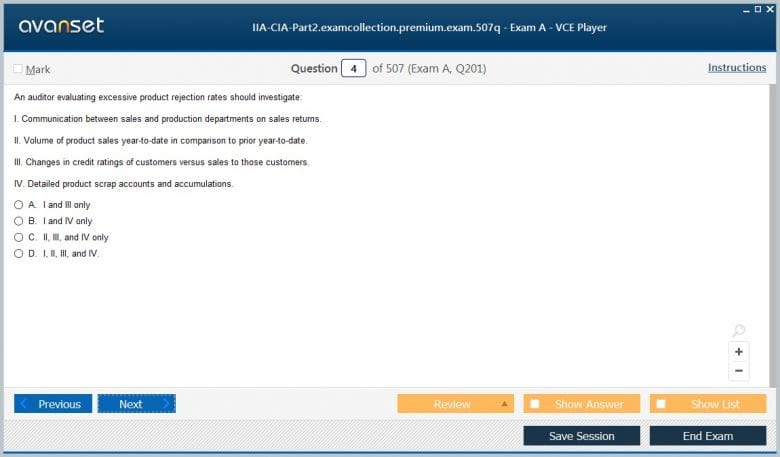
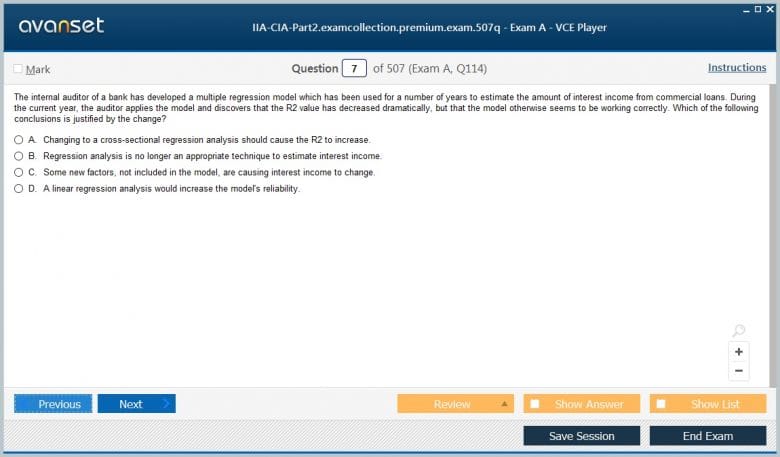
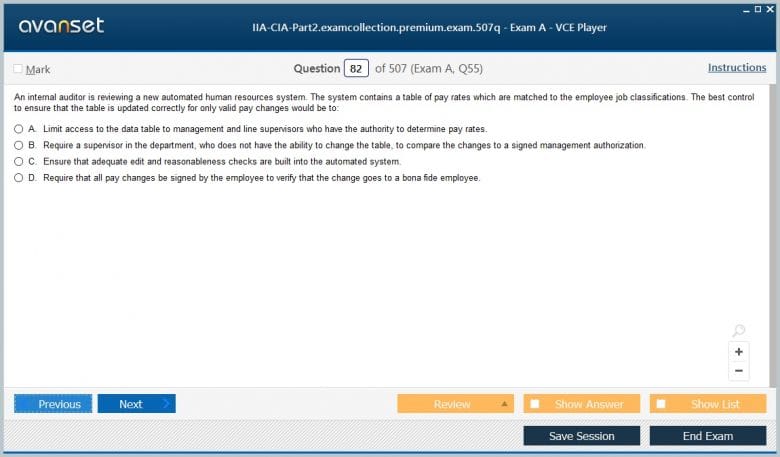
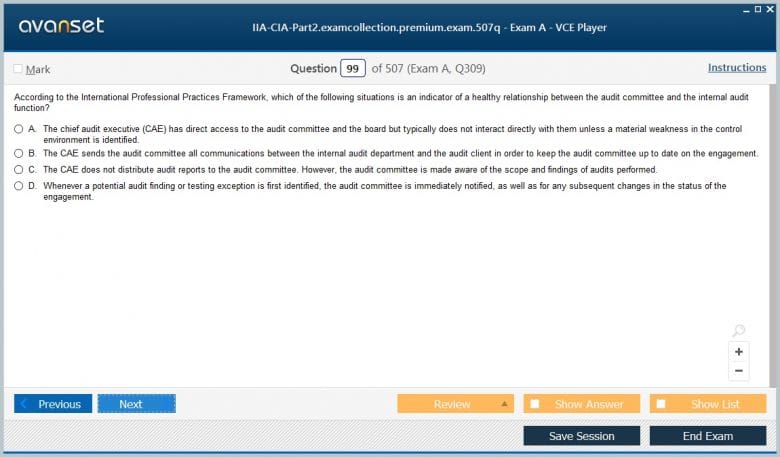
IIA IIA-CIA-Part2 Practice Test Questions in VCE Format
| File | Votes | Size | Date |
|---|---|---|---|
File IIA.certkiller.IIA-CIA-Part2.v2026-08-12.by.eliska.347q.vce |
Votes 1 |
Size 3.1 MB |
Date Aug 12, 2026 |
File IIA.testking.IIA-CIA-Part2.v2021-12-27.by.eliza.332q.vce |
Votes 1 |
Size 2.77 MB |
Date Dec 27, 2021 |
File IIA.realtests.IIA-CIA-Part2.v2021-11-19.by.landon.304q.vce |
Votes 1 |
Size 3.55 MB |
Date Nov 19, 2021 |
File IIA.passguide.IIA-CIA-Part2.v2021-04-28.by.limin.279q.vce |
Votes 1 |
Size 428.14 KB |
Date Apr 28, 2021 |
File IIA.Test4prep.IIA-CIA-Part2.v2019-03-17.by.Paul.275q.vce |
Votes 2 |
Size 416.07 KB |
Date Mar 19, 2019 |
IIA IIA-CIA-Part2 Practice Test Questions, Exam Dumps
IIA IIA-CIA-Part2 (Certified Internal Auditor - Part 2, Practice of Internal Auditing) exam dumps vce, practice test questions, study guide & video training course to study and pass quickly and easily. IIA IIA-CIA-Part2 Certified Internal Auditor - Part 2, Practice of Internal Auditing exam dumps & practice test questions and answers. You need avanset vce exam simulator in order to study the IIA IIA-CIA-Part2 certification exam dumps & IIA IIA-CIA-Part2 practice test questions in vce format.
Older ExamCollection material labeled IIA CIA Part 2 belongs to the 2019-era CIA engagement exam rather than the blueprint a current candidate should assume by default. The 2025 replacement is CIA Part 2 2025, now titled “Internal Audit Engagement.” This legacy page therefore has two jobs: preserve engagement reasoning that still transfers and explain how the earlier domain structure was reorganized under the redesigned three-part CIA pathway.
The old page remains useful because core engagement skills did not disappear. Planning, risk assessment, sampling, documentation, evidence, analytics, findings, and communication are still essential. The risk is assuming that an older domain breakdown, standards reference, or question emphasis still matches the current exam. Preparation should use legacy material to practice transferable reasoning while the new IIA syllabus controls scope and weighting.
Earlier CIA Part 2 material focused heavily on managing an engagement, planning, performing procedures, analyzing evidence, documenting results, and communicating conclusions. Those skills are durable because they describe the lifecycle of assurance work. An auditor still has to understand the process, identify risk, decide what evidence is needed, test controls or transactions, evaluate exceptions, and communicate what the evidence means.
The 2025 redesign makes that lifecycle more explicit and aligns it with the current Global Internal Audit Standards. Candidates should therefore study old material by asking where each concept sits in the new engagement model rather than trying to memorize two parallel blueprints.
The enduring structure of an engagement is still recognizable: understand the activity, identify risks, define objectives and scope, establish criteria, develop a work program, obtain evidence, analyze results, document work, communicate conclusions, and follow through on issues. What changes over time is the emphasis, terminology, and weighting around those activities. That is why an older Part 2 bank can be useful for practicing audit judgment while still being a poor source for deciding exactly what the current exam prioritizes.
Under the 2019 syllabus, Part 2 was divided into Managing the Internal Audit Activity (20 percent), Planning the Engagement (20 percent), Performing the Engagement (40 percent), and Communicating Engagement Results and Monitoring Progress (20 percent). The exam used 100 multiple-choice questions in 120 minutes. The 2025 exam keeps the same question count and time limit, but the blueprint is now Engagement Planning (50 percent), Information Gathering, Analysis, and Evaluation (40 percent), and Engagement Supervision and Communication (10 percent).
That change is more than a renaming exercise. Function-level responsibilities that were previously mixed into Part 2 now sit more naturally in the current Part 3, while Part 2 stays tightly focused on the individual engagement. The result is a clearer progression: plan the engagement, obtain and evaluate information, supervise the work, and communicate the result. Legacy questions about managing the audit department can still teach useful concepts, but they may no longer represent where that concept is tested in the current three-part structure.
The current Part 2 gives engagement planning 50 percent, which signals that planning is not a short preliminary phase. Objectives, scope, criteria, risk assessment, approach, work program, resources, and skills all belong there. Prior reports, stakeholder requests, regulation, strategy, risk appetite, technology, business continuity, finance, cybersecurity, third parties, and organizational culture can influence the plan.
An older question about a work program may still be useful, but the candidate should connect it to the current emphasis on risk and criteria. Procedures should exist because they address an engagement objective and risk. A detailed test step that does not help answer the engagement question is not good auditing merely because it is thorough.
The 50 percent planning weight in the 2025 syllabus reflects how much professional judgment occurs before detailed testing. Poorly chosen objectives or scope can make technically perfect procedures irrelevant. Planning considers strategy, process objectives, stakeholder concerns, prior work, other assurance, risk assessments, regulatory obligations, available resources, fraud exposure, and potential scope limitations. Candidates should therefore resist jumping from a scenario directly to a test step. First ask what the engagement is trying to conclude and which risk makes the procedure necessary.
The heavier planning weight also absorbs topics that older candidates may have associated with general business or technology knowledge. Current questions can bring cybersecurity, IT, finance, business continuity, third-party risk, performance measures, or organizational culture into an engagement scenario because those facts influence risk, criteria, procedures, and evidence. A candidate does not need to answer a free-standing technology trivia question to be tested on technology risk; the issue may be whether an auditor designed the right work around a system-dependent process.
For that reason, old Part 2 material should be mapped by decision rather than by chapter title. A question about selecting a sample, analyzing a variance, interviewing process owners, confirming an account, reviewing system access, or drafting a finding can remain highly relevant if the underlying reasoning still fits the current standards. A question whose “correct” answer exists only because of an obsolete standards reference or former domain boundary should be rewritten or set aside.
Legacy preparation sometimes encourages candidates to think in terms of “more evidence.” Current practice requires enough relevant, sufficient, and reliable information to support conclusions. Source, independence, corroboration, timeliness, completeness, and the effectiveness of the system producing the information all affect reliability. One strong independent confirmation may be more persuasive than several unverified explanations.
Conflicting evidence should trigger additional work. The auditor should not resolve inconsistency by choosing the document that supports the expected result. Understanding why records differ can reveal timing issues, data transformation errors, control failures, or intentional manipulation. That investigative mindset is more valuable than memorizing a hierarchy of evidence without context.
Evidence should also be evaluated as a body rather than as isolated documents. One invoice, one interview, or one exception rarely proves the full condition of a population. Corroboration can strengthen a conclusion when sources are independent or when different procedures point to the same result. Contradictory evidence should trigger additional work rather than be ignored because most evidence supports the expected answer. This is where professional skepticism becomes operational: the auditor remains open to competing explanations until the evidence is sufficient for the conclusion.
Older Part 2 questions about sampling remain relevant when they test representative selection, sample risk, population definition, tolerable error, or evaluation of exceptions. The same principle applies to modern analytics. Before testing, the auditor must understand what population the data represents and whether it is complete. A sophisticated analysis of the wrong population can produce a confidently wrong conclusion.
Targeted selections and statistical samples answer different questions. Selecting every transaction above a threshold can be excellent for a specific high-value risk, but it does not automatically support a conclusion about smaller transactions. Candidates should identify the inference being made before deciding whether the selection method is suitable.
Sampling decisions should follow the objective and population. Statistical sampling can support quantified inference when its assumptions and selection method are appropriate; nonstatistical sampling can also be valid when professional judgment is documented and the conclusion does not overstate what the sample proves. Data analytics may test an entire population, but even full-population testing does not remove the need to validate data completeness and logic. Current Part 2 preparation should therefore focus on the question the procedure answers, not on treating a larger dataset as automatically stronger evidence.
A finding is not simply an exception count. The auditor needs credible criteria, an observed condition, an understanding of cause where supportable, and an explanation of why the difference matters. Root-cause analysis helps prevent recommendations that treat symptoms. If approvals are repeatedly late, the cause may be workload, unclear authority, system design, or incentives rather than carelessness.
Management responses should be evaluated against risk. Internal audit can recommend outcomes and controls while leaving management responsible for choosing and implementing the response. If management accepts exposure that appears beyond authorized tolerance, the matter may require escalation through the organization’s governance process rather than an endless argument over the auditor’s preferred action.
Cause analysis is often what converts an observation into useful assurance. A missing approval could arise from unclear responsibility, inadequate system configuration, poor training, intentional override, excessive workload, or a policy that does not fit the process. Each cause suggests a different response. If the recommendation merely says “obtain approvals” without understanding why approvals are absent, the weakness may recur. Current engagement practice therefore links condition and criteria to risk significance and then seeks a corrective action that addresses the underlying reason.
Supervisors help ensure objectives remain achievable, evidence supports conclusions, judgments are documented, and staff receive guidance appropriate to experience. Review notes are not cosmetic defects to clear at the end; unresolved questions can reveal gaps in scope or reasoning. Resource constraints should be communicated when they threaten the ability to complete the engagement to the required quality.
Workpapers should allow an informed reviewer to understand what was tested, how it was tested, what evidence was obtained, what exceptions were found, and how the conclusion followed. Excess documentation can obscure that logic just as easily as insufficient documentation can leave it unsupported.
Current CIA Part 1 2025 establishes the professional principles that shape the engagement, while CIA Part 3 extends into function management, quality, coordination, reporting, and follow-up. The Certified Internal Auditor pathway therefore rewards candidates who understand how responsibilities change as the perspective moves from principle to engagement to function.
The same topic can appear differently across that progression. Control in Part 1 is a concept and governance responsibility; in Part 2 it becomes something to evaluate and test; in Part 3 it can influence audit planning, quality, communication, and the chief audit executive’s assessment of residual risk.
Legacy questions can still be valuable when they require the candidate to choose an appropriate procedure, evaluate evidence, identify a sampling problem, or improve communication. They are weaker when they depend on old standards numbering, old domain weightings, or obsolete operational policy. Mark those items for current-source verification rather than memorizing them.
Within the broader IIA exams collection, this historical Part 2 destination remains separate from current CIA resources. Current IIA documents should still control the exam a candidate will actually sit. The purpose here is to preserve transferable engagement knowledge without allowing retired structure, weighting, or terminology to compete with the 2025 blueprint.
Candidates migrating from the old page should create a simple crosswalk: retain durable material on risk-based planning, evidence, sampling, analytics, workpapers, findings, supervision, and communication; replace superseded terminology with current standards; and use the 2025 blueprint to decide study priority. This prevents two opposite errors—discarding useful engagement technique simply because it is old, or assuming every old topic deserves the same weight now. The current exam should determine emphasis even when legacy questions are used for practice.
Go to testing centre with ease on our mind when you use IIA IIA-CIA-Part2 vce exam dumps, practice test questions and answers. IIA IIA-CIA-Part2 Certified Internal Auditor - Part 2, Practice of Internal Auditing certification practice test questions and answers, study guide, exam dumps and video training course in vce format to help you study with ease. Prepare with confidence and study using IIA IIA-CIA-Part2 exam dumps & practice test questions and answers vce from ExamCollection.
Purchase Individually

IIA IIA-CIA-Part2 Video Course
Top IIA Certifications

Top IIA Certification Exams
Site Search:

SPECIAL OFFER: GET 10% OFF

Pass your Exam with ExamCollection's PREMIUM files!
SPECIAL OFFER: GET 10% OFF
Use Discount Code:
MIN10OFF
A confirmation link was sent to your e-mail.
Please check your mailbox for a message from support@examcollection.com and follow the directions.

Download Free Demo of VCE Exam Simulator
Experience Avanset VCE Exam Simulator for yourself.
Simply submit your e-mail address below to get started with our interactive software demo of your free trial.