



Premium File
96 Q&A
$76.99$69.99
HP HPE0-S22 Exam Questions & Answers, Accurate & Verified By IT Experts
Instant Download, Free Fast Updates, 99.6% Pass Rate
96 Questions & Answers
Last Update: Nov 02, 2026
$69.99
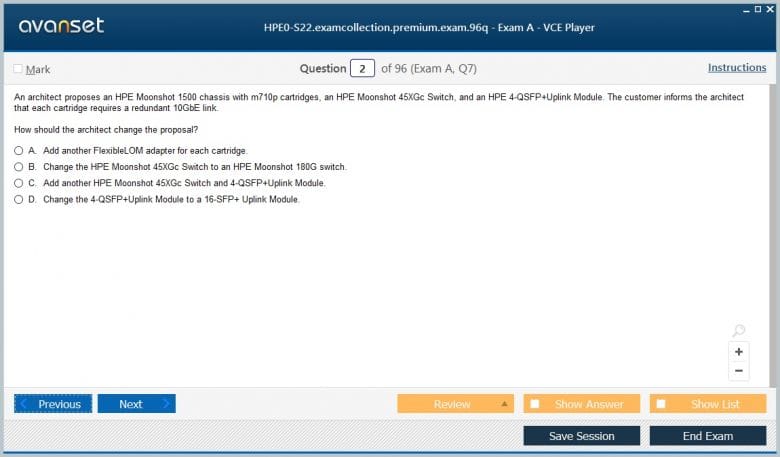
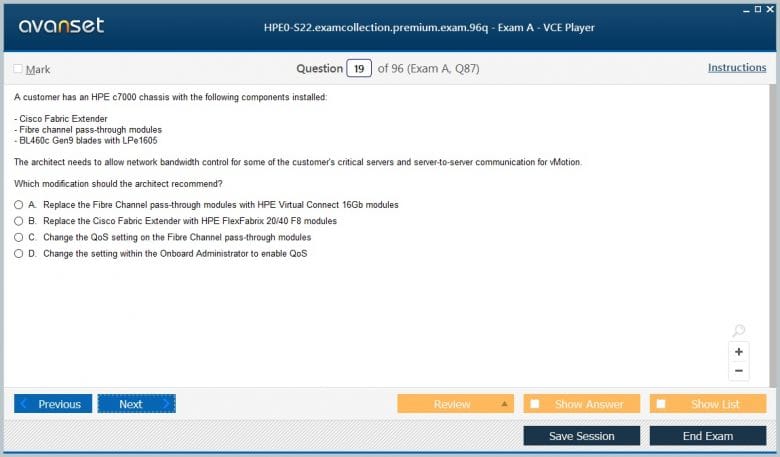
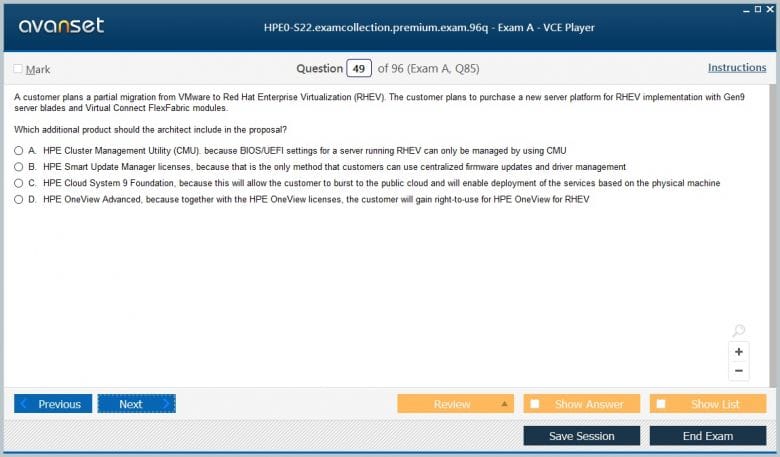
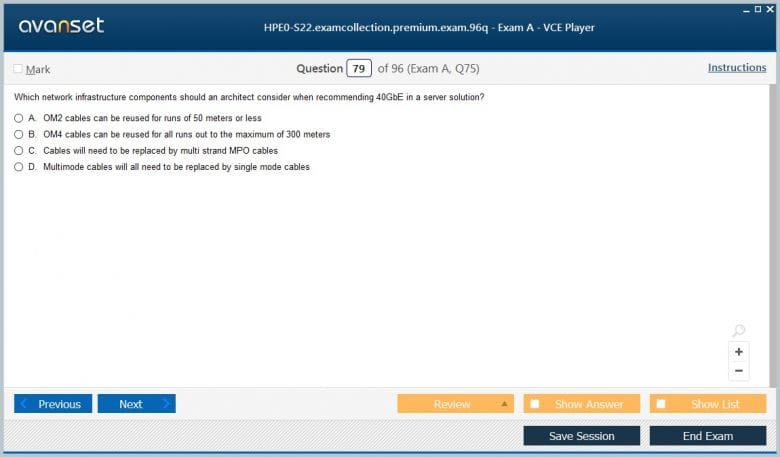
HP HPE0-S22 Exam Screenshots
HP HPE0-S22 Practice Test Questions in VCE Format
| File | Votes | Size | Date |
|---|---|---|---|
File HP.test4prep.HPE0-S22.v2026-10-01.by.stanley.58q.vce |
Votes 1 |
Size 730.6 KB |
Date Oct 01, 2026 |
File HP.Examskey.HPE0-S22.v2019-01-14.by.Andres.51q.vce |
Votes 4 |
Size 816.98 KB |
Date Jan 20, 2019 |
File HP.Selftestengine.HPE0-S22.v2017-05-24.by.Alex.31q.vce |
Votes 9 |
Size 629.95 KB |
Date May 25, 2017 |
HP HPE0-S22 Practice Test Questions, Exam Dumps
HP HPE0-S22 (Architecting Advanced HPE Server Solutions) exam dumps vce, practice test questions, study guide & video training course to study and pass quickly and easily. HP HPE0-S22 Architecting Advanced HPE Server Solutions exam dumps & practice test questions and answers. You need avanset vce exam simulator in order to study the HP HPE0-S22 certification exam dumps & HP HPE0-S22 practice test questions in vce format.
HPE0-S22, Architecting Advanced HPE Server Solutions, is an inactive Hewlett Packard Enterprise exam. HPE’s current certification data labels the code inactive and associates it with the earlier HPE Master ASE Advanced Server Solutions Architect V3 pathway. The exam therefore belongs in a legacy context rather than being presented as a current objective in 2026.
The technical subject remains valuable because advanced server architecture still requires workload analysis, compute sizing, memory design, local storage, networking, management, resiliency, facilities planning, virtualization, and lifecycle operations. What changed is the HPE product portfolio and certification structure used to validate those skills.
Current HPE compute certification has moved through several revisions, and even HPE0-S59 Compute Solutions reached an inactive date in September 2026 as the modular structure evolved. That rapid movement is exactly why old server exam content needs explicit dates and careful separation between durable architecture principles and retired exam requirements.
Server design should start with what the application needs: CPU characteristics, memory footprint, storage behavior, GPU or accelerator requirements, network throughput, latency sensitivity, availability, licensing constraints, and growth. A standard server configuration may be efficient operationally, but it should not override a workload requirement that materially changes the architecture.
CPU sizing is not simply a core count exercise. Frequency, core density, NUMA behavior, virtualization overhead, software licensing, and application parallelism can all influence the right choice. More cores can increase licensing cost or reduce per-core performance for some workloads, while too few can create contention.
Memory design has similar tradeoffs. Capacity, speed, channel population, persistent or specialized memory technologies, and workload locality affect performance. Architects should understand how the platform populates memory and what configuration choices change effective bandwidth or resilience.
Redundant power supplies do not create an available service if both feed the same power source. Dual network adapters do not provide resilience if both connect to one switch. Clustered hosts do not protect an application if they share a single storage or management failure point. Advanced architecture is about tracing dependencies through the entire stack.
Failure domains should be explicit: component, chassis, rack, power feed, network fabric, management plane, storage system, site, and region where appropriate. The design can then assign controls to the failures that matter most rather than adding redundancy blindly.
Operational procedures are part of resilience. Maintenance, firmware updates, spare strategy, monitoring, and tested failover can determine whether redundant hardware actually reduces downtime. A system that cannot be maintained safely will eventually turn planned work into an incident.
HPE server environments have long depended on centralized management for inventory, firmware, profiles, monitoring, and automation. OneView and related management concepts were important in the era of HPE0-S22 and remain relevant to understanding how infrastructure is standardized at scale.
The approved HPE OneView exam destination reflects that continuing management role. Server architects should understand how profiles, templates, firmware baselines, network definitions, and centralized visibility reduce configuration drift and accelerate deployment.
Management resilience also deserves design attention. If administrators cannot reach the control plane during an outage, recovery becomes harder. Networks, credentials, backups, and access paths for management should be planned as deliberately as production traffic.
The HPE0-S22 era overlapped with a strong HPE emphasis on composable infrastructure, especially Synergy. The architectural idea was to treat compute, storage connectivity, and fabric resources as pools that could be defined through software and profiles rather than configured individually for every server.
That model improved repeatability but increased the importance of template and automation quality. A mistake in a reusable profile can be propagated widely. Architects therefore need governance around templates, versioning, validation, and change control.
Legacy material on composable infrastructure can still teach infrastructure-as-code thinking, but candidates should not assume every historical Synergy component or workflow is central to current HPE certification. The current portfolio has expanded into private cloud, AI, edge-to-cloud, and software-defined operations.
Advanced compute design includes rack units, power draw, cooling, cable density, floor capacity, and service access. High-density servers or GPU systems can create thermal and power requirements that invalidate a design even when the logical configuration is perfect.
Power redundancy should be checked against the facility. Two power supplies need independent feeds if the goal is to survive a feed failure. Rack placement should consider weight and cooling. Network and storage cables should preserve path diversity and serviceability rather than forming a tangled single failure domain.
Current high-density and AI infrastructure makes these considerations even more important. The exact products have changed since HPE0-S22, but the architecture discipline has become more—not less—relevant.
Virtualized environments pool server resources, so architecture should consider consolidation ratio, workload peaks, host failure capacity, live migration, storage and network oversubscription, and hypervisor support. Average utilization is not enough if a host failure forces many workloads onto fewer servers.
Hybrid-cloud and private-cloud models add orchestration and service layers. The current HPE0-V27 Edge-to-Cloud Solutions exam shows how HPE architecture has broadened beyond server hardware to complete solutions spanning GreenLake, compute, storage, networking, and different hosting locations.
This evolution helps interpret HPE0-S22 correctly. Its advanced server architecture principles remain useful, but modern design decisions occur inside a larger cloud and automation context.
The approved HPE ASE Compute Solutions destination represents a more recent certification family, while HPE’s current portal now describes modular compute architect and integrator structures. Requirements can change quickly, so candidates should verify the active exam set rather than assuming S22 or S59 remains schedulable.
The legacy HPE0-S54 Designing HPE Server Solutions exam belongs to the same historical server-design lineage at a lower level. Studying S54 and S22 together can show the progression from solution design to advanced architecture, but both should be labeled inactive.
The old ExamCollection post on HP ATP Server Solutions is useful only as historical program context. It demonstrates how HPE’s server credentials evolved, not what a 2026 candidate should schedule.
Sort old HPE0-S22 content into durable and obsolete categories. Workload analysis, failure domains, capacity, facilities, management, lifecycle planning, virtualization, and change control remain durable. Exact product generations, model numbers, old certification prerequisites, and deprecated tools require verification or removal.
Practice with architecture scenarios rather than memorizing old exam answers. Given a workload and constraints, explain how you would design compute, memory, network, management, storage connectivity, resiliency, and operations. Then identify which assumptions depend on current HPE products and documentation.
HPE0-S22 is best understood as a historical advanced-server benchmark. It should not be marketed as a current exam, but its architecture mindset remains relevant to anyone designing complex HPE compute environments today.
Security architecture deserves its own place in advanced compute design. Firmware trust, secure boot, management-plane protection, privileged access, network segmentation, encryption, and supply-chain controls can affect both platform selection and operational procedures. An advanced architect should understand how these controls interact with automation and remote management rather than treating security as a checklist applied after sizing.
Capacity modeling should include degraded states. A cluster sized to 90 percent utilization during normal operation may have no room to absorb workloads when one host is down for maintenance. N+1 or N+2 design is not a slogan; it requires calculating whether the surviving nodes can still meet CPU, memory, network, and accelerator demand.
Performance troubleshooting can also influence architecture. If historical telemetry shows memory pressure, storage latency, or network saturation, adding more CPU may not improve the service. Architects should use measured bottlenecks to shape the next design and avoid reproducing the same constraint on newer hardware.
Automation changes operational risk. Standardized profiles, scripts, and templates can make deployments faster and more consistent, but they can also propagate an error across many systems. Advanced design therefore includes testing, version control, staged rollout, and clear rollback procedures for reusable infrastructure definitions.
Documentation should connect the physical and logical architecture. Rack and power diagrams, network connections, management endpoints, profile definitions, cluster membership, storage paths, and recovery procedures give operations teams a coherent model of the environment. Without that model, even a well-designed platform becomes difficult to maintain safely.
Architecture should also account for licensing and support economics. Processor selection, virtualization density, accelerator choices, and socket counts can materially affect software cost. A technically elegant platform may be economically poor if it increases per-core licensing or requires specialized support that the customer did not plan for.
Growth planning needs more than spare rack units. Future servers may require higher power density, faster fabrics, different cooling, larger management domains, or new security controls. Advanced architects should reserve flexibility in the surrounding infrastructure rather than assuming that expansion means repeating the same node indefinitely.
Disaster recovery creates another layer of dependency. Compute recovery may require replicated storage, network reconfiguration, identity services, application orchestration, and capacity at a second location. A server architecture that is highly available inside one site can still fail the business requirement if site-level recovery is undefined.
Operational ownership should be explicit as well. Hardware teams, virtualization teams, network engineers, application owners, and security staff may all control part of the service. The design should identify handoff points and monitoring responsibilities so incidents do not stall between teams.
The current advanced architecture role is represented more directly by HPE7-S01 Advanced HPE Compute Architect, which HPE positions around complex compute designs, automation, orchestration, resiliency, performance, and manageability. It is not a one-for-one replacement for HPE0-S22, but it is a more appropriate current reference for professionals pursuing advanced compute architecture.
Go to testing centre with ease on our mind when you use HP HPE0-S22 vce exam dumps, practice test questions and answers. HP HPE0-S22 Architecting Advanced HPE Server Solutions certification practice test questions and answers, study guide, exam dumps and video training course in vce format to help you study with ease. Prepare with confidence and study using HP HPE0-S22 exam dumps & practice test questions and answers vce from ExamCollection.
Purchase Individually
Top HP Certifications


Top HP Certification Exams
Site Search:

SPECIAL OFFER: GET 10% OFF

Pass your Exam with ExamCollection's PREMIUM files!
SPECIAL OFFER: GET 10% OFF
Use Discount Code:
MIN10OFF
A confirmation link was sent to your e-mail.
Please check your mailbox for a message from support@examcollection.com and follow the directions.

Download Free Demo of VCE Exam Simulator
Experience Avanset VCE Exam Simulator for yourself.
Simply submit your e-mail address below to get started with our interactive software demo of your free trial.