



Premium File
84 Q&A
$76.99$69.99
HP HPE6-A68 Exam Questions & Answers, Accurate & Verified By IT Experts
Instant Download, Free Fast Updates, 99.6% Pass Rate
84 Questions & Answers
Last Update: Oct 26, 2026
$69.99
HP HPE6-A68 Exam Screenshots
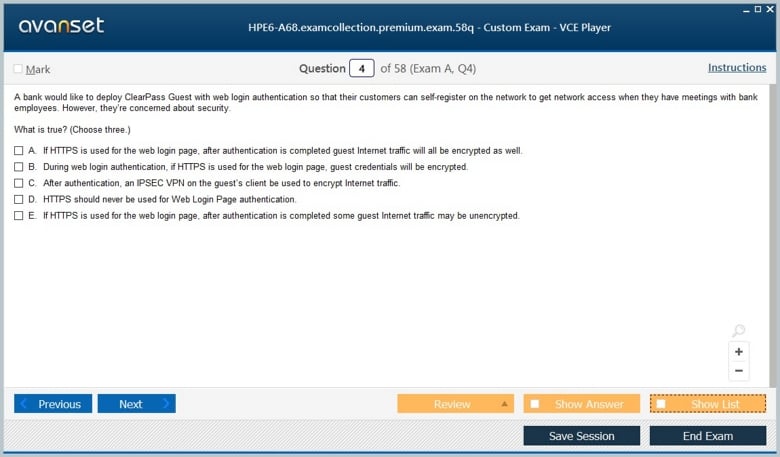
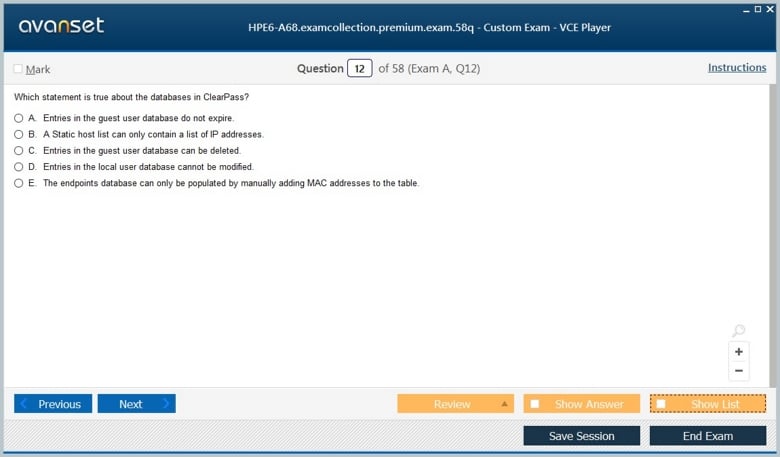
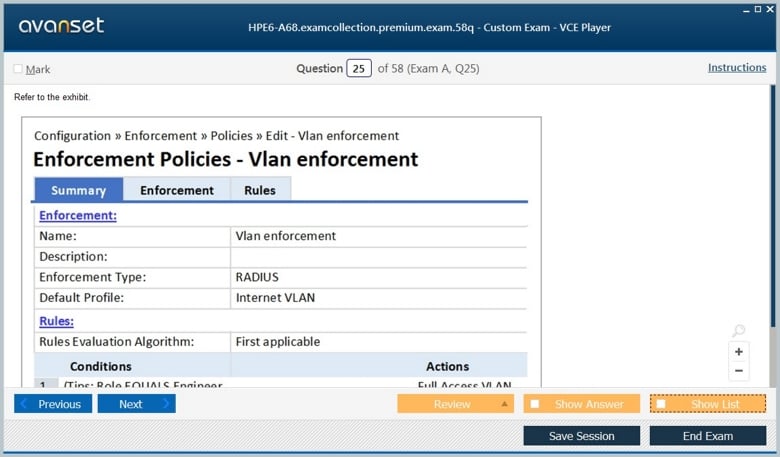
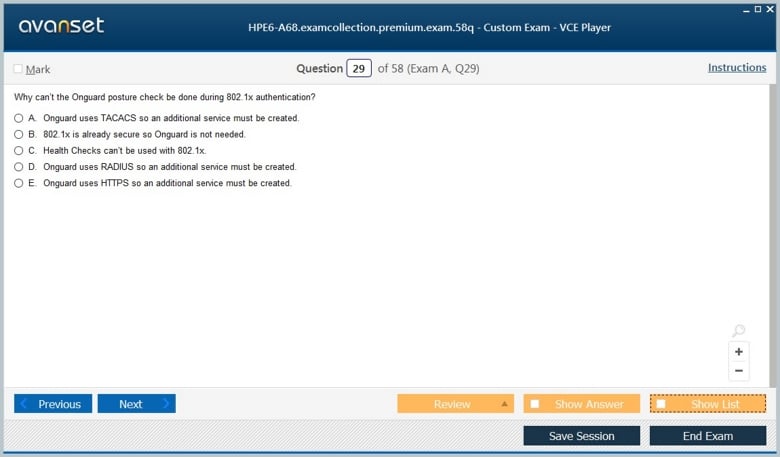
HP HPE6-A68 Practice Test Questions in VCE Format
| File | Votes | Size | Date |
|---|---|---|---|
File HP.examlabs.HPE6-A68.v2026-08-20.by.iwei.34q.vce |
Votes 1 |
Size 3.37 MB |
Date Aug 20, 2026 |
File HP.Braindumps.HPE6-A68.v2019-12-16.by.Andrew.26q.vce |
Votes 2 |
Size 3.19 MB |
Date Dec 18, 2019 |
HP HPE6-A68 Practice Test Questions, Exam Dumps
HP HPE6-A68 (Aruba Certified ClearPass Professional (ACCP) V6.7) exam dumps vce, practice test questions, study guide & video training course to study and pass quickly and easily. HP HPE6-A68 Aruba Certified ClearPass Professional (ACCP) V6.7 exam dumps & practice test questions and answers. You need avanset vce exam simulator in order to study the HP HPE6-A68 certification exam dumps & HP HPE6-A68 practice test questions in vce format.
HPE6-A68 Aruba Certified ClearPass Professional belongs to the retired ACCP certification generation. HPE’s current certification records mark the old Aruba Certified ClearPass Professional credential as inactive. The underlying technology, however, remains important: HPE now offers the active HPE Networking ClearPass exam, which validates foundational network-access-control skills across Policy Manager, Guest, OnGuard, Onboard, Active Directory integration, monitoring, and deployment practice.
That transition is useful because ClearPass is not just an old exam topic. It remains part of HPE Aruba Networking’s identity and policy architecture. What changed is the certification structure and product generation, so historical A68 material should be used for durable concepts while current HPE6-A88 objectives govern present-day preparation.
The central idea is policy based on context. ClearPass collects identity and device information, evaluates rules, and returns an enforcement result that the network can apply. Candidates who understand that flow can reason through many scenarios without relying on memorized screen sequences.
Authentication answers who or what is connecting. Authorization determines what that identity is allowed to do. Accounting records relevant activity. ClearPass participates in these functions by integrating with network access devices, directories, certificates, databases, and other identity sources.
A candidate should understand common exchanges such as RADIUS authentication and the role of the network device as an enforcement point. When authentication fails, troubleshooting should examine the full path: client behavior, network device configuration, ClearPass service selection, identity source, certificate trust where applicable, and the final enforcement response.
Good policy design keeps authentication method separate from business access where possible. Two users might authenticate differently but still receive the same role, or the same user might receive different access depending on device posture and location. That flexibility is one reason context-aware policy can scale better than static per-port configuration.
Role mapping lets ClearPass take attributes—group membership, device type, authentication method, endpoint category, location, or other context—and assign a role that is meaningful to policy. The role becomes an abstraction between raw identity data and the enforcement action.
This is important for maintainability. If every enforcement rule directly checks dozens of directory groups and endpoint attributes, policy becomes difficult to review. A well-designed role model expresses intent: employee, contractor, managed device, guest, IoT sensor, administrator, or another meaningful category.
Roles should be specific enough to support least privilege but not so granular that operations become unmanageable. A good study exercise is to take a large rule set and ask which conditions describe identity, which describe context, and which should be converted into reusable roles.
After ClearPass determines context and role, enforcement policy decides what result to return. Depending on the environment, that may include VLAN assignment, downloadable roles, access-control attributes, session limits, posture actions, or other instructions consumed by the access device.
Candidates need to understand both policy logic and device support. A perfectly written enforcement profile is useless if the network device does not understand the attribute or is not configured to apply it. Troubleshooting therefore requires checking the response sent by ClearPass and the behavior of the switch, gateway, controller, or access point that receives it.
The current HPE Network Security Professional exam extends this policy model into broader Zero Trust and network-security implementation, including ClearPass, role mapping, enforcement, and contextual visibility.
Guest networking involves identity, sponsorship, acceptable-use policy, credential lifecycle, captive portal behavior, segmentation, and expiration. A guest service should be easy enough for legitimate visitors to use while preventing unmanaged access from quietly becoming permanent.
Designers should decide who can create or approve guest accounts, how long credentials remain valid, what information is collected, which resources guests can reach, and how the workflow behaves when external services such as SMS or email are unavailable. These are operational and policy questions, not just portal customization.
ClearPass Guest is powerful because it connects that workflow to the same policy engine used for other identities. The candidate should be able to trace a visitor from onboarding through authentication and final network enforcement.
Identity alone does not describe device risk. A valid employee account may be connecting from an endpoint that is missing required controls or has an unhealthy posture. OnGuard allows policy to consider endpoint health information and trigger remediation or restricted access according to organizational requirements.
Posture design needs clear expectations. Which checks are required? Which platforms are supported? What happens when a device is noncompliant? Can the user remediate without help-desk intervention? Are exceptions logged and time-limited? Aggressive posture rules without a workable remediation path can create more operational friction than security value.
Candidates should also recognize that posture is one signal. It can complement identity, profiling, certificates, and device management information rather than replacing them.
Certificate-based authentication can reduce reliance on passwords and provide stronger device identity, but the onboarding process must handle enrollment, trust, renewal, revocation, and user experience. ClearPass Onboard helps organizations provision credentials and profiles so devices can use certificate-based access.
For policy design, the value is that a certificate can represent a managed relationship between the organization and the device. That can support more reliable authorization than simply recognizing a MAC address. It also creates lifecycle responsibilities: certificates expire, devices are replaced, users leave, and compromised credentials may need revocation.
Study certificate scenarios by following the chain of trust. Identify the issuing authority, client certificate, server certificate, supplicant behavior, validation rules, and failure symptoms. Certificate problems often look like generic authentication failures until the trust relationship is examined directly.
Many IoT, printer, voice, medical, and building systems do not support the same authentication methods as laptops and phones. Profiling uses observed attributes to help classify those endpoints and apply an appropriate policy. This is useful, but classification confidence matters.
Profiles can be built from DHCP information, MAC characteristics, traffic behavior, and other observable signals. Administrators should understand that these signals can be incomplete or spoofed, so a profile should not automatically be treated as a cryptographic identity. It is one piece of context.
The current HPE Network Security Expert scope extends this idea into enterprise endpoint classification, Device Insight, role-based architecture, and advanced security design. That makes A68’s profiling concepts part of a larger modern Zero Trust story.
Production ClearPass deployments need resilient policy services. Candidates should understand publisher and subscriber roles, replication, service distribution, and what happens when a node or dependency becomes unavailable. High availability is not just installing multiple nodes; network devices must be configured to use them appropriately and external identity services must also be reachable.
Troubleshooting should start with evidence. Access Tracker, authentication logs, service selection, role mapping, enforcement results, certificate messages, and network-device logs can show where the workflow diverged from expectation. Guessing and changing several policy layers at once makes the system harder to diagnose.
The best habit is to trace one request end to end. Identify the client, access device, authentication method, service, identity source, roles, enforcement profile, response, and final network behavior. That method works across both legacy and current ClearPass generations.
The HPE Aruba Networking exam inventory contains current ClearPass and network-security destinations alongside older Aruba codes. Anyone studying A68 should avoid using old licensing, interface, or version details as current facts, but should preserve the logic of identity, context, role mapping, enforcement, onboarding, posture, profiling, and resilient operation.
Current HPE6-A88 material is the appropriate source for today’s ClearPass exam. HPE7-A02 and HPE7-A10 show how the same policy concepts fit into broader network-security implementation and architecture. Together they provide a clearer modern progression than treating the retired ACCP code as if it still represented the active program.
The durable lesson is that network access control is a decision system. ClearPass becomes easier to understand when every feature is connected to the same question: what do we know about this connection, what policy should apply, how is that decision enforced, and how can we prove what happened?
Policy change control is equally important. A small condition added to a role-mapping or enforcement rule can affect thousands of sessions if it is evaluated earlier than expected. Administrators should test representative identities and devices, understand rule order, record the intended outcome, and have a safe way to reverse changes.
Reporting can support that discipline. Authentication trends, failed services, endpoint categories, guest activity, posture results, and policy outcomes can reveal both technical problems and unexpected usage. Metrics are most valuable when they answer operational questions rather than simply filling dashboards.
ClearPass policy work also depends on careful treatment of identity evidence. Different authentication methods expose different attributes and assurance levels, and authorization decisions should not assume that every identity source is equally trustworthy. Engineers need to understand where role, device, posture, certificate, directory, guest, and endpoint context originates and how stale or conflicting information can affect enforcement. Good policy design makes those dependencies visible instead of burying them in a long rule set.
For migration from the A68 era, validation should include more than whether a user receives network access. Test expected roles, VLAN or downloadable policy outcomes, guest workflows, profiling behavior, certificate trust, failure handling, logging, and administrative access. A staged policy migration with representative users and devices is safer than importing historical logic wholesale. That approach preserves the useful ClearPass reasoning from the retired exam while adapting it to current software, current network infrastructure, and the organization’s present security model.
Go to testing centre with ease on our mind when you use HP HPE6-A68 vce exam dumps, practice test questions and answers. HP HPE6-A68 Aruba Certified ClearPass Professional (ACCP) V6.7 certification practice test questions and answers, study guide, exam dumps and video training course in vce format to help you study with ease. Prepare with confidence and study using HP HPE6-A68 exam dumps & practice test questions and answers vce from ExamCollection.
Purchase Individually
Top HP Certifications


Top HP Certification Exams
Site Search:

SPECIAL OFFER: GET 10% OFF

Pass your Exam with ExamCollection's PREMIUM files!
SPECIAL OFFER: GET 10% OFF
Use Discount Code:
MIN10OFF
A confirmation link was sent to your e-mail.
Please check your mailbox for a message from support@examcollection.com and follow the directions.

Download Free Demo of VCE Exam Simulator
Experience Avanset VCE Exam Simulator for yourself.
Simply submit your e-mail address below to get started with our interactive software demo of your free trial.