



Premium File
109 Q&A
$76.99$69.99
HP HPE0-S54 Exam Questions & Answers, Accurate & Verified By IT Experts
Instant Download, Free Fast Updates, 99.6% Pass Rate

HPE0-S54 Premium File: 109 Questions & Answers
Last Update: Sep 27, 2026
HPE0-S54 PDF Study Guide: 864 Pages
$74.99
HP HPE0-S54 Exam Screenshots
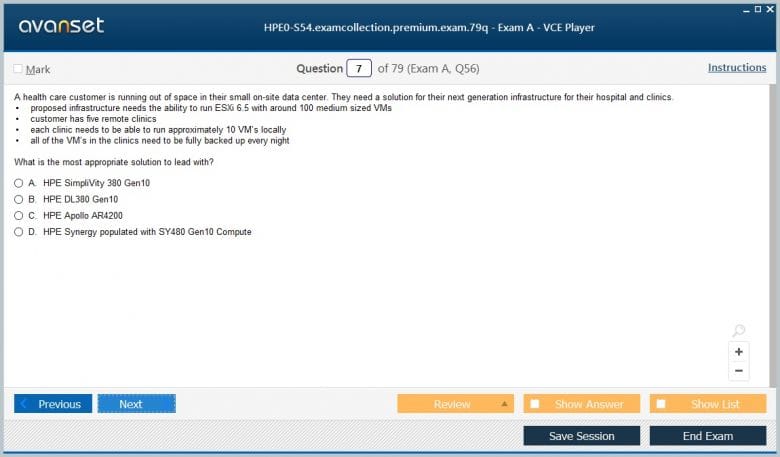
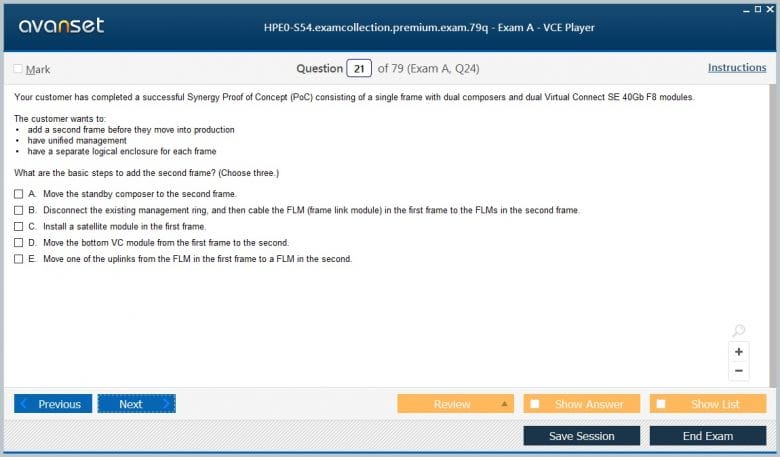
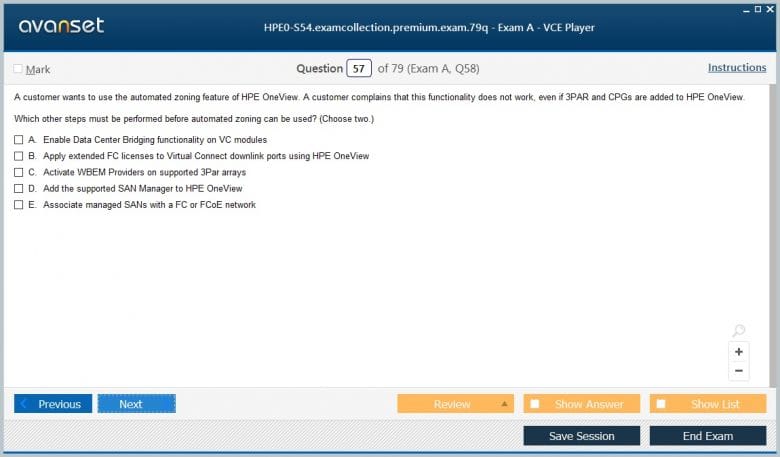
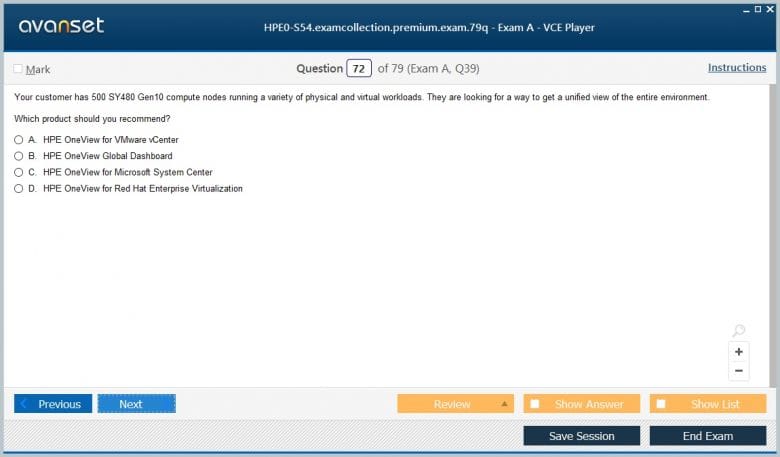
HP HPE0-S54 Practice Test Questions in VCE Format
| File | Votes | Size | Date |
|---|---|---|---|
File HP.practicetest.HPE0-S54.v2026-08-31.by.ethan.65q.vce |
Votes 1 |
Size 84.08 KB |
Date Aug 31, 2026 |
File HP.Pass4sure.HPE0-S54.v2019-09-21.by.Nick.53q.vce |
Votes 5 |
Size 144.46 KB |
Date Sep 24, 2019 |
HP HPE0-S54 Practice Test Questions, Exam Dumps
HP HPE0-S54 (Designing HPE Server Solutions) exam dumps vce, practice test questions, study guide & video training course to study and pass quickly and easily. HP HPE0-S54 Designing HPE Server Solutions exam dumps & practice test questions and answers. You need avanset vce exam simulator in order to study the HP HPE0-S54 certification exam dumps & HP HPE0-S54 practice test questions in vce format.
HPE0-S54, Designing HPE Server Solutions, is an inactive Hewlett Packard Enterprise exam from the HPE ASE Server Solutions Architect V4 period. HPE’s current certification data explicitly marks HPE0-S54 inactive. The code should therefore be treated as legacy content, even though server-design topics from the exam remain relevant to modern infrastructure work.
The historical role sat between foundational server knowledge and advanced architecture. Candidates were expected to interpret customer requirements, select server platforms and options, account for management and networking, design resilient solutions, and consider lifecycle operations. That type of solution design still exists, but the HPE certification portfolio has moved into newer compute, hybrid-cloud, and edge-to-cloud structures.
The broader HPE inventory contains both legacy and newer codes, so chronology matters. HPE0-S54 should not be confused with the later HPE0-S59 Compute Solutions exam, which itself reached an inactive date in September 2026 as HPE continued revising the compute program.
A design is only as good as the requirements collected. Server architects need workload type, user or transaction scale, CPU demand, memory footprint, local-storage needs, network traffic, availability targets, backup expectations, security constraints, virtualization strategy, growth, facilities limits, budget, and lifecycle plans.
Discovery should also expose operational preferences. Some customers prioritize standardized server models and simple support; others need specialized GPU, large-memory, or mission-critical configurations. Management tools, automation skills, and staffing influence which design will be supportable after installation.
Requirements should be ranked. “Maximum performance,” “lowest cost,” and “highest availability” can conflict. The architect should identify mandatory constraints and document assumptions so later changes can be evaluated against the original design.
Processors should be selected based on application behavior, not a generic “more cores is better” rule. Core count, clock speed, cache, NUMA layout, accelerator support, licensing, and virtualization can all change the best configuration. Some software is licensed per core, making dense CPUs financially inefficient even when they increase theoretical throughput.
Memory capacity and bandwidth often determine virtualization and database density. Architects should understand population rules, channels, speed tradeoffs, and what happens when a configuration crosses NUMA boundaries. An unbalanced memory design can underperform despite having sufficient total capacity.
Local storage can serve boot, caching, databases, hyperconverged software, or temporary high-performance workloads. Drive type, RAID, controller capabilities, endurance, and replaceability should match the use case rather than be chosen only on capacity.
Server solutions depend on network interfaces, switch fabrics, storage protocols, and path redundancy. Architects should identify required bandwidth, segmentation, virtualization, management networks, storage traffic, and failure-domain separation. A server with multiple adapters can still have a single point of failure if they converge on one upstream device.
Storage connectivity may include Fibre Channel, Ethernet-based block access, local drives, or software-defined storage. The design should reflect application requirements and the customer’s operational standards. Interoperability matters as much as raw performance.
Documenting port use and network intent reduces deployment errors. A diagram should make it clear which connections carry management, production, storage, migration, backup, or cluster traffic and which paths are expected to survive a failure.
HPE server architecture has long used centralized management to standardize firmware, profiles, templates, inventory, and monitoring. The approved HPE OneView destination represents the continuing importance of infrastructure management even as server exam codes change.
Templates and profiles create repeatability. They also create blast radius: an error in a shared definition can affect many systems. Architects should therefore design governance around versioning, testing, approvals, and rollback.
Out-of-band management is another key dependency. Remote console, power control, firmware access, and hardware health can be essential during incidents. The management network should be secured and resilient enough to remain useful when production services fail.
Server redundancy includes power, fans, memory protection, storage, network paths, and sometimes multiple compute nodes. But application availability depends on more than hardware. Clustering, virtualization, load balancing, database replication, and recovery procedures may be needed to meet the service objective.
Failure domains should be traced explicitly. Two hosts in one rack may not protect against rack power failure. Two racks in one facility may not protect against site loss. The design should apply redundancy at the level justified by business impact.
Maintenance is part of availability. If firmware or component replacement cannot be performed without violating the service target, the architecture is incomplete. Capacity during maintenance should be modeled the same way as capacity during an unplanned host failure.
Rack space, weight, power, cooling, acoustic limits, cable paths, and data-center standards can invalidate a server configuration before it is installed. High-density systems make these constraints more visible, but they have always been part of professional solution design.
Lifecycle planning includes firmware, support, monitoring, spares, warranty or service coverage, expansion, refresh, data migration, and decommissioning. Customers should know how the environment will be maintained over several years, not just how it looks on day one.
Energy and cooling efficiency can also affect operating cost and capacity planning. Modern HPE compute increasingly intersects with AI and high-density workloads, making facilities analysis even more significant than during the HPE0-S54 era.
The approved HPE ASE Compute Solutions destination reflects a later phase in which HPE grouped server, management, and related technologies into a broader compute role. HPE’s 2026 learning portal now emphasizes modular compute architect and integrator structures, demonstrating continued evolution beyond the HPE0-S54 path.
At the advanced level, HPE0-S22 Architecting Advanced HPE Server Solutions represents the older Master ASE progression from the same server-focused era. Both S54 and S22 are inactive, so they should be used to understand historical skill progression rather than current exam planning.
The old ExamCollection material on HP ATP Server Solutions can help illustrate how the program developed, but its certification details are historical. Current candidates should always validate active requirements in HPE’s present certification portal.
The current HPE0-V27 Edge-to-Cloud Solutions exam demonstrates the broader direction of HPE architecture. It combines GreenLake, storage, compute, networking, consumption models, and hosting locations. A modern architect still needs server expertise but must place it inside a complete service design.
This broader context changes how old S54 material should be reused. Processor, memory, network, management, resilience, and facilities concepts remain relevant. Historical product positioning or assumptions that the solution ends at the server boundary do not.
Hybrid cloud also adds questions about where workloads should run, how they are managed consistently, and how on-premises infrastructure connects to cloud services. These are natural extensions of the same requirement-analysis discipline S54 expected.
When reviewing old HPE0-S54 questions, identify the design principle behind the answer. Was the scenario testing resilience, workload sizing, management, network redundancy, facilities, or lifecycle support? Keep that principle, then check whether the product-specific implementation remains current.
Create modern equivalents of old scenarios. Replace retired server models with current categories, update management assumptions, and ask how GreenLake or hybrid-cloud requirements would change the design. This preserves educational value without pretending the old exam is still active.
HPE0-S54 is best treated as a historical server-architecture reference. It should clearly be labeled inactive, while its durable lessons—requirements first, end-to-end resilience, standardized management, and lifecycle-aware design—remain useful for current HPE compute professionals.
Security considerations should be included during solution design. Management interfaces, firmware integrity, administrator roles, secure boot, encryption capabilities, and network segmentation influence both risk and operational complexity. A server architecture can meet performance goals and still be unacceptable if privileged access or management traffic is poorly controlled.
Standardization is valuable, but architects should know when exceptions are justified. A common server model reduces spares and support complexity, yet specialized workloads may require different accelerators, memory density, local storage, or network interfaces. The design should document why an exception exists so it does not become accidental sprawl.
Capacity planning should include maintenance and failure. If a virtualized cluster is sized only for normal average load, losing one host can overload the survivors. CPU, memory, network, and storage dependencies all need enough headroom to preserve service during planned and unplanned reductions in capacity.
Acceptance testing should prove the design assumptions. Verify redundant power and network paths, management access, firmware baselines, profile application, host visibility, failover behavior, monitoring, and the customer’s workload requirements. A paper architecture becomes a production solution only after those expectations are demonstrated.
Interoperability checks are essential before procurement. Server firmware, operating systems, hypervisors, adapters, switches, storage, and management software all need supported combinations. A design that looks correct at component level can still fail if the versions do not coexist in a validated stack.
Architects should also consider the operational cost of diversity. Too many server models, firmware branches, adapter types, or management exceptions increase testing and support effort. Standardization can improve reliability by making patching, spares, documentation, and automation more predictable.
Finally, design documents should include assumptions and decision rationale. When a future team asks why a particular processor, memory layout, network topology, or management model was chosen, the answer should be recoverable from the design. That context helps later architects decide whether a change is safe or whether it invalidates an original requirement.
Modern progression also separates advanced architecture from integration. The approved HPE7-S01 Advanced HPE Compute Architect destination represents today’s higher-level design role, while current modular paths increasingly combine written exams with practical validation.
Go to testing centre with ease on our mind when you use HP HPE0-S54 vce exam dumps, practice test questions and answers. HP HPE0-S54 Designing HPE Server Solutions certification practice test questions and answers, study guide, exam dumps and video training course in vce format to help you study with ease. Prepare with confidence and study using HP HPE0-S54 exam dumps & practice test questions and answers vce from ExamCollection.
Purchase Individually

Top HP Certifications


Top HP Certification Exams
Site Search:

SPECIAL OFFER: GET 10% OFF

Pass your Exam with ExamCollection's PREMIUM files!
SPECIAL OFFER: GET 10% OFF
Use Discount Code:
MIN10OFF
A confirmation link was sent to your e-mail.
Please check your mailbox for a message from support@examcollection.com and follow the directions.

Download Free Demo of VCE Exam Simulator
Experience Avanset VCE Exam Simulator for yourself.
Simply submit your e-mail address below to get started with our interactive software demo of your free trial.