



Premium File
60 Q&A
$76.99$69.99
Huawei H31-523 Exam Questions & Answers, Accurate & Verified By IT Experts
Instant Download, Free Fast Updates, 99.6% Pass Rate
60 Questions & Answers
Last Update: Sep 14, 2026
$69.99
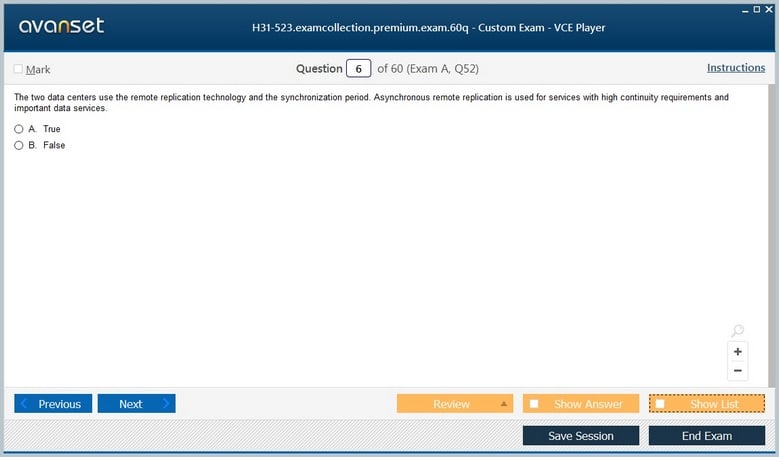
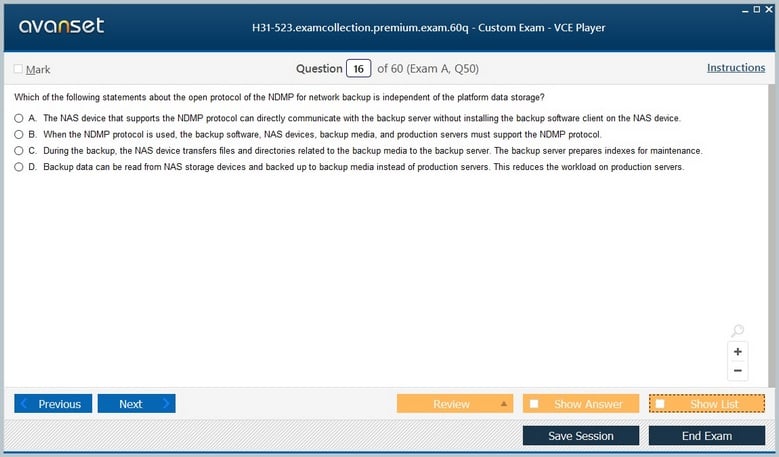
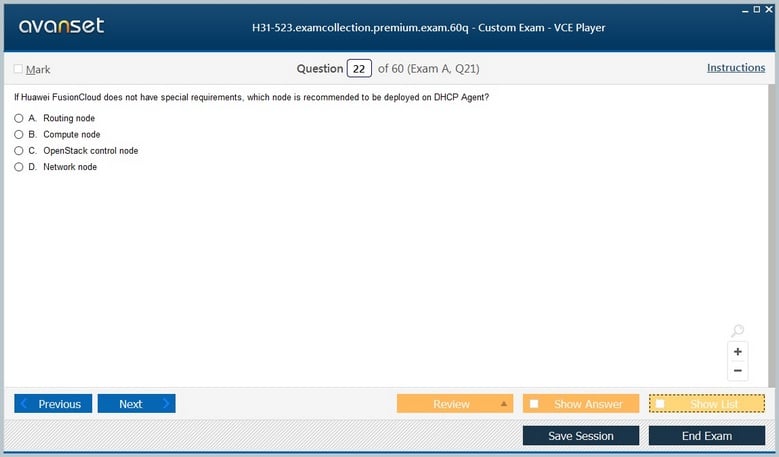
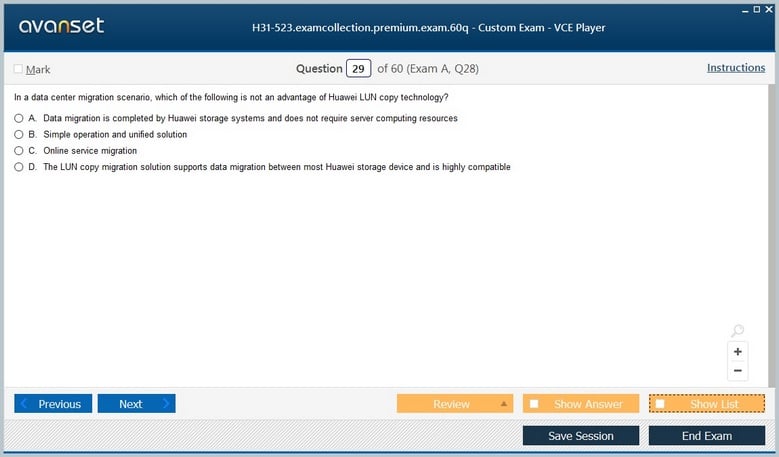
Huawei H31-523 Exam Screenshots
Huawei H31-523 Practice Test Questions in VCE Format
| File | Votes | Size | Date |
|---|---|---|---|
File Huawei.Test-king.H31-523.v2026-09-21.by.Larry.25q.vce |
Votes 3 |
Size 31.03 KB |
Date Sep 21, 2026 |
Huawei H31-523 Practice Test Questions, Exam Dumps
Huawei H31-523 (HCIP-Cloud Computing-CDSM) exam dumps vce, practice test questions, study guide & video training course to study and pass quickly and easily. Huawei H31-523 HCIP-Cloud Computing-CDSM exam dumps & practice test questions and answers. You need avanset vce exam simulator in order to study the Huawei H31-523 certification exam dumps & Huawei H31-523 practice test questions in vce format.
H31-523 is a legacy Huawei cloud/data-center operations exam that appears under inconsistent historical labels across old catalogs, including HCIP-Cloud Computing-CDSM and HCIE/HCSE Cloud Data Center Operations written naming. That inconsistency is itself a reason to treat the page carefully. It should preserve the operational knowledge associated with the code without asserting that the old designation remains a current Huawei certification in 2026.
The durable theme is operating a cloud data center as a system. Compute virtualization, distributed storage, virtual networking, resource pools, management platforms, backup, monitoring, capacity, change control, and troubleshooting all meet in daily operations. The useful study question is always “what service is affected, which layer owns the symptom, and what evidence proves the cause?”
Cloud operations abstracts applications away from individual machines, but the physical infrastructure still exists underneath. A virtual machine depends on compute capacity, storage, networking, hypervisor health, management services, and often shared authentication or orchestration. When an incident occurs, the operator must map the affected service back through those dependencies instead of assuming the visible virtual layer is the root cause.
Build a dependency diagram for one virtual workload: tenant or project, VM, virtual NIC, virtual network, host, storage volume, management plane, and upstream network. Mark which components are redundant and which are shared by many workloads. This immediately shows where a small infrastructure fault can have a large blast radius.
Clustering and live migration can reduce dependence on one server, yet they also create new shared services such as control clusters, storage fabrics, and management databases. A professional operator should distinguish host failure, hypervisor failure, guest operating-system failure, application failure, and control-plane failure because the recovery action is different for each.
Virtualization study offers broader context on the skills involved. For H31-523, focus less on one vendor interface and more on workload mobility, resource contention, availability, and how operators prove which layer is unhealthy.
Cloud platforms often distribute data across multiple disks or nodes so services can survive individual failures. That protection has capacity cost, rebuild behavior, and performance consequences. Operators should know what happens when a disk or node is lost, how data is reconstructed, and when the system has returned to a protected state rather than merely a running state.
Capacity planning should separate raw, usable, allocated, and consumed space. Snapshots, replicas, thin provisioning, metadata, and reserve can make those numbers diverge. A cloud environment can experience service risk even when a storage dashboard still shows nominal free capacity if one pool or performance tier is constrained.
Overlay networks, virtual switches, security policies, address management, and gateways create logical connectivity that may not be visible from the physical cabling. Troubleshooting therefore needs both views. Verify virtual port state and policy, then trace the underlay path that carries the encapsulated traffic. A healthy physical link does not prove that the tenant network is configured correctly.
Virtual network architecture provides a useful cross-platform analogy. The provider-specific objects differ, but segmentation, routing, address planning, gateways, and fault isolation remain fundamental cloud-networking skills.
Operators can lose visibility or orchestration while workloads continue running. That creates a dangerous state: the service may appear healthy to users, but the team cannot safely change, recover, or scale it. Monitor management databases, controller services, authentication, time synchronization, messaging, and API reachability separately from tenant workload health.
Create response playbooks for partial control-plane failure. Define what changes should be frozen, what evidence can still be collected, how administrators regain safe access, and how consistency is verified after recovery. Control-plane incidents require restraint because repeated retries or ad hoc changes can make state divergence worse.
A successful backup job is not the same as a successful recovery. Cloud workloads may depend on several volumes, databases, network settings, secrets, and external services. Recovery planning must define consistency, restore order, target location, RPO, RTO, and validation. The only reliable proof is a tested restoration that produces a usable service.
The comparison of backup and disaster-recovery models is useful for structuring these choices. Apply the patterns to cloud operations by identifying what must already exist at the recovery site and what can be rebuilt after an incident.
Average cluster utilization can hide a hotspot. CPU ready time, memory pressure, datastore latency, east-west network congestion, and oversubscribed uplinks can affect a subset of workloads while the overall platform looks comfortable. Operators should monitor at the level where contention actually occurs: host, pool, datastore, virtual network, or shared service.
When performance changes, compare against the normal baseline and recent change history. Ask whether demand increased, placement changed, a protection rebuild is consuming resources, or a failed component reduced available capacity. This keeps troubleshooting evidence-driven and avoids blaming the application by default.
Cloud platforms are highly interconnected, so a seemingly small infrastructure change can affect many workloads. Mature operations define scope, prerequisites, backup, maintenance windows, rollback, validation, and communication before change begins. Automation can reduce manual error, but it can also propagate a bad change quickly if the inputs are wrong.
Infrastructure automation reinforces the value of repeatability. In an operations context, combine repeatable execution with review, version control, staged rollout, and post-change verification rather than treating automation as permission to skip governance.
The strongest reason to preserve this page is that the operational disciplines remain relevant even if the certification label has changed. Dependency mapping, virtualization, distributed storage, virtual networking, backup, observability, capacity management, and controlled change are core cloud data-center skills. Present them as durable knowledge while making the old exam identity explicit.
Placed within the broader Huawei certifications portfolio, candidates should verify the current cloud and data-center pathways separately instead of assuming H31-523 still sits in a modern sequence. The approved URL supports the historical exam page; it does not by itself prove present-day certification status.
Create a capstone incident where several virtual machines become slow after one storage node fails and a rebuild starts. Decide what metrics to check, how to distinguish storage contention from compute or network problems, and what changes are safe while redundancy is reduced. This integrates the most valuable operational ideas on the page.
Finally, keep historical names in a status note rather than forcing one disputed label into every paragraph. Where old sources disagree on whether the code belonged to HCIP, HCSE, or HCIE-era naming, the safest editorial choice is to describe the code as legacy Cloud Data Center Operations and teach the supported technical context.
Patch and upgrade planning should include dependency order. Management controllers, hypervisors, storage nodes, and virtual-network components may have supported-version relationships that limit which component can move first. A cloud operator should capture compatibility before the maintenance window, not discover it during an outage. Staged upgrades with health checks between steps reduce the blast radius of an unexpected defect.
Identity and privilege are also cloud-operations concerns. Administrative roles, service accounts, API credentials, and break-glass access should be separated and logged. A control-plane incident becomes much harder to investigate if many engineers share powerful credentials or automation runs under an unbounded account. Least privilege improves both security and troubleshooting accountability.
Time synchronization deserves attention because distributed platforms rely on consistent timestamps for logs, certificates, cluster behavior, and incident reconstruction. Clock drift can produce misleading event order or authentication problems that appear unrelated to time. Include time-source health in platform baselines and check it early when logs from different components seem contradictory.
Capacity decisions should include failure-state headroom. A cluster that averages 70 percent utilization may have very little room if one host or storage node is removed. Calculate whether remaining resources can absorb the protected workloads during maintenance or failure. This turns capacity planning into availability engineering instead of a simple utilization report.
Operational runbooks should be tested by someone who did not write them. If a recovery procedure depends on undocumented knowledge, hidden credentials, or a sequence that only one engineer understands, the platform is not truly recoverable. Periodic drills expose those gaps and convert individual expertise into organizational capability.
Event timelines are essential in distributed cloud incidents. Collect alerts, orchestration actions, host events, storage events, and administrator changes on one timeline before drawing conclusions. The first visible alarm is not always the initiating event, especially when monitoring intervals differ. Chronology helps distinguish trigger, propagation, and recovery.
Quorum-based services deserve special operational attention. A cluster may remain available after losing one member but become unable to tolerate another failure or make configuration changes safely. Operators should know the minimum healthy state for each control service and avoid maintenance that removes additional members while the cluster is already degraded.
Tenant communication should be proportional to impact and uncertainty. During a shared-platform incident, state which services are affected, whether data integrity is at risk, what recovery action is underway, and when the next update will occur. Technical teams make better decisions when they are not simultaneously improvising communication under pressure.
Cloud operations also benefit from clear service ownership. Map every shared platform component to an operating team, escalation path, maintenance window, and recovery objective. When ownership is ambiguous, incidents stall even when the technical cause is visible. A mature cloud platform therefore combines technology redundancy with organizational clarity about who acts when a dependency fails.
Go to testing centre with ease on our mind when you use Huawei H31-523 vce exam dumps, practice test questions and answers. Huawei H31-523 HCIP-Cloud Computing-CDSM certification practice test questions and answers, study guide, exam dumps and video training course in vce format to help you study with ease. Prepare with confidence and study using Huawei H31-523 exam dumps & practice test questions and answers vce from ExamCollection.
Purchase Individually
Top Huawei Certification Exams
Site Search:

SPECIAL OFFER: GET 10% OFF

Pass your Exam with ExamCollection's PREMIUM files!
SPECIAL OFFER: GET 10% OFF
Use Discount Code:
MIN10OFF
A confirmation link was sent to your e-mail.
Please check your mailbox for a message from support@examcollection.com and follow the directions.

Download Free Demo of VCE Exam Simulator
Experience Avanset VCE Exam Simulator for yourself.
Simply submit your e-mail address below to get started with our interactive software demo of your free trial.
good