



Premium File
316 Q&A
$76.99$69.99
Huawei H13-622 Exam Questions & Answers, Accurate & Verified By IT Experts
Instant Download, Free Fast Updates, 99.6% Pass Rate
316 Questions & Answers
Last Update: Sep 17, 2026
$69.99
Huawei H13-622 Exam Screenshots
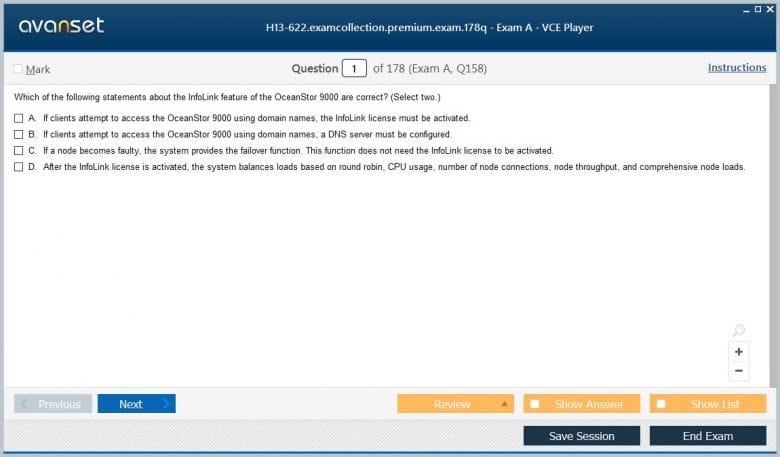
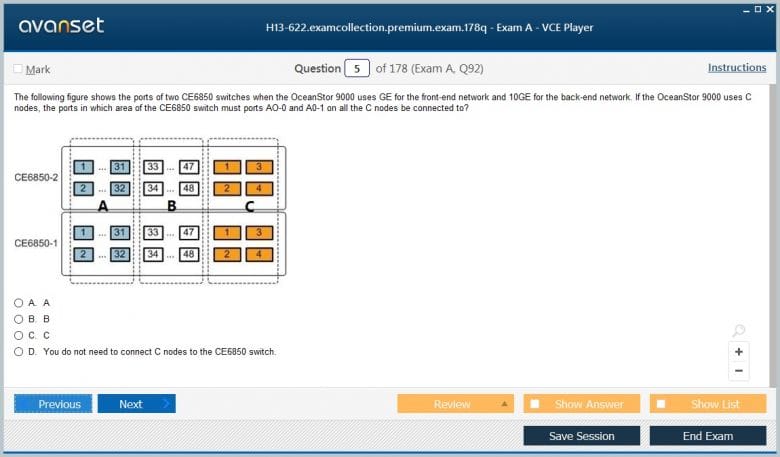
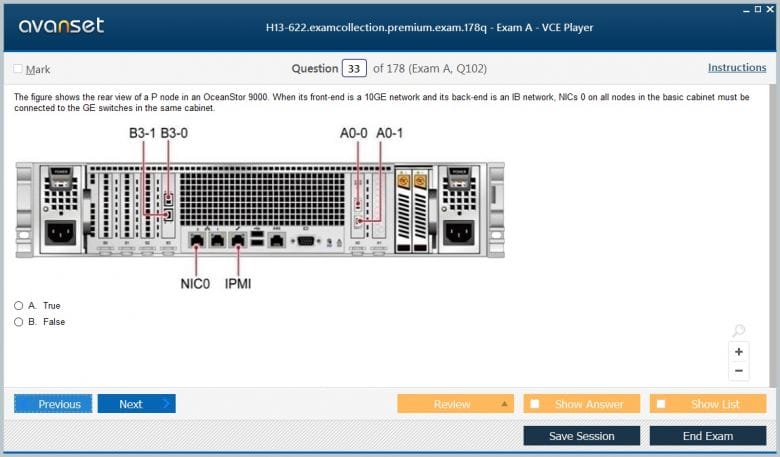
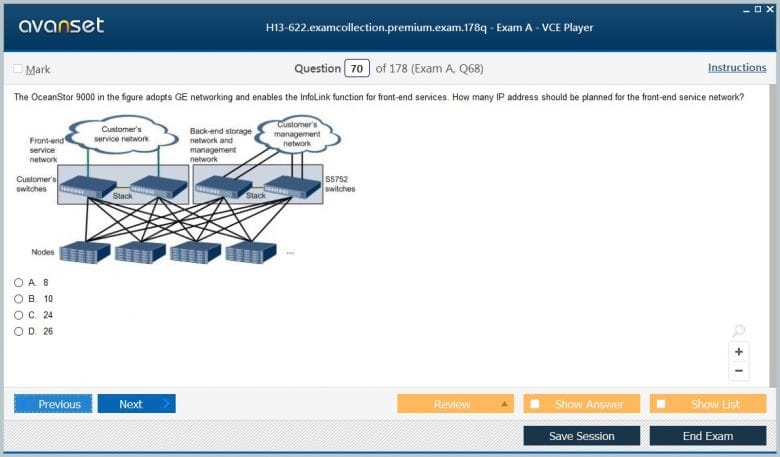
Huawei H13-622 Practice Test Questions in VCE Format
| File | Votes | Size | Date |
|---|---|---|---|
File Huawei.Selftestengine.H13-622.v2026-02-28.by.Verona.159q.vce |
Votes 6 |
Size 475.75 KB |
Date Feb 28, 2026 |
Huawei H13-622 Practice Test Questions, Exam Dumps
Huawei H13-622 (Huawei Certified Network Professional- Constructing Big Data Solution) exam dumps vce, practice test questions, study guide & video training course to study and pass quickly and easily. Huawei H13-622 Huawei Certified Network Professional- Constructing Big Data Solution exam dumps & practice test questions and answers. You need avanset vce exam simulator in order to study the Huawei H13-622 certification exam dumps & Huawei H13-622 practice test questions in vce format.
H13-622 is a legacy Huawei professional-storage exam associated with HCNP-Storage CBDS, “Constructing Big Data Storage.” Older material centered on scale-out storage, large distributed datasets, installation, networking, and operations in environments where capacity and throughput grow across many nodes. Huawei's current professional storage structure is different, but the architectural problems behind H13-622 remain relevant wherever storage has to scale beyond a traditional dual-controller array.
The page is most useful when treated as a study of distributed storage principles rather than a current certification requirement. Candidates should retain lessons about node roles, data distribution, metadata, failure domains, capacity expansion, network design, and operational repair. Product releases, old OceanStor 9000 procedures, and the retired HCNP ladder should remain explicitly historical.
Large datasets are not challenging only because they consume terabytes or petabytes. Ingest rate, file count, object size, concurrency, retention, and processing patterns can change the ideal storage design. A system optimized for huge sequential files may behave poorly with billions of tiny objects, while an analytics platform may need high aggregate throughput across many workers rather than low latency for one transaction.
The overview of the five Vs of big data helps frame those pressures. Translate each “V” into an infrastructure question. Volume affects capacity, velocity stresses ingest and network throughput, variety affects interfaces and metadata, veracity influences protection and validation, and value determines what data deserves expensive performance or retention.
In a traditional array, a failed drive or controller is often discussed inside one chassis. Scale-out platforms distribute data and services across nodes, so node loss, network partition, rebalance, and cluster quorum become part of the failure model. Candidates should understand that redundancy is only useful if the cluster can still locate enough valid data and coordinate access after a component disappears.
Draw a small cluster with data fragments distributed across several nodes. Remove one node and show which copies or erasure-coded fragments remain. Then remove a network path rather than a node and ask whether the cluster can distinguish isolation from failure. This exercise illustrates why distributed systems need both data redundancy and coordination logic.
Scale-out storage relies heavily on east-west traffic for replication, rebuilding, client access, metadata operations, and rebalancing. Network design therefore influences storage performance and recovery behavior. Oversubscribed links may look acceptable during normal operation and become a serious bottleneck when a node failure triggers large-scale rebuild traffic.
Create a traffic matrix for normal operation, expansion, and rebuild. Mark which flows are client-facing and which are internal to the cluster. Then identify the links that carry both. The important lesson is that storage network capacity should be evaluated under failure and maintenance conditions, not only during a quiet steady state.
Distributed platforms spread data so work and capacity can scale, but placement decisions affect recovery. Too much concentration inside one failure domain increases risk. Too much replication can consume excessive capacity. Erasure coding can improve efficiency while adding computation and reconstruction complexity. The right design depends on failure assumptions and workload priorities.
Practice with a hypothetical ten-node cluster. Define a protection policy, then calculate what happens when a disk, node, or rack fails. Do not stop at “data remains available.” Estimate how much data must move during repair and which network and disk resources carry that work. Recovery load is part of the design, not an afterthought.
Large-storage systems are often judged by raw capacity, but metadata operations can become the limiting factor when workloads create huge numbers of files or objects. Directory structure, namespace operations, indexing, and consistency mechanisms may stress different resources from bulk sequential I/O. Candidates should therefore ask what “performance” means for the actual dataset.
Compare two test plans: one writes a few large files; the other creates millions of small items and repeatedly lists, opens, and deletes them. The capacity used may be similar while the metadata workload is completely different. This is a valuable legacy lesson from big-data storage because it teaches candidates to test the operation pattern, not just the data volume.
Adding nodes increases capacity, but a distributed system may need to redistribute data before the new resources are used evenly. That process consumes bandwidth and media performance. A badly timed expansion can compete with production demand or extend the period during which the cluster is already operating near a threshold.
Write an expansion plan that includes current health, free capacity, network headroom, expected data movement, maintenance windows, and post-expansion balance checks. Include a stop condition if the cluster develops new faults during the change. This turns “scale out” from a marketing capability into an operational procedure with measurable risk.
Distribution is not a substitute for backup. A cluster can replicate accidental deletion, application corruption, or malicious changes across healthy nodes. The broader article on data-storage security is useful here because large shared platforms increase the importance of access control, integrity, auditability, and protected recovery copies.
For a distributed dataset, identify which failures the platform's internal redundancy handles and which require a separate backup or replication policy. Then define retention and restore testing. A system that can survive multiple disk failures but cannot recover yesterday's clean dataset after a destructive administrative action still has an incomplete protection design.
H13-622 once sat beside H13-621 CUSN and H13-623 CDPS. That old structure separated shared-storage networking, big-data storage, and data protection. The current represented professional destination, HCIP-Storage V5.5, instead covers flash and distributed storage technologies, deployment, performance tuning, operations, and troubleshooting within one professional blueprint.
This is a useful migration path for old notes. Keep H13-622 material that deepens distributed-storage architecture, but use the current HCIP outline to decide how much detail is relevant. If an old lesson depends on a retired product command or interface, preserve the concept and revalidate the implementation.
Large analytics systems increasingly combine distributed storage with cloud services, data lakes, container platforms, and database engines. The article on the emergence of cloud-native big-data processing shows why storage engineers now need to understand how compute and orchestration consume data, even when those systems are not part of the old H13-622 blueprint.
Use that context carefully: it should broaden architectural thinking, not rewrite the historical exam. Ask how a modern processing layer changes access patterns, elasticity, lifecycle, and network demand. The storage engineer's job is still to deliver predictable data access, but the consumers may now scale and move much faster than the traditional applications for which older platforms were designed.
Seen in that context, H13-622 is best preserved as a distributed-storage case study rather than a current exam target.
The historical value of CBDS is the discipline of thinking at cluster scale. Capacity, performance, failure, repair, and growth all become distributed problems. Those lessons remain valuable in any modern storage environment that spreads data across nodes, even when the product names and certification structure have changed.
In the wider structure of Huawei certifications, mark H13-622 as legacy and use HCIA-Storage, current HCIP-Storage material, and the expert H13-629 path to orient present-day study. Keep the old exam where it helps explain scale-out storage behavior. Do not let a retired code define the current path simply because its technical topics are still interesting.
Repair and rebalance policies should be studied as resource consumers. A cluster can remain online after a node failure while simultaneously using large amounts of bandwidth, CPU, and disk throughput to restore protection. If production demand is already close to system limits, the recovery process itself can create performance incidents. Capacity planning should therefore include degraded-mode behavior and not assume that all resources are available for user workloads during repair.
Data locality can matter as much as raw capacity. Analytics jobs may perform better when compute executes near the data, while other architectures deliberately separate compute and storage for elasticity. When reviewing a legacy scale-out design, ask whether workloads move to the data, data moves to the workload, or both communicate across the network. That answer changes network requirements, failure behavior, and expansion planning.
Operational consistency across many nodes is another distributed-system challenge. Firmware, network settings, time synchronization, security configuration, and capacity thresholds need to remain aligned. A single drifted node can create difficult intermittent problems even while the cluster appears generally healthy. Define a configuration baseline and compare nodes against it after upgrades, replacements, or expansion.
Decommissioning also deserves attention. Removing a node safely may require data evacuation or confirmation that protection is still sufficient after capacity is reduced. The operator should verify that the cluster has enough space and performance headroom to absorb the change before hardware is removed. This is the reverse of scale-out and should be planned with the same care.
A useful capstone is to design a scale-out platform for a dataset that doubles over two years. Define node count, protection policy, network headroom, growth checkpoints, rebalance windows, and the minimum free-capacity reserve. Then add one failed node during a high-ingest period and explain how the recovery load affects the plan. This exercise combines the strongest H13-622 themes—distribution, scale, networking, repair, and operations—without depending on a retired product interface.
The same reasoning should be used when a node returns after repair: verify health, capacity, network state, and rebalance behavior before assuming the cluster is fully recovered.
Go to testing centre with ease on our mind when you use Huawei H13-622 vce exam dumps, practice test questions and answers. Huawei H13-622 Huawei Certified Network Professional- Constructing Big Data Solution certification practice test questions and answers, study guide, exam dumps and video training course in vce format to help you study with ease. Prepare with confidence and study using Huawei H13-622 exam dumps & practice test questions and answers vce from ExamCollection.
Purchase Individually
Top Huawei Certification Exams
Site Search:

SPECIAL OFFER: GET 10% OFF

Pass your Exam with ExamCollection's PREMIUM files!
SPECIAL OFFER: GET 10% OFF
Use Discount Code:
MIN10OFF
A confirmation link was sent to your e-mail.
Please check your mailbox for a message from support@examcollection.com and follow the directions.

Download Free Demo of VCE Exam Simulator
Experience Avanset VCE Exam Simulator for yourself.
Simply submit your e-mail address below to get started with our interactive software demo of your free trial.