



Premium File
803 Q&A
$76.99$69.99
Huawei H12-224 Exam Questions & Answers, Accurate & Verified By IT Experts
Instant Download, Free Fast Updates, 99.6% Pass Rate
803 Questions & Answers
Last Update: Oct 24, 2026
$69.99
Huawei H12-224 Exam Screenshots
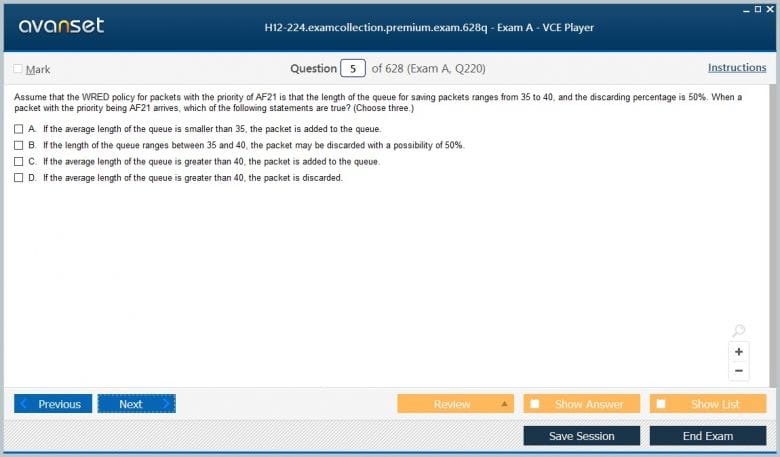
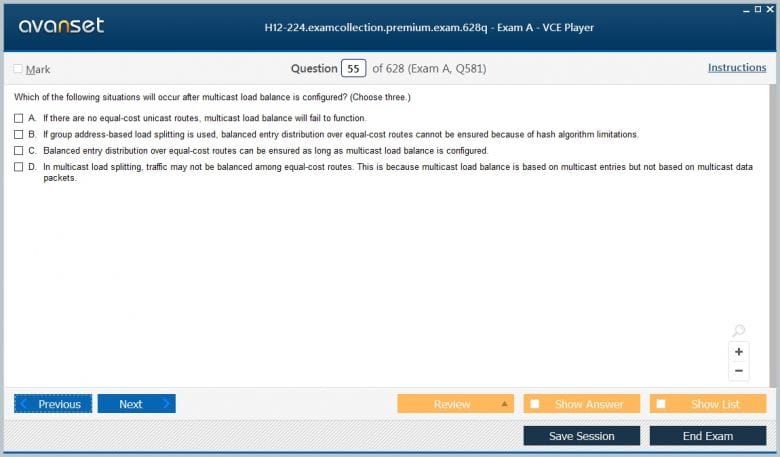
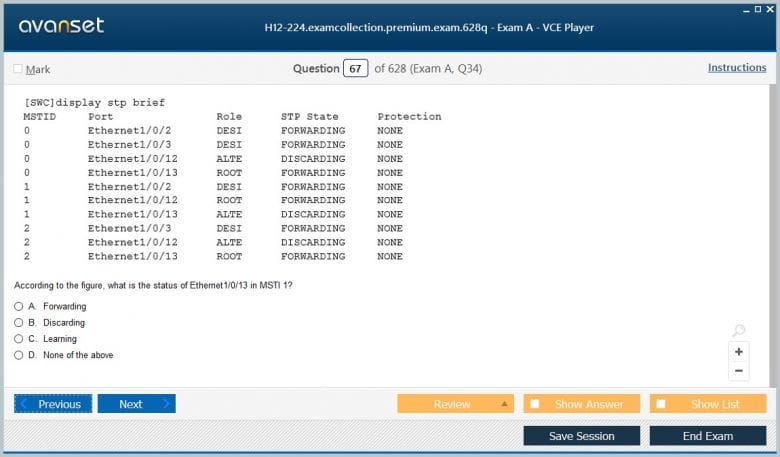
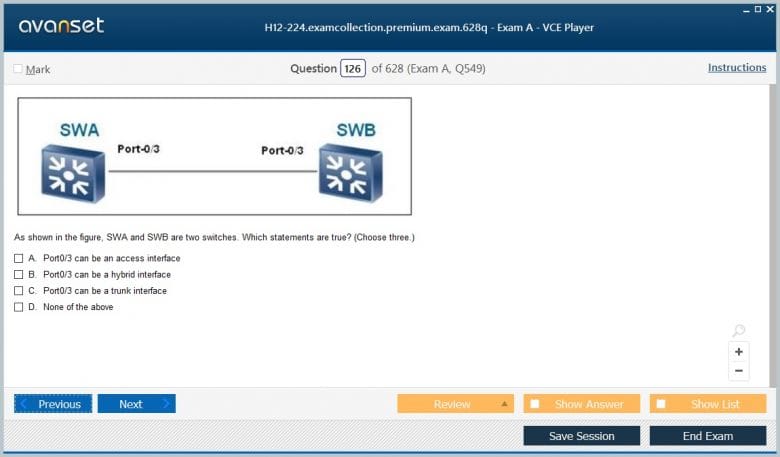
Huawei H12-224 Practice Test Questions in VCE Format
| File | Votes | Size | Date |
|---|---|---|---|
File Huawei.practiceexam.H12-224.v2026-05-29.by.harry.442q.vce |
Votes 1 |
Size 2.31 MB |
Date May 29, 2026 |
File Huawei.Prepaway.H12-224.v2020-02-28.by.Paul.432q.vce |
Votes 3 |
Size 2.61 MB |
Date Feb 29, 2020 |
File Huawei.Train4sure.H12-224.v2019-03-20.by.Viktor.373q.vce |
Votes 7 |
Size 1.95 MB |
Date Mar 24, 2019 |
File Huawei.Testking.H12-224.v2015-03-08.by.DIANE.629q.vce |
Votes 27 |
Size 1.24 MB |
Date Mar 08, 2015 |
Huawei H12-224 Practice Test Questions, Exam Dumps
Huawei H12-224 (HCNP-R&S Fast Track (Huawei Certified Network Professional - Routing & Switching Fast Track)) exam dumps vce, practice test questions, study guide & video training course to study and pass quickly and easily. Huawei H12-224 HCNP-R&S Fast Track (Huawei Certified Network Professional - Routing & Switching Fast Track) exam dumps & practice test questions and answers. You need avanset vce exam simulator in order to study the Huawei H12-224 certification exam dumps & Huawei H12-224 practice test questions in vce format.
H12-224 is a legacy fast-track exam associated with Huawei’s professional Routing & Switching era. Fast-track exams were designed for experienced candidates who could demonstrate a broad body of knowledge without following the full multi-exam route. Historical material around H12-224 therefore spans a wide range: routing, switching, reliability, QoS, multicast, security, WAN behavior, and troubleshooting.
The important current-status fact is that Huawei’s Datacom certification replaced the old R&S family. Candidates should not interpret the continued existence of a H12-224 page as evidence that the old professional route is still the live path. Today the approved workbook contains H12-821 HCIP-Datacom Core Technology and H12-831 Advanced Routing & Switching Technology, which represent the modern professional progression.
The challenge of a broad professional exam is not that every topic is individually advanced. It is that several topics can interact in one scenario. A route-policy change can affect redundancy. A spanning-tree decision can change the path that a first-hop gateway uses. QoS can appear to be ineffective because traffic follows an unexpected interface. Multicast can fail because the unicast RPF path changed.
Preparation should therefore use integrated topologies rather than isolated chapter labs. Build a campus with redundant switching, dynamic routing, a WAN edge, multicast or real-time traffic, and basic policy. Then change one assumption and observe which other systems react. This teaches dependency awareness, which is the real value behind a fast-track style of assessment.
A professional routing design often uses an IGP for internal reachability and BGP or policy mechanisms at boundaries. Candidates should know how routes move between those domains and how preference is expressed. They should also understand the risk of redistribution, default-route propagation, summarization, and filtering.
A useful lab is to provide two exits and several internal prefixes, then require one application network to prefer a different path without breaking failover. Solve the requirement using explicit policy and verify both normal and failed states. The exercise forces the candidate to think about control-plane intent, not just protocol adjacency.
Layer 2 topology determines how hosts reach their first-hop gateway, so spanning tree and gateway redundancy should not be designed independently. If the active gateway is placed behind a blocked or suboptimal Layer 2 path, traffic can take unnecessary detours. In a failure, the new gateway and new spanning-tree path should converge in a coordinated way.
Fast-track preparation should include VLANs, trunks, aggregation, MSTP or rapid spanning tree, and virtual-gateway behavior in the same topology. Verify the normal forwarding path and then remove links or devices. Measure which mechanisms converge first and whether the resulting path still has enough capacity.
Quality of Service features can be configured perfectly and have no visible effect when a link is idle. The engineering question is how traffic behaves when demand exceeds available capacity. Classification, marking, policing, shaping, queueing, and scheduling each influence a different stage. Candidates should know which mechanism addresses the stated problem.
Lab work should generate competing traffic classes and observe delay, loss, and throughput before and after policy. If voice or interactive traffic is prioritized, verify that the priority is limited so it cannot starve everything else. If a shaper is used, understand the target rate and queue behavior. This turns QoS from terminology into measurable service design.
Multicast depends on receiver state and reverse-path checks that differ from ordinary unicast forwarding. Redundancy mechanisms can change those checks during a failure. Candidates should therefore verify multicast after routing changes rather than assuming that unicast reachability proves the service is healthy.
Likewise, VRRP or similar first-hop redundancy can keep a gateway address available while upstream routing or Layer 2 topology is broken. A resilient design has to be tested end to end. The fast-track mindset is useful because it asks whether the service survives the combined failure, not whether each individual protocol claims to be healthy.
Professional network security begins with controlled management access, authentication, authorization, secure protocols, logging, and policy that limits unnecessary reachability. ACLs and device hardening should be evaluated for operational impact. A rule that blocks an attack but also prevents routing protocol or management traffic is not a successful control.
Management reachability also needs redundancy. Engineers should know how devices will be accessed if the production path is degraded and how configuration changes are audited. Current Datacom environments may add controllers and automation platforms, but the same principle remains: the team must be able to observe and recover the network during failure.
Huawei’s Datacom program was designed to extend the older routing-and-switching knowledge into WLAN, SDN, automation, and solution-oriented networking. The associate foundation now sits under H12-811, and professional candidates build on a common core before choosing advanced directions. That structure better reflects enterprise networks where wired, wireless, WAN, and automation responsibilities overlap.
Candidates coming from H12-224 material should identify the gaps explicitly. Classic routing and switching may be strong, but modern preparation should add programmability, network management, controller concepts, and solution architecture. Treat the old fast-track syllabus as a technical baseline, not as a complete current blueprint.
The modern expert destination in the approved inventory is H12-891 HCIE-Datacom. Huawei’s current expert outline combines advanced routing and switching with campus, WAN, network automation, and cross-domain deployment. That makes the transition from H12-224 especially instructive: the industry still values deep protocol knowledge, but expects it to operate inside larger automated architectures.
The approved editorial article on Huawei HCIE in enterprise network engineering provides useful broader career context for that expert progression. It should be read as supporting perspective, not as a substitute for Huawei’s live exam outline.
A strong legacy fast-track lab uses one topology to exercise many domains: VLANs and trunks, redundant gateways, OSPF, BGP or route policy, multicast, QoS, ACLs, NAT or WAN access, and management. Document the intended forwarding path for several traffic classes. Then fail a link, change a policy, or overload a path and predict the result.
After each scenario, require a short incident report: symptom, evidence, root cause, minimal fix, and prevention. This converts technical knowledge into operational judgment. It also exposes weak areas quickly because candidates cannot hide behind memorization when several protocols interact.
H12-224 belongs to a retired certification architecture, but its fast-track philosophy still has value. Experienced engineers preparing for modern Huawei certifications should be able to integrate routing, switching, reliability, performance, security, and troubleshooting in one network. The current Datacom path changes the exam structure and adds newer domains; it does not remove the need for that integrated competence.
Broad exams also expose weak foundational assumptions. An engineer may be comfortable with BGP but still make a poor decision because the underlying addressing plan overlaps, the Layer 2 failure domain is too large, or the monitoring path depends on the same circuit as production. Fast-track preparation should therefore include architecture review before advanced configuration. The candidate should be able to identify a design flaw even when every protocol command appears correct.
IPv6 is another useful cross-domain topic. It affects addressing, neighbor discovery, routing, ACLs, management, and service reachability. Candidates who study it as one isolated chapter often struggle when an IPv6 fault appears inside a routing or security scenario. Integrated labs should run IPv4 and IPv6 together so dual-stack operational differences become familiar.
Failure testing should include degraded states, not only complete outages. A path with high loss, an interface with errors, a route that oscillates, or a bundle with one unhealthy member can create worse user experience than a clean failure because traffic continues to flow unpredictably. Professional engineers need thresholds and evidence that let them recognize when “up” is not the same as “healthy.”
Fast-track study also benefits from peer review. Give another engineer the topology and intended policy without the final configuration and ask them to predict the state. Differences between the two interpretations expose ambiguous requirements before they become device errors. This mirrors production design review and helps candidates learn to explain decisions clearly rather than relying on personal familiarity with the lab.
A broad professional review should include naming, time, and management dependencies because they frequently sit outside the routing diagram. DNS failures can look like application or controller outages; time drift can break authentication and log correlation; management platforms can become unreachable while production forwarding continues. Fast-track candidates should be able to identify these shared services and decide whether they need redundancy, alternate access, or explicit validation during network changes. The habit is valuable because broad professional incidents often begin in a dependency the routing diagram does not show.
Integrated fast-track labs should distinguish configuration state from service state. A router can contain the intended policy while traffic still follows the wrong path because of an upstream dependency; a switch can show the correct VLAN while a gateway or return route is missing; a redundant link can be up but too constrained to carry the failed-over load. After each change, candidates should therefore validate the service from several perspectives: control-plane tables, interface and protocol state, forwarding behavior, application reachability, and monitoring evidence. Then inject a partial failure rather than only a clean outage and predict which signals will change first. This creates the kind of cross-domain reasoning that a fast-track exam was meant to reward. It also makes old H12-224 material useful without pretending the certification structure is current, because the exercise focuses on enduring operational judgment while the current Datacom blueprint supplies the modern scope and terminology.
Engineers should also rehearse recovery when the first fix does not work. A rollback may restore configuration but not session state, ARP entries, or routing convergence immediately. Knowing what state persists after rollback and which checks prove recovery is an important part of broad professional troubleshooting, especially when several protocols have reacted to the original change.
Go to testing centre with ease on our mind when you use Huawei H12-224 vce exam dumps, practice test questions and answers. Huawei H12-224 HCNP-R&S Fast Track (Huawei Certified Network Professional - Routing & Switching Fast Track) certification practice test questions and answers, study guide, exam dumps and video training course in vce format to help you study with ease. Prepare with confidence and study using Huawei H12-224 exam dumps & practice test questions and answers vce from ExamCollection.
Purchase Individually
Top Huawei Certification Exams
Site Search:

SPECIAL OFFER: GET 10% OFF

Pass your Exam with ExamCollection's PREMIUM files!
SPECIAL OFFER: GET 10% OFF
Use Discount Code:
MIN10OFF
A confirmation link was sent to your e-mail.
Please check your mailbox for a message from support@examcollection.com and follow the directions.

Download Free Demo of VCE Exam Simulator
Experience Avanset VCE Exam Simulator for yourself.
Simply submit your e-mail address below to get started with our interactive software demo of your free trial.
Is these dumps still valid?
Thanks alot
The current valid version has 628 questions
Hello,
This dump is correct?