



Premium File
152 Q&A
$76.99$69.99
Nokia 4A0-102 Exam Questions & Answers, Accurate & Verified By IT Experts
Instant Download, Free Fast Updates, 99.6% Pass Rate
152 Questions & Answers
Last Update: Sep 20, 2026
$69.99
Nokia 4A0-102 Exam Screenshots
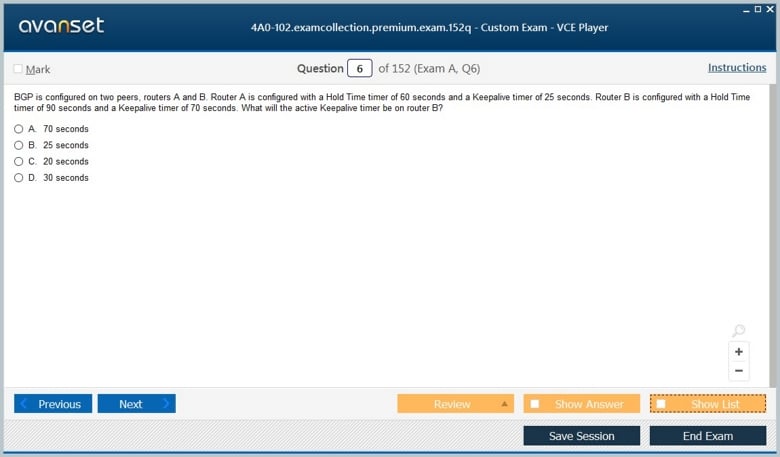
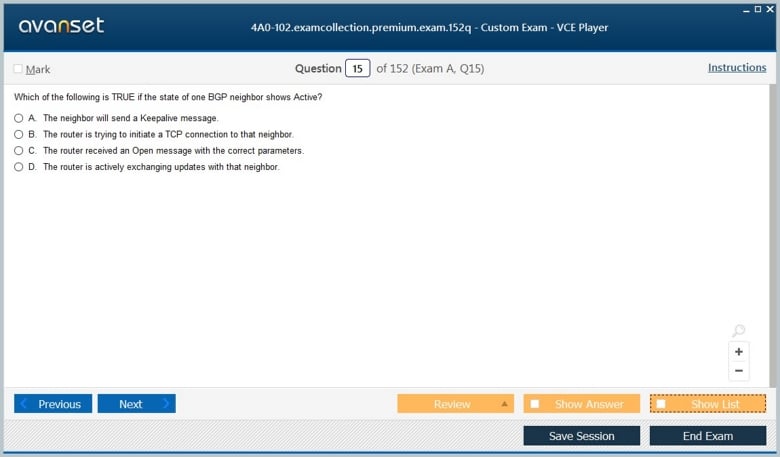
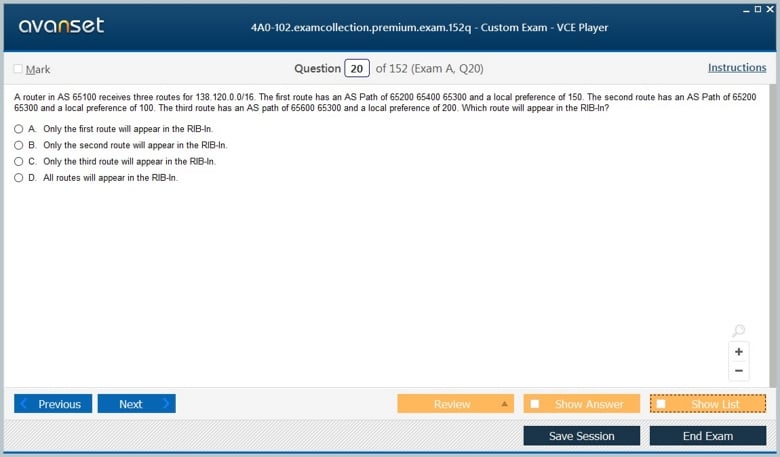
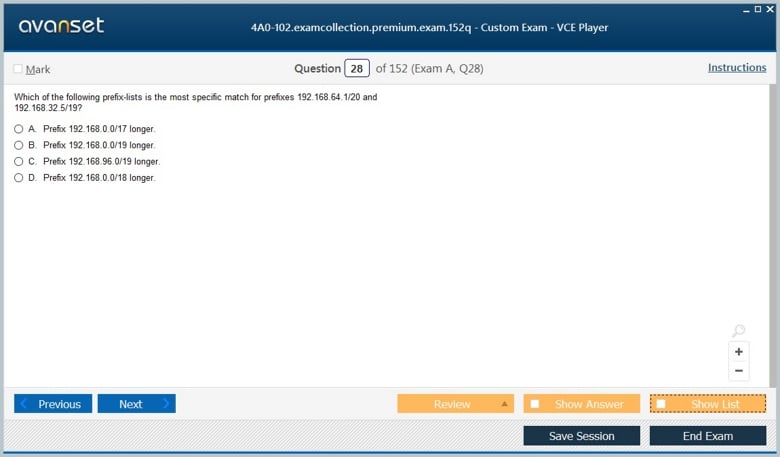
Nokia 4A0-102 Practice Test Questions in VCE Format
| File | Votes | Size | Date |
|---|---|---|---|
File Nokia.questionspaper.4A0-102.v2026-08-21.by.gabriel.97q.vce |
Votes 1 |
Size 3.08 MB |
Date Aug 21, 2026 |
Nokia 4A0-102 Practice Test Questions, Exam Dumps
Nokia 4A0-102 (Nokia Border Gateway Protocol) exam dumps vce, practice test questions, study guide & video training course to study and pass quickly and easily. Nokia 4A0-102 Nokia Border Gateway Protocol exam dumps & practice test questions and answers. You need avanset vce exam simulator in order to study the Nokia 4A0-102 certification exam dumps & Nokia 4A0-102 practice test questions in vce format.
The 4A0-102 exam is Nokia Border Gateway Protocol for Internet Routing, a current written exam in the Service Routing Architect path. Nokia lists 40 questions, 90 minutes, and no mandatory prerequisite, while the current SRA requirements also place it beside 4A0-105 VPLS, 4A0-106 VPRN, 4A0-107 QoS, and the newer EVPN exam. That context matters because BGP is not tested as an isolated protocol; it is part of building and controlling large service-provider routing domains.
Within Nokia certifications, BGP study should focus on policy as much as reachability. An IGP answers how to reach infrastructure inside a routing domain. BGP adds inter-domain path information, attributes, route selection, import and export policy, scalability mechanisms, and operational controls. Candidates who memorize configuration commands without understanding why a route should or should not be advertised are vulnerable to scenario questions that change only one policy condition.
The most productive study method is to build a small multi-AS lab and keep a route diary. For every prefix, record where it originated, which peers received it, which attributes changed, which path became active, and what would happen if a policy or session changed. This turns BGP from a collection of attributes into a visible decision system.
BGP relies on peer relationships, so begin with session formation. Understand eBGP and iBGP roles, the transport dependency, neighbor reachability, autonomous system numbers, and the basic state progression. When a session does not establish, separate IP reachability from transport, authentication, configuration, and policy. A route-policy problem cannot explain a neighbor that never forms a session.
Lab deliberate failures: wrong peer address, wrong AS, blocked TCP, missing route to a loopback, and authentication mismatch. For each one, capture the evidence that identifies the failing layer. This creates a troubleshooting order that remains useful when the topology becomes much larger.
Once basic sessions work, move the peers to loopback addresses or otherwise add an extra reachability dependency and observe what changes. The exercise forces you to distinguish the BGP neighbor relationship from the physical interface carrying the packets. It also demonstrates why a route to the peer and correct source selection matter even when the two routers are connected by multiple working links.
Do not memorize BGP attributes as a flat list. Group them by what they influence: local preference inside an AS, AS-path length and loop prevention, origin and MED in path comparison, next-hop reachability, and communities for policy signaling. Then study the actual decision process used by the platform and know which attributes are compared before others.
Build a topology with two exits and make the preferred path change for a reason you can explain. Adjust local preference, prepend an AS path, or use a policy that changes route acceptance. Verify both the control-plane result and the forwarding path. If the traffic path does not follow the route you expected, investigate next-hop resolution and return routing instead of assuming the attribute was ignored.
Create cases where the best path changes because one attribute is altered while all others remain constant. Keep a small decision worksheet that lists the candidate paths, relevant attributes, and the first comparison that breaks the tie. The worksheet prevents you from jumping directly to the attribute you remember best and makes the selection process reproducible during troubleshooting.
A service provider rarely wants to accept and advertise every route without restriction. Prefix filters, policy statements, communities, and attribute changes define who can reach what and through which path. Study policy as a contract: what routes are allowed in, what routes may leave, what attributes are changed, and what happens to anything that does not match an explicit rule.
Write policies from plain-language requirements before converting them to Nokia syntax. For example, accept only customer prefixes, prefer one upstream, tag routes for downstream treatment, and never leak internal infrastructure space. This order keeps the configuration aligned with the intended network behavior and makes it easier to review for accidental route leaks.
Add explicit validation after every policy change. Count received and advertised prefixes, inspect a few representative routes, and compare the results with the written requirement. A policy that accepts the intended customer route but also leaks a default or infrastructure prefix is not correct. Route-policy testing should therefore include negative cases just like a firewall or access policy.
Large BGP designs use techniques such as route reflection, aggregation, default routes, and policy hierarchy to avoid unnecessary state and configuration. Each technique solves a scale problem but introduces trade-offs. Route reflection reduces the full-mesh requirement for iBGP, while aggregation reduces routing-table detail but can hide topology information needed for precise traffic engineering.
For every scalability technique, ask what information is removed or abstracted and what failure mode that can create. Then verify whether the data plane still has a valid path when a component fails. Scalability is not simply having fewer routes; it is maintaining predictable reachability with an operationally manageable control plane.
Route reflection is especially useful to study with visibility questions. Ask which routers know the original next hop, which cluster or reflection attributes appear, and whether path diversity is preserved after the topology is simplified. A design that scales the control plane but hides a useful alternate path can create surprising failover behavior, so scale and path quality must be considered together.
Troubleshooting is faster when you ask three different questions: is the BGP session up, is the expected route in the BGP table and routing table, and can the router actually forward to the next hop? Packet-level thinking such as capturing and inspecting traffic can help validate what control-plane output cannot show by itself.
Practice cases where only one layer is broken. A session may be established but a policy rejects the route. A route may be selected but the next hop is unresolved. Forwarding may work outbound while return traffic follows a different provider. This layered approach prevents endless policy edits when the real problem is transport or reachability.
BGP peers exchange information that can influence very large traffic flows, so control-plane protection matters. Apply the general principles behind network security threats to routing: authenticate peers where supported, limit which addresses can form sessions, filter prefixes aggressively, control administrative access, monitor unexpected route changes, and log policy modifications.
Operational security also includes protecting against human error. Use peer groups, naming conventions, change review, rollback plans, and validation commands before and after a change. A perfectly secured session can still cause an outage if an export policy accidentally announces the wrong routes.
Include resource protection in the security plan. Prefix limits, maximum-route thresholds, and monitoring for sudden changes can reduce the impact of a misconfigured or compromised peer. Decide what the router should do when a peer exceeds the expected scale and how operations will distinguish a legitimate growth event from a leak. Security is stronger when the network has defined normal bounds instead of only authentication.
BGP is most useful in the SRA path when connected to the rest of the service-routing stack. 4A0-103 MPLS provides the label-switched transport context, while 4A0-104 Services Architecture explains how provider services use control and data planes together. Later service exams add VPN and EVPN-specific route distribution.
In labs, do not stop after establishing an IPv4 unicast session. Trace how routing information supports a service, which next hop or label is installed, and how policy affects customer reachability. This creates the cross-exam understanding expected of an architect-level candidate.
Use a customer VPN example to make that connection concrete. The core may use an IGP and MPLS to reach provider edges, while BGP carries service-specific reachability between those edges. If you can explain which routes belong to the underlay and which belong to the service, you are less likely to troubleshoot a missing customer prefix by changing the wrong routing process.
Build a final matrix of symptoms and likely evidence: session down, route absent, route rejected, path not preferred, next hop unreachable, asymmetric routing, route leak, and slow convergence. For each symptom, write the first commands or tables you would inspect and the policy conditions most likely to matter.
Then practice explaining the correction without immediately reaching for a configuration command. State what the network is doing, why it is doing it, what evidence proves the cause, and what the smallest safe change would be. That reasoning pattern is more durable than memorizing a collection of BGP recipes and is closer to the judgment 4A0-102 is meant to assess.
Add maintenance scenarios to the matrix. A planned upstream change may require temporarily preferring a second provider, draining traffic, or changing advertisements without disrupting customer reachability. Write the safe sequence before touching policy: baseline routes, make the preference change, verify forwarding, perform the work, restore the normal state, and confirm that no temporary route attributes remain. This trains controlled change rather than only break/fix troubleshooting.
Finally, practice reading only the evidence a trouble ticket would realistically provide: a few routes, one neighbor state, and a customer symptom. Decide what additional command or table would reduce uncertainty the most. This trains diagnostic economy and prevents the common habit of collecting huge amounts of output without a hypothesis.
Go to testing centre with ease on our mind when you use Nokia 4A0-102 vce exam dumps, practice test questions and answers. Nokia 4A0-102 Nokia Border Gateway Protocol certification practice test questions and answers, study guide, exam dumps and video training course in vce format to help you study with ease. Prepare with confidence and study using Nokia 4A0-102 exam dumps & practice test questions and answers vce from ExamCollection.
Purchase Individually
Top Nokia Certification Exams
Site Search:

SPECIAL OFFER: GET 10% OFF

Pass your Exam with ExamCollection's PREMIUM files!
SPECIAL OFFER: GET 10% OFF
Use Discount Code:
MIN10OFF
A confirmation link was sent to your e-mail.
Please check your mailbox for a message from support@examcollection.com and follow the directions.

Download Free Demo of VCE Exam Simulator
Experience Avanset VCE Exam Simulator for yourself.
Simply submit your e-mail address below to get started with our interactive software demo of your free trial.