



Premium File
219 Q&A
$76.99$69.99
Nokia 4A0-106 Exam Questions & Answers, Accurate & Verified By IT Experts
Instant Download, Free Fast Updates, 99.6% Pass Rate
219 Questions & Answers
Last Update: Sep 06, 2026
$69.99
Nokia 4A0-106 Exam Screenshots
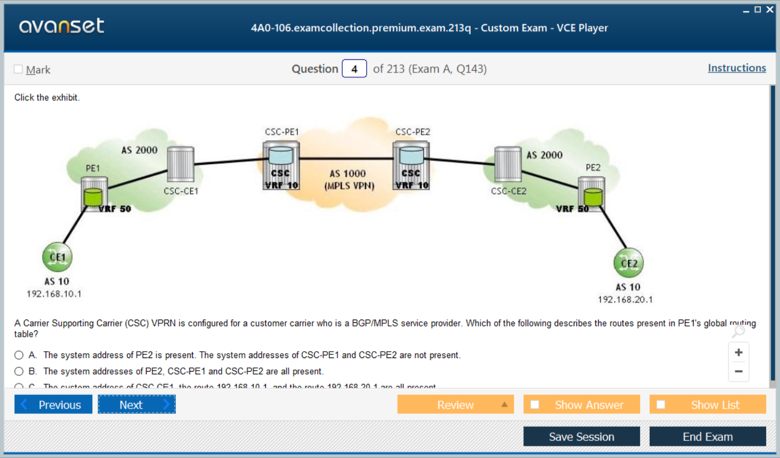
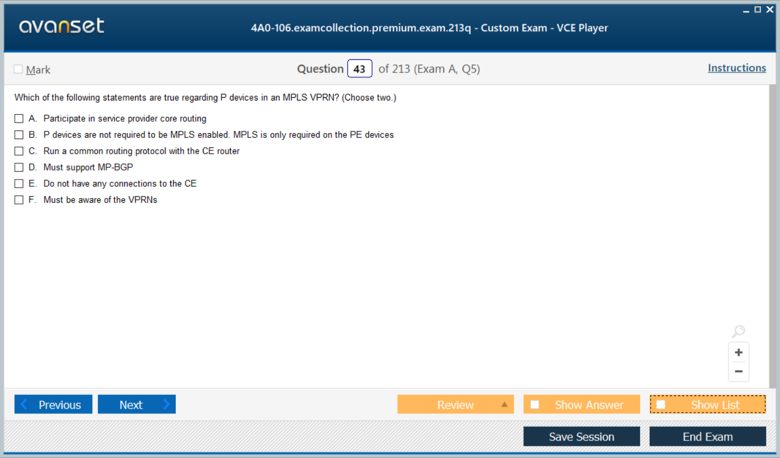
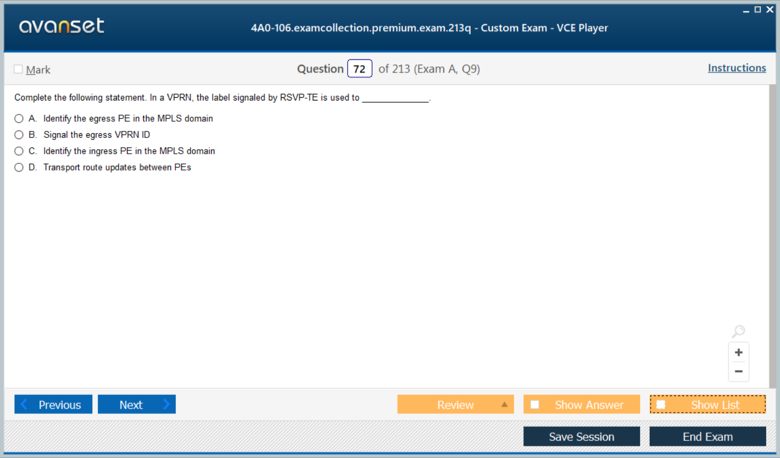
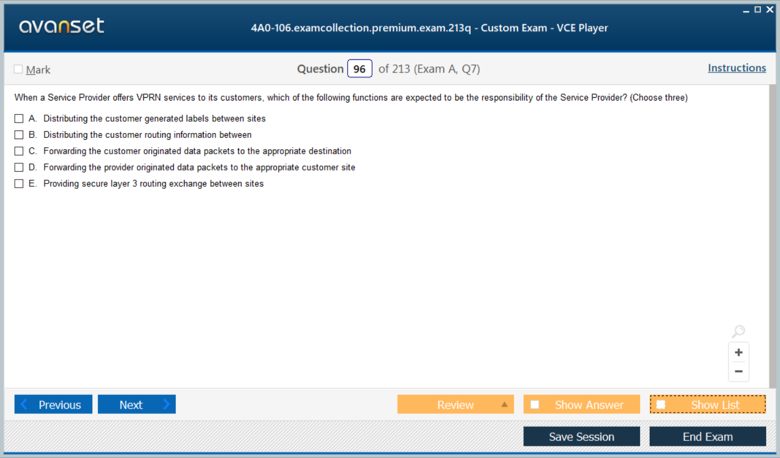
Nokia 4A0-106 Practice Test Questions in VCE Format
| File | Votes | Size | Date |
|---|---|---|---|
File Nokia.pass4sureexam.4A0-106.v2026-06-21.by.easton.107q.vce |
Votes 1 |
Size 6.66 MB |
Date Jun 21, 2026 |
Nokia 4A0-106 Practice Test Questions, Exam Dumps
Nokia 4A0-106 (Nokia Virtual Private Routed Networks) exam dumps vce, practice test questions, study guide & video training course to study and pass quickly and easily. Nokia 4A0-106 Nokia Virtual Private Routed Networks exam dumps & practice test questions and answers. You need avanset vce exam simulator in order to study the Nokia 4A0-106 certification exam dumps & Nokia 4A0-106 practice test questions in vce format.
The 4A0-106 exam is Nokia Virtual Private Routed Networks, a current written requirement in the Service Routing Architect path. Nokia lists 40 questions, 90 minutes, and no mandatory prerequisite. VPRN is the Layer 3 VPN side of the SRA service portfolio, so the exam brings together routing instances, customer route exchange, BGP-based service distribution, MPLS transport, policy, and operations.
The Nokia certifications path places VPRN beside 4A0-105 VPLS for a reason: both create private customer connectivity over shared provider infrastructure, but they divide responsibility differently. VPLS extends Layer 2 behavior; VPRN gives the provider a separate routing context for each customer. That distinction changes what the provider learns, what the customer controls, and how faults are isolated.
A good preparation lab uses at least two customer routing instances and overlapping private address space. If both customers can use the same prefixes without interfering, you can see the practical value of routing-table isolation. Then add route exchange between provider edges and trace how a customer prefix becomes reachable at a remote site.
A VPRN keeps customer routes in a context separate from the global routing table and from other customers. Understand how interfaces are attached to the correct service and how the router selects the appropriate routing table when a packet arrives. A correct route in the wrong context is operationally equivalent to no route at all.
Practice overlapping-prefix scenarios deliberately. Give two customers the same internal network and verify that traffic remains isolated. Then misattach an interface to the wrong routing instance and observe the symptom. This teaches isolation more effectively than memorizing the definition of a VRF-like construct.
Add management and monitoring context to the separation. Operators need commands, telemetry and logs that clearly identify which routing instance produced an event. A generic route or interface alarm can be misleading when identical prefixes exist in several customers. Consistent service names and context-aware monitoring are therefore operational extensions of the isolation model, not just administrative conveniences.
A customer may exchange routes with the provider edge using static routing or a dynamic protocol. The provider must control which routes are accepted, how they are preferred, and what is advertised back. Study the operational consequences of each choice, including convergence, scale, and the risk of accepting an unexpected prefix.
Write a simple import policy in plain language before considering syntax. Define the allowed customer prefixes, default-route behavior, and what should happen if the customer advertises something outside the contract. This frames route policy as a service-boundary control rather than an optional refinement.
Test a customer that accidentally advertises a default route or a prefix belonging to another site. Verify that import policy rejects it and that the rejection is visible to operations. This turns policy into a protective service boundary and demonstrates why trusting every customer route can threaten both correctness and scale.
The deeper BGP reasoning from 4A0-102 becomes especially important in VPRN. The provider needs a scalable way to distribute customer VPN routes without confusing overlapping address spaces. Route distinguishers and route targets serve different purposes: one makes routes unique in the provider control plane, while the other controls import and export relationships among routing instances.
Build examples with two route targets and predict which sites should import each route. Then verify the BGP VPN table and the customer routing table separately. If a route exists in BGP but not in the VPRN routing table, the import policy or route target is a more likely problem than the underlying MPLS transport.
Add route withdrawal to the lab. Remove a customer prefix at one edge and watch the VPN route disappear from remote BGP and VPRN tables. Note the order and timing. Understanding withdrawal behavior matters because stale reachability can be as damaging as missing reachability during maintenance or failure.
A VPRN packet usually carries information that identifies both the transport path and the VPN forwarding context. Keep those functions separate in your mental model. The outer transport label moves the packet across the core; the service or VPN label tells the egress provider edge how to process the packet for the correct customer context.
Capture or inspect label stacks in the lab and annotate each label. Then follow the control-plane information that caused each label to be installed. This prevents a common learning mistake: treating every label as if it came from the same protocol or represented the same decision.
Follow one return packet as carefully as the forward packet. VPN services often appear healthy in one direction while return routing or a label binding is wrong elsewhere. Bidirectional tracing reinforces that two endpoints may select different provider paths and that each direction has its own control-plane dependencies.
Route targets and policy can create full-mesh, hub-and-spoke, or more selective connectivity among customer sites. That means a VPN route being absent is not always a failure; it may be the intended topology. Candidates should read the business requirement before deciding whether every site should learn every prefix.
Design a hub-and-spoke VPRN and write the import/export behavior for hub and spokes. Then test a prohibited spoke-to-spoke path and confirm it fails for the intended reason. Negative validation is essential when policy is supposed to restrict reachability.
VPRN resilience can depend on customer-edge routing, provider-edge redundancy, MP-BGP convergence, MPLS transport, and remote route selection. When a path fails, several control planes may react. Study which layer detects the failure first and how the resulting route change reaches the customer routing table.
Run a failover with continuous customer traffic and record the route changes at each layer. If the backup path exists but the customer still experiences prolonged loss, identify which convergence step dominates. This helps connect protocol theory to service-level recovery.
Add a provider-edge maintenance scenario. Move or fail the customer attachment, observe route withdrawal and re-advertisement, and measure how quickly the remote site learns the alternate path. Then compare that with a core-link failure where the VPN routes remain stable but the transport next hop changes. The two outages may look similar to the customer but have different control-plane causes.
For a missing remote prefix, ask whether the provider edge learned it from the customer, converted it into the correct VPN route, advertised it through MP-BGP, imported it at the remote edge, installed it in the correct routing instance, and programmed forwarding. Each step has distinct evidence and narrows the fault domain.
Keep packet forwarding separate from route presence. A route may be correctly installed while the customer interface is down, the next hop is unresolved, or an access filter blocks traffic. A layered checklist prevents the routing table from becoming the only diagnostic tool.
Use route counts and representative prefixes together. A single expected prefix can be present while hundreds of other routes are missing because a policy limit or filter changed. Conversely, an unexpected jump in routes may indicate a leak even when all critical applications still work. Scale evidence helps distinguish an isolated customer issue from a systemic control-plane problem.
The current SRA path includes 4A0-115 EVPN Services and 4A0-116 Segment Routing, so VPRN study benefits from a broader service-evolution perspective. Modern provider networks may combine EVPN route types, segment routing, and Layer 3 services in ways that differ from older designs while preserving the same goals of scale, isolation, and policy control.
For 4A0-106, keep the VPRN objectives primary. Use newer technologies only to sharpen the durable questions: how customer routes are isolated, how they are distributed, what forwarding context is installed, and how the service recovers from failure. Those questions remain valuable even as the surrounding transport evolves.
Keep a version-aware vocabulary list as you study. Some modern deployments may express Layer 3 VPN reachability through newer EVPN constructs, while the 4A0-106 objectives use the classic VPRN model. Knowing which term belongs to which architecture prevents current operational experience from being projected incorrectly onto an exam question about the older model.
Add route-scale and observability questions to the final review. How many customer routes should a provider edge expect, what increase would be suspicious, which routing instance owns the change, and how would an engineer trace it to the originating site? Large VPNs can fail through gradual route growth as easily as through a hard outage. Capacity and monitoring are therefore part of correct VPRN operation, not separate management topics.
For final lab work, add a route-leak prevention test between two customer routing instances. Configure a deliberate but controlled policy mistake, observe which table or import rule allows the leak, then restore isolation and prove the routes have been withdrawn everywhere. This reinforces both the security value of routing-instance separation and the need to validate negative outcomes, not just successful reachability.
Keep customer-route documentation synchronized with policy. When a site adds or removes a prefix, the intended import/export rules, route limits, and monitoring thresholds may also need adjustment. Treat the route contract as living operational data. Stale documentation makes a correct policy look suspicious and a wrong policy look normal during an incident.
A final check should compare the documented customer topology with the routes actually installed at every participating provider edge.
Go to testing centre with ease on our mind when you use Nokia 4A0-106 vce exam dumps, practice test questions and answers. Nokia 4A0-106 Nokia Virtual Private Routed Networks certification practice test questions and answers, study guide, exam dumps and video training course in vce format to help you study with ease. Prepare with confidence and study using Nokia 4A0-106 exam dumps & practice test questions and answers vce from ExamCollection.
Purchase Individually
Top Nokia Certification Exams
Site Search:

SPECIAL OFFER: GET 10% OFF

Pass your Exam with ExamCollection's PREMIUM files!
SPECIAL OFFER: GET 10% OFF
Use Discount Code:
MIN10OFF
A confirmation link was sent to your e-mail.
Please check your mailbox for a message from support@examcollection.com and follow the directions.

Download Free Demo of VCE Exam Simulator
Experience Avanset VCE Exam Simulator for yourself.
Simply submit your e-mail address below to get started with our interactive software demo of your free trial.