



Premium File
212 Q&A
$76.99$69.99
Nokia 4A0-107 Exam Questions & Answers, Accurate & Verified By IT Experts
Instant Download, Free Fast Updates, 99.6% Pass Rate
212 Questions & Answers
Last Update: Oct 30, 2026
$69.99
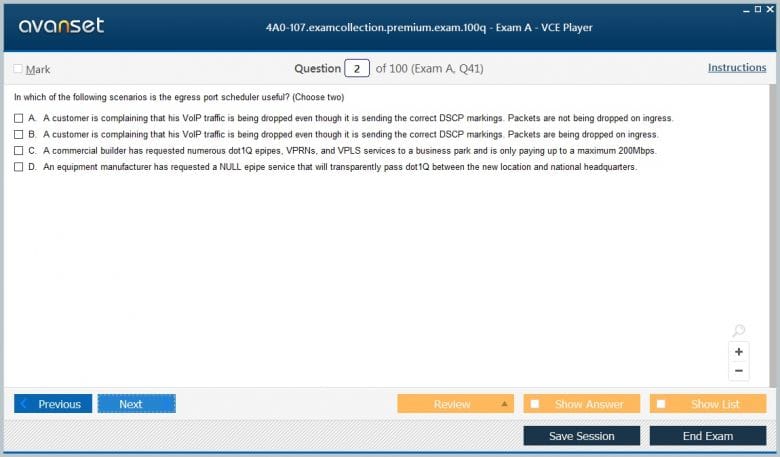
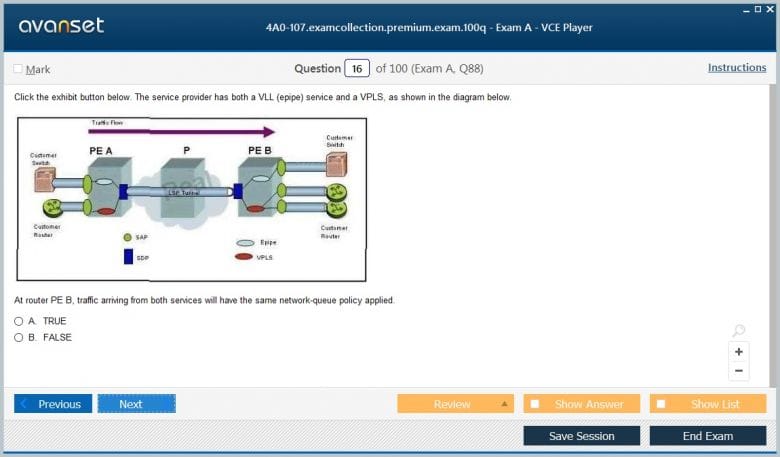
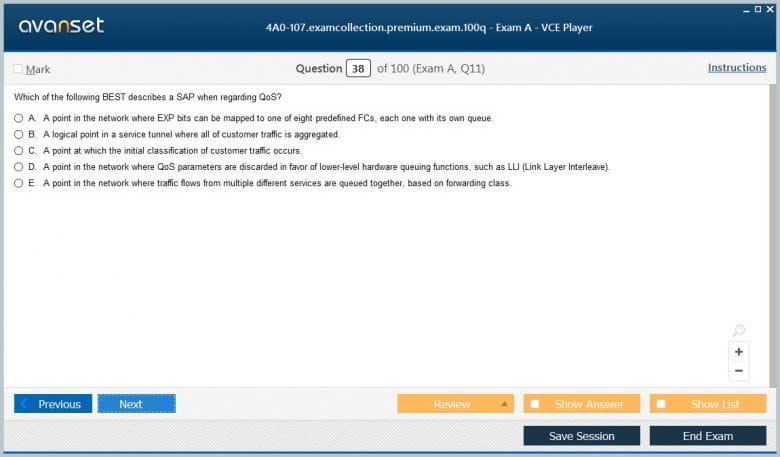
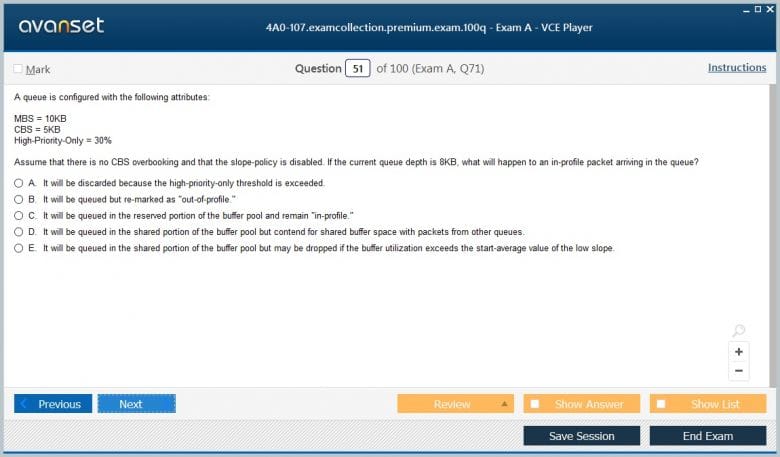
Nokia 4A0-107 Exam Screenshots
Nokia 4A0-107 Practice Test Questions in VCE Format
| File | Votes | Size | Date |
|---|---|---|---|
File Nokia.selftestengine.4A0-107.v2026-10-05.by.darcey.92q.vce |
Votes 2 |
Size 1.56 MB |
Date Oct 05, 2026 |
Nokia 4A0-107 Practice Test Questions, Exam Dumps
Nokia 4A0-107 (Nokia Quality of Service) exam dumps vce, practice test questions, study guide & video training course to study and pass quickly and easily. Nokia 4A0-107 Nokia Quality of Service exam dumps & practice test questions and answers. You need avanset vce exam simulator in order to study the Nokia 4A0-107 certification exam dumps & Nokia 4A0-107 practice test questions in vce format.
The 4A0-107 exam is Nokia Quality of Service, a current Service Routing Architect written exam. Nokia lists 40 questions, 90 minutes, and no mandatory prerequisite. QoS is a cross-cutting subject because every service ultimately competes for finite forwarding resources. The exam therefore tests more than terminology: candidates need to understand classification, marking, scheduling, policing, shaping, queue behavior, and how those tools interact across a service path.
Within Nokia certifications, QoS sits beside service exams such as 4A0-105 VPLS and 4A0-106 VPRN. A VPLS or VPRN can be logically correct yet fail the customer expectation if critical traffic suffers excessive delay, jitter, or loss under congestion. The broad idea behind network congestion is therefore central: QoS changes how scarce capacity is allocated; it does not create unlimited bandwidth.
The best labs force contention. If every interface is uncongested, classification and scheduling policies may appear correct even when they are not doing anything meaningful. Create a bottleneck, generate multiple traffic classes, and observe which queues grow, which packets are dropped or delayed, and whether the results match the policy intent.
QoS design begins with application and business requirements. Voice may need low delay and jitter, transactional traffic may need reliable delivery, and bulk transfers may simply need a fair share of remaining bandwidth. Translate those requirements into classes before choosing queue parameters. Otherwise the configuration becomes a set of numbers without a defensible objective.
For each class, document what traffic belongs there, how it will be recognized, how it should be marked, what minimum or maximum resource it needs, and what behavior is acceptable during congestion. This service-policy table becomes the reference for every later configuration and troubleshooting decision.
Add measurement criteria to every class. A statement such as 'voice is important' is not testable; a target for delay, jitter, loss or minimum bandwidth is. Even when the exam does not ask for a full service-level agreement, thinking in measurable terms makes it easier to choose between priority, guaranteed bandwidth, policing and shaping behaviors.
Traffic can be classified by interface, protocol information, existing markings, or other fields supported by the platform. Marking carries an intent or treatment signal into later nodes. The important question is where you trust existing markings and where the network should reclassify or rewrite them to enforce the provider policy.
Practice with untrusted customer markings. Send high-priority markings from a traffic source that should not receive priority and verify that the ingress policy normalizes them. QoS security matters because a customer that can arbitrarily claim the highest class can starve legitimate traffic.
Trace marking across multiple devices. A packet may enter with one DSCP value, be mapped to an internal forwarding class, receive a different egress marking, and then be interpreted by the next network according to another policy. Document each trust boundary and mapping. Many QoS problems come from assuming that a marking has the same meaning everywhere.
Policing enforces a rate by classifying traffic as conforming or exceeding and then applying an action such as drop or remark. Shaping buffers traffic to smooth the transmitted rate. Candidates should understand how each technique affects bursty traffic, delay, and loss rather than simply memorizing which one drops packets.
Model a burst that temporarily exceeds a committed rate. A shaper may delay some packets and send them later; a policer may mark or discard the excess immediately. Decide which behavior fits the service contract and where in the path it should be enforced.
Work through token-bucket style burst reasoning conceptually. Even without memorizing every implementation detail, understand that a configured rate and burst allowance determine whether short bursts are tolerated or treated as excess. This explains why two policers with the same long-term rate can produce different application behavior if their burst parameters differ.
Schedulers choose among packets waiting in queues. Study strict priority, weighted sharing, and the risks of giving one class unlimited priority. A priority queue can protect delay-sensitive traffic, but if admission and policing are weak it can starve other classes. Weighted approaches provide predictable sharing but may not meet a very tight latency objective.
Create a lab with at least three classes and a deliberate bottleneck. Measure throughput and latency as the offered load rises. Then change one scheduler parameter and predict the result before running the test. This turns scheduler behavior into observable engineering rather than a set of abstract algorithms.
Also test starvation protection. Increase priority-class traffic until it approaches the bottleneck and observe what happens to lower classes. If the design depends on a priority queue, pair it with admission control or policing so the priority class cannot consume the entire link. This demonstrates why scheduling and rate enforcement are often designed together.
Large buffers can absorb bursts, but excessive buffering can produce long delays. Small buffers reduce queueing delay but may drop traffic quickly. Learn how queue depth, drop thresholds, and active queue behavior influence different applications. The correct answer depends on the service objective, not a universal rule that more buffering is always safer.
Observe queue occupancy during a congestion test and correlate it with application response. If throughput remains high while interactive traffic feels slow, queueing delay may be the real problem. This is why QoS verification should include latency and drops, not only interface utilization.
Provider services often need policy at several levels: per customer, per service, per traffic class, and per physical interface. Hierarchical scheduling lets those relationships coexist. Candidates should be able to explain which limit or guarantee applies at each level and what happens when both a child class and its parent are congested.
Draw the scheduler hierarchy as a tree with rates and priorities. Then calculate which branches can borrow unused capacity and which are capped. This visual approach makes complex policies easier to reason about than reading a long configuration from top to bottom.
Use a customer with two services to show hierarchy. Each service can have its own class policy while both are constrained by the customer's aggregate contract and the physical port. Change demand in one service and observe whether unused capacity can be borrowed. The result makes parent-child scheduler relationships easier to understand than a purely numeric configuration example.
If a customer reports poor performance, first verify that the traffic is classified into the expected forwarding class. Then determine whether the relevant queue is actually congested and how the scheduler treats it. A policy may be perfectly correct but irrelevant because the bottleneck exists on a different link outside the policy boundary.
Use counters at ingress, queue, and egress to follow the traffic through the policy. Check markings before and after rewrite, dropped packets, queue occupancy, and transmitted bytes. Evidence at each stage helps distinguish misclassification from a real resource shortage.
Do not forget the reverse direction. Many applications use asymmetric traffic volumes or paths, and QoS policy may differ between ingress and egress. A voice call, transaction or tunnel can therefore have excellent quality one way and poor quality the other. Test and measure both directions before concluding that the class policy is correct end to end.
A single well-configured router cannot guarantee service quality if markings are lost or policies differ elsewhere. Pair QoS validation with the path reasoning from end-to-end TCP/IP communication and verify treatment across every trust boundary. A packet may be prioritized at access, remark at a provider edge, and then enter a different class downstream if policy is inconsistent.
For final preparation, build one congested service with voice-like, transactional, and bulk traffic. Define the business intent, classify and mark each flow, apply rate enforcement and scheduling, then fail a link so the path and bottleneck change. If you can predict and explain the resulting queue behavior, you are studying QoS at the level 4A0-107 expects.
Include failure and reroute conditions in the validation. A backup path may have less bandwidth or a different QoS policy, so a class that meets objectives normally may degrade during convergence. If the service promise must survive a failure, the alternate path must be dimensioned and configured for that requirement as well.
Use before-and-after evidence for every policy change. Capture class counters, offered load, drops, latency and queue depth before modifying the scheduler, then repeat the same test after the change. Without a controlled comparison, an engineer can mistake a naturally quieter traffic period for an improvement. The same discipline also protects against a change that helps one class while silently degrading another.
Keep policy intent next to the counters you monitor. A high drop count is not automatically a fault if it belongs to a policer intentionally enforcing a contract, while zero drops in a priority class does not prove good service if latency is caused elsewhere. Metrics become useful only when interpreted against the behavior the policy was designed to create.
Repeat the final test with realistic packet sizes and flow counts. A policy that behaves well with one synthetic stream may react differently when many short flows, large transfers, and real-time packets compete at once. Diversity in the test load gives a better picture of scheduler and queue behavior under production-like conditions.
Go to testing centre with ease on our mind when you use Nokia 4A0-107 vce exam dumps, practice test questions and answers. Nokia 4A0-107 Nokia Quality of Service certification practice test questions and answers, study guide, exam dumps and video training course in vce format to help you study with ease. Prepare with confidence and study using Nokia 4A0-107 exam dumps & practice test questions and answers vce from ExamCollection.
Purchase Individually
Top Nokia Certification Exams
Site Search:

SPECIAL OFFER: GET 10% OFF

Pass your Exam with ExamCollection's PREMIUM files!
SPECIAL OFFER: GET 10% OFF
Use Discount Code:
MIN10OFF
A confirmation link was sent to your e-mail.
Please check your mailbox for a message from support@examcollection.com and follow the directions.

Download Free Demo of VCE Exam Simulator
Experience Avanset VCE Exam Simulator for yourself.
Simply submit your e-mail address below to get started with our interactive software demo of your free trial.