



Premium File
300 Q&A
$76.99$69.99
Nokia 4A0-104 Exam Questions & Answers, Accurate & Verified By IT Experts
Instant Download, Free Fast Updates, 99.6% Pass Rate
300 Questions & Answers
Last Update: Oct 27, 2026
$69.99
Nokia 4A0-104 Exam Screenshots
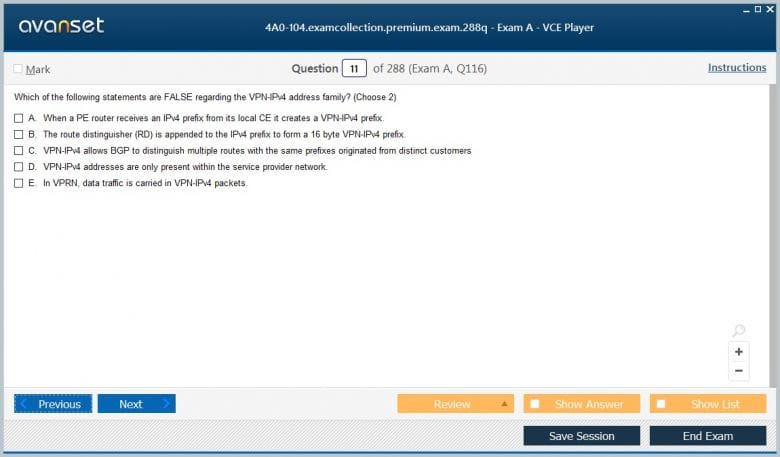
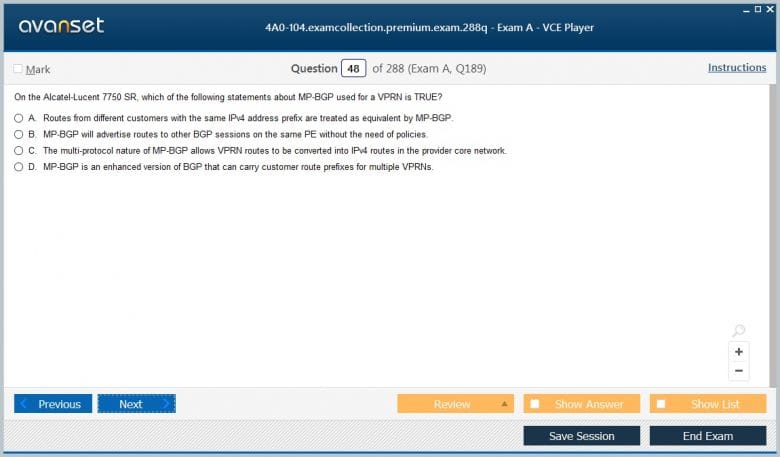
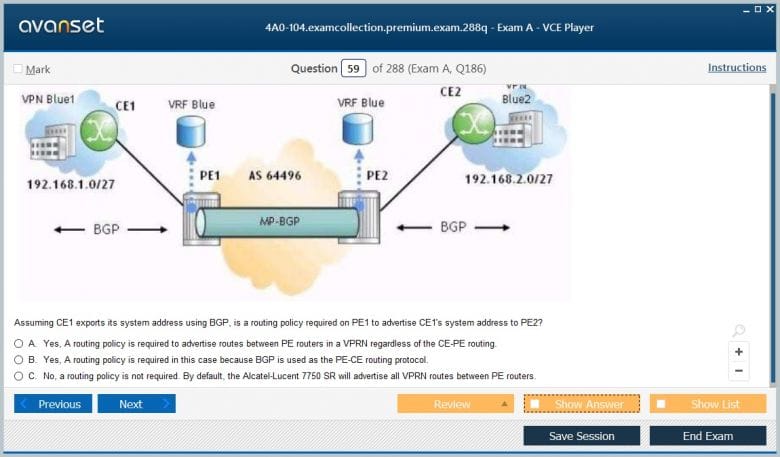
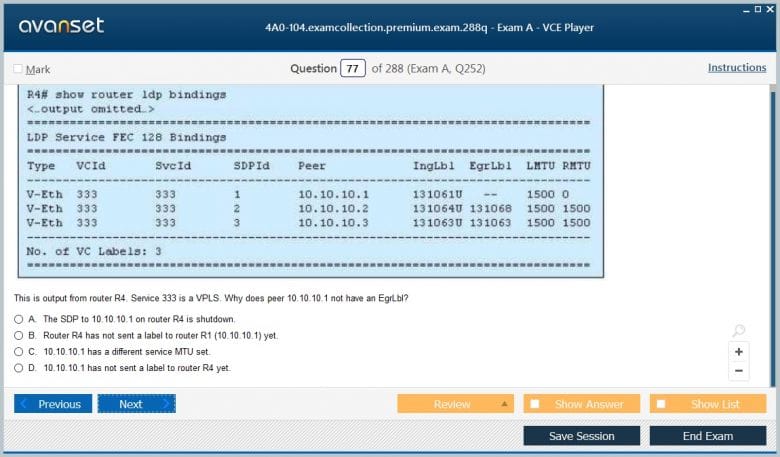
Nokia 4A0-104 Practice Test Questions in VCE Format
| File | Votes | Size | Date |
|---|---|---|---|
File Nokia.actualtests.4A0-104.v2026-09-02.by.agustin.176q.vce |
Votes 1 |
Size 3.27 MB |
Date Sep 02, 2026 |
File Alcatel-Lucent.Test4prep.4A0-104.v2019-03-12.by.Elwell.178q.vce |
Votes 3 |
Size 1.73 MB |
Date Mar 13, 2019 |
Nokia 4A0-104 Practice Test Questions, Exam Dumps
Nokia 4A0-104 (Nokia Services Architecture) exam dumps vce, practice test questions, study guide & video training course to study and pass quickly and easily. Nokia 4A0-104 Nokia Services Architecture exam dumps & practice test questions and answers. You need avanset vce exam simulator in order to study the Nokia 4A0-104 certification exam dumps & Nokia 4A0-104 practice test questions in vce format.
The 4A0-104 exam is Nokia Services Architecture, a current written exam in the Network Routing Specialist II program and a key piece of advanced service-routing study. Nokia lists 40 questions and 90 minutes with no mandatory prerequisite, but the subject assumes that candidates can already reason about routed networks and MPLS transport. Services Architecture is where those lower-level mechanisms are organized into the customer-facing services a provider actually delivers.
The exam is easiest to understand inside the Nokia certifications stack. 4A0-103 MPLS provides the label-switched core, while later exams such as 4A0-105 VPLS and 4A0-106 VPRN examine specific services in depth. 4A0-104 teaches the architectural vocabulary that connects access interfaces, service identifiers, customer separation, control-plane signaling, forwarding behavior, and operations.
A strong study approach is to keep two diagrams for every service: the physical topology and the logical service topology. The physical diagram shows ports, routers, links, and transport. The logical diagram shows customer sites, service access points, service instances, and how traffic is separated. Many errors happen because candidates mentally collapse those two views into one.
A provider service begins at the attachment point where customer traffic enters the network. Learn how access interfaces, encapsulation, VLAN tags, SAPs, and service identifiers distinguish one customer or service from another. The same physical port can carry multiple logical services, so the configuration must make the classification rule explicit.
Use the concepts in Ethernet framing to reason about what the provider receives from the customer and what information can be used to classify it. Then ask what the provider must preserve, rewrite, or discard. This turns tagging from a memorization exercise into a service-boundary decision.
Include MTU and encapsulation overhead in the handoff design. A service may classify customer traffic correctly yet still drop larger frames after additional tags or labels are added. Calculate the expected frame size across the provider edge and verify the physical and logical interfaces can carry it. This is an example of an architectural detail that surfaces later as an apparently random application problem.
A healthy MPLS core does not guarantee a healthy customer service. The transport LSP may be intact while a service binding, pseudowire, route, or attachment circuit is missing. Study operational outputs in layers: first confirm the underlay, then the service control plane, then the customer-facing forwarding state.
Build a troubleshooting table with one row per layer and the evidence expected when that layer is healthy. When a customer reports an outage, work from the common infrastructure toward the specific service rather than making random changes at the edge. This also reduces the risk of disrupting other customers while diagnosing a single service.
Use the scope of impact to guide that layered diagnosis. If many unrelated services fail across the same path, the common transport is suspect. If only one customer or one attachment is affected, the service layer is more likely. This simple reasoning can save time and reduce risky changes because it tells you which shared components should remain untouched while you isolate the fault.
Make the same distinction during monitoring design. Core alarms should identify shared transport failures, while service-level alarms should identify a specific customer or instance. If every event appears only as a device alarm, operations must reconstruct service impact manually during an incident. Good architecture makes dependencies observable as well as technically correct.
Providers rely on logical identifiers to keep customer traffic separated even when many services share the same routers and links. Understand how service IDs, labels, routing instances, and other context prevent one customer's traffic from being forwarded according to another customer's rules. Isolation is both a forwarding requirement and a security requirement.
Lab misbinding scenarios deliberately. Attach an access circuit to the wrong service, use an unexpected VLAN tag, or remove a required identifier and observe what breaks. Then restore the service and verify that traffic is not leaking into an adjacent context. Negative testing is valuable because correct isolation is easier to understand after you have seen what a classification mistake looks like.
A Layer 2 service can make remote sites appear to share an Ethernet domain, while a Layer 3 service places routing responsibility in the provider service. Candidates should understand the operational consequences: broadcast behavior, MAC learning, routing-table separation, customer control, and the scale implications of each model.
When comparing service options, start with the customer's requirement rather than the provider feature. Does the customer need to run its own routing across sites, extend a VLAN, exchange many prefixes, or isolate departments? Once the requirement is clear, the service architecture and troubleshooting model become easier to select.
Add operational ownership to the comparison. A Layer 2 service gives the customer more control over routing but also leaves the customer responsible for some convergence and loop decisions. A Layer 3 service shifts more routing responsibility to the provider. Neither is universally better; the right choice depends on the customer's skills, topology, address plan, scale and desired demarcation of responsibility.
Service protocols exist to create forwarding state. Do not stop at message names; ask what route, label, pseudowire, or service binding the protocol causes a router to install. This mindset is especially important when multiple protocols coexist and a failure in one layer surfaces as missing state somewhere else.
Trace one service from configuration through signaling to forwarding. Record what each router learns and which table changes. Then remove one signaling relationship and predict the exact state that should disappear. This is much more powerful than learning command sequences in isolation.
When several protocols contribute state, annotate the dependency chain. For example, an IGP may reach the remote provider edge, MPLS may create transport, BGP or another service protocol may advertise service information, and the service manager may install the final forwarding object. If the last object is missing, check the chain backward rather than restarting every protocol blindly.
Redundant links and routers matter only if the customer service survives the failure. For every design, identify the failure that redundancy is supposed to cover, the expected convergence behavior, and the customer-visible effect. A topology may be physically redundant while a single service attachment or policy still creates a single point of failure.
During lab failovers, monitor both provider state and customer traffic. Record which sessions reconverge, which labels or routes change, and whether MAC or ARP state must relearn. This creates an operational view of resiliency rather than a purely diagrammatic one.
Document the expected customer-visible behavior for planned maintenance as well as failure. A provider should know whether a service can be moved or rerouted without interruption, whether MAC or routing state must relearn, and whether the customer will see a topology change. Maintenance testing often exposes the same design weaknesses as an unplanned outage but in a controlled setting.
Service-provider networks contain many similar objects, so operational clarity matters. The principles behind router and firewall logging apply here: useful logs, consistent identifiers, timestamps, and change records make it possible to correlate a customer report with control-plane events and configuration changes.
Develop a naming convention that lets an engineer trace a service from ticket to router configuration without guessing. Pair that with pre-change and post-change validation. The exam may focus on architecture, but real service quality depends on whether another engineer can understand and support the design after deployment.
After 4A0-104, the SRA path becomes more service-specific. Study 4A0-107 QoS as a cross-cutting behavior that influences multiple services, and use the current 4A0-115 EVPN exam to understand how modern Ethernet VPN services extend the architecture. The newer 4A0-116 Segment Routing exam adds another transport and traffic-engineering perspective.
For final review, take one fictional customer with three sites and design both a Layer 2 and Layer 3 service. Document access classification, provider transport, control-plane state, forwarding tables, resiliency, QoS, and acceptance tests. If you can explain the differences and operational trade-offs without relying on memorized diagrams, you are ready for architecture-level questions.
Build a small design-review checklist that covers customer requirement, access classification, transport dependency, control-plane signaling, isolation, resiliency, QoS, security, observability and handoff documentation. Apply it to each later service exam. The repetition is useful because the architecture questions stay constant even while the technology implementing them changes.
Add a service-turn-up document to the review. It should state the customer handoff, encapsulation, service identifier, remote endpoints, expected control-plane state, QoS profile, MTU, resilience behavior, monitoring points, and rollback plan. Then verify each item against the running network. Architecture becomes operationally meaningful when the diagram can be translated into an acceptance test another engineer can execute.
Review designs from the customer's perspective as well. The provider may see a healthy pseudowire, label and route, while the customer sees only whether its sites can exchange the intended traffic with the agreed performance and isolation. Translate provider state into customer-visible outcomes during every validation exercise. That habit keeps architecture focused on the service being sold rather than only the machinery delivering it.
A concise architecture summary should also state what is deliberately not provided. If the service does not extend broadcast domains, does not advertise a default route, or does not guarantee a particular failure time, make that boundary explicit. Clear non-goals prevent later teams from assuming capabilities the design never promised.
Go to testing centre with ease on our mind when you use Nokia 4A0-104 vce exam dumps, practice test questions and answers. Nokia 4A0-104 Nokia Services Architecture certification practice test questions and answers, study guide, exam dumps and video training course in vce format to help you study with ease. Prepare with confidence and study using Nokia 4A0-104 exam dumps & practice test questions and answers vce from ExamCollection.
Purchase Individually
Top Nokia Certification Exams
Site Search:

SPECIAL OFFER: GET 10% OFF

Pass your Exam with ExamCollection's PREMIUM files!
SPECIAL OFFER: GET 10% OFF
Use Discount Code:
MIN10OFF
A confirmation link was sent to your e-mail.
Please check your mailbox for a message from support@examcollection.com and follow the directions.

Download Free Demo of VCE Exam Simulator
Experience Avanset VCE Exam Simulator for yourself.
Simply submit your e-mail address below to get started with our interactive software demo of your free trial.