



Premium File
256 Q&A
$76.99$69.99
Nokia 4A0-103 Exam Questions & Answers, Accurate & Verified By IT Experts
Instant Download, Free Fast Updates, 99.6% Pass Rate
256 Questions & Answers
Last Update: Sep 21, 2026
$69.99
Nokia 4A0-103 Exam Screenshots
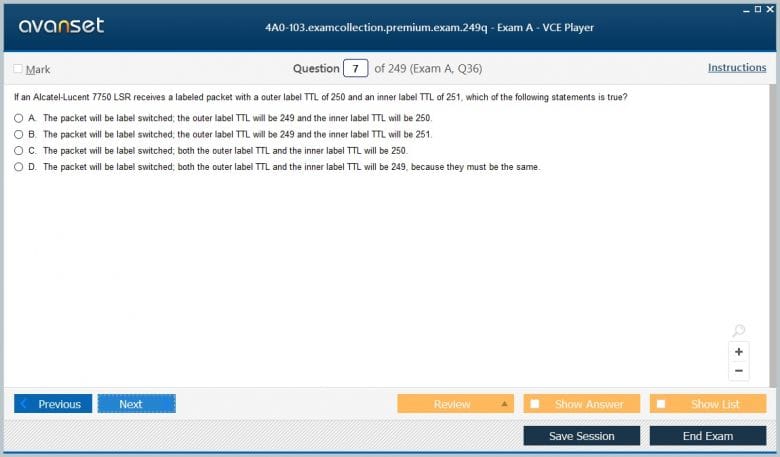
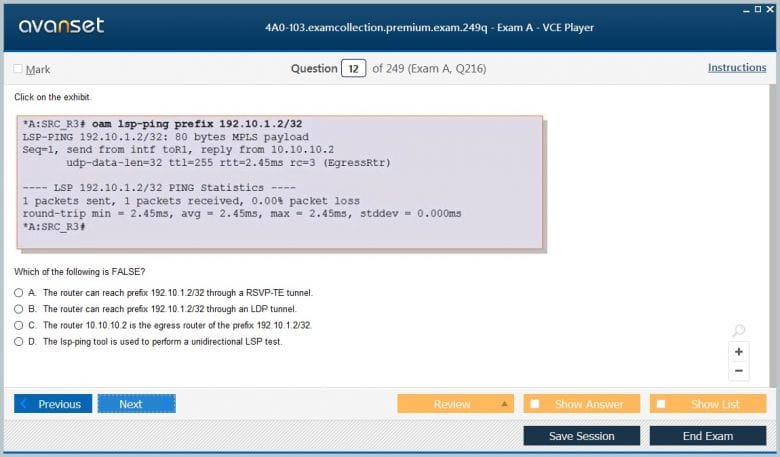
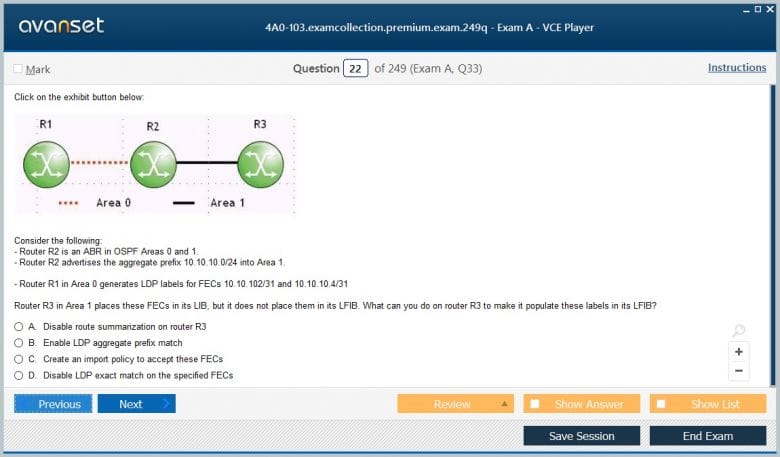
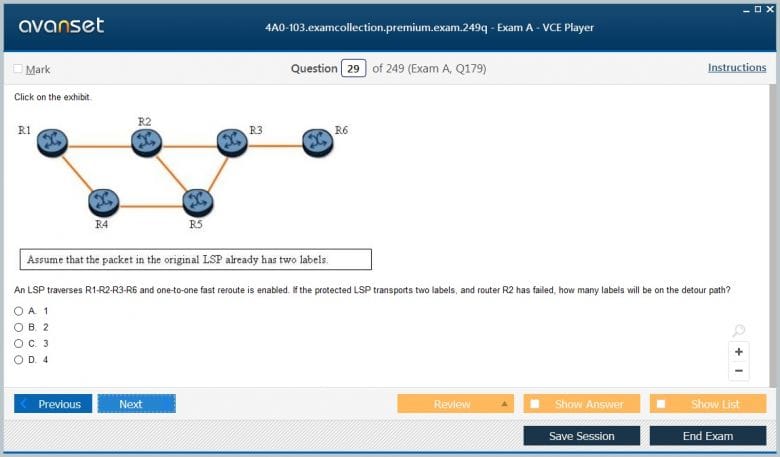
Nokia 4A0-103 Practice Test Questions in VCE Format
| File | Votes | Size | Date |
|---|---|---|---|
File Nokia.braindumps.4A0-103.v2026-08-17.by.erin.149q.vce |
Votes 1 |
Size 3.54 MB |
Date Aug 17, 2026 |
File Alcatel-Lucent.Passcertification.4A0-103.v2019-03-17.by.Karter.155q.vce |
Votes 2 |
Size 2.74 MB |
Date Mar 22, 2019 |
Nokia 4A0-103 Practice Test Questions, Exam Dumps
Nokia 4A0-103 (Nokia Multiprotocol Label Switching) exam dumps vce, practice test questions, study guide & video training course to study and pass quickly and easily. Nokia 4A0-103 Nokia Multiprotocol Label Switching exam dumps & practice test questions and answers. You need avanset vce exam simulator in order to study the Nokia 4A0-103 certification exam dumps & Nokia 4A0-103 practice test questions in vce format.
The 4A0-103 exam is Nokia Multiprotocol Label Switching, a current exam in the Nokia Network Routing Specialist II program. Nokia still lists it in the active NRS II path for advanced service-routing study, and the topic remains foundational to the transport used by many provider services. Candidates should therefore learn MPLS as a forwarding architecture rather than as a list of labels and protocol messages.
In the current Nokia certifications sequence, MPLS sits naturally beside 4A0-104 Services Architecture and the NRS II routing exams such as 4A0-114. IP routing determines where traffic should go; MPLS adds a label-based forwarding plane that can carry traffic across a provider core while supporting service separation, traffic engineering, and scalable edge behavior.
A productive lab starts with a clean routed core, confirms end-to-end IP reachability, then enables label distribution and observes how forwarding changes. If you skip the routed baseline, it becomes difficult to tell whether a broken label-switched path is really an MPLS problem or an unresolved IGP dependency.
An MPLS router assigns traffic to a forwarding equivalence class and uses labels to represent forwarding decisions along the path. Study how labels are imposed, swapped, and removed, and how the label forwarding information base relates to the IP routing table. The label is not meaningful in isolation; it is locally significant state created from routing and label-distribution information.
Trace one packet hop by hop. Record the ingress IP lookup, the label imposed, every swap, and the action at egress. Then repeat after a route changes. This exercise shows why the control plane and data plane must be examined together and prepares you to interpret label tables during troubleshooting.
Compare the control-plane view with an actual packet capture or platform forwarding display. Write the expected label stack before generating the packet, then verify whether the observed values match. If they do not, work backward from the first unexpected action to the route or label binding that created it. This habit turns label tables into evidence rather than static output to memorize.
Label Distribution Protocol can establish sessions and advertise label bindings only when the supporting IP network is correct. Learn discovery, adjacency, session establishment, targeted sessions where relevant, and the way a router associates labels with routes. If an LSP is missing, verify IGP reachability and router identifiers before assuming the label protocol itself is defective.
Create failure drills that break one dependency at a time: remove a route, change an interface state, alter the LDP transport address, or block a session. Capture the resulting routing, adjacency, and label state. This gives you a practical troubleshooting order and reinforces the idea that MPLS does not replace IP routing; it builds on it.
Add ECMP or parallel-path behavior to the lab. Confirm which next hops the IGP installs, how LDP binds labels for the reachable FECs, and how forwarding changes when one parallel path disappears. This makes it clear that MPLS resilience is constrained by the routed topology beneath it and that label state cannot repair an underlay path the IGP no longer considers usable.
Penultimate-hop popping reduces the label-processing work required at the egress by allowing the upstream router to remove the outer label before the packet arrives. Candidates should understand why the behavior exists, how it appears in forwarding tables, and when a label may need to be retained for a particular service or operational reason.
Do not memorize special label values without context. Tie them to the forwarding action they signal and verify them in a lab capture or platform output. When you can explain why the penultimate router performs a pop rather than a swap, the numeric details become easier to remember.
When an LSP fails, inspect the route to the destination FEC, label bindings, session state, forwarding entries, and physical interface health in that order. An isolated command rarely tells the whole story. A label may be present but associated with the wrong next hop, or an LSP may exist while a service layered above it is still broken.
Use traceroute-style and label-aware verification tools where supported and compare control-plane state on consecutive routers. The goal is to find the first point where the expected label or next hop diverges. That is faster and safer than changing configuration at the service edge before proving the core transport is at fault.
Keep an LSP worksheet with source, destination FEC, IGP next hop, learned label, programmed action, and outgoing interface for every hop. During a fault, compare the expected and observed row at each router. The first divergence usually identifies the layer that deserves attention and prevents a broad, disruptive search across every node in the path.
When two routers disagree about a label path, compare the timing of their control-plane updates. A recent IGP change may have reached one node before another, or an LDP session may be reestablishing while stale state is still visible elsewhere. Time correlation matters because snapshots from different moments can make a normal convergence process look like an impossible steady-state mismatch.
A redundant core can still produce unacceptable outages if control-plane or label convergence is slow. Study how routing reconvergence affects label-switched paths and how design choices reduce the failure domain. During labs, fail a link and watch route, label, and traffic behavior together rather than merely confirming that an alternate physical path exists.
Record the order of events during failure and restoration. Did the IGP converge before label state? Did traffic return automatically? Was there transient loss or a loop? This operational evidence helps you evaluate whether redundancy actually meets the service objective.
Different failures may converge differently. A direct interface loss can be detected immediately while a remote failure may depend on protocol timers. Measure both cases and note whether fast-reroute or other protection mechanisms alter the traffic impact. The exam value is understanding that redundancy, failure detection, control-plane convergence and forwarding repair are separate stages of recovery.
Provider services such as VPLS and VPRN use the MPLS core differently while relying on the same fundamental transport. The VPN concepts in tunneling and virtual private networking provide broad context, but Nokia's service exams are where the platform-specific control and forwarding behavior becomes concrete. Think of MPLS as the transport substrate rather than the finished customer service.
Draw a layered diagram for each service you study later: customer attachment, service identifier, control-plane signaling, transport label, and egress forwarding. Seeing the layers prevents you from treating every label in a packet as if it serves the same purpose.
Also compare per-service state with per-transport state. A single transport LSP can support many services, so a failure in the core may affect many customers at once, while one bad service label or binding can isolate a single customer. This distinction is crucial for fault scoping: the number and pattern of affected services often tell you whether to start in the transport or service layer.
A label-switched path does not eliminate congestion, interface errors, or transport limitations. The same basic traffic-congestion principles still apply. If a service is slow, verify interface utilization, drops, queues, latency, and routing changes before blaming label distribution. MPLS can steer traffic efficiently, but it cannot create bandwidth that is not there.
Practice a case where the LSP is healthy but one link is congested. Compare label state with interface counters and queue statistics. This reinforces an important exam and operational lesson: a working control plane is necessary, not sufficient, for a healthy service.
Current candidates should pair MPLS study with 4A0-112 or the other current IGP option, plus Services Architecture and BGP Fundamentals for Services. The 4A0-114 BGP exam places BGP on the services side of the NRS II path. These exams overlap because routing, labels, and services all depend on the same network state.
For final review, build one topology that forces you to verify IP routing, LDP sessions, label bindings, forwarding, convergence, and a service layered on the core. If you can explain every table transition during normal operation and after a failure, you are preparing at a much deeper level than someone who can only reproduce configuration syntax.
Create a final oral walkthrough in which you explain a packet from ingress IP lookup to label imposition, core swaps, penultimate-hop behavior, egress processing, and delivery. Then repeat after a link failure. If you cannot narrate which control-plane information supports each forwarding action, return to the lab until the story is complete.
Also practice reading a topology you did not build. Start with only interface addresses, IGP routes, and partial label output and reconstruct the likely LSP. This is closer to real operations, where an engineer inherits state rather than designing every component. The exercise reveals whether you understand the relationship among routes, label bindings and forwarding strongly enough to infer missing information instead of relying on a familiar lab layout.
Keep a short glossary that separates route, FEC, label binding, LSP, service label and forwarding action. These terms are related but not interchangeable. Precise vocabulary helps when an exam scenario describes one layer indirectly and also improves communication during real incidents where several engineers may be discussing the same path from different perspectives.
Go to testing centre with ease on our mind when you use Nokia 4A0-103 vce exam dumps, practice test questions and answers. Nokia 4A0-103 Nokia Multiprotocol Label Switching certification practice test questions and answers, study guide, exam dumps and video training course in vce format to help you study with ease. Prepare with confidence and study using Nokia 4A0-103 exam dumps & practice test questions and answers vce from ExamCollection.
Purchase Individually
Top Nokia Certification Exams
Site Search:

SPECIAL OFFER: GET 10% OFF

Pass your Exam with ExamCollection's PREMIUM files!
SPECIAL OFFER: GET 10% OFF
Use Discount Code:
MIN10OFF
A confirmation link was sent to your e-mail.
Please check your mailbox for a message from support@examcollection.com and follow the directions.

Download Free Demo of VCE Exam Simulator
Experience Avanset VCE Exam Simulator for yourself.
Simply submit your e-mail address below to get started with our interactive software demo of your free trial.