



Premium File
382 Q&A
$76.99$69.99
Nokia 4A0-100 Exam Questions & Answers, Accurate & Verified By IT Experts
Instant Download, Free Fast Updates, 99.6% Pass Rate
382 Questions & Answers
Last Update: Aug 31, 2026
$69.99
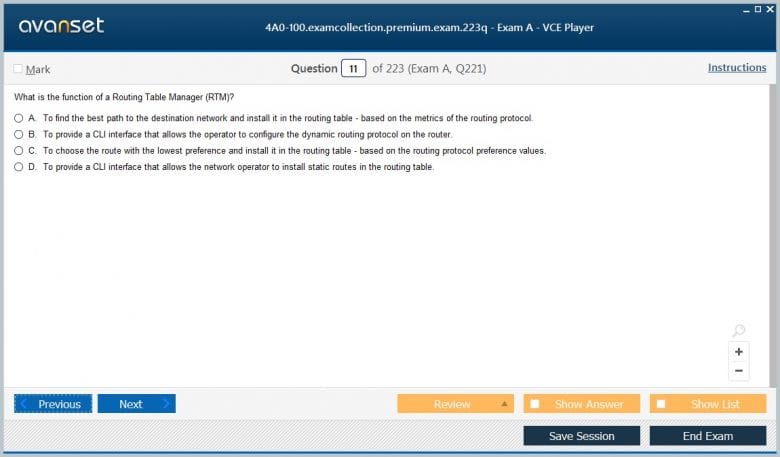
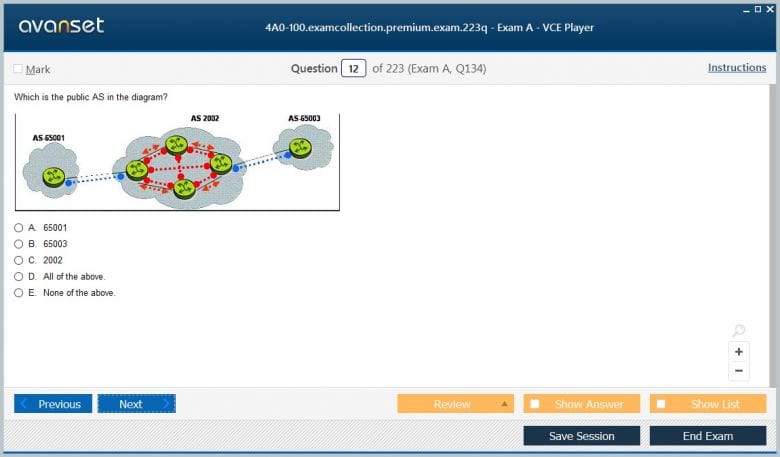
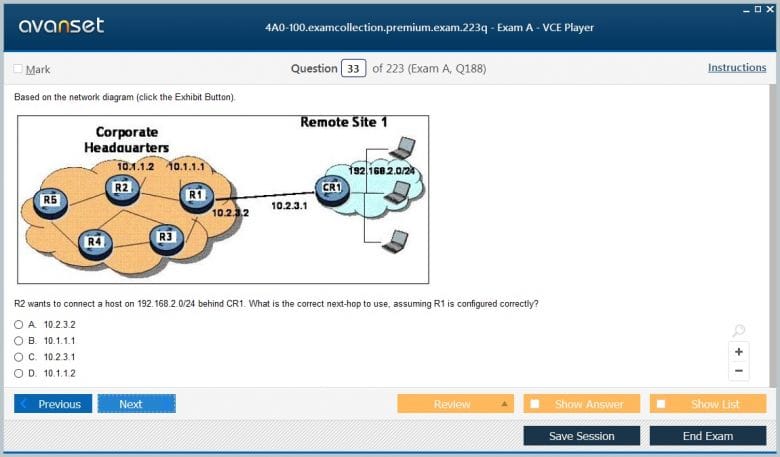
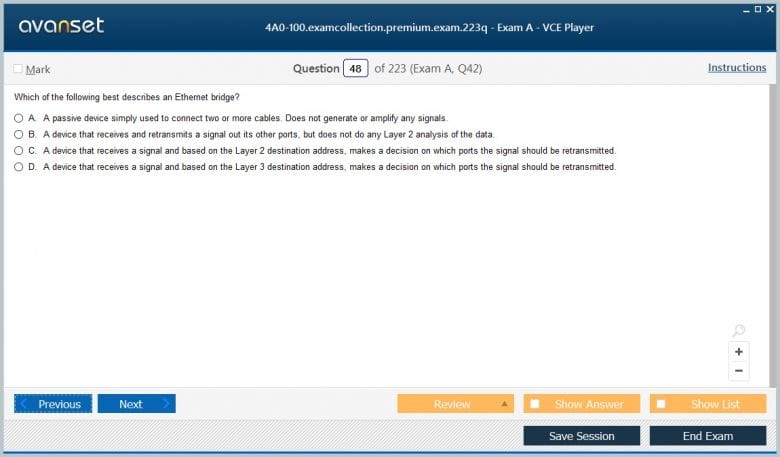
Nokia 4A0-100 Exam Screenshots
Nokia 4A0-100 Practice Test Questions in VCE Format
| File | Votes | Size | Date |
|---|---|---|---|
File Nokia.practicetest.4A0-100.v2026-08-07.by.greyson.208q.vce |
Votes 1 |
Size 2.01 MB |
Date Aug 07, 2026 |
File Nokia.test-inside.4A0-100.v2021-04-29.by.zara.194q.vce |
Votes 1 |
Size 1.63 MB |
Date Apr 28, 2021 |
File Nokia.real-exams.4A0-100.v2020-03-17.by.benjamin.182q.vce |
Votes 2 |
Size 1.39 MB |
Date Mar 17, 2020 |
File Nokia.Passit4sure.4A0-100.v2019-05-08.by.Frank.157q.vce |
Votes 4 |
Size 696.88 KB |
Date May 13, 2019 |
File Alcatel-Lucent.Actualtests.4A0-100.v2015-04-04.by.Gladys.245q.vce |
Votes 4 |
Size 802.63 KB |
Date Apr 04, 2015 |
File Alcatel-Lucent.Actualanswers.4A0-100.v2013-12-26.by.Watson.194q.vce |
Votes 15 |
Size 970.13 KB |
Date Dec 26, 2013 |
Nokia 4A0-100 Practice Test Questions, Exam Dumps
Nokia 4A0-100 (Nokia IP Networks and Services Fundamentals) exam dumps vce, practice test questions, study guide & video training course to study and pass quickly and easily. Nokia 4A0-100 Nokia IP Networks and Services Fundamentals exam dumps & practice test questions and answers. You need avanset vce exam simulator in order to study the Nokia 4A0-100 certification exam dumps & Nokia 4A0-100 practice test questions in vce format.
The 4A0-100 exam is Nokia's IP Networks and Services Fundamentals examination and remains the written requirement for the Nokia Certified Network Routing Specialist I credential. Nokia currently lists 40 questions, 90 minutes of exam time, and no mandatory prerequisite. Nokia has also announced that the exam will be updated on March 9, 2027 and unavailable from February 9 through March 8, 2027, so candidates preparing now should use the current objectives while keeping the scheduled refresh in view.
The broader Nokia certifications path explains the exam's role. 4A0-100 is a foundation for service-router study: IP addressing, forwarding, Ethernet, routing concepts, transport behavior, service-provider context, and the logic of common network devices. Those subjects lead naturally into deeper routing and services work such as 4A0-103 MPLS and the current NRS II routing exams. The goal is not to turn an entry candidate into an architect, but to build a mental model strong enough that later protocol details have somewhere to fit.
A useful preparation habit is to connect the syllabus to packet movement. The concepts in the OSI model and TCP/IP communication are most valuable when used to explain what actually happens as traffic moves from an application through a host, switch, router, provider network, and destination. If you can narrate that journey, many apparently separate exam topics become variations of the same forwarding story.
IPv4 and IPv6 addressing are easier when you can see the boundary between network and host information rather than memorizing isolated prefix facts. Practice translating between masks and prefixes, identifying usable ranges, recognizing network and broadcast behavior where applicable, and deciding whether two addresses are local to each other. Then add the operational question: if the hosts are not local, which next hop will carry the traffic?
Use progressively messier examples. Start with clean /24 and /64 networks, then move to smaller IPv4 subnets, summarization decisions, point-to-point links, and mixed topologies. Explain each answer in terms of forwarding, not just arithmetic. This makes subnetting a network-design skill and reduces the temptation to rely on shortcuts that fail when the prefix is unfamiliar.
Add route summarization to the same exercises. Given several adjacent prefixes, determine whether they can be represented by a shorter aggregate without also covering networks that should remain separate. Then reverse the problem: expand an aggregate into its component ranges and identify which subnet contains a host. These drills prepare you for later service-provider routing where compact route advertisements and exact prefix boundaries both matter.
Ethernet is more than speed and cable types. Know how MAC addresses are learned, how switches build forwarding tables, what happens to unknown unicast and broadcast traffic, and how loops can destabilize a Layer 2 domain. The broader Ethernet fundamentals are useful because service-router networks still depend on predictable Layer 2 behavior at access and handoff points.
Lab with a small switched topology and observe what changes after a MAC table ages out, a host moves ports, or a link fails. Then trace an ARP or neighbor-discovery exchange and relate it to the frame destination used on the local segment. These exercises turn several memorized protocols into one coherent local-delivery process.
Include link aggregation and redundancy in the Layer 2 picture. A bundled link can provide more capacity and resilience, but only when member links agree on configuration and the hashing behavior matches the traffic pattern. Compare a physical-link failure with a forwarding-loop problem: both can cause disruption, yet the counters and topology evidence look very different. Learning to distinguish them early creates a better troubleshooting habit for later Nokia labs.
Routers do not forward based on intent; they compare the destination against the routing table, select the best matching prefix according to the platform's rules, resolve the next hop, and send the packet out an interface. Practice reading routing tables with connected, static, default, and dynamically learned routes. The key skill is to predict which entry wins and why.
Create troubleshooting cases where the routing table contains a route but traffic still fails. The next hop may be unreachable, the return path may differ, the interface may be down, or a filter may drop the packet. This prevents an overly narrow habit of treating the presence of a route as proof that end-to-end forwarding must work.
Pair forwarding-table exercises with packet headers. Change the destination address, TTL or hop limit, and next-hop reachability and predict which field or table entry changes the outcome. Then compare a router-generated packet with a transit packet. This reinforces that routing is a repeated local decision made at each hop, not an end-to-end reservation of one fixed path.
At the foundation level, understand why networks use dynamic routing, how interior and exterior routing differ, and why convergence matters. You do not need the depth of 4A0-102 BGP for Internet Routing yet, but you should understand the problem BGP solves compared with an IGP. The same is true of the current NRS II routing path, which also includes 4A0-112 and 4A0-114.
When studying a protocol, first ask what information it exchanges, with whom, and how the result affects the routing table. Only then add packet types, timers, and metrics. This order keeps protocol details connected to the forwarding outcome and makes later vendor-specific configuration much easier to learn.
TCP and UDP differ in connection handling, reliability, sequencing, and overhead, but the exam value comes from recognizing how those properties affect applications. A successful ping does not prove that a TCP service is listening, and an open transport session does not prove that the application is healthy. Separate reachability, transport establishment, and application response in your troubleshooting sequence.
Practice with common services and ports, but avoid rote port-number study without context. Ask whether the application is client/server or peer-to-peer, whether it relies on TCP or UDP, and how DNS or other dependencies influence the session. This creates a layered diagnostic model instead of a disconnected list of numbers.
Add MTU and fragmentation scenarios. A small diagnostic packet may pass while a larger application flow fails because one segment cannot carry the packet size or because path-MTU discovery is disrupted. When troubleshooting, compare packet size, DF behavior, interface MTU, and ICMP feedback instead of assuming that successful basic reachability proves the path can carry the application reliably.
Switches, routers, firewalls, access devices, and service routers can all move traffic, but they make different decisions and maintain different state. The core networking devices concept is useful when you compare them by forwarding layer, table or state used, and the boundaries they create. A service router may combine several functions, yet the underlying decisions remain distinct.
Draw a simple provider edge and enterprise edge and label which device owns each responsibility: Layer 2 adjacency, IP routing, policy enforcement, translation, and service handoff. If a packet is dropped, identify which table or state you would inspect first on each device. This links architecture to troubleshooting.
A network can have enough nominal bandwidth and still perform badly because of queueing, loss, retransmissions, or poorly matched traffic patterns. The discussion of network congestion is relevant because service quality depends on what happens when demand exceeds an interface or path's ability to forward immediately. Understand throughput, latency, jitter, and loss as related but different measurements.
Use small calculations and diagrams to reason about bottlenecks. If a fast access link feeds a slower WAN, the bottleneck is not the access port. If loss forces retransmission, application throughput may fall even when interface utilization looks moderate. These basic performance relationships prepare you for later QoS study in 4A0-107.
Build a simple queueing thought experiment. Two flows may share the same bottleneck but experience different application results because one is delay-sensitive and the other can tolerate buffering. This prepares you for 4A0-107 without requiring advanced QoS configuration yet. The important foundation is recognizing that throughput, delay, jitter and loss describe different aspects of service quality and must be measured separately.
The scheduled March 2027 refresh should change how you manage timing, not how you study fundamentals. If you plan to test before the February blackout, prepare against the current official objectives and practice exam. If your test date will fall after the update, expect Nokia to publish revised objectives and reconcile your notes once they appear.
Finish with mixed labs that require addressing, switching, routing-table interpretation, basic protocol reasoning, and fault isolation in the same topology. That is a stronger readiness signal than completing isolated chapter quizzes because real network behavior crosses layers continuously. The durable fundamentals will remain useful even when Nokia updates the exam version.
Keep a change log in your notes as Nokia publishes new material. Do not rewrite the entire study plan every time a page changes; record the date, the affected topic, and whether the change alters a fundamental concept or only a product/version detail. That makes the March 2027 transition manageable and prevents new objectives from being mixed accidentally with the version you intend to sit.
Keep the official Nokia practice exam separate from your lab notes. Use the practice questions to identify conceptual weak spots, then reproduce the related behavior in a topology whenever possible. This two-way process—question to lab and lab back to explanation—helps prevent a future exam refresh from making your preparation obsolete overnight.
Go to testing centre with ease on our mind when you use Nokia 4A0-100 vce exam dumps, practice test questions and answers. Nokia 4A0-100 Nokia IP Networks and Services Fundamentals certification practice test questions and answers, study guide, exam dumps and video training course in vce format to help you study with ease. Prepare with confidence and study using Nokia 4A0-100 exam dumps & practice test questions and answers vce from ExamCollection.
Purchase Individually
Top Nokia Certification Exams
Site Search:

SPECIAL OFFER: GET 10% OFF

Pass your Exam with ExamCollection's PREMIUM files!
SPECIAL OFFER: GET 10% OFF
Use Discount Code:
MIN10OFF
A confirmation link was sent to your e-mail.
Please check your mailbox for a message from support@examcollection.com and follow the directions.

Download Free Demo of VCE Exam Simulator
Experience Avanset VCE Exam Simulator for yourself.
Simply submit your e-mail address below to get started with our interactive software demo of your free trial.