

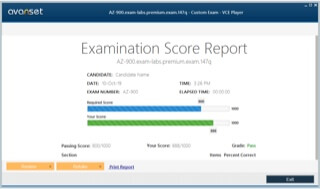

Premium File
193 Q&A
$76.99$69.99
Nokia 4A0-105 Exam Questions & Answers, Accurate & Verified By IT Experts
Instant Download, Free Fast Updates, 99.6% Pass Rate
193 Questions & Answers
Last Update: Sep 18, 2026
$69.99
Nokia 4A0-105 Exam Screenshots
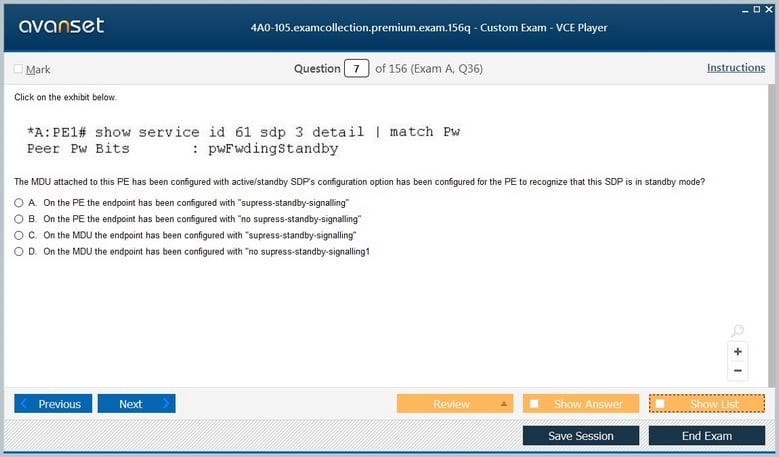
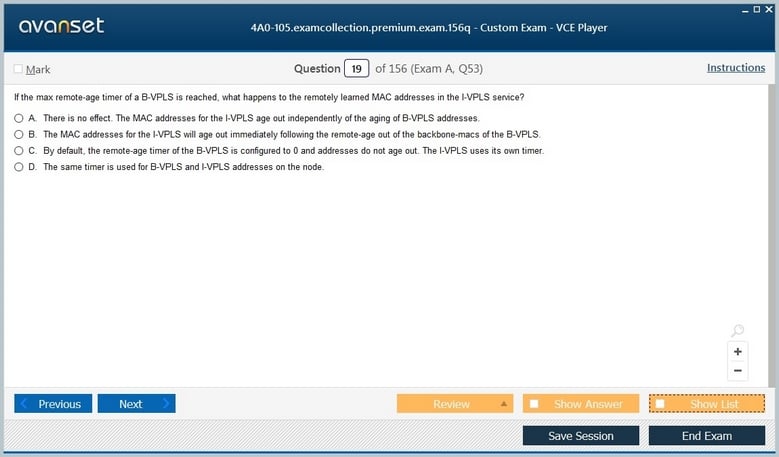
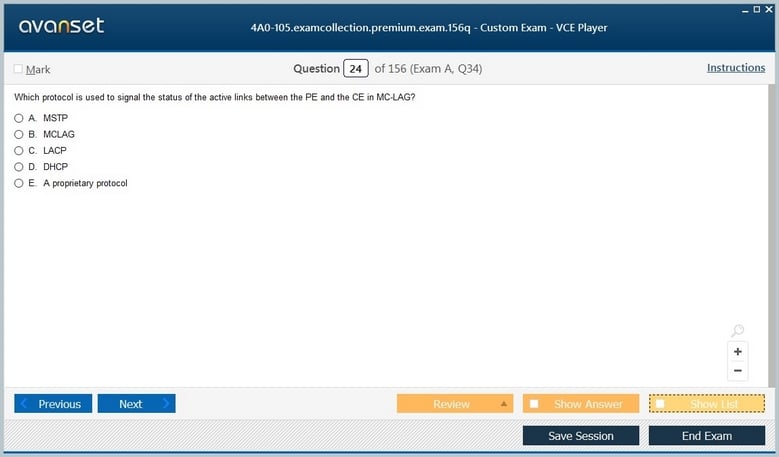
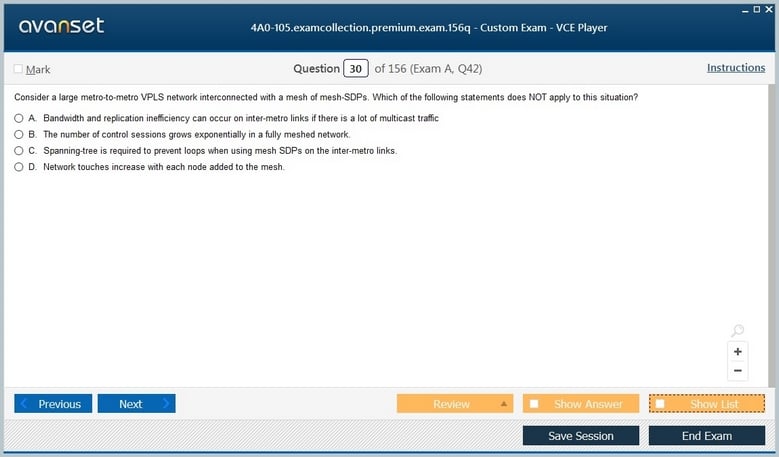
Nokia 4A0-105 Practice Test Questions in VCE Format
| File | Votes | Size | Date |
|---|---|---|---|
File Alcatel-Lucent.Passcertification.4A0-105.v2026-07-10.by.Jace.97q.vce |
Votes 2 |
Size 1.93 MB |
Date Jul 14, 2026 |
Nokia 4A0-105 Practice Test Questions, Exam Dumps
Nokia 4A0-105 (Nokia Virtual Private LAN Services) exam dumps vce, practice test questions, study guide & video training course to study and pass quickly and easily. Nokia 4A0-105 Nokia Virtual Private LAN Services exam dumps & practice test questions and answers. You need avanset vce exam simulator in order to study the Nokia 4A0-105 certification exam dumps & Nokia 4A0-105 practice test questions in vce format.
The 4A0-105 exam is Nokia Virtual Private LAN Services, a current Service Routing Architect written exam. Nokia lists 40 questions, 90 minutes, and no mandatory prerequisite. In the current SRA path it sits beside 4A0-102 BGP, 4A0-106 VPRN, 4A0-107 QoS, and EVPN. That placement makes sense because VPLS is not merely an Ethernet topic: it is a multipoint Layer 2 service built on provider transport and control-plane mechanisms.
Within Nokia certifications, candidates should think of VPLS as a distributed virtual switch. Customer sites attach at service access points, the provider carries Ethernet frames across pseudowires, and participating provider-edge routers learn enough state to deliver traffic to the correct site. The broad VPN and tunneling concepts are useful background, but the Nokia exam expects much more precise reasoning about service identifiers, MAC learning, flooding, split horizon, and operational state.
The best lab is multipoint. Two sites can hide behaviors that become obvious with three or four. Build several customer attachments, generate traffic between them, inspect MAC tables on each provider edge, and observe how unknown traffic is flooded. Then break one spoke or pseudowire and watch how the rest of the service behaves.
Ethernet switches learn source MAC addresses and forward known destinations selectively; VPLS extends that learning model across provider edges. Study which MAC addresses are learned from local customer access and which are learned through remote service paths. Unknown destinations, broadcasts, and multicasts must be replicated appropriately without creating loops.
Practice tracing one source MAC as it appears at multiple provider edges. Then move the customer device to a different site and observe aging or relearning. This makes MAC mobility and stale forwarding state tangible rather than abstract.
Include destination-MAC behavior in the trace. For a known remote MAC, identify exactly which service path should carry the frame; for an unknown destination, identify every place the frame may be replicated. Then compare the forwarding after learning has occurred. This demonstrates why the same customer flow can create very different provider traffic depending on the state of the MAC tables.
The access side can classify traffic by port, VLAN, encapsulation, or other service-specific criteria. A correct core cannot compensate for an incorrect classification at the edge. Candidates should know how a customer frame is matched into the service and what happens when the encapsulation or tag does not meet the expected rule.
Use acceptance tests that include both positive and negative cases. Confirm intended VLANs pass, unintended VLANs do not, MTU is sufficient, and customer control traffic is handled as designed. These tests reduce the risk of declaring the VPLS healthy just because one ping succeeds.
Add customer-edge mistakes to the acceptance plan. A trunk may send an unexpected native VLAN, a tag may be rewritten upstream, or the customer may exceed the agreed MTU. Capturing traffic on both sides of the handoff shows whether the provider received the frame it expected. This is often faster than troubleshooting the pseudowire when the frame never entered the correct service at all.
A VPLS instance needs remote connectivity between provider edges. Study how service signaling establishes these relationships, how labels identify the service over the MPLS transport, and which operational states indicate that a pseudowire is usable. Keep the transport label and service label conceptually separate even when they appear together in the data plane.
When a remote site is unreachable, verify underlay LSP reachability before troubleshooting the service pseudowire. Then inspect service state, labels, and remote identifiers. This layered order avoids changing VPLS configuration when the actual fault is a broken transport path.
If the pseudowire is down, distinguish signaling failure from transport failure. The service may know the remote endpoint but be unable to reach it across the MPLS core, or the transport may be healthy while service identifiers do not match. Record the remote peer, labels, operational status and underlying LSP so the dependency is explicit.
Flooding traffic among many provider edges creates loop risk if frames can be reflected back through the same logical mesh without control. Understand the split-horizon behavior Nokia uses to prevent inappropriate forwarding between service paths. The principle is simple: a distributed bridge still needs rules that stop loops just as a physical bridged network does.
Create a diagram showing which traffic may move from local access to remote service paths and which forwarding combinations are prohibited. Use that diagram to explain why an apparently redundant service topology does not behave like an uncontrolled Ethernet loop.
A large Layer 2 domain can accumulate significant MAC state and broadcast or unknown-unicast traffic. The same congestion and traffic-volume principles that matter on LANs also matter when a provider carries many customer frames across a shared core. Candidates should understand aging, flooding, replication, and the operational consequences of a noisy customer segment.
In labs, clear a MAC table and measure what happens to traffic until learning stabilizes. Then generate a burst of broadcast traffic and inspect counters. This makes it easier to recognize whether a problem is a control-plane failure or simply expected flooding amplified by the size of the service.
Plan for MAC churn as well as absolute scale. A service with many devices that move frequently can create control and forwarding pressure even if the total MAC count is within limits. Track moves, aging, and relearning during a simulated site failover. This is particularly useful in data-center or mobility scenarios where endpoint location changes are normal rather than exceptional.
A VPLS can have multiple failure points: customer access, provider edge, MPLS transport, pseudowire signaling, or remote attachment. Redundancy should be designed so that loss of one component does not leave stale forwarding state or create unexpected duplication. Understand what must reconverge at each layer after a failure.
Test failures while continuous traffic runs among multiple sites. Observe which MAC entries age or move, whether remote paths recover, and how long the customer experiences loss. If the service recovers but takes longer than the business can tolerate, the design still has a resiliency problem.
Consider dual-homed customer access and the possibility of duplicate forwarding during convergence. The resilience design should define which attachment is active, how failover is detected, and how stale MAC state is corrected after the move. A redundant circuit is only useful when the service logic can transition cleanly between attachment points.
Start with the customer-facing symptom and identify whether the failure affects one site, one pair of sites, or the whole service. A single site suggests access classification or a local provider-edge issue; all remote sites failing may point to transport or service signaling; intermittent reachability may indicate MAC movement or flooding behavior.
Capture evidence at the service boundary before changing anything. Confirm ingress counters, service association, learned MAC addresses, pseudowire state, and transport reachability. This sequence gives you a defensible fault domain and reduces the chance of causing a larger outage during troubleshooting.
After restoring service, clear or verify stale MAC state carefully rather than declaring success after the first successful packet. A VPLS can appear recovered for one destination while other endpoints still point to an old attachment. Test several known and unknown destinations across multiple sites so the validation covers both learned forwarding and flooding behavior.
Nokia's current SRA requirements include 4A0-115 Ethernet Virtual Private Network Services, so VPLS candidates benefit from understanding why EVPN became important. Both deliver Ethernet services, but EVPN introduces a more explicit control-plane approach to distributing endpoint information and supporting modern multihoming models.
Do not replace VPLS study with EVPN study; 4A0-105 still tests VPLS itself. Instead, use the comparison to clarify what VPLS learns in the data plane, what it floods, and how its signaling model differs. The contrast makes both technologies easier to reason about and prepares you for the wider SRA service portfolio.
Use the comparison as a control-plane exercise. List which endpoint information VPLS learns from data-plane traffic and which EVPN can advertise explicitly. Then identify what flooding remains necessary in each design. This helps explain the operational motivation for EVPN without turning a VPLS study session into an unrelated newer-exam review.
Finish VPLS study with a controlled migration thought experiment. Imagine a customer service moving from an older VPLS design toward EVPN. Identify what must remain stable for the customer—addressing, VLAN handoff, reachability and service-level behavior—and which provider control-plane mechanisms may change underneath. This separates the service contract from the implementation and helps explain why providers can modernize the core without forcing every customer to redesign at the same time.
Document the expected MAC-learning pattern before testing the migration case. If a remote endpoint should be learned through one service path but appears through another, that can reveal a loop, stale state or incorrect attachment. A written expectation makes verification objective and prevents engineers from accepting whatever table happens to appear after the change.
When validating a multipoint service, include traffic between every meaningful pair of sites instead of testing only from a central site. A partial mesh problem can remain hidden if all tests originate from one location. Pairwise validation exposes asymmetric pseudowire, learning, and access issues that a hub-only test misses.
Go to testing centre with ease on our mind when you use Nokia 4A0-105 vce exam dumps, practice test questions and answers. Nokia 4A0-105 Nokia Virtual Private LAN Services certification practice test questions and answers, study guide, exam dumps and video training course in vce format to help you study with ease. Prepare with confidence and study using Nokia 4A0-105 exam dumps & practice test questions and answers vce from ExamCollection.
Purchase Individually
Top Nokia Certification Exams
Site Search:

SPECIAL OFFER: GET 10% OFF

Pass your Exam with ExamCollection's PREMIUM files!
SPECIAL OFFER: GET 10% OFF
Use Discount Code:
MIN10OFF
A confirmation link was sent to your e-mail.
Please check your mailbox for a message from support@examcollection.com and follow the directions.

Download Free Demo of VCE Exam Simulator
Experience Avanset VCE Exam Simulator for yourself.
Simply submit your e-mail address below to get started with our interactive software demo of your free trial.