
Pass Your Six Sigma Lean Six Sigma Black Belt Certification Easy!
Six Sigma Lean Six Sigma Black Belt Certification Exams Questions & Answers, Accurate & Verified By IT Experts
Instant Download, Free Fast Updates, 99.6% Pass Rate.

$69.99
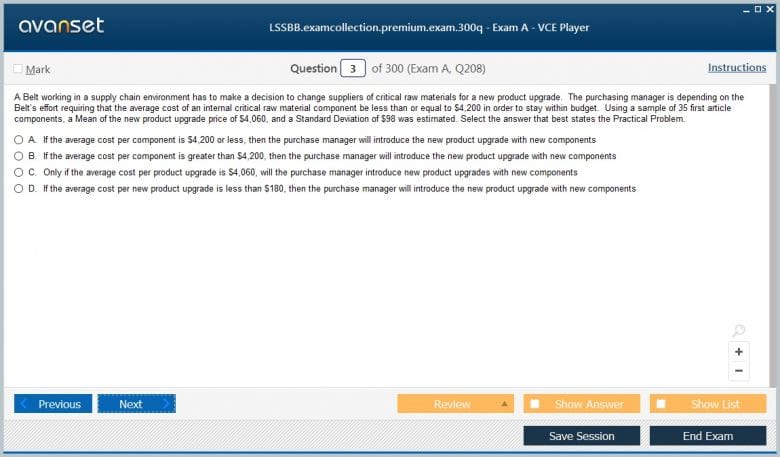
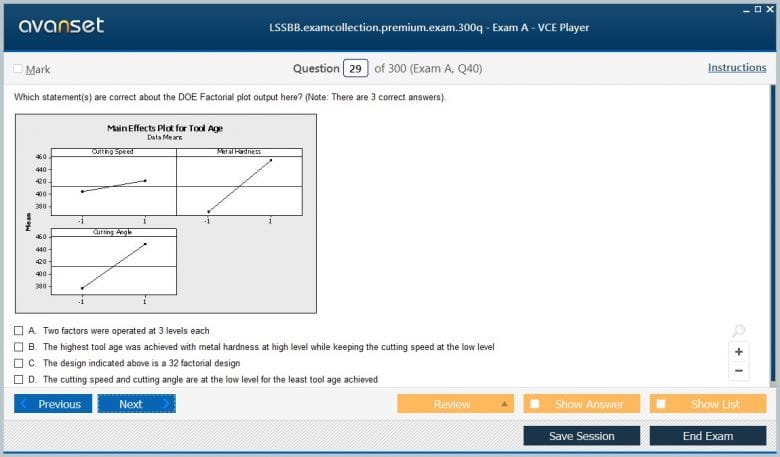
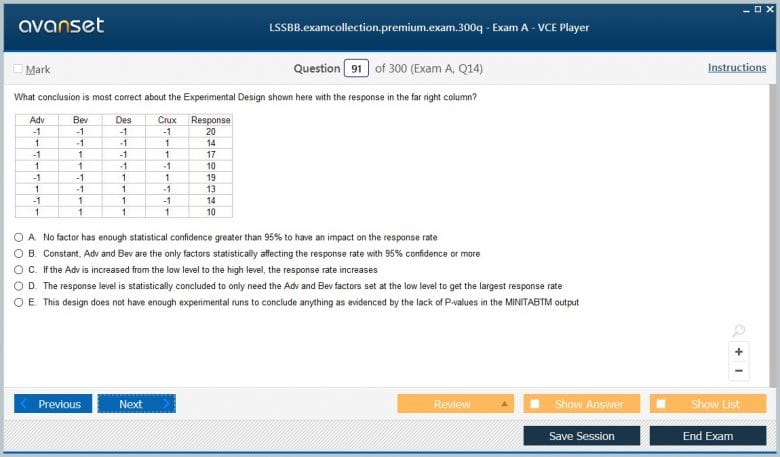
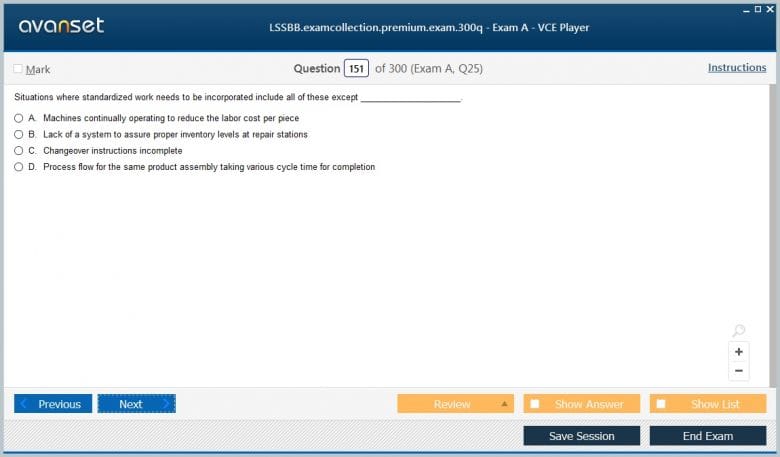
Six Sigma Lean Six Sigma Black Belt Certification Exams Screenshots
Lean Six Sigma Black Belt Product Reviews
Download Free Lean Six Sigma Black Belt Practice Test Questions VCE Files
| Exam | Title | Files |
|---|---|---|
Exam LSSBB |
Title Lean Six Sigma Black Belt |
Files 5 |
Six Sigma Lean Six Sigma Black Belt Certification Exam Dumps & Practice Test Questions
Prepare with top-notch Six Sigma Lean Six Sigma Black Belt certification practice test questions and answers, vce exam dumps, study guide, video training course from ExamCollection. All Six Sigma Lean Six Sigma Black Belt certification exam dumps & practice test questions and answers are uploaded by users who have passed the exam themselves and formatted them into vce file format.
Lean Six Sigma Black Belt: Leading DMAIC with Statistical Discipline
A Lean Six Sigma Black Belt is expected to do more than know improvement tools. The role combines project leadership, process diagnosis, statistical reasoning, facilitation, change management, and the ability to turn an ambiguous business problem into a controlled improvement effort. Current certification providers continue to use Black Belt as an advanced level, but their exam structures, prerequisites, project requirements, and renewal rules differ, so candidates should always verify the provider they plan to use.
For exam preparation, the LSSBB exam is a useful focal point, but Black Belt readiness is better judged through complete DMAIC projects. A candidate should be able to defend the project charter, measurement system, analytical method, improvement decision, and control design. Knowing which menu produces a regression output is less important than knowing whether regression is appropriate and how its result changes the decision.
The broader Lean Six Sigma framework gives Black Belts two complementary responsibilities: improve flow and remove non-value-added work, while also controlling variation and defects with evidence. Strong practitioners move between those lenses instead of forcing every problem into a statistical test or every delay into a waste category.
Black Belt work begins with selecting the right problem
Large improvement projects consume attention across functions, so poor project selection is expensive. A Black Belt should test whether the problem is important, measurable, scoped, connected to organizational goals, and likely to benefit from structured improvement. Projects with predetermined solutions, unstable sponsorship, or no credible data source often fail before DMAIC has a chance to help.
Practice evaluating candidate projects using business impact, customer impact, feasibility, data availability, risk, and controllability. A project to reduce late shipments may be promising if the organization can measure cycle time and influence the process. A project to “improve employee motivation” may require clearer operational definitions before it belongs in a DMAIC portfolio. The Black Belt’s first contribution is often narrowing the problem.
Define turns stakeholder frustration into an operational contract
The Define phase establishes the problem statement, goal, scope, customer requirements, team, timeline, and expected business value. Voice-of-customer information should be translated into requirements that can be measured rather than left as general sentiment. A charter is useful when it constrains the project and aligns expectations; it is not useful when it simply repeats the sponsor’s complaint in formal language.
Build practice charters that include explicit exclusions. If the project covers domestic order fulfillment from one distribution center, say so. Use SIPOC and high-level process mapping to make boundaries visible, then identify stakeholders who own upstream inputs or downstream outcomes. Black Belts reduce later conflict by making the project agreement clear before the team invests in detailed analysis.
Measure requires confidence in the measurement system, not just a larger spreadsheet
Before calculating capability, trends, or baseline performance, the team must know that the data represents the process consistently. Operational definitions, sampling plans, data types, measurement system analysis, and collection discipline are part of the analytical foundation. If inspectors classify defects differently or timestamps are captured at inconsistent process points, more observations do not automatically make the conclusion more reliable.
For variable measurements, study repeatability and reproducibility concepts; for attribute data, study agreement and classification quality. Then connect measurement error to business risk. A process can appear unstable because the gauge is inconsistent, and a defect rate can change because the definition changed. The Black Belt should be able to separate process variation from measurement variation before asking the team to redesign the process.
Analyze is where statistical technique must remain subordinate to the question
Black Belt curricula commonly include probability, distributions, hypothesis testing, correlation, regression, analysis of variance, capability, and other statistical methods. These tools can narrow uncertainty, but they do not replace process knowledge or causal reasoning. The best analysis begins with a specific question: which factors may explain the defect, delay, or variation, and what evidence would distinguish competing explanations?
Practice with data sets where the obvious visual pattern is misleading. Stratify by shift, supplier, machine, product family, or channel and see whether the relationship changes. Check assumptions before applying a test, interpret confidence intervals rather than only p-values, and distinguish statistical significance from operational significance. A tiny effect can be statistically clear and still not justify the cost or risk of changing the process.
Lean analysis exposes flow problems that averages can hide
Cycle time can be dominated by waiting even when the value-adding work is efficient. Value-stream mapping, takt concepts, work-in-process analysis, pull systems, 5S, standard work, setup reduction, and mistake-proofing help teams see where flow is constrained. Black Belts should recognize when the most important improvement opportunity is not a sophisticated model but a queue, handoff, batching rule, or unnecessary approval.
Walk the process physically or virtually instead of relying entirely on documented procedures. Measure elapsed time and touch time separately. Follow one item through the system and record where it waits, loops, or returns for correction. Lean Six Sigma methods combine this attention to flow with variation reduction, but the two problems remain related rather than identical.
Improve should use experiments that make causal claims more credible
Improvement ideas often arrive before the analysis is complete because teams already have favorite solutions. A Black Belt should create a disciplined path from root cause to countermeasure, compare alternatives, evaluate risk, and use pilots or designed experiments when appropriate. Design of experiments becomes especially valuable when several controllable factors may interact and one-factor-at-a-time testing would miss those interactions.
Define the response measure and decision rule before changing the process. If a pilot reduces average cycle time but increases variation or defect risk, the result may not be acceptable. If two factors interact, optimizing one in isolation may fail. Improvement is strongest when the team can explain why the change should work, what evidence shows that it did, and what new risks were introduced.
Black Belts lead teams through uncertainty as much as through analysis
Cross-functional projects bring different incentives, authority levels, and technical languages into one room. Facilitation, conflict management, stakeholder communication, meeting design, and coaching are therefore part of the job. A statistically correct recommendation can still fail if the process owner does not trust the evidence or the affected team does not understand how the new process will work.
Practice explaining the same result to three audiences: an operator, a finance leader, and a technical specialist. Each needs different detail without changing the underlying conclusion. Use visual evidence, clear assumptions, and explicit decisions. A Green Belt may lead a defined improvement effort; the Black Belt is more often expected to coordinate multiple disciplines and coach others through the reasoning.
Control plans must define how the organization reacts when performance changes
Control charts, process metrics, standard work, visual management, ownership, audits, and response plans protect the improvement after the project team steps away. A control chart is not a decorative proof that the project used statistics. The team needs to know what constitutes a signal, who investigates it, which actions are authorized, and how the baseline or limits are updated when the process legitimately changes.
Build a control plan for a process you know. Include metric definition, collection frequency, owner, threshold or statistical rule, escalation path, and response. Then imagine the sponsor leaves six months later. Would a new manager understand why the controls exist and what to do with them? Sustainable improvement means the process can defend its gains without depending on the Black Belt’s memory.
Black Belts should also practice presenting uncertainty without weakening the decision. A confidence interval, residual pattern, capability estimate, or imperfect measurement system may limit how strongly a conclusion can be stated. Good leadership makes those limits visible, then identifies the next piece of evidence that would reduce risk. That is more credible than turning statistical output into certainty it cannot support.
A Black Belt portfolio should prove both analytical depth and business judgment
Use the Six Sigma certification family to compare related credentials, but keep a separate portfolio of applied work. A strong project record includes the original problem, baseline, measurement decisions, analytical evidence, rejected hypotheses, selected changes, quantified results, risks, and control plan. It should also explain where the team changed course after learning something new.
Real project evidence is useful even when the chosen certification provider does not require a project. It forces the candidate to connect tools across phases and exposes weak areas that practice questions can hide. A concrete defect identification and correction case shows why technical improvement becomes valuable only when measurement, diagnosis, and corrective action stay connected to the process.
Lean Six Sigma Black Belt remains a meaningful advanced path because complex processes still need people who can lead evidence-based change across functions. Automation and analytics can accelerate measurement, but they do not decide which problem matters, whether data is trustworthy, or whether an intervention is operationally sensible.
The strongest candidates prepare by leading the reasoning end to end. They can challenge a weak charter, repair a bad measurement plan, choose analysis that fits the question, pilot a change safely, communicate uncertainty, and leave behind controls that process owners can actually operate. That is the standard a Black Belt title should represent.
ExamCollection provides the complete prep materials in vce files format which include Six Sigma Lean Six Sigma Black Belt certification exam dumps, practice test questions and answers, video training course and study guide which help the exam candidates to pass the exams quickly. Fast updates to Six Sigma Lean Six Sigma Black Belt certification exam dumps, practice test questions and accurate answers vce verified by industry experts are taken from the latest pool of questions.


Six Sigma Lean Six Sigma Black Belt Video Courses

Top Six Sigma Certifications





Top Six Sigma Certification Exams
Site Search:




comrades! premium files for lssbb are the best. they the reason behind me clearing the exam successfully. recommend!
wow! i am very happy that i have managed to pass lssbb exam retake. for sure if was aware of lssbb braindumps in my first attempt I could have passed. they are really great!
score excellent grade in the cert exam by utilizing lssbb premium file. i have proven it is helpful. out of all the learning materials i utilized in the prep for the test, i think it contributed the biggest proportion of my success.
i have passed the test using lssbb practice questions and answers in my revision. they are informative. i recommend them.
i feel pissed off after failing cert exam of lssbb in my first trial. i hope lssbb vce files provided will help me pass the retake.
guys, the excellent way to prepare for cert exam of lssbb is by utilizing lssbb practice test. it idealizes you on the questions you should expect in the actual exam. for sure, it is awesome!
@tom, i have used exam dumps for lssbb in the past and i can attest that they are are really helpful. they helped me perform excellently in lssbb certification exam. utilize them and I am confident they will grant success.
hello guys? are lssbb exam dumps valid?
i have discovered that lean six sigma black belt training course contains all what is necessary for passing the cert exam of lssbb. it has helped me score 79 percent in the exam.
hey guys? i need someone to assist me with excellent learning materials which will help me pass the exam of lean six sigma master black belt. some guys have instilled fear in me by telling me that the test is usually tough and thus there are low chances of passing if you don’t study well.
it has been not an easy task to attain the pass mark in cert exam of lean six sigma black belt. i have been spending sleepless nights revising for the exam to ensure i don’t fail. i am happy that it was not all in futile. my efforts have been rewarded by an excellent grade.