
Pass Your Six Sigma Green Belt Certification Easy!
Six Sigma Green Belt Certification Exams Questions & Answers, Accurate & Verified By IT Experts
Instant Download, Free Fast Updates, 99.6% Pass Rate.

$69.99
Six Sigma Green Belt Certification Exams Screenshots
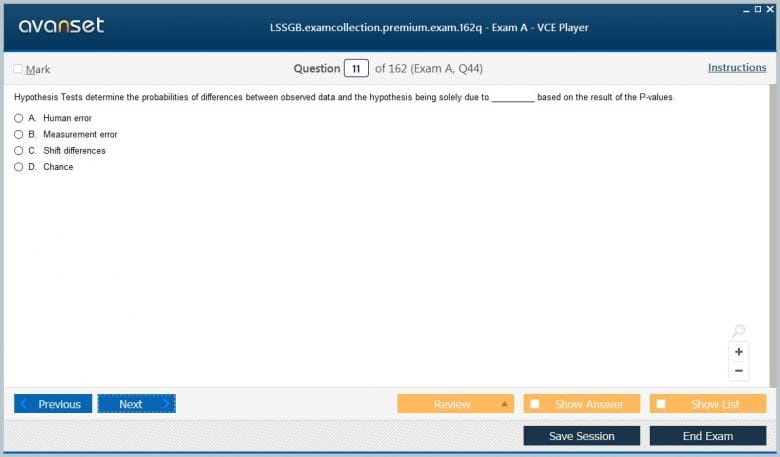
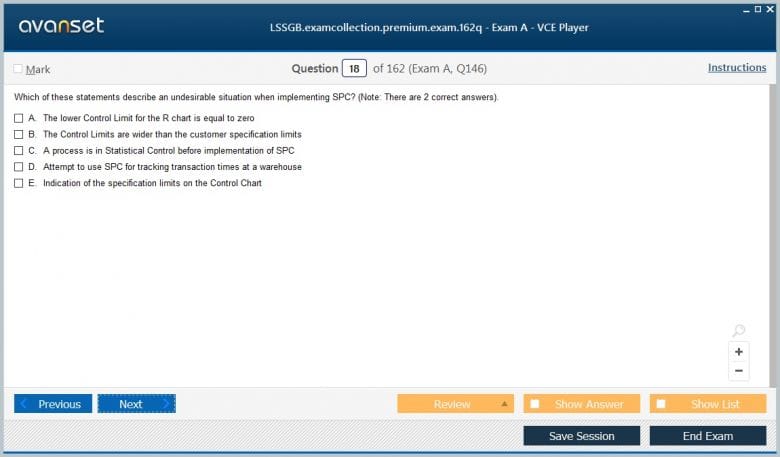
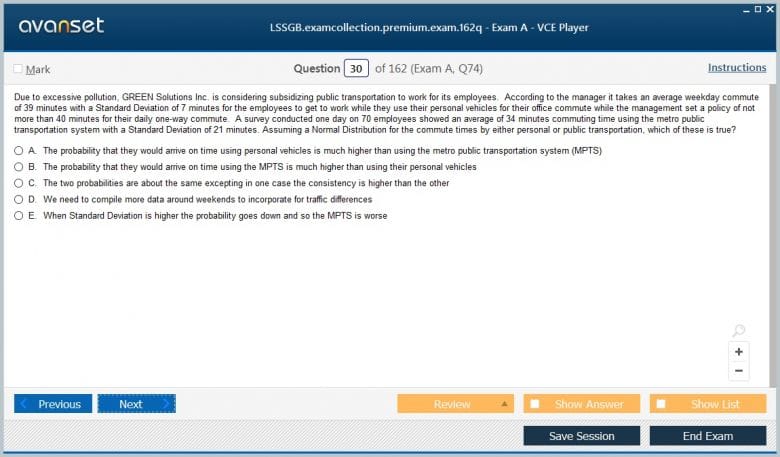
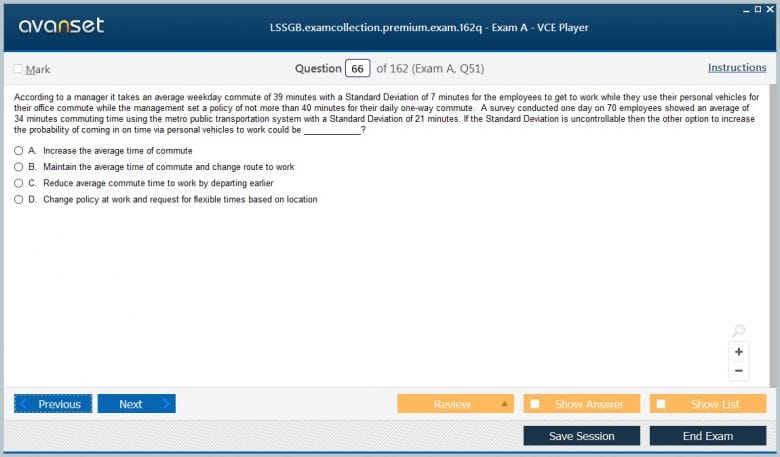
Six Sigma Green Belt Product Reviews
Download Free Six Sigma Green Belt Practice Test Questions VCE Files
| Exam | Title | Files |
|---|---|---|
Exam LSSGB |
Title Lean Six Sigma Green Belt |
Files 5 |
Six Sigma Green Belt Certification Exam Dumps & Practice Test Questions
Prepare with top-notch Six Sigma Green Belt certification practice test questions and answers, vce exam dumps, study guide, video training course from ExamCollection. All Six Sigma Green Belt certification exam dumps & practice test questions and answers are uploaded by users who have passed the exam themselves and formatted them into vce file format.
Six Sigma Green Belt: Turning Process Data into Better Decisions
Six Sigma Green Belt sits in the middle of the improvement ladder: deeper than introductory participation, but usually narrower than the enterprise-level project leadership expected from a Black Belt. The label is used by several certification organizations, so candidates should separate the enduring Green Belt capability from one provider’s specific rules. The useful question is not simply whether you can name DMAIC tools; it is whether you can frame a real process problem, collect trustworthy data, analyze causes, test improvements, and help the process owner hold the gain after the project team moves on.
A current example is ASQ’s Certified Six Sigma Green Belt, assessed through the CSSGB exam. ASQ currently requires three years of full-time paid experience in areas covered by its body of knowledge and uses an open-book computer-delivered exam. Those details belong to ASQ rather than to every Green Belt program. The broader Six Sigma certification family includes credentials with different eligibility and maintenance models, so provider verification should be the first step in any study plan.
The strongest preparation keeps the method connected to decisions. Green Belt work is valuable because organizations have processes that are expensive, slow, inconsistent, error-prone, or frustrating to customers. The candidate who can connect a metric to a process mechanism is more useful than the candidate who memorizes a list of quality tools without knowing when each one changes what the team should do next.
A Green Belt should begin by defining a problem without preselecting the solution
Weak improvement projects often start with a preferred answer: automate the workflow, add a person, buy new software, change the supplier. DMAIC begins differently. Define should establish the problem, the customer or business consequence, the process boundary, the stakeholders, the baseline condition, and the intended improvement without pretending the root cause is already known. Voice-of-the-customer work, SIPOC, critical-to-quality characteristics, project charters, and stakeholder analysis matter because they convert an uncomfortable situation into a question that evidence can answer. Practice rewriting solution-shaped requests into measurable problem statements. “We need a new approval tool” becomes “approval cycle time exceeds the service target in 38 percent of cases, with most delay occurring between technical review and authorization.” That wording creates room to discover whether the real constraint is tooling, policy, queue design, rework, staffing, or something else.
Measure is where the project earns the right to trust its own numbers
Before comparing averages or calculating capability, a Green Belt needs confidence that the data describes the process consistently. Operational definitions, sampling plans, data types, measurement-system analysis, repeatability, reproducibility, process maps, and baseline metrics are therefore not administrative preliminaries. They determine whether later conclusions are believable. A defect that one inspector records differently from another can produce a false trend. A cycle-time study that excludes difficult cases can make a weak process look healthy. Build study exercises that ask what exactly is being measured, when the clock starts and stops, who records the observation, what units are used, and which cases are excluded. If two people can interpret the definition differently, fix the definition before adding more statistics. That habit is one of the clearest differences between data collection and disciplined measurement.
Analyze should narrow uncertainty rather than decorate the project with statistics
Green Belt analysis can include Pareto charts, cause-and-effect diagrams, scatterplots, distributions, confidence intervals, hypothesis tests, correlation, regression, and other methods depending on the provider’s body of knowledge. The tool should follow the question. If the team wants to know whether two process conditions produce materially different outcomes, the analysis should be designed around that comparison. If the concern is association between an input and an output, the method should match the data types and assumptions. Statistical significance is not the finish line: a tiny difference can be statistically detectable and still operationally irrelevant. Conversely, a practically important effect can be missed in a weak sample. Train yourself to state the practical question, the null and alternative logic where appropriate, the assumptions, the uncertainty, and the decision consequence before touching a calculator.
Improve is an experiment in cause and effect, not a brainstorming contest
Once likely causes are supported by evidence, improvement moves from diagnosis to intervention. The Green Belt should be comfortable comparing alternatives, assessing risk, piloting changes, mistake-proofing, reducing unnecessary steps, and validating whether the result is real. Some projects need a simple before-and-after pilot; others benefit from designed experiments that vary factors deliberately and reveal interactions. The important discipline is to define what success will look like before the change is implemented. If cycle time improves but defects rise, the project may have traded one failure mode for another. If average performance improves while variation becomes unstable, the gain may not survive. Keep the application of Six Sigma to defect reduction in mind as a model for connecting an observable quality problem to evidence rather than to assumptions.
Control turns a successful pilot into a process that can survive ordinary operations
Control plans, standard work, process ownership, visual management, response rules, control charts, audits, training, and documentation are what keep improvement from fading. A Green Belt should be able to answer who watches the key metric, how often it is reviewed, what signal requires investigation, what corrective action is authorized, and when the process should be escalated. Control charts are especially important because they separate routine common-cause variation from signals that the process may have changed. The goal is not to react to every up-and-down movement. It is to recognize when the pattern contains evidence worth acting on. Practice writing a control plan as if the improvement team disappeared tomorrow. If the process owner could not operate the new method or know when it is drifting, the project is not finished.
Capability, variation, and stability answer different questions
Candidates often memorize Cp, Cpk, control limits, specification limits, and sigma terminology together, then blur what each concept means. Specifications represent requirements; control limits describe observed process behavior. A process can be stable yet unable to meet specifications, or capable on a short sample while unstable over time. Green Belt preparation should repeatedly separate these ideas. Ask first whether the process is stable enough for capability analysis to make sense. Then ask whether the distribution, centering, and spread are consistent with the customer or engineering limits. Avoid treating one capability number as a verdict without context. The practical response to a poorly centered process may differ from the response to excessive spread, measurement error, or a special cause. Understanding those differences is more valuable than being able to recite formulas from memory.
The Green Belt role is both analytical and collaborative
Most Green Belts work inside an operating function rather than as full-time improvement specialists. That means they must collect evidence without alienating process owners, facilitate meetings without turning them into lectures, and translate analysis into changes that people can actually perform. The adjacent Six Sigma Yellow Belt level is useful for understanding how team members contribute to improvement work, while the Six Sigma Black Belt level shows the deeper statistical and leadership expectations of larger cross-functional projects. A Green Belt should be able to lead appropriately scoped projects, support a Black Belt when the problem requires greater depth, and coach Yellow Belt participants on the process and evidence they need to contribute.
Lean and Six Sigma overlap, but they do not ask exactly the same questions
Six Sigma concentrates strongly on variation, defects, measurement, and process capability. Lean concentrates on value, flow, delay, handoffs, inventory, overprocessing, and other forms of waste. Many organizations combine the two because a process can be slow without being statistically unstable, or stable while containing enormous waiting and rework. The Lean Six Sigma Green Belt perspective is especially helpful when a project needs both flow improvement and variation reduction. The distinction should remain clear enough that you can explain why a particular tool is being used. Value-stream mapping is not interchangeable with a control chart, and a hypothesis test does not tell you whether a handoff adds customer value. The relationship between Six Sigma and Lean Six Sigma is worth studying as a methodological choice rather than a branding difference.
Exam preparation should alternate concept review with small project decisions
For ASQ CSSGB, the current computer-delivered exam includes 100 scored questions plus 10 unscored questions, with 4 hours and 18 minutes of exam time, and ASQ allows bound reference materials under its open-book policy. Knowing the format helps with pacing, but the preparation method should still center on application. Build a compact reference system that lets you find assumptions, formulas, definitions, and decision rules quickly. Then work scenario questions in which two or three tools look plausible and you must choose the one that answers the actual problem. Review mistakes by asking why the wrong option was attractive. That creates a stronger mental model than merely recording the correct letter. Provider details can change, so verify the current rules before registration and treat your notes as working tools rather than permanent specifications.
A useful Green Belt portfolio contains more than certificates. Capture a few improvement examples with the problem statement, process map, operational definitions, baseline, analysis, rejected causes, verified causes, improvement choice, result, and control plan. The project does not need to be enormous; it needs to show disciplined reasoning. Small improvements in billing accuracy, service response, manufacturing yield, onboarding time, or data quality can demonstrate the same habits when the evidence and decisions are clear.
Six Sigma Green Belt is most valuable when the credential reflects a repeatable way of thinking. Define the problem without locking onto a favorite solution, measure what is actually happening, analyze causes with methods that fit the data, improve through controlled change, and build control into ordinary work. When those habits become natural, the exam becomes one milestone in a broader capability: using evidence to make processes measurably better.
ExamCollection provides the complete prep materials in vce files format which include Six Sigma Green Belt certification exam dumps, practice test questions and answers, video training course and study guide which help the exam candidates to pass the exams quickly. Fast updates to Six Sigma Green Belt certification exam dumps, practice test questions and accurate answers vce verified by industry experts are taken from the latest pool of questions.

Six Sigma Six Sigma Green Belt Video Courses


Top Six Sigma Certifications



Site Search:




wow! what a great performance in the cert exam! thanks for six sigma green belt dumps, they have really helped achieve success in the exam.
@caleb, you have to study thoroughly because the exam is challenging. Spend a lot of time studying six sigma green belt prep material and training course in order to have a high chance of passing. you can get the reliable study materials from examcollection website.
six sigma green belt course differentiates yourself from the crowd with new skills as well as techniques. grow your career now by enrolling this course. It will enable you to have the ability to provide outstanding six sigma services relevant to your employers as well as clients.
six sigma green belt certification online free training program materials can be accessed by everyone. in fact i used these materials and they truly helped perform excellently in the real exam. I am glad guys.
for sure six sigma green belt cost is worth compared to the skills and knowledge an individual gains. the relevant certification also gives you a competitive advantage in the job market.
is true that six sigma green belt exam is very tough? let some confirm this to me pliz. Also guide me on the best way to revise the exam so as to attain the passing score.
huhuh…i used to think six sigma green belt certification cost is very high but i have realized it’s very cheap. It can actually can be afforded by everyone who has the necessary qualifications.
i would like utilize six sigma green belt certification online questions to prepare for the exam. i hope they will help me prepare adequately in order to pass the cert exam.
if it ware not for six sigma green belt training course, i could have failed the cert exam. i feel relieved after attaining the pass mark and knowing that I will not retake.
six sigma green belt certification exam is not easy even though i passed. i used to have sleepless nights revising for the same and at long last, my efforts were awarded with a good grade.
hey guys? i will be taking the cert exam of six sigma green belt next month and i need someone to advise me on what to do in order to ensure i don’t fail.