
Pass Your Six Sigma Lean Six Sigma Green Belt Certification Easy!
Six Sigma Lean Six Sigma Green Belt Certification Exams Questions & Answers, Accurate & Verified By IT Experts
Instant Download, Free Fast Updates, 99.6% Pass Rate.

$69.99
Six Sigma Lean Six Sigma Green Belt Certification Exams Screenshots
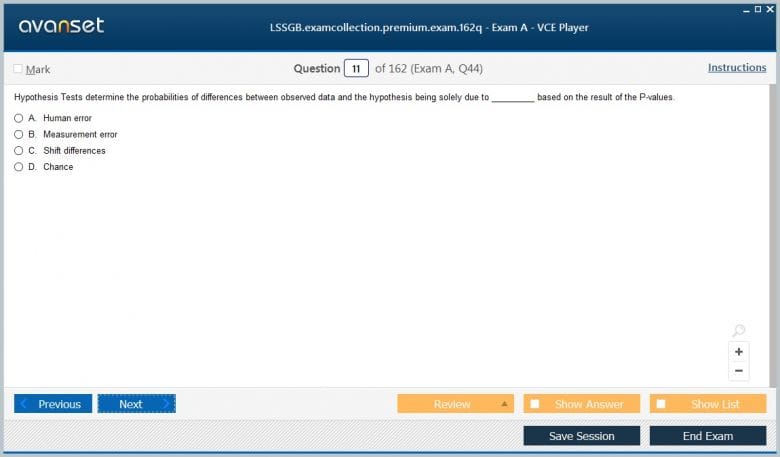
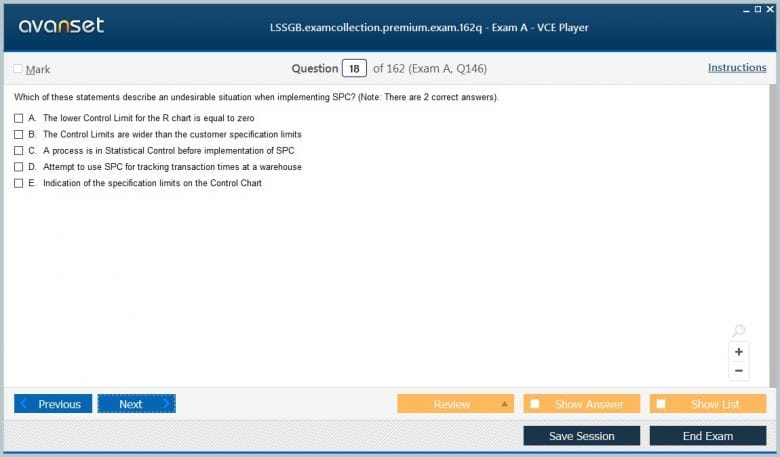
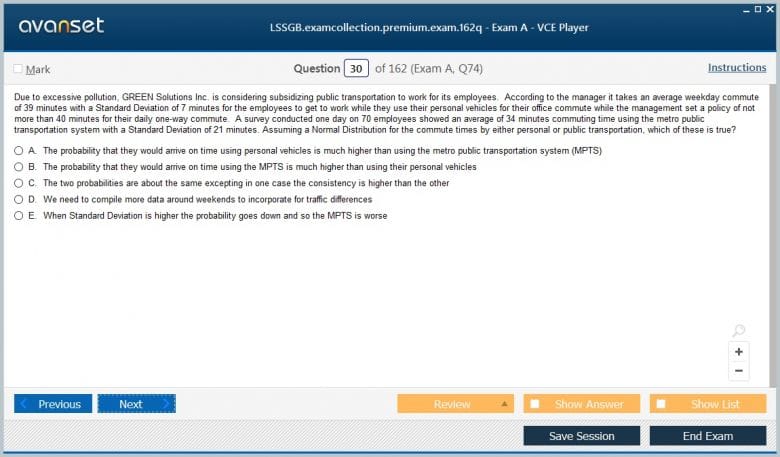
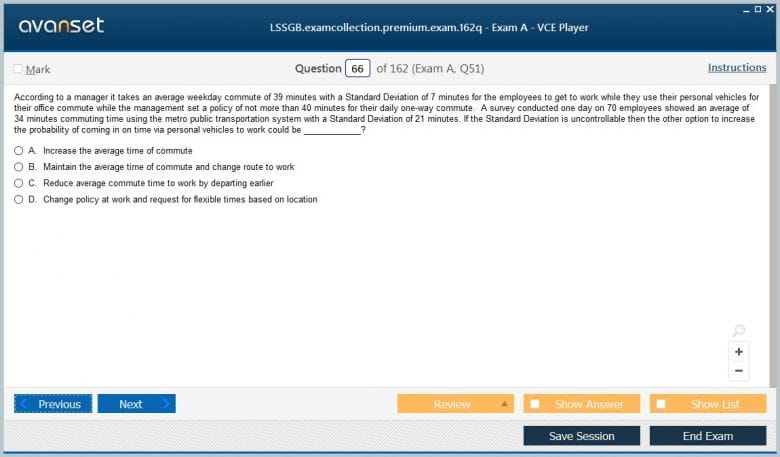
Lean Six Sigma Green Belt Product Reviews
Download Free Lean Six Sigma Green Belt Practice Test Questions VCE Files
| Exam | Title | Files |
|---|---|---|
Exam LSSGB |
Title Lean Six Sigma Green Belt |
Files 5 |
Six Sigma Lean Six Sigma Green Belt Certification Exam Dumps & Practice Test Questions
Prepare with top-notch Six Sigma Lean Six Sigma Green Belt certification practice test questions and answers, vce exam dumps, study guide, video training course from ExamCollection. All Six Sigma Lean Six Sigma Green Belt certification exam dumps & practice test questions and answers are uploaded by users who have passed the exam themselves and formatted them into vce file format.
Lean Six Sigma Green Belt: Turning Process Data into Measurable Improvement
Lean Six Sigma Green Belt sits in the middle of the improvement ladder: deeper than foundational participation, but usually narrower in scope than full-time Black Belt leadership. Current credential providers continue to use Green Belt for practitioners who can run defined DMAIC projects, analyze process data, apply Lean tools, and support larger cross-functional initiatives. The exact exam and renewal rules vary by provider, so candidates should treat the LSSGB exam as one credential target within a broader skills path.
A Green Belt should be able to improve a process with evidence, not simply recite tool names. That means framing the problem, measuring current performance, identifying likely causes, using appropriate analysis, testing an improvement, and creating controls that process owners can sustain. The role is particularly valuable for professionals who stay close to daily operations because they can combine local process knowledge with a disciplined improvement method.
The best preparation project is small enough to complete but important enough to matter. Choose a process you can observe directly, such as ticket resolution, order entry, billing corrections, laboratory turnaround, recruiting handoffs, or software release approvals. Avoid a project whose outcome depends mostly on factors outside your control. Green Belt learning accelerates when every DMAIC tool answers a real question about the chosen process.
A Green Belt project needs a narrow problem and a credible business reason
Improvement projects often fail because the scope expands faster than the team’s ability to measure it. A Green Belt should convert a broad complaint into a specific process, population, time period, customer impact, and measurable outcome. “Reduce onboarding delays for new enterprise customers in the first 30 days” is a better starting point than “fix customer experience” because the team can define the workflow and collect relevant data.
Write a charter with a problem statement, goal, in-scope boundaries, exclusions, stakeholders, and expected value. Then ask a skeptical colleague to challenge every vague word. If “late,” “defect,” “complete,” or “approved” can be interpreted two ways, the project is not ready for measurement. Clear scope protects the team from solving several unrelated problems under one project name.
Process mapping reveals where data should be collected
SIPOC, swimlane maps, value-stream maps, and detailed process maps help teams see handoffs, rework, queues, and decision points. Mapping is most useful when it represents what actually happens rather than the official procedure. A Green Belt should walk the process, observe exceptions, and capture alternative routes instead of building a perfect diagram from policy documents alone.
Use the map to decide where timing, quality, volume, and defect data should be collected. A delay at a review step may be caused by queue length, missing information, rework, or batch scheduling; the map helps separate these possibilities. This is where Lean Six Sigma thinking becomes practical: flow analysis tells you where work waits, while measurement tells you whether the suspected constraint is large enough to matter.
Measurement quality determines whether later analysis deserves trust
Green Belts need working knowledge of data types, sampling, operational definitions, basic measurement system concepts, descriptive statistics, and baseline performance. The objective is not to become a statistician; it is to avoid drawing precise conclusions from unreliable data. A dashboard with thousands of records can still be misleading if the underlying event is logged inconsistently.
Create a measurement plan that states what is measured, how it is defined, where the data comes from, who collects it, and how often. Test the definition on several real cases before scaling collection. If two reviewers classify the same defect differently, resolve the definition first. A clean baseline is one of the most valuable outputs a Green Belt can leave behind because it gives the organization a reliable reference for future improvement.
Basic statistics should help the team understand variation, not intimidate it
Measures of center and spread, distributions, confidence intervals, capability, and simple graphical analysis help explain how a process behaves. Averages alone can hide important variation. Two teams can have the same mean cycle time while one is predictable and the other alternates between very fast and extremely slow work. Green Belts should learn to ask about the distribution and the operational consequences of its shape.
Practice with histograms, box plots, run charts, Pareto charts, and scatter plots before reaching for formal tests. Visualization often reveals segmentation, outliers, trends, or data-quality problems that should be addressed first. When a statistical test is appropriate, state the question and decision rule in plain language before calculating anything. The analysis should make the business decision clearer.
Root-cause analysis should separate hypotheses from verified causes
Teams naturally generate explanations for poor performance. Fishbone diagrams, 5 Whys, cause-and-effect matrices, and process knowledge help organize those ideas, but they do not prove them. The Green Belt’s job is to turn plausible explanations into testable hypotheses and collect evidence that can eliminate weak ones. This prevents the loudest opinion in the room from becoming the improvement plan.
Stratify the data by variables that make process sense: product, location, shift, request type, supplier, channel, or experience level. Compare patterns and follow the evidence back to the workflow. A cause should explain the observed problem and create a reasonable mechanism for change. If the relationship disappears when data is segmented correctly, the original explanation was probably incomplete.
Lean tools are most powerful when they remove friction from a measured constraint
5S, visual management, standard work, kanban, mistake-proofing, workload balancing, and value-stream redesign can improve speed and reliability, but they should target a diagnosed problem. Applying 5S to an already organized work area because it appears in the syllabus wastes improvement capacity. Green Belts should connect each Lean intervention to a specific source of delay, error, or excessive work in process.
Measure touch time and waiting time separately. A process may contain only ten minutes of work but take two days because requests wait in queues or for approvals. Reducing operator time by one minute will not meaningfully change customer experience in that system. Flow analysis helps teams focus effort where elapsed time and work accumulation actually occur.
Improve through controlled pilots rather than immediate full rollout
Once the team has evidence about causes, generate several countermeasures and compare them using expected benefit, effort, risk, reversibility, and effect on other parts of the process. Small pilots create learning without committing the whole organization. Define the metric, population, duration, and success criteria before the pilot starts so the team cannot quietly redefine success after seeing the result.
For defect-reduction work, Six Sigma applied to welding defects shows why observation and corrective action need to stay tied to measurable outcomes. Whether the setting is manufacturing or a digital service, an improvement should change the process mechanism that caused the problem, not merely add inspection at the end.
Control makes Green Belt work visible after the project closes
A control plan assigns ownership, defines metrics, documents standard work, and specifies the response when performance moves outside expectations. Control charts can be useful when process data supports them, but the core idea is broader: the organization must know how to detect deterioration and what action to take. A metric without a response plan is monitoring, not control.
Hand the process back to its owner deliberately. Review the new standard work, verify that dashboards or checks are available, define who updates documentation, and decide when the baseline should be reconsidered. The Black Belt level expands the leadership and analytical depth, but a strong Green Belt should already be able to close a project without leaving hidden dependencies on the improvement team.
Before declaring a pilot successful, check whether the result holds across the shifts, products, customer groups, or operating conditions that matter. A local improvement can disappear when the process meets a different mix of work. Green Belt judgment includes knowing when a result is broad enough to standardize and when another round of measurement is needed.
A Green Belt portfolio should show repeatable reasoning across different processes
Use the Six Sigma certification family to compare adjacent routes, including the Yellow Belt foundation, but keep your own record of applied projects. For each project, save the charter, baseline, process map, analysis, improvement decision, quantified result, and control plan. A short project completed well teaches more than a giant unfinished transformation program.
Review your portfolio for patterns. Do you routinely jump from Define to Improve? Do you collect more data than you analyze? Do you rely on averages? Do your control plans lack named owners? These recurring weaknesses are more useful study signals than a single practice-test score because they show where your improvement reasoning breaks under real conditions.
Lean Six Sigma Green Belt remains valuable because organizations need people inside operational teams who can translate everyday problems into measurable improvement work. The role is close enough to the process to understand context and structured enough to challenge assumptions with data.
The strongest candidates finish preparation able to tell a complete improvement story: what the problem was, how the baseline was established, which causes were supported by evidence, what changed, how much performance improved, and how the new result will be maintained. That narrative is the practical core of Green Belt competence.
ExamCollection provides the complete prep materials in vce files format which include Six Sigma Lean Six Sigma Green Belt certification exam dumps, practice test questions and answers, video training course and study guide which help the exam candidates to pass the exams quickly. Fast updates to Six Sigma Lean Six Sigma Green Belt certification exam dumps, practice test questions and accurate answers vce verified by industry experts are taken from the latest pool of questions.


Six Sigma Lean Six Sigma Green Belt Video Courses

Top Six Sigma Certifications







Site Search:




i have passed the exam using lssgb dumps…they are informative and reliable.
i will be sitting for exam lssgb in the next two weeks. kindly, may someone idealize me on what I should expect in the test and how to manage it. i am really afraid of failing the test.
i feel so nice having passed lssgb cert exam. for sure I couldn’t withstand failing. premium file for lssgb exam has made me proud.
lssgb vce files comprise all what it takes to score above the passing score in the test. the contents of the vce files are very informative as far as lssgb cert exam is concerned. they helped me greatly!
i don’t know how to express the feeling after scoring 80 percent in the exam. thank you guys for simplifying my work of answering exam questions for lssgb by providing reliable study resources.
@davis, thorough study is the key to success in lssgb exam. utilize various learning materials from examcollection website and will pass the retake.
are you afraid of not attaining the passing score in the lssgb cert exam? use the lssgb practice questions and answers and i am confident you will pass the test.
i performed well in the exam yesterday. i am just waiting for lean six sigma green belt certification online so that i may be in position to apply the knowledge and technical expertise I gained in the it field.
if you truly want to pass the lssgb cert exam you need to take lean six sigma green belt training course seriously. it helped me pass the exam and earn the relevant certification.
lean six sigma green belt certification exam is one among the toughest it certification exams. however, i have managed to score above the pass mark. thanks for providing braindumps which are reliable.
hello guys, i did the cert exam of lean six sigma green belt last month but I didn’t manage to attain the passing score. i am planning to retake the exam as soon as possible. kindly, advise me on what to do to ensure i perform well in the retake.