



Premium File
324 Q&A
$76.99$69.99
Six Sigma ICBB Exam Questions & Answers, Accurate & Verified By IT Experts
Instant Download, Free Fast Updates, 99.6% Pass Rate
324 Questions & Answers
Last Update: Sep 30, 2026
$69.99
Six Sigma ICBB Exam Screenshots
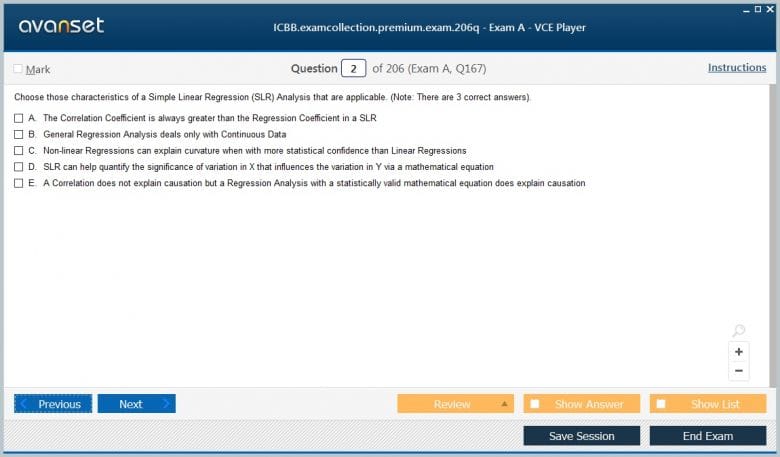
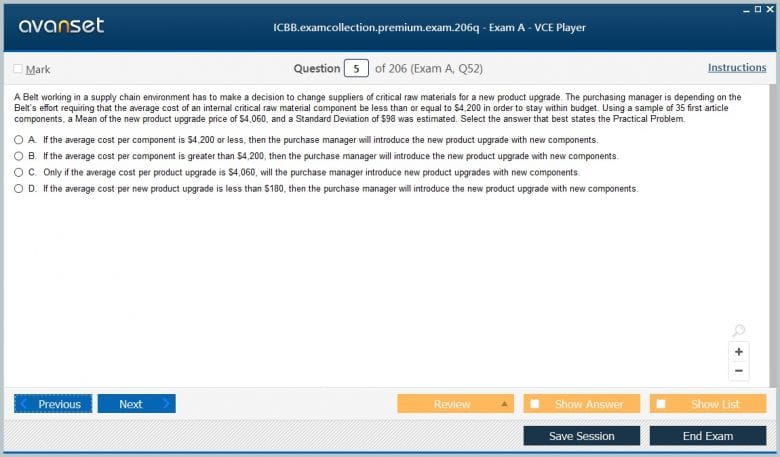
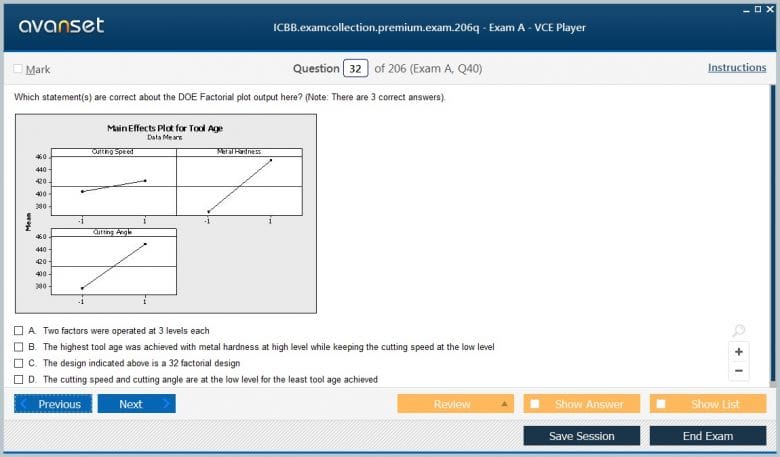
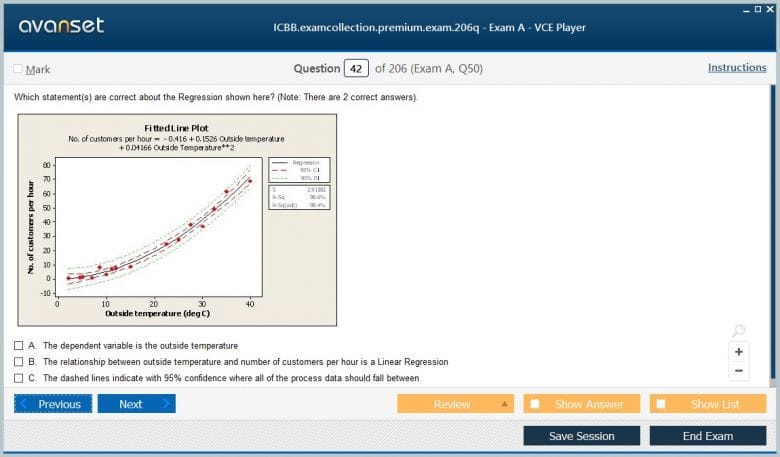
Six Sigma ICBB Practice Test Questions in VCE Format
| File | Votes | Size | Date |
|---|---|---|---|
File Six Sigma.braindumps.ICBB.v2026-07-08.by.eli.194q.vce |
Votes 1 |
Size 1013.55 KB |
Date Jul 08, 2026 |
File Six Sigma.practicetest.ICBB.v2020-06-24.by.wangqiang.137q.vce |
Votes 2 |
Size 981.27 KB |
Date Jun 24, 2020 |
Six Sigma ICBB Practice Test Questions, Exam Dumps
Six Sigma ICBB (IASSC Certified Lean Six Sigma Black Belt) exam dumps vce, practice test questions, study guide & video training course to study and pass quickly and easily. Six Sigma ICBB IASSC Certified Lean Six Sigma Black Belt exam dumps & practice test questions and answers. You need avanset vce exam simulator in order to study the Six Sigma ICBB certification exam dumps & Six Sigma ICBB practice test questions in vce format.
IASSC Certified Lean Six Sigma Black Belt (ICBB) remains a current PeopleCert/IASSC certification for practitioners expected to lead complex improvement work. The current exam is 150 multiple-choice questions in 240 minutes, closed book, with a 70% passing score. Its scope combines Lean waste reduction, the DMAIC method, advanced statistical analysis, process capability, experimental methods, control systems, and the leadership needed to move cross-functional teams through change.
Within PeopleCert certifications, the Black Belt is not simply a harder vocabulary test than a Green Belt. It assumes the practitioner can select an improvement problem worth solving, define a reliable measurement system, distinguish causes from symptoms, design and validate changes, quantify benefits, and transfer a stable process back to operational owners.
The broader Lean Six Sigma Black Belt body of knowledge is best learned as a sequence of decisions. Every tool should answer a question in the project. A control chart without a decision is decoration; a regression model without a process theory is fragile; a kaizen event without verified baseline data can optimize the wrong problem.
Black Belt work begins before statistics. The team needs a clear problem statement, business case, goal, scope, customer definition, stakeholders, timeline, and decision authority. A project that is too broad becomes unmanageable; one that is too narrow may improve a local metric while shifting cost or delay to another part of the value stream.
Candidates should be able to separate the problem from the solution. “Install automation” is a proposed solution, not a problem statement. “Order-entry defects average 8 percent and create rework that delays shipment by two days” is measurable and leaves room to discover the cause. Good Define work prevents the team from spending months proving an idea management had already chosen.
Improvement decisions depend on trustworthy measurements. Operational definitions specify exactly what counts as a defect, unit, opportunity, cycle time, or successful outcome. Measurement system analysis tests whether the observed variation comes from the process or from the way people and instruments measure it.
Candidates should know why repeatability, reproducibility, stability, bias, linearity, and resolution matter in different measurement contexts. If two inspectors classify the same defect differently, the project may need to fix the measurement system before calculating process capability. Statistical precision cannot compensate for ambiguous definitions or bad data collection.
Teams naturally generate explanations: supplier quality, operator training, machine wear, scheduling, temperature, workload, or customer mix. Black Belt practice turns those hypotheses into testable relationships. Process maps, cause-and-effect analysis, stratification, Pareto analysis, hypothesis tests, correlation, regression, and other methods help narrow which inputs have credible evidence behind them.
The practitioner must also avoid confusing statistical significance with practical significance. A very large dataset can make a tiny effect look statistically convincing, while a smaller sample may miss an operationally important difference. Candidates should connect p-values, confidence intervals, effect size, process knowledge, and business impact rather than treating one statistic as the entire decision.
Capability metrics compare process performance with specification limits, but a process that is unstable does not have a predictable long-term distribution. Candidates should understand the relationship between control charts and capability: first ask whether the process is in statistical control, then evaluate whether its stable performance can meet customer or engineering requirements.
Cp, Cpk, Pp, and Ppk communicate different views of spread and centering. The correct interpretation depends on how the data were collected and whether short-term or overall variation is being represented. A high capability number should not distract from a shifted mean, non-normal distribution, poor measurement system, or special-cause behavior.
Improvement ideas can come from Lean analysis, designed experiments, benchmarking, mistake-proofing, technology, standard work, layout changes, supplier changes, or many other sources. The Black Belt’s job is to select changes that address verified causes and to test them in a way that separates real improvement from random variation or temporary enthusiasm.
Pilot design matters. Define the expected effect, success metrics, sample, duration, operating conditions, and rollback plan before changing the process. Failure mode and effects analysis can help identify what the proposed change could break. Candidates should be able to explain why a controlled pilot often provides stronger evidence than a full rollout based on intuition.
Complex processes often have inputs that interact. Changing temperature may improve yield only at a particular pressure; a staffing change may reduce wait time only when demand exceeds a threshold. Design of experiments allows the team to vary factors systematically and estimate main effects and interactions more efficiently than changing one factor at a time.
Candidates should understand the purpose of factors, levels, responses, randomization, replication, blocking, and interaction analysis. The goal is not to memorize every design table. It is to recognize when experimental structure is needed and how uncontrolled noise or confounding could make the conclusion unreliable.
Six Sigma reduces variation and defects; Lean improves flow by attacking delay, excess work, movement, inventory, handoffs, and other waste. The combined perspective described in Lean Six Sigma prevents a team from optimizing quality while ignoring lead time or improving speed while allowing unstable output.
Value-stream mapping, takt, pull, Kanban, 5S, standard work, setup reduction, mistake-proofing, and visual management are practical methods, but they need a purpose. Candidates should choose the tool from the constraint. A Kanban system will not solve a measurement problem; a hypothesis test will not directly remove unnecessary transport. Tool selection should follow the process question.
A project is not complete when the pilot improves the metric. The new process needs documented standards, trained owners, control limits or operational thresholds, reaction plans, audit mechanisms, and a clear handoff. The team should know what signal indicates deterioration and who is responsible for responding before performance returns to baseline.
The practical importance of sustaining improvement is part of the wider discussion of Six Sigma and Lean Six Sigma. Candidates should think beyond project closure slides: control plans, mistake-proofing, process ownership, monitoring cadence, and financial validation determine whether benefits remain real months after the Black Belt leaves.
Use a realistic case such as manufacturing defects, claims errors, call-center delay, order rework, or laboratory turnaround. Work through chartering, SIPOC, data planning, MSA, baseline capability, cause analysis, hypothesis testing, improvement selection, pilot design, and control. If you have Green Belt experience, compare the deeper leadership and analytical scope with ICGB.
Then vary the data so the obvious tool is sometimes wrong: an unstable process before capability analysis, non-normal data, an insignificant correlation, poor gauge repeatability, or an improvement that raises another critical metric. ICBB success comes from selecting methods in the right sequence and interpreting results in business context. The formulas matter, but judgment about when a formula is valid matters more.
Project selection is a leadership responsibility because Black Belt time is expensive. A strong pipeline evaluates strategic alignment, financial impact, customer pain, feasibility, data availability, sponsor commitment, and control over the process. Projects chosen only because data are easy to collect may produce elegant statistics with little business value. Candidates should understand how to screen opportunities and when to stop a project whose benefits no longer justify the effort.
Financial validation should distinguish hard savings, cost avoidance, revenue impact, working-capital improvement, and capacity release. A reduction in cycle time is operationally meaningful, but the organization should know whether it creates lower cost, more throughput, faster cash, or another measurable benefit. Black Belts often work with finance to confirm assumptions so that improvement claims remain credible after project closure rather than relying on optimistic projections.
Change leadership becomes critical when a statistically superior process conflicts with local incentives or professional identity. Operators may resist a new method because it changes staffing, removes autonomy, or exposes performance differences. Stakeholder analysis, participation in solution design, transparent data, pilot feedback, and sponsor support can reduce resistance. Candidates should recognize that technical proof is necessary but not sufficient for adoption; the social system can determine whether the improved process survives.
Black Belts should also know when DMAIC is the wrong framework. If the process does not yet exist and the organization needs to design a new product or service, Design for Six Sigma methods may be more appropriate. If the issue is an obvious local waste with a safe, reversible countermeasure, a rapid improvement event may be faster. Method discipline includes selecting the lightest rigorous approach that fits the problem rather than forcing every opportunity into a full DMAIC project.
Mentoring is another Black Belt responsibility because improvement capability should outlast one project leader. Green Belts and process owners may need help choosing metrics, validating measurement systems, interpreting tests, planning pilots, or building control plans. A Black Belt who performs every analysis personally can become a bottleneck and leave the organization dependent on one expert. Candidates should view coaching as part of process excellence: teach teams enough statistical and Lean reasoning to make sound local decisions while reserving advanced methods for situations that truly require them.
During calculation practice, write the business interpretation beside every result. If Cpk rises, explain what changed in centering or spread; if a hypothesis test is significant, state what decision it supports and what it does not prove. This habit prevents formula recall from becoming detached from the process-management judgment expected at Black Belt level.
Go to testing centre with ease on our mind when you use Six Sigma ICBB vce exam dumps, practice test questions and answers. Six Sigma ICBB IASSC Certified Lean Six Sigma Black Belt certification practice test questions and answers, study guide, exam dumps and video training course in vce format to help you study with ease. Prepare with confidence and study using Six Sigma ICBB exam dumps & practice test questions and answers vce from ExamCollection.
Purchase Individually
Top Six Sigma Certifications




Top Six Sigma Certification Exams
Site Search:

SPECIAL OFFER: GET 10% OFF

Pass your Exam with ExamCollection's PREMIUM files!
SPECIAL OFFER: GET 10% OFF
Use Discount Code:
MIN10OFF
A confirmation link was sent to your e-mail.
Please check your mailbox for a message from support@examcollection.com and follow the directions.

Download Free Demo of VCE Exam Simulator
Experience Avanset VCE Exam Simulator for yourself.
Simply submit your e-mail address below to get started with our interactive software demo of your free trial.