



Premium File
91 Q&A
$76.99$69.99
Juniper JN0-334 Exam Questions & Answers, Accurate & Verified By IT Experts
Instant Download, Free Fast Updates, 99.6% Pass Rate
91 Questions & Answers
Last Update: Aug 31, 2026
$69.99
Juniper JN0-334 Exam Screenshots
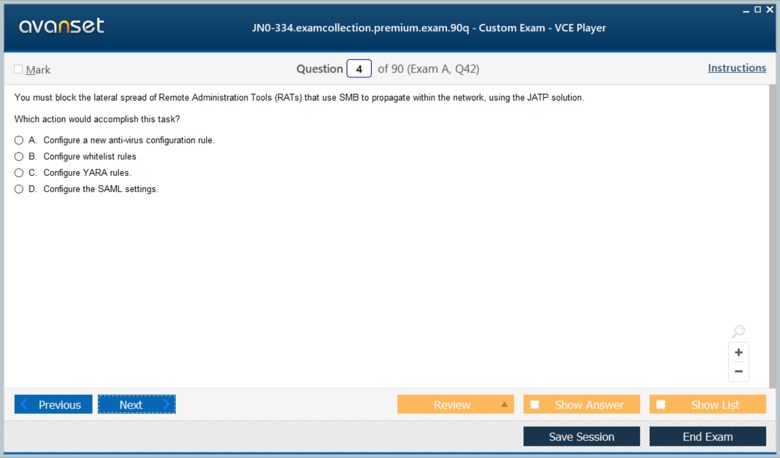
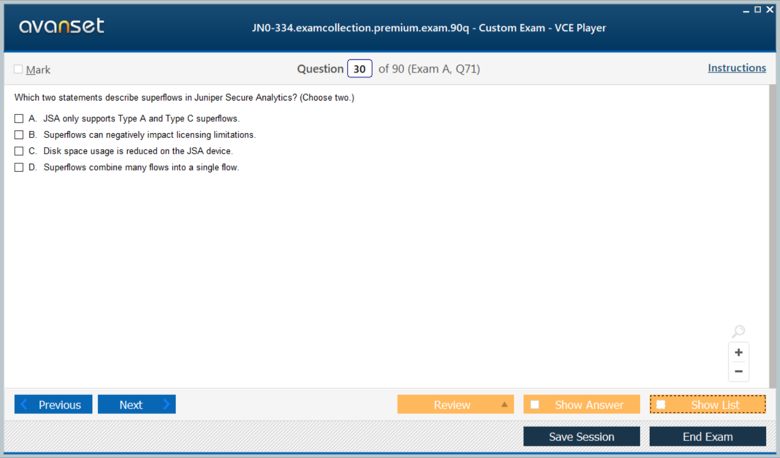
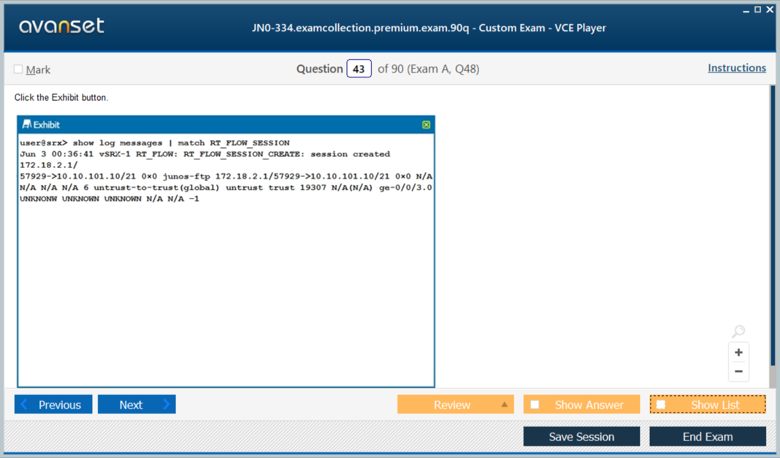
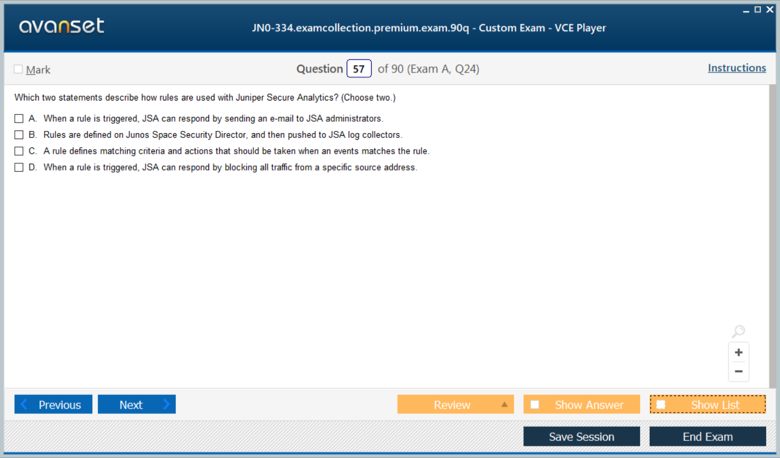
Juniper JN0-334 Practice Test Questions in VCE Format
| File | Votes | Size | Date |
|---|---|---|---|
File Juniper.test-king.JN0-334.v2026-09-05.by.james.54q.vce |
Votes 1 |
Size 1.21 MB |
Date Sep 05, 2026 |
File Juniper.practicetest.JN0-334.v2021-04-28.by.harry.50q.vce |
Votes 1 |
Size 555.05 KB |
Date Apr 28, 2021 |
File Juniper.test-king.JN0-334.v2020-05-12.by.florence.28q.vce |
Votes 2 |
Size 456.1 KB |
Date May 12, 2020 |
Juniper JN0-334 Practice Test Questions, Exam Dumps
Juniper JN0-334 (Security, Specialist) exam dumps vce, practice test questions, study guide & video training course to study and pass quickly and easily. Juniper JN0-334 Security, Specialist exam dumps & practice test questions and answers. You need avanset vce exam simulator in order to study the Juniper JN0-334 certification exam dumps & Juniper JN0-334 practice test questions in vce format.
JN0-334 was a Juniper Networks Certified Specialist, Security exam introduced in September 2019. Juniper retired it on January 8, 2023 and replaced it with JN0-335 on January 9. The specialist credential itself continues, but JN0-334 is historical. It belongs to an earlier SRX security era and should not be presented as a live exam or used to infer current software versions.
The useful part of the old code is the specialist operating mindset. JNCIS-SEC sits beyond basic zone and policy configuration and expects engineers to reason about deeper threat controls, secure connectivity, availability, identity, encrypted traffic, and centralized operations. Those themes remain visible in the current JN0-336, even though product capabilities and objective wording have changed since the JN0-334 period.
An associate can configure zones, policies, and basic NAT. A specialist must understand what happens when those basic controls are combined with threat prevention, VPNs, identity, high availability, and operational tooling. The most important shift is from “can I permit this flow?” to “can I protect, observe, recover, and explain this service under realistic conditions?” That broader question defines the value of specialist study.
Legacy JN0-334 material is still useful when it teaches that layered reasoning. A security policy might be correct while an IPsec negotiation fails, an intrusion policy blocks an application, or a cluster node has not synchronized the expected state. Each feature has its own evidence and failure modes, and troubleshooting depends on separating them.
Specialist work also changes the expected depth of evidence. At associate level, proving that a policy matched may be enough. At specialist level, the operator may need to correlate a policy match with an IDP event, VPN state, identity mapping, or cluster transition. The ability to join evidence across features is what makes complex security troubleshooting manageable.
Intrusion detection and prevention extends the firewall beyond address and port matching. The system examines traffic for patterns or behaviors associated with attacks and can alert, drop, or otherwise respond. A specialist needs to understand policy placement, signature databases, update behavior, logging, and the operational consequences of enabling aggressive detection.
The difficult part is tuning. A control that blocks legitimate business traffic is not automatically successful because it is “secure.” Operators need enough evidence to distinguish a true attack from a false positive, understand what traffic triggered the event, and decide whether the policy should change. That judgment is a recurring theme throughout specialist security work.
IDP tuning should also consider the protected application’s importance. A low-confidence signature on a public test service may be handled differently from the same alert on a critical administrative interface. Risk context influences enforcement. This is why specialists need to understand the traffic and business role, not only the signature name or severity field.
At specialist depth, VPN knowledge needs to go beyond defining IKE and ESP. Engineers should be able to separate peer reachability, negotiation, proposals, security associations, routing, security policy, and protected traffic. The deeper explanation of IPsec tunnel operation supports this layered model and helps make troubleshooting systematic.
A production VPN also raises availability and lifecycle issues. Certificates or pre-shared keys expire or change, peers may use different routing decisions, and tunnel state can look healthy while only one traffic direction works. A specialist should be able to identify which counters and logs prove that each stage is functioning.
VPN design should account for monitoring. Teams need a way to detect when negotiation repeatedly fails, when a tunnel flaps, or when traffic stops despite active security associations. Historical exam material often focuses on configuration, but operational maturity comes from turning those states into observable signals that can be investigated before users report a widespread problem.
Juniper security platforms have long combined on-device controls with threat intelligence and cloud-assisted analysis. The specific service names and capabilities have evolved, which is one reason old exam material needs careful version labeling. The durable idea is that a firewall can submit, receive, or consume intelligence that changes how traffic is classified and handled.
That creates operational dependencies outside the local policy. Connectivity to cloud services, update status, supported file types, remediation actions, DNS intelligence, and administrative workflows can influence the result. Candidates should learn to verify the data path and the intelligence path separately rather than assuming a threat feature is working because the base firewall can reach the Internet.
Threat-intelligence workflows also need a response owner. Detecting a suspicious file or domain is only the first step; someone must decide whether to block, investigate endpoints, update policy, or treat the event as benign. This connection between detection and remediation is what turns security telemetry into a control loop rather than a collection of alerts.
A security cluster must preserve more than link connectivity. Stateful firewalling means sessions, translations, and other real-time objects may need synchronization so that a node failure does not unnecessarily break active traffic. The specialist perspective asks how control and data state move between nodes, what interfaces and redundancy groups depend on one another, and which failures cause service interruption.
Testing should include node failure, interface failure, and recovery. A cluster that fails over in a diagram but cannot pass traffic after the event is not highly available. Candidates should also consider asymmetric paths and upstream routing because the firewall cluster is part of a larger network, not an isolated pair of appliances.
Cluster design should include maintenance as well as failure. Planned upgrades or hardware work can use the same redundancy mechanisms that protect against faults. If operators cannot move service cleanly between nodes during maintenance, the architecture may be technically redundant but operationally fragile. Exam study benefits from viewing high availability as a lifecycle capability.
Security policies become more expressive when identity information can supplement IP addresses. That improves control in environments where users move, addresses change, or a network needs different policy for different roles. At the same time, identity services introduce new dependencies: directory reachability, synchronization, ports, authentication flows, and mapping accuracy can all affect enforcement.
Encrypted traffic presents a related problem. If traffic is protected by TLS, a firewall may have limited visibility unless an authorized inspection design is used. SSL proxy features therefore involve certificates, trust, privacy, application compatibility, and performance. A specialist needs to understand the operational tradeoff, not merely that inspection exists.
Identity systems also raise stale-data questions. A user may change roles, log out, or move networks while an old mapping remains cached. Specialists should understand that identity-aware enforcement is only as accurate as the mapping lifecycle. Troubleshooting needs to consider refresh, timeout, and synchronization behavior rather than assuming every identity record is instantly current.
Security Director and similar management systems matter because a large fleet cannot be operated safely as a collection of unrelated boxes. Centralized onboarding, policy management, visibility, and change workflows can improve consistency, but they also create a control-plane dependency that needs its own access security, backup, and monitoring. A bad centralized change can have a wide blast radius.
This is where network security logging also becomes relevant. Central operations need evidence that a policy was deployed, matched traffic, and produced the intended result. Logging is not an afterthought; it is part of verifying that security intent survived the move from a management platform to the enforcement point.
Central management should be paired with a clear rollback strategy. A policy deployment that affects many devices needs a way to detect failure and restore a known state. Even if an exam objective focuses on onboarding and policy management, thinking through validation and rollback makes the technology easier to understand and mirrors how mature security teams operate.
JN0-334 was followed by JN0-335 in 2023 and then by JN0-336 in 2025. The current specialist still sits above JNCIA-SEC, now represented by JN0-232, and below the professional level such as JN0-637. That continuity makes the old exam useful for understanding how Juniper’s security track developed.
The safe study method is to use JN0-334 topics as historical practice scenarios while validating commands, product names, software versions, and exam logistics against current sources. The exam code is retired, but the engineering problems it represented—threat detection, secure connectivity, high availability, identity, encryption, and operational evidence—remain central to SRX security work.
The historical value of JN0-334 is strongest when it is used to compare generations of the same security problems. Threat names, cloud services, and software releases change, but engineers still need to control access, inspect risky traffic, keep services available, and prove what happened. Those durable objectives explain why the old exam can remain educational without being current.
One final way to extract value from the retired blueprint is to build a control matrix. Put the protected service on one axis and the relevant controls—policy, IDP, VPN, threat intelligence, cluster state, identity, decryption, and centralized management—on the other. For each intersection, write what evidence proves the control is working. This exercise exposes monitoring gaps and turns a list of security features into an operational design that can be tested and audited.
Go to testing centre with ease on our mind when you use Juniper JN0-334 vce exam dumps, practice test questions and answers. Juniper JN0-334 Security, Specialist certification practice test questions and answers, study guide, exam dumps and video training course in vce format to help you study with ease. Prepare with confidence and study using Juniper JN0-334 exam dumps & practice test questions and answers vce from ExamCollection.
Purchase Individually
Top Juniper Certifications




Top Juniper Certification Exams
Site Search:

SPECIAL OFFER: GET 10% OFF

Pass your Exam with ExamCollection's PREMIUM files!
SPECIAL OFFER: GET 10% OFF
Use Discount Code:
MIN10OFF
A confirmation link was sent to your e-mail.
Please check your mailbox for a message from support@examcollection.com and follow the directions.

Download Free Demo of VCE Exam Simulator
Experience Avanset VCE Exam Simulator for yourself.
Simply submit your e-mail address below to get started with our interactive software demo of your free trial.