



Premium File
65 Q&A
$76.99$69.99
Juniper JN0-1331 Exam Questions & Answers, Accurate & Verified By IT Experts
Instant Download, Free Fast Updates, 99.6% Pass Rate
65 Questions & Answers
Last Update: Oct 29, 2026
$69.99
Juniper JN0-1331 Exam Screenshots
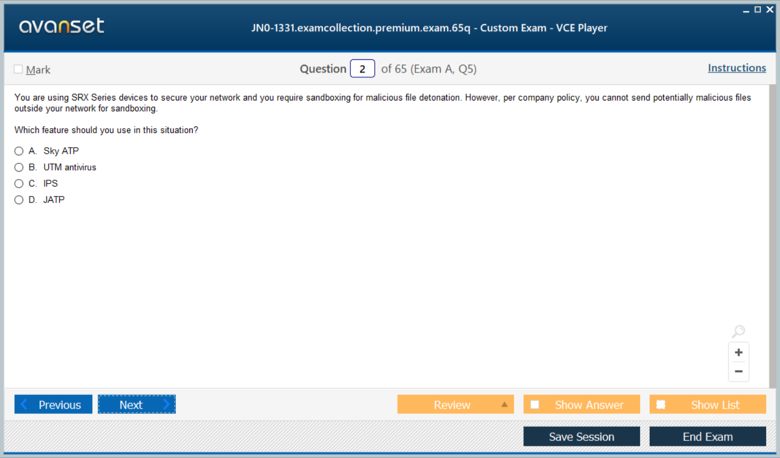
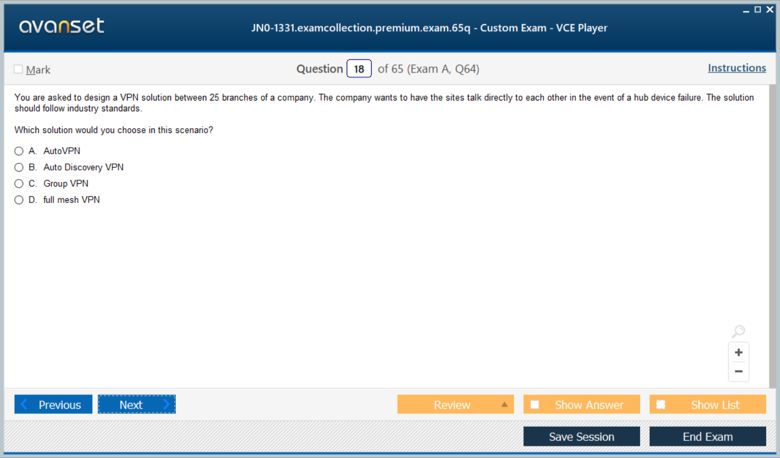
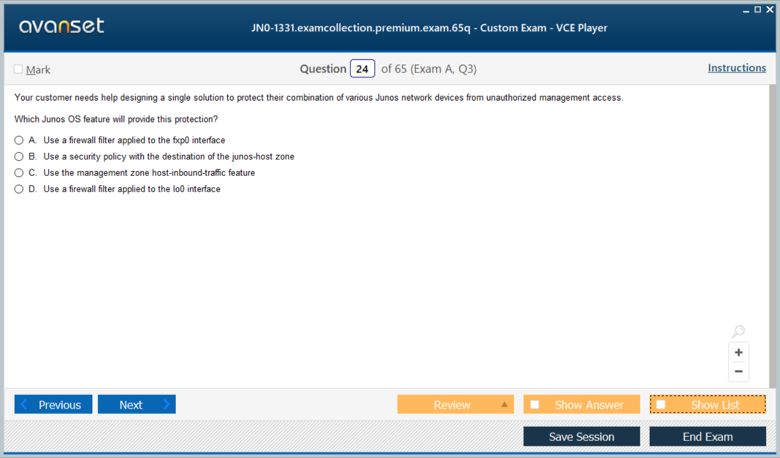
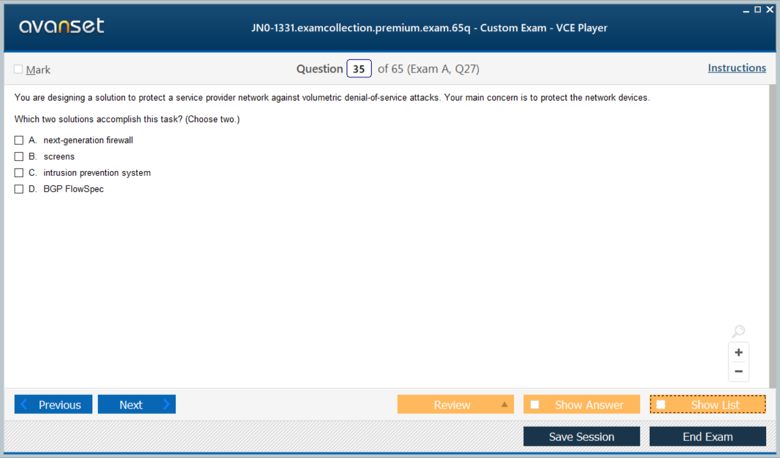
Juniper JN0-1331 Practice Test Questions in VCE Format
| File | Votes | Size | Date |
|---|---|---|---|
File Juniper.train4sure.JN0-1331.v2026-08-13.by.liyan.39q.vce |
Votes 1 |
Size 115.48 KB |
Date Aug 13, 2026 |
File Juniper.pass4sure.JN0-1331.v2020-12-07.by.tyler.30q.vce |
Votes 1 |
Size 133.56 KB |
Date Dec 07, 2020 |
Juniper JN0-1331 Practice Test Questions, Exam Dumps
Juniper JN0-1331 (Security Design, Specialist (JNCDS-SEC)) exam dumps vce, practice test questions, study guide & video training course to study and pass quickly and easily. Juniper JN0-1331 Security Design, Specialist (JNCDS-SEC) exam dumps & practice test questions and answers. You need avanset vce exam simulator in order to study the Juniper JN0-1331 certification exam dumps & Juniper JN0-1331 practice test questions in vce format.
JN0-1331 is a retired Juniper Security Design, Specialist exam. Juniper replaced it with JN0-1332 on January 18, 2021, after retiring JN0-1331 on January 17. The story did not stop there: Juniper later ended the entire Security Design Specialist certification and its corresponding exam on January 17, 2023. A reader using older study material therefore needs two layers of context—the exam code was superseded, and the specialist design credential itself was later discontinued.
The technical content remains useful because the exam treated security as architecture rather than as a list of firewall features. It connected campus access, remote access, WAN protection, service-provider concerns, data center segmentation, automation, virtualization, and high availability. Those themes still matter to anyone studying design through the current JN0-1103 Design, Associate path or working with security across Juniper certifications and technologies.
Before choosing controls, a designer needs to identify users, workloads, administrators, partners, Internet-facing services, management systems, and the trust relationships among them. Zones and segmentation are architectural tools for limiting how far a compromise can move and for making policy easier to express. The old security design exam rewarded candidates who could place controls according to risk and traffic flow rather than simply inserting a firewall at every boundary.
The same reasoning applies to identity. A device inside a corporate address range is not automatically trustworthy, and a remote user is not automatically untrusted. Modern zero-trust language makes that principle more explicit, but the design problem is longstanding: access should reflect identity, device posture, application need, and context. Good architecture reduces implicit trust while preserving a usable path for legitimate work.
Trust-boundary design should also consider data sensitivity and administrative privilege. A management workstation that can change firewalls or routers is a higher-value target than a normal user endpoint, even if both sit in the same building. Separating privileged access paths and applying stronger controls to them reduces the chance that a single endpoint compromise becomes an infrastructure compromise.
Campus design must consider wired and wireless access, 802.1X, endpoint onboarding, guest access, network admission, internal segmentation, and administrative reachability. Remote access adds Internet exposure, VPN termination, identity verification, split-tunnel decisions, and dependency on external networks. Security controls should fit the traffic pattern rather than forcing all users through one identical path.
A scenario can become difficult when availability and security pull in different directions. Centralizing enforcement simplifies policy but can create concentration risk. Distributing controls can improve locality but increase policy-management complexity. Specialist-level thinking is about recognizing that tradeoff and choosing an architecture whose operational model can actually maintain the intended security posture.
Remote-access design benefits from explicit threat modeling. Consider stolen credentials, unmanaged devices, compromised home networks, split tunneling, and unavailable identity providers. The architecture should define how access degrades and which controls are mandatory before a session reaches internal services. This is more useful than thinking only about the VPN protocol itself.
Protecting a WAN involves more than encrypting user traffic. Designers need to consider routing protocol protection, control-plane policing, DDoS exposure, Internet edge design, provider relationships, CG-NAT in some service-provider environments, and how policy follows traffic across multiple paths. Encryption, filtering, and reachability controls must be coordinated with convergence and high availability.
The older JN0-1361 Service Provider Design syllabus approached many of these subjects from a service-provider architecture perspective. JN0-1331 approached them from security design. The overlap shows why certification silos should not be mistaken for real-world silos: routing, transport, service design, and security decisions influence one another.
Provider-edge security also requires rate and scale awareness. A control that works for hundreds of sessions may not behave the same way under millions of flows or a volumetric attack. Security design therefore needs performance assumptions, telemetry thresholds, and escalation paths that match the size of the environment.
Traditional perimeter controls see north-south traffic well but can miss lateral movement between workloads. Data center designs therefore use segmentation, virtual routing, firewalls, policy groups, and sometimes service chaining to keep application tiers and tenants separated. Virtualized environments make this harder because workloads can move while their security requirements stay constant.
A good security architecture defines policy independently of physical port location. It also provides telemetry to verify that intended controls are active. Candidates should practice thinking about what happens when a workload moves, a security service fails, or a new application tier is introduced. The design should preserve both enforcement and diagnosability.
East-west security is strongest when policy is based on application relationships rather than IP addresses alone. Workload identity, labels, or orchestration metadata can make segmentation more resilient to mobility. Even in older designs, the principle is the same: policy should follow the service, not depend entirely on a fixed physical location.
Security automation can standardize policy, accelerate response, reduce configuration drift, and make large environments manageable. It can also propagate a flawed rule very quickly. A secure automation model therefore needs validation, role separation, version control, rollback, auditability, and carefully scoped permissions. The key design question is not whether automation is good, but how to use it without creating a new high-impact failure mechanism.
This distinction is useful when comparing historical design material with the current JN0-224 Automation and DevOps exam. The automation exam focuses on APIs, data formats, Python, PyEZ, and operational tooling. Security design uses those capabilities as part of a policy and control architecture.
Automation pipelines should treat policy as code with review and testing. A change can be validated for syntax, prohibited rules, unexpected broad access, and target scope before it reaches production. This kind of control is especially important for security because a single overly broad object or wildcard can have immediate enterprise-wide consequences.
Virtual firewalls and network functions can be inserted closer to workloads or service edges than fixed appliances, but virtual placement introduces dependencies on orchestration, compute resources, virtual switching, and policy lifecycle. Service chains also create ordering questions: inspection, NAT, logging, and application services may need to occur in a specific sequence.
A candidate studying old JN0-1331 material should ask which concepts are architectural and which are product-specific. The architectural questions—where policy is enforced, how services scale, how state is preserved, and how a failure is bypassed or contained—remain useful. Exact platform details may have changed significantly since the exam was active.
Virtual security functions also need resource guarantees. CPU contention, memory pressure, or host failure can degrade inspection capacity even when the network path remains available. Designers should therefore include compute failure and orchestration behavior in security availability analysis rather than looking only at network redundancy.
Failover is not successful if traffic keeps flowing but bypasses required controls or loses critical session state. Security high availability needs to account for asymmetric routing, chassis clustering, state synchronization, redundant links, and the behavior of upstream and downstream routing during a failure. Designers must also verify that management and logging remain available during degraded operation.
This is why test scenarios should include failure, not just steady state. Ask what happens when one security node disappears, when a path becomes asymmetric, or when a control service is unreachable. The right answer usually protects both connectivity and policy rather than optimizing one while silently sacrificing the other.
Logging architecture matters during failover. If both active and standby devices send evidence to one unreachable collector, incident reconstruction can lose the very period when the failure occurred. Independent log paths, buffering, time synchronization, and clear event correlation improve both operations and post-incident analysis.
JN0-1331 should not be presented as a current certification target. The current design entry point is JN0-1103, and Juniper retired the specialist design family in 2023. The historical JN0-1302 Data Center Design page can still complement JN0-1331 when studying segmentation and data center risk, but both need a clear legacy label.
Used correctly, the old security design blueprint teaches a durable habit: every security control changes traffic, operations, dependencies, or failure behavior. Good design makes those effects visible before deployment. That architectural discipline is worth preserving even after the exam number and credential path have disappeared.
Legacy security-design study is most productive when each control is tied to a threat and a failure mode. Ask what attack the control mitigates, what dependency the control introduces, and how traffic behaves if the control fails. That three-part analysis keeps historical material relevant even when product names change.
Security architecture should also be reviewed from the defender’s operating position. During an incident, teams need to know which controls made a decision, which logs recorded it, how policy was distributed, and whether a failover changed enforcement. Designing that evidence path in advance reduces ambiguity when several firewalls, virtual functions, identity systems, and routing changes are involved in the same event.
Go to testing centre with ease on our mind when you use Juniper JN0-1331 vce exam dumps, practice test questions and answers. Juniper JN0-1331 Security Design, Specialist (JNCDS-SEC) certification practice test questions and answers, study guide, exam dumps and video training course in vce format to help you study with ease. Prepare with confidence and study using Juniper JN0-1331 exam dumps & practice test questions and answers vce from ExamCollection.
Purchase Individually
Top Juniper Certifications




Top Juniper Certification Exams
Site Search:

SPECIAL OFFER: GET 10% OFF

Pass your Exam with ExamCollection's PREMIUM files!
SPECIAL OFFER: GET 10% OFF
Use Discount Code:
MIN10OFF
A confirmation link was sent to your e-mail.
Please check your mailbox for a message from support@examcollection.com and follow the directions.

Download Free Demo of VCE Exam Simulator
Experience Avanset VCE Exam Simulator for yourself.
Simply submit your e-mail address below to get started with our interactive software demo of your free trial.