


Premium File
60 Q&A
$76.99$69.99
Huawei H31-211 Exam Questions & Answers, Accurate & Verified By IT Experts
Instant Download, Free Fast Updates, 99.6% Pass Rate
60 Questions & Answers
Last Update: Sep 18, 2026
$69.99
Huawei H31-211 Exam Screenshots
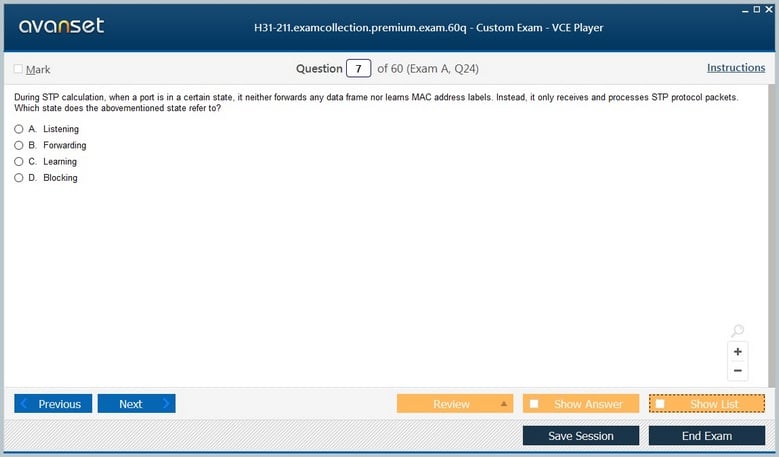
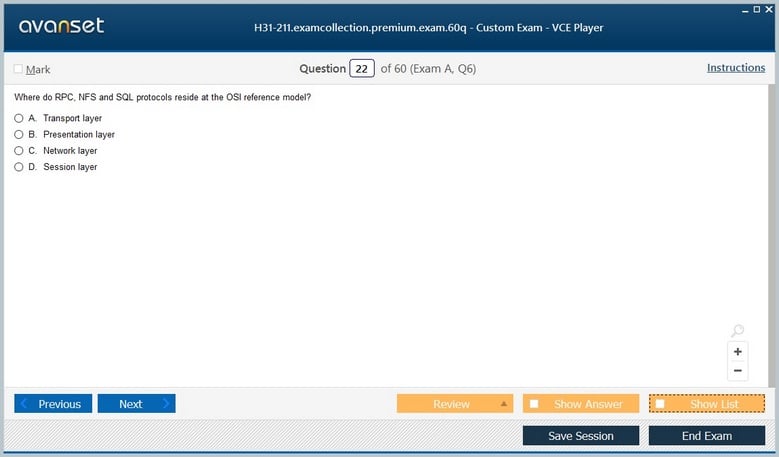
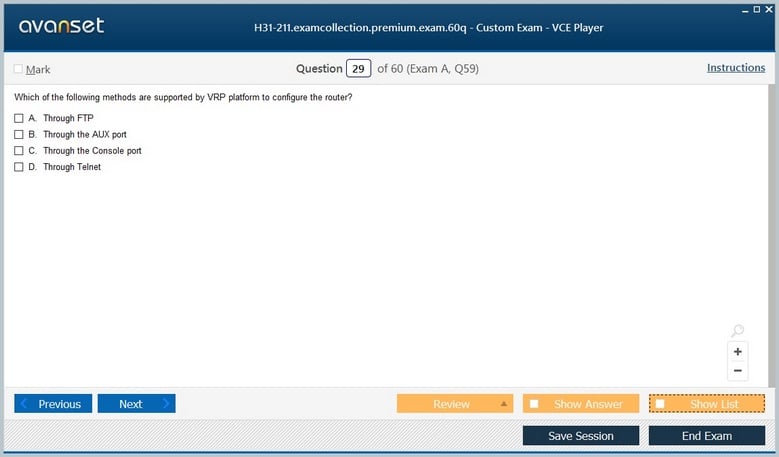
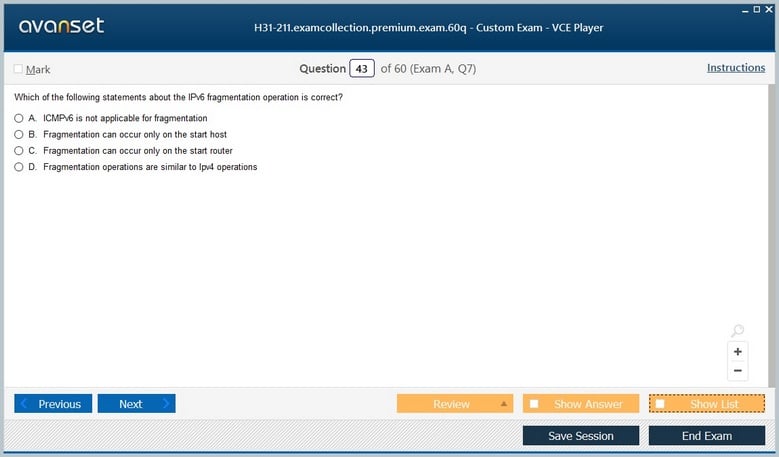
Huawei H31-211 Practice Test Questions in VCE Format
| File | Votes | Size | Date |
|---|---|---|---|
File Huawei.actualtests.H31-211.v2026-07-12.by.rosie.30q.vce |
Votes 1 |
Size 32.64 KB |
Date Jul 12, 2026 |
File Huawei.Braindumps.H31-211.v2019-05-22.by.Owen.28q.vce |
Votes 3 |
Size 30.77 KB |
Date May 23, 2019 |
Huawei H31-211 Practice Test Questions, Exam Dumps
Huawei H31-211 (HCNA - Carrier IP) exam dumps vce, practice test questions, study guide & video training course to study and pass quickly and easily. Huawei H31-211 HCNA - Carrier IP exam dumps & practice test questions and answers. You need avanset vce exam simulator in order to study the Huawei H31-211 certification exam dumps & Huawei H31-211 practice test questions in vce format.
H31-311 V2.5 is the associate-level HCIA-Transmission exam. Huawei’s first-party certification brochure defines the V2.5 scope around transport-network fundamentals, SDH and WDM principles, transmission products, NCE-T basics, Ethernet services, OTN protocol, NG WDM networking, and protection. That gives the page a clear purpose: teach how optical transport carries services reliably before moving into advanced commissioning and troubleshooting.
Transmission study is easier when every acronym is connected to a signal path. Start with the client service, identify how it is mapped or groomed, follow it through electrical and optical layers, note where amplification or regeneration may occur, and explain how protection changes the path after failure. The exam is not a collection of unrelated optical terms; it is a model of how capacity is transported across distance.
Optical transport is infrastructure for other networks and applications. Ethernet, mobile bearer, storage, and data-center connectivity all arrive with bandwidth, latency, availability, and distance requirements. Associate-level design starts by identifying the client signal and then asking how the transport layer can carry it efficiently and protect it. That keeps the technology tied to a real service instead of a wavelength diagram with no purpose.
Draw a simple end-to-end chain: client interface, mapping, electrical grooming where applicable, optical channel, line system, intermediate nodes, and destination. Label where management sees alarms and where protection can switch traffic. This picture becomes the reference model for most H31-311 topics.
Wavelength-division multiplexing carries multiple optical channels on the same fiber by separating them by wavelength. The business benefit is obvious—more capacity from a fiber pair—but the engineering constraints are equally important. Channel power, span loss, amplifier behavior, dispersion, optical signal quality, and component compatibility all affect whether the wavelengths arrive usable at the far end.
Do not memorize WDM as “many colors on one fiber.” Practice reading a route as a sequence of optical losses and functions. Ask where signals are added, dropped, amplified, monitored, or converted. When a channel degrades, think about whether the fault is local to that wavelength, common to the line, or introduced by the client side.
Optical Transport Network concepts give the candidate a framework for wrapping, multiplexing, monitoring, and managing client signals across an optical infrastructure. At this level, focus on why overhead and hierarchy exist: operators need performance information, fault localization, and a predictable way to combine lower-rate services into higher-rate transport structures.
The key study technique is to connect layer names to operational questions. Which layer reports a client-side problem? Which indicator suggests a downstream defect? Where is a service mapped or groomed? A hierarchy becomes memorable when each level has a job rather than being learned as a sequence of labels.
Huawei’s V2.5 outline explicitly includes SDH principles because real transport environments often contain multiple generations of technology. Candidates should understand synchronous transport, multiplexing, protection concepts, and how legacy services can coexist with newer packet and OTN transport. The objective is not to treat SDH as the future; it is to recognize what an operator may still encounter and migrate.
Legacy awareness is operationally valuable. During faults or modernization, a service may cross old and new layers. Engineers who understand only the newest platform can misread alarms or dependencies at the boundary. Keep historical technology in the topology, but label it clearly so current architecture and legacy context do not blur together.
Fiber cuts, board failures, node outages, and power loss create different recovery requirements. Transmission protection mechanisms provide alternate paths or resources, but they cannot protect against every common-mode failure. For each protection scheme, state what is duplicated, how failure is detected, what changes after the event, and what shared dependency remains.
The same reasoning used in recovery planning applies here: recovery is credible only when the failure scenario and recovery objective are explicit. In optical transport, the timescale is usually faster and the mechanisms are network-native, but the discipline of defining failure domains is the same.
The V2.5 scope includes Ethernet principles and services because modern transport networks carry a large amount of packet traffic. Understand MAC behavior, VLANs, service handoff, bandwidth profiles, and the distinction between an Ethernet client and the transport mechanism underneath it. A packet service can be healthy at the optical layer while still failing because of VLAN or interface configuration.
Ethernet troubleshooting provides useful background for separating physical, link, and higher-layer symptoms. Apply that layered method to transmission: first establish whether the optical path is healthy, then whether the client service is mapped and presented correctly.
Management platforms turn distributed equipment into an operable network. At associate level, understand discovery, topology, configuration, alarms, performance monitoring, and the need for consistent inventory. A graphical platform can accelerate work, but candidates should still know what device or service condition sits behind the alarm they see.
Create alarm-correlation exercises. Start with a fiber failure and predict which downstream symptoms may appear; then decide which alarm is closest to the root cause. Repeat for a client-port problem, power event, and degraded optical channel. This develops the habit of reading an alarm storm as a dependency graph instead of treating every message as an independent fault.
HCIP-Transmission V2.5 is the natural next relationship. Huawei’s professional outline adds deeper commissioning, grooming, MS-OTN, alarm flow analysis, routine maintenance, and troubleshooting. Use that progression when deciding how deeply to study: H31-311 should make the network understandable enough that advanced fault isolation has a solid base.
In the surrounding Huawei certifications landscape, transmission is a distinct technical field alongside access, 5G, security, and Datacom. That matters because the optical network is often the physical transport beneath those services. A candidate who understands both packet and optical layers is much better prepared to diagnose cross-domain failures.
Finish with an end-to-end transport trace. Build one scenario with a client Ethernet service crossing two optical nodes and a protected route. Describe the mapping, optical path, monitoring points, protection behavior, and management alarms. Then inject a fiber cut, a failed client interface, and an optical degradation event. For each case, predict the symptom, protection action, and first diagnostic evidence.
Keep the exercise conceptual enough to survive product changes. Exact hardware families and software interfaces can evolve, but signal hierarchy, protection logic, optical impairment, and fault localization remain durable. That is the right balance for an exam page that must stay useful beyond one release cycle.
The official V2.5 outline provides unusually clear boundaries for this exam, so preparation should follow that structure instead of generic fiber-optics reading. Use the percentages only to allocate revision time; use end-to-end scenarios to understand how the topics interact.
Before scheduling or relying on a historical training document, confirm the current Huawei exam status. The workbook approves H31-311 V2.5 as an internal destination, while current-status claims should always come from current certification sources rather than from the URL alone.
Fiber handling and connector cleanliness deserve explicit study because optical faults can be introduced by maintenance itself. Contamination, poor mating, excessive bend, or incorrect patching can create loss or reflection that looks like a more complex system problem. A disciplined workflow inspects and cleans before repeated reconnection, documents the intended fiber route, and compares measured power with expected values at known reference points.
Optical budgets should be treated as margins rather than exact predictions. Component tolerances, repairs, aging, temperature, and measurement uncertainty can all consume headroom. When a link is commissioned close to its limit, it may pass today and fail after a future splice or environmental change. Associate engineers should therefore understand why healthy designs preserve margin instead of merely satisfying a minimum threshold.
Transport documentation should connect physical and logical identifiers. Fiber pair, wavelength, board, port, client service, protection group, and management object all need consistent naming. During an outage, that mapping allows field and NOC teams to discuss the same path without ambiguity. Poor records can turn a straightforward fiber fault into a long service-impacting investigation.
Capacity growth should be planned before all channels or ports are consumed. Record current utilization, reserved capacity, expected service additions, and the constraints that require hardware or spectrum expansion. Transmission networks often support other teams’ growth, so lead time matters: a new mobile or data-center service cannot be delivered if optical capacity planning begins only after the request arrives.
Commissioning should also establish escalation thresholds. Define which optical-power deviation, error rate, recurring alarm, or protection event requires investigation even if traffic still passes. This prevents teams from normalizing a degraded condition simply because customers have not complained yet. Associate engineers learn good habits when they know that “up” and “healthy” are not the same state.
Maintenance planning should preserve fiber identification and cleanliness controls. Before disconnecting anything, verify both ends, label the patch, document the existing power level, and protect unused connectors. After work, restore the original route deliberately and compare measurements with the baseline. These simple steps prevent many self-inflicted optical incidents.
When studying with diagrams, include the operations layer as well as the optical layer. Mark which system owns inventory, alarms, performance history, and configuration. Transport networks become much easier to operate when every physical object and service has a consistent management identity, especially during incidents that cross several nodes and require coordination between field and NOC teams.
Go to testing centre with ease on our mind when you use Huawei H31-211 vce exam dumps, practice test questions and answers. Huawei H31-211 HCNA - Carrier IP certification practice test questions and answers, study guide, exam dumps and video training course in vce format to help you study with ease. Prepare with confidence and study using Huawei H31-211 exam dumps & practice test questions and answers vce from ExamCollection.
Purchase Individually
Top Huawei Certification Exams
Site Search:

SPECIAL OFFER: GET 10% OFF

Pass your Exam with ExamCollection's PREMIUM files!
SPECIAL OFFER: GET 10% OFF
Use Discount Code:
MIN10OFF
A confirmation link was sent to your e-mail.
Please check your mailbox for a message from support@examcollection.com and follow the directions.

Download Free Demo of VCE Exam Simulator
Experience Avanset VCE Exam Simulator for yourself.
Simply submit your e-mail address below to get started with our interactive software demo of your free trial.