



Premium File
60 Q&A
$76.99$69.99
Salesforce Certified Heroku Architecture Designer Exam Questions & Answers, Accurate & Verified By IT Experts
Instant Download, Free Fast Updates, 99.6% Pass Rate

Certified Heroku Architecture Designer Premium File: 60 Questions & Answers
Last Update: Sep 27, 2026
Certified Heroku Architecture Designer Premium File: 60 Questions & Answers
Last Update: Sep 27, 2026
$110.52
Salesforce Certified Heroku Architecture Designer Exam Screenshots
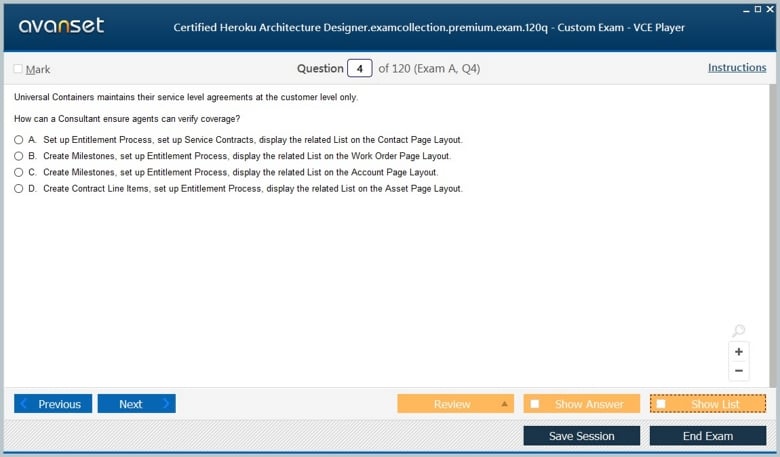
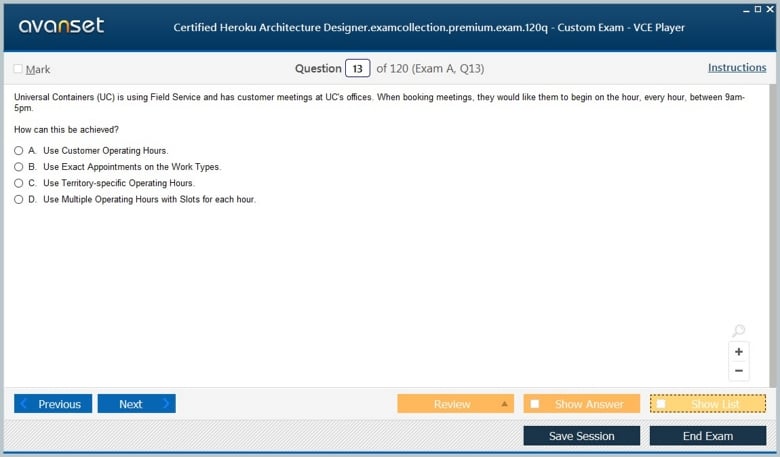
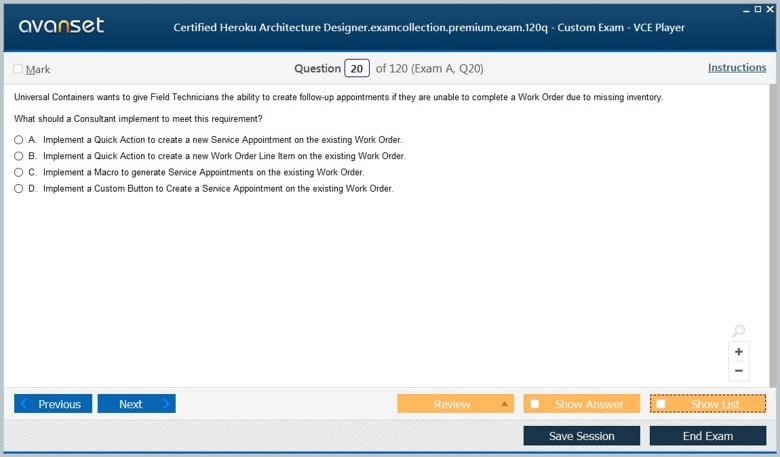
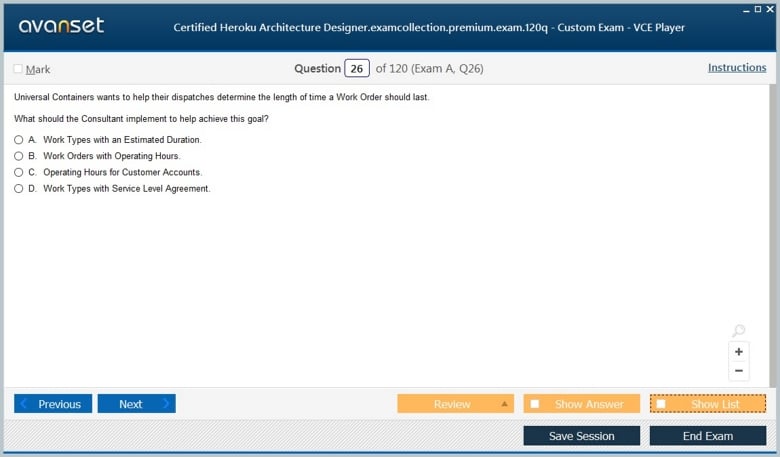
Salesforce Certified Heroku Architecture Designer Practice Test Questions in VCE Format
| File | Votes | Size | Date |
|---|---|---|---|
File Salesforce.Testking.Certified Heroku Architecture Designer.v2026-09-05.by.Gary.59q.vce |
Votes 3 |
Size 91.45 KB |
Date Sep 08, 2026 |
Salesforce Certified Heroku Architecture Designer Practice Test Questions, Exam Dumps
Salesforce Certified Heroku Architecture Designer (Certified Heroku Architecture Designer) exam dumps vce, practice test questions, study guide & video training course to study and pass quickly and easily. Salesforce Certified Heroku Architecture Designer Certified Heroku Architecture Designer exam dumps & practice test questions and answers. You need avanset vce exam simulator in order to study the Salesforce Certified Heroku Architecture Designer certification exam dumps & Salesforce Certified Heroku Architecture Designer practice test questions in vce format.
The Salesforce Certified Heroku Architecture Designer exam uses the credential’s pre-2021 name. Salesforce renamed it Heroku Architect when it separated architect certifications from the newer Designer role family, and the current Salesforce catalog still lists Certified Heroku Architect as an active credential. The role is centered on architecting scalable applications, deploying and operating them on Heroku, and designing the team and build workflows that keep those applications reliable.
That scope makes Heroku Architect broader than application development. Candidates need to reason about runtime behavior, data services, security, enterprise controls, deployment pipelines, observability, networking, and integration with Salesforce and other systems. A design is successful only when it continues to operate predictably under growth, failure, security requirements, and continuous change.
Inside the wider Salesforce certifications ecosystem, Heroku sits beyond the core transactional platform. It is often the right place for custom web services, polyglot applications, event-driven workloads, or experiences that need a flexible application runtime while still connecting to Salesforce data and processes.
Like several historical Salesforce credentials, Heroku Architecture Designer used “Designer” to describe someone who makes architecture decisions. The modern Heroku Architect title is clearer: the candidate is expected to choose platform patterns, explain trade-offs, and design systems that development and operations teams can run over time.
Older study resources can still be useful when they cover enduring Heroku principles, but the platform has evolved. Current maintenance material reflects newer routing, tooling, deployment, AI, security, and integration capabilities. Candidates should use the current Heroku Architect learning path to validate any legacy tutorial that assumes older platform behavior.
Heroku encourages applications that treat dynos as disposable compute. Local filesystem state should not be assumed to persist, and horizontal scaling works best when application instances can be added or replaced without manual coordination. Architects should design session state, background work, file storage, and caching with that model in mind.
This is where twelve-factor principles become practical rather than theoretical. Configuration should be externalized, backing services treated as attached resources, processes kept independently scalable, and deployments designed to be repeatable. Candidates should be able to explain how these choices improve resilience and why violating them creates operational problems later.
Web requests, background jobs, scheduled work, event consumers, and data processing can have very different resource profiles. Architects should separate workloads when they need independent scaling or isolation. Increasing web dynos will not fix a slow database query, and increasing worker capacity can make matters worse if downstream systems cannot absorb the additional throughput.
Performance design therefore starts with observation. Request latency, queue depth, error rate, memory use, database load, and external dependency timing reveal where capacity is constrained. Scaling decisions should follow those signals rather than a generic assumption that more compute always improves the application.
Capacity planning should distinguish sustained demand from burst behavior. A web workload with short requests, a background queue that processes large jobs, and a scheduled integration can all consume resources differently even when average traffic looks similar. Architects should identify concurrency, memory pressure, external-call latency, queue depth, and the consequences of work being retried. Scaling only the web tier can leave a bottleneck untouched if the real constraint sits in a database, downstream API, or worker process. Scenario analysis should therefore follow the request across the entire service path.
Heroku applications can use managed relational databases, key-value stores, event streaming, and other add-ons. The architect should understand which type of data belongs in which service, how backups and recovery work, and what availability or compliance characteristics the workload requires. A cache should not become the only durable copy of business data simply because it is fast.
Database design also affects scale. Connection counts, transaction boundaries, indexing, query patterns, replication, and maintenance windows can constrain application performance. Architects should plan for growth and know how application behavior changes when the primary database is under load or temporarily unavailable.
Heroku’s developer experience is strongest when source control, automated tests, review environments, staging, and production promotion form a predictable flow. Architects should design pipelines that let teams release frequently while preserving the evidence needed to know what changed and whether it is safe.
The relationship with Salesforce Platform Developer skills is useful when teams span Heroku and the Salesforce Platform, but the runtime and deployment models are different. A cross-platform release may require coordination between Heroku application changes, Salesforce metadata, API contracts, and data migrations. Architecture should make those dependencies explicit.
Logs, metrics, traces, alerts, and application-level health checks help teams understand whether a system is operating correctly. Heroku provides platform-level signals, but architects should define what the application itself must emit. A process can be technically running while customers experience timeouts, stale data, or failed downstream transactions.
Alerting should be actionable. Too many low-value alerts train teams to ignore them, while missing business-critical signals delays response. Candidates should think in terms of service objectives: which failures matter, how quickly they must be detected, and what information an on-call engineer needs to diagnose the issue.
Release architecture should also account for database and contract compatibility. Application code can be rolled back quickly only when schema changes, messages, and external APIs tolerate both old and new versions during the transition. Techniques such as additive changes, staged migrations, feature controls, and backward-compatible interfaces reduce the need for coordinated “big bang” releases. The architectural principle is broader than any Heroku feature: design change so that components can evolve independently where practical and so that recovery does not depend on reconstructing a previous production state under pressure.
Heroku architecture includes secrets, TLS, access control, private networking, team permissions, compliance requirements, and data protection. Configuration variables should not become an unmanaged secret store, and access to production applications should be based on role and operational need. Enterprise teams also need procedures for offboarding and reviewing privileged access.
Private Spaces and related enterprise capabilities can provide stronger network isolation and control for workloads that need them. Architects should avoid assuming that every application needs the most isolated option or that public networking is acceptable by default. Security choices should follow the workload’s data classification, integration path, compliance obligations, and threat model.
Security reviews should include the application’s dependencies and delivery path, not only runtime settings. A vulnerable library, over-privileged automation credential, or unmanaged add-on can undermine an otherwise sound platform configuration. Architects should know where secrets are stored, how access is rotated, which services can reach sensitive data, and how changes are reviewed. That broader view keeps platform governance connected to the software supply chain and day-to-day operating model.
Heroku applications can integrate with Salesforce through APIs, data synchronization, events, and other mechanisms. The architect should decide whether the use case needs synchronous request-response behavior, near-real-time events, replicated data, or asynchronous processing. Each pattern has different implications for latency, consistency, failure handling, and scale.
The Salesforce Integration Architect discipline is a natural adjacent area because cross-platform systems depend on clear contracts. Idempotency, retries, rate limits, authentication, event replay, and source-of-truth decisions should be designed explicitly rather than discovered through production failures.
A scalable application platform also needs a scalable operating model. Teams should know who owns each app, which repositories and pipelines are authoritative, who can promote to production, and how shared add-ons or data services are governed. Without those boundaries, a growing Heroku estate can become difficult to audit and expensive to maintain.
Review apps and automated environments can improve collaboration, but they also create cost and data-handling questions. Architects should decide what test data is appropriate, how temporary resources are cleaned up, and whether external services can safely be called from ephemeral environments. Convenience should not create uncontrolled copies of sensitive information.
The Salesforce boundary is often where otherwise sound Heroku designs become fragile. High-volume synchronization, user-facing request/response calls, event-driven updates, and analytical replication should not automatically use the same integration mechanism. Architects need to compare latency, transaction coupling, retry semantics, API consumption, data ownership, and failure visibility. A resilient design makes asynchronous work idempotent where possible and gives operators enough correlation information to trace a business event across Heroku and Salesforce rather than treating the two platforms as separate operational worlds.
The Heroku Developer Accredited Professional path focused more directly on building applications and is scheduled to retire in 2027, with Salesforce pointing learners toward Heroku Architect as a continuing certification route. That reinforces the difference between knowing how to build on the platform and being able to design an enterprise operating architecture around it.
Architects should be comfortable discussing language/runtime choices and developer workflows, but they must also account for networking, data services, security, observability, release strategy, team governance, and integration. A technically elegant application that cannot be operated safely at scale is not a complete architecture.
A strong study project is to design a production Heroku application with web traffic, background processing, a relational database, caching, an external API, Salesforce integration, and an automated deployment pipeline. Define scaling signals, backup and recovery, secrets management, team access, monitoring, and the release process.
Then introduce realistic failures: a database slowdown, exhausted connections, an external API outage, a failed deployment, a region-specific networking issue, an expired certificate, a bad configuration variable, and a sudden traffic spike. The ability to explain how the architecture detects, contains, and recovers from those conditions is what the Heroku Architect credential is ultimately measuring, regardless of whether older material still says Architecture Designer.
Go to testing centre with ease on our mind when you use Salesforce Certified Heroku Architecture Designer vce exam dumps, practice test questions and answers. Salesforce Certified Heroku Architecture Designer Certified Heroku Architecture Designer certification practice test questions and answers, study guide, exam dumps and video training course in vce format to help you study with ease. Prepare with confidence and study using Salesforce Certified Heroku Architecture Designer exam dumps & practice test questions and answers vce from ExamCollection.
Purchase Individually
Top Salesforce Certifications







Top Salesforce Certification Exams
Site Search:

SPECIAL OFFER: GET 10% OFF

Pass your Exam with ExamCollection's PREMIUM files!
SPECIAL OFFER: GET 10% OFF
Use Discount Code:
MIN10OFF
A confirmation link was sent to your e-mail.
Please check your mailbox for a message from support@examcollection.com and follow the directions.

Download Free Demo of VCE Exam Simulator
Experience Avanset VCE Exam Simulator for yourself.
Simply submit your e-mail address below to get started with our interactive software demo of your free trial.
Hi, I would like to ask kindly form which release are these questions?
Kind regards