



Premium File
493 Q&A
$76.99$69.99
Salesforce Certified Sales Cloud Consultant Exam Questions & Answers, Accurate & Verified By IT Experts
Instant Download, Free Fast Updates, 99.6% Pass Rate

Certified Sales Cloud Consultant Premium File: 493 Questions & Answers
Last Update: Oct 27, 2026
Certified Sales Cloud Consultant Training Course: 63 Video Lectures
$74.99
Salesforce Certified Sales Cloud Consultant Exam Screenshots
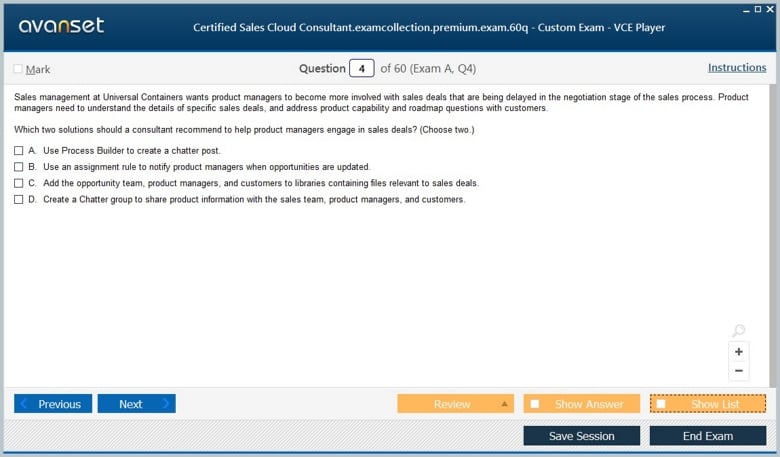
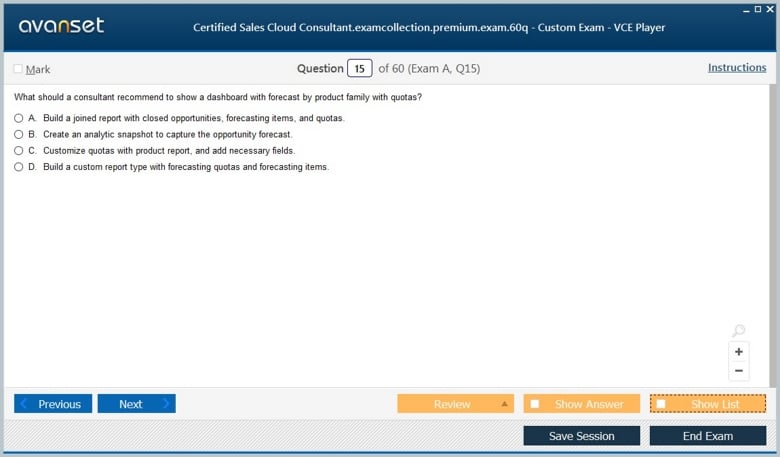
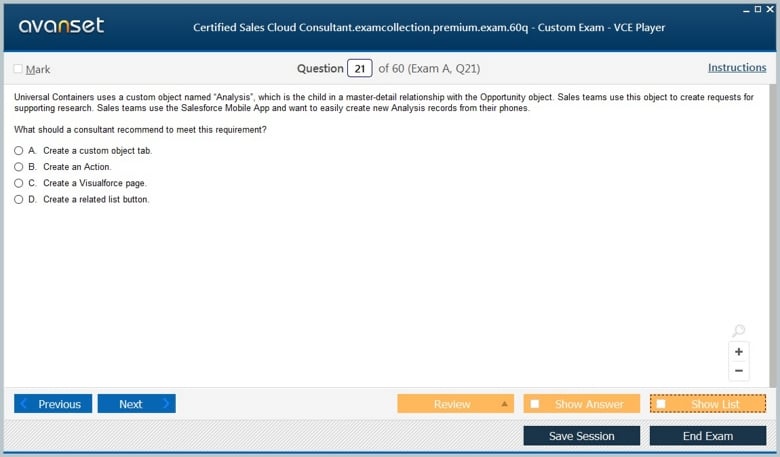
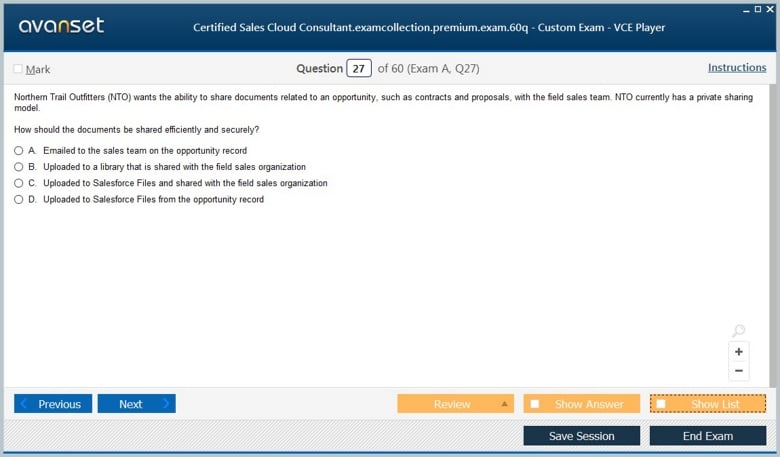
Salesforce Certified Sales Cloud Consultant Practice Test Questions in VCE Format
| File | Votes | Size | Date |
|---|---|---|---|
File Salesforce.passcertification.Certified Sales Cloud Consultant.v2026-09-28.by.alexander.94q.vce |
Votes 1 |
Size 2.62 MB |
Date Sep 28, 2026 |
File Salesforce.selftesttraining.Certified Sales Cloud Consultant.v2021-11-16.by.eliza.82q.vce |
Votes 1 |
Size 2.24 MB |
Date Nov 16, 2021 |
File Salesforce.examdumps.Certified Sales Cloud Consultant.v2021-04-26.by.gracie.69q.vce |
Votes 1 |
Size 115.76 KB |
Date Apr 28, 2021 |
File Salesforce.testking.Certified Sales Cloud Consultant.v2020-04-17.by.abdullah.52q.vce |
Votes 2 |
Size 89.75 KB |
Date Apr 17, 2020 |
File Salesforce.Test-king.Certified Sales Cloud Consultant.v2020-01-24.by.Oscar.28q.vce |
Votes 4 |
Size 49.05 KB |
Date Jan 26, 2020 |
Salesforce Certified Sales Cloud Consultant Practice Test Questions, Exam Dumps
Salesforce Certified Sales Cloud Consultant (Certified Sales Cloud Consultant) exam dumps vce, practice test questions, study guide & video training course to study and pass quickly and easily. Salesforce Certified Sales Cloud Consultant Certified Sales Cloud Consultant exam dumps & practice test questions and answers. You need avanset vce exam simulator in order to study the Salesforce Certified Sales Cloud Consultant certification exam dumps & Salesforce Certified Sales Cloud Consultant practice test questions in vce format.
The Salesforce Sales Cloud Consultant now has a different official name. On July 24, 2026, Salesforce renamed Salesforce Certified Sales Cloud Consultant to Salesforce Certified Agentforce Sales Consultant. Salesforce states that this naming update did not change the underlying exam content or annual maintenance requirements and did not require existing holders to re-earn the certification.
The current credential still validates the ability to design and implement sustainable, scalable Sales Cloud solutions. Salesforce lists Platform Administrator as the prerequisite on the current credential path, so consultant preparation assumes that basic platform administration is already familiar and shifts attention toward discovery, solution design, sales process, adoption, and long-term customer success.
For study planning, treat “Sales Cloud Consultant” as the legacy name for the current Agentforce Sales Consultant credential, not as a separate exam. Within Salesforce certifications, the consultant role connects platform configuration with the operating reality of sales teams, where pipeline quality, forecasting, automation, data discipline, and user adoption determine whether a technically correct implementation delivers value.
A strong implementation begins by understanding how the organization acquires leads, qualifies demand, manages accounts, advances opportunities, collaborates on deals, forecasts revenue, and hands work to downstream teams. The consultant should ask which stages represent real business commitments, which metrics leaders trust, and where sellers currently work around the process because the system does not reflect reality.
This discovery step prevents a common failure: reproducing an old spreadsheet or legacy CRM inside Salesforce without challenging unnecessary steps. The consultant should preserve controls that protect revenue quality while simplifying fields, stages, and handoffs that add no decision value. The platform should make the desired sales behavior easier, not merely document it.
Lead handling requires rules for assignment, qualification, duplicate management, conversion, and follow-up. Some organizations need a formal lead stage; others work primarily from accounts and contacts. The consultant should select a model that fits the sales motion rather than assume every business needs the same lead process.
Account structures also need careful design. Parent-child relationships, territories, ownership, teams, and household or partner patterns can affect reporting and visibility. A clean model gives sellers enough context to act while avoiding duplicated customer identities that distort pipeline and activity history.
Opportunity stages are useful when each one has a clear entry condition, exit condition, probability meaning, and required evidence. If stages are defined loosely, sellers can move deals forward to improve appearances and forecasts become political rather than operational. Consultants should work with sales leadership to define observable milestones and the fields or activities that support them.
This is also where automation needs restraint. Validation, guidance, and required data can improve quality, but too many blocking rules make sellers avoid the system. The consultant should decide which controls are necessary before a deal can progress, which can be warnings, and which are better handled through coaching or dashboards.
Consultants should also model deals that move backward or pause. Real opportunities can lose budget, change decision date, or return to evaluation after legal review. A process that assumes every stage change moves forward encourages users to close and recreate records or manipulate dates. Clear regression rules preserve pipeline history and make coaching more honest.
Close-date governance is especially important for forecasting. Rather than simply requiring a date, define what evidence supports it and how stale dates are detected. Scheduled reports, nudges, or automation can highlight aging opportunities without automatically rewriting seller judgment. The system should make uncertainty visible rather than manufacture false precision.
Forecasts are not repaired by changing a dashboard if opportunity amounts, close dates, stages, categories, or ownership are unreliable. Consultants should align forecast categories and hierarchy with the way managers actually review business. They also need to understand how overlays, teams, territories, and adjustments affect what different leaders see.
Preparation should include scenarios where the same pipeline must support frontline coaching, executive forecasting, and operational planning. Those audiences may need different views, but they should not rely on contradictory definitions. The consultant’s role is to make the data model and process consistent enough that reporting differences are intentional rather than accidental.
Assignment rules, flows, approval processes, notifications, guided selling, and other automation can remove repetitive work, but every automation adds a dependency. Consultants should use automation where the business rule is stable and the outcome can be explained. Highly variable judgment may be better supported with guidance than encoded as rigid logic.
The declarative boundary overlaps with Platform App Builder. A consultant does not need to turn every requirement into code. When configuration can enforce the rule clearly and remain maintainable, it is usually preferable; when complexity exceeds declarative tools, the requirement should be handed to development with a precise business contract.
Sales teams often need a mixture of private ownership and collaboration. Managers may need inherited visibility, account teams may need shared access, and specialists may need temporary participation in a deal. The sharing design should support those patterns without exposing every account and opportunity to the entire sales organization.
Consultants should distinguish capability from visibility. A permission set can allow a user to edit opportunities, but record sharing determines which opportunities are available to edit. Territory, role, team, and account relationships should be chosen deliberately so that the access model remains explainable during reorganizations.
Territory models can support matrix sales organizations where account access and forecast responsibility do not follow one management tree. Before using territories, consultants should define assignment logic, exception handling, overlay participation, and how territory changes affect existing records. The feature should solve a real coverage problem, not be introduced because the company uses the word “territory” in spreadsheets.
Sensitive fields may also need stricter controls than the opportunity record itself. Margin, discount authority, partner terms, or strategic notes can require field-level restrictions even when many users collaborate on the deal. Record sharing and field security should therefore be reviewed together rather than assuming one visible opportunity means every field should be visible to every collaborator.
Duplicate accounts, missing contact roles, stale close dates, inconsistent product data, and free-text values make automation and analytics less trustworthy. Consultants should decide which data is required at creation, which becomes necessary later, and which can be derived or enriched automatically. Requiring everything at once often leads to fake values and user resistance.
The Salesforce Business Analyst perspective is useful because good data requirements come from business decisions. Ask what action each field supports, who maintains it, and how accuracy is checked. If no process uses a field, collecting it may create more noise than value.
An opportunity rarely represents the entire customer lifecycle. Quoting and product configuration may connect to Revenue Management, while won business may create onboarding, fulfillment, or service work. Consultants should define the handoff so downstream teams receive stable identifiers and agreed business state rather than interpreting partially complete sales records.
Integration design should also avoid duplicating ownership. If ERP is authoritative for billing status or another system owns product master data, Salesforce should consume that information according to a clear contract rather than maintain a competing version. Sales users need a coherent view without turning Sales Cloud into the master of every enterprise domain.
Build a sample sales process from lead through closed opportunity, but then change the assumptions: add a new sales channel, introduce territories, require specialist collaboration, change forecasting rules, and connect a revenue process. Evaluate which parts of the design adapt cleanly and which reveal brittle configuration.
The current Agentforce Sales Consultant name should also remind candidates that Salesforce product language is evolving. Do not assume the rename created a new exam blueprint; Salesforce explicitly says it did not. Focus on durable consulting judgment—requirements, scalable design, seller usability, data quality, security, analytics, and governance—while verifying release-specific interfaces against current documentation.
Add adoption telemetry to the practice org. Track missing contact roles, stale opportunities, overdue activities, forecast movement, and use of key sales features. Then decide whether each problem is caused by training, poor process design, data burden, confusing automation, or lack of management reinforcement. A consultant earns credibility by diagnosing why users resist a process instead of responding with more validation rules.
Finally, prepare a release plan for a major sales-process change. Include sandbox testing, representative users, historical data impact, reporting changes, communications, and a transition period. Consulting work is not complete when configuration is correct; the organization has to move from the old operating model to the new one without losing pipeline visibility.
Practice presenting the design to different audiences. Sales leadership wants pipeline confidence and adoption, administrators want maintainable configuration, security teams want controlled access, and sellers want fewer obstacles. Explaining how one design satisfies those concerns without pretending they are identical is useful consultant preparation because most real trade-offs are organizational as well as technical.
After the change goes live, define a short stabilization period with named owners for data fixes, automation defects, reporting questions, and training gaps. That operational follow-through helps separate a configuration issue from a behavior-change issue and gives the sales organization confidence that the new process will be supported rather than abandoned after deployment.
Go to testing centre with ease on our mind when you use Salesforce Certified Sales Cloud Consultant vce exam dumps, practice test questions and answers. Salesforce Certified Sales Cloud Consultant Certified Sales Cloud Consultant certification practice test questions and answers, study guide, exam dumps and video training course in vce format to help you study with ease. Prepare with confidence and study using Salesforce Certified Sales Cloud Consultant exam dumps & practice test questions and answers vce from ExamCollection.
Purchase Individually

Salesforce Certified Sales Cloud Consultant Video Course

Top Salesforce Certifications





Top Salesforce Certification Exams
Site Search:

SPECIAL OFFER: GET 10% OFF

Pass your Exam with ExamCollection's PREMIUM files!
SPECIAL OFFER: GET 10% OFF
Use Discount Code:
MIN10OFF
A confirmation link was sent to your e-mail.
Please check your mailbox for a message from support@examcollection.com and follow the directions.

Download Free Demo of VCE Exam Simulator
Experience Avanset VCE Exam Simulator for yourself.
Simply submit your e-mail address below to get started with our interactive software demo of your free trial.