

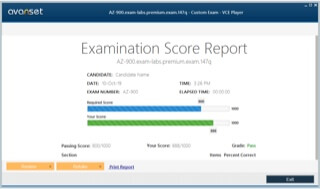

Premium File
59 Q&A
$76.99$69.99
Salesforce Certified Platform Sharing and Visibility Architect Exam Questions & Answers, Accurate & Verified By IT Experts
Instant Download, Free Fast Updates, 99.6% Pass Rate
59 Questions & Answers
Last Update: Sep 17, 2026
$69.99
Salesforce Certified Platform Sharing and Visibility Architect Practice Test Questions in VCE Format
| File | Votes | Size | Date |
|---|---|---|---|
File Salesforce.test-inside.Certified Platform Sharing and Visibility Architect.v2026-07-19.by.ezra.7q.vce |
Votes 1 |
Size 18.57 KB |
Date Jul 19, 2026 |
Salesforce Certified Platform Sharing and Visibility Architect Practice Test Questions, Exam Dumps
Salesforce Certified Platform Sharing and Visibility Architect (Certified Platform Sharing and Visibility Architect) exam dumps vce, practice test questions, study guide & video training course to study and pass quickly and easily. Salesforce Certified Platform Sharing and Visibility Architect Certified Platform Sharing and Visibility Architect exam dumps & practice test questions and answers. You need avanset vce exam simulator in order to study the Salesforce Certified Platform Sharing and Visibility Architect certification exam dumps & Salesforce Certified Platform Sharing and Visibility Architect practice test questions in vce format.
The Salesforce Platform Sharing and Visibility Architect credential focuses on designing scalable technical solutions that meet sharing and visibility requirements. It sits at the point where business ownership rules become concrete access decisions: who can see a record, who can edit it, how access is inherited or granted, and how the model behaves when millions of records or complex external-user populations are involved.
The current Salesforce name includes the Platform prefix. Historical material also uses the Sharing and Visibility Architect label and the still older Designer label, so candidates need to separate naming history from the enduring mechanics of the security model.
This architecture domain is closely tied to Platform Data Architect because data ownership, relationship structure, record volume, and sharing recalculation affect one another. A good design makes access understandable first and fast second; performance tuning cannot rescue a model whose authorization rules are conceptually wrong.
Organization-wide defaults establish the baseline for record access. The architect should begin by deciding what a user should see if no hierarchy, sharing rule, team, territory, or manual grant expands that access. Starting permissive and trying to subtract access later usually produces a fragile model because many Salesforce sharing mechanisms are designed to grant additional access rather than act as deny rules.
The baseline should be stated in business language before configuration language. For example, “case owners and their management chain can see cases unless a support team is explicitly granted access” is easier to validate than a list of settings. Once the rule is clear, the architect can map it to ownership, OWD, hierarchy behavior, and the smallest number of additional grants required.
Roles influence record access through hierarchy, but they do not need to reproduce every department and reporting line. A complicated corporate chart translated directly into roles can become difficult to maintain and may grant visibility for reasons that have little to do with data ownership. The better question is which groups need inherited visibility into records owned below them.
Candidates should distinguish roles from profiles and permission sets. Roles primarily affect record-level access; profiles and permission sets govern capabilities and object or field permissions. Mixing those concepts leads to designs where an access problem is “fixed” in the wrong layer, creating privileges that are much broader than the business requirement.
Owner-based and criteria-based sharing rules are powerful when the population and target group can be expressed declaratively. They make the reason for access visible to administrators and reduce custom code. The architect should know when public groups, territories, roles, or other group structures make a rule easier to maintain than thousands of individual grants.
The important trade-off is not simply declarative versus code. It is whether the rule remains understandable as ownership and data volume change. A criteria rule that causes huge recalculations on a frequently changing field may be technically correct but operationally expensive. Good architecture considers how often the rule changes, how many records it touches, and whether the access relationship can be modeled more directly.
Public groups can simplify rules, but group nesting and dynamic membership create their own governance problem. The architect should know who owns membership, how changes are approved, and whether the group is reused for unrelated purposes. A group created for record sharing should not silently become an all-purpose security construct because another team found it convenient. Stable, purpose-specific groups make access reviews and recalculation behavior easier to predict.
Criteria-based sharing should also be reviewed for data ownership. If a user can edit the field that determines whether a record is shared, that user may indirectly influence access. Sometimes that is intended; sometimes it creates an escalation path. The access model should identify which fields are security-relevant and protect their modification accordingly.
Account teams, opportunity teams, case teams, manual sharing, and implicit parent-child access can grant visibility without redesigning the entire enterprise model. These mechanisms are useful when access follows collaboration around specific records rather than a company-wide rule. They should not become the default answer for access that needs to be recreated continuously by administrators or integrations.
Candidates should trace why a user has access. In a complex org, one person may receive the same record through hierarchy, a sharing rule, a team, and manual sharing. Removing one path may not change effective access at all. Troubleshooting therefore requires examining all grant sources rather than assuming the most visible configuration is the decisive one.
Apex-managed sharing can represent sophisticated rules, but custom code brings lifecycle obligations. The implementation must handle record ownership changes, deletion, recalculation, retries, bulk operations, and deployment. It also needs a clear reason code or durable way to understand why access exists. A custom grant that nobody can explain later is a governance failure even if it works technically.
This is where the architect should collaborate with Platform Developer II skills. The sharing model defines the rule; code implements only the necessary gaps. Keeping that division clear prevents security policy from disappearing inside triggers or utility classes that are difficult for administrators and auditors to inspect.
Record sharing does not grant object permission or field access, and object permission does not guarantee record visibility. Architects should reason through the full stack: license and feature eligibility, object-level permissions, field-level security, record sharing, and any application-specific controls. A user needs the right combination to perform an action, while removing one layer should not accidentally be compensated for by another.
Programmatic interfaces complicate the picture because execution context can bypass assumptions made from the user interface. Apex, APIs, flows, and integration users need explicit review. The security design should describe which layer enforces each rule so developers do not implement duplicate checks in some paths while leaving other paths unprotected.
Large data volumes change the cost of seemingly simple sharing choices. Ownership skew can concentrate huge numbers of records under one user or group, while frequent group-membership changes can trigger expensive recalculation. Moving an account between territories or changing hierarchy structure may affect far more records than the administrator who made the change expects.
Scalable design reduces unnecessary churn. Stable group structures, sensible ownership distribution, careful rule criteria, and planned maintenance windows can matter as much as the logical access rule. Candidates should be able to identify designs that are safe in a small sandbox but risky when the same model serves millions of records and thousands of users.
Large-scale testing should include group-maintenance operations, not only record queries. Adding a user to a large group, moving a role with many descendants, or changing territory membership can cause broad access recalculation. The implementation team should know whether these changes are routine business operations or exceptional maintenance events and schedule them accordingly.
Ownership strategy can reduce future pain. Integration users, queue ownership, automated record creation, and account reassignment should be designed so that one principal does not become the owner of an extreme share of high-volume data without reason. Skew is not merely a database concern; it can amplify locking, sharing calculation, and administrative operations.
Customers and partners often need access tied to an account, contact, relationship, or community membership rather than the internal role hierarchy. External sharing models, sharing sets, account relationships, and partner roles should be selected according to the population and data relationship. The design should avoid exposing internal records simply because two users share a broad account or group.
External access also intersects with identity. The Platform Identity and Access Management Architect domain determines who the external user is and how the session is established; sharing and visibility determines what that authenticated identity can actually see. Secure architecture needs both halves to agree.
Take a realistic org with private defaults and model internal sellers, managers, service staff, partners, and customers. For several records, write down every path by which each user gets access. Then change ownership, move a user in the role hierarchy, add a sharing rule, and remove a team member. Predict the resulting visibility before checking the system.
Older Sharing and Visibility Designer resources can still be useful for core concepts, but current preparation should use today’s Platform Sharing and Visibility Architect terminology and current platform behavior. The strongest candidate can defend an access model to both security reviewers and operations teams because every grant has a business reason, an implementation owner, and a known scaling impact.
Add a security-review exercise to the lab. Choose one sensitive object and create a matrix of personas against create, read, edit, delete, and record visibility. Then validate the matrix with actual users and APIs. When a result differs, identify whether the cause is object permission, field security, hierarchy, explicit sharing, implicit access, or execution context. This practice trains the diagnostic discipline expected of an architect.
Finally, test removal as deliberately as granting. Remove a user from a group, transfer the record, change a criteria field, and deactivate a partner relationship. Confirm that access disappears through every path and within the expected operational window. Security architecture is incomplete if teams know how to add visibility but cannot reliably prove that obsolete visibility has been revoked.
Go to testing centre with ease on our mind when you use Salesforce Certified Platform Sharing and Visibility Architect vce exam dumps, practice test questions and answers. Salesforce Certified Platform Sharing and Visibility Architect Certified Platform Sharing and Visibility Architect certification practice test questions and answers, study guide, exam dumps and video training course in vce format to help you study with ease. Prepare with confidence and study using Salesforce Certified Platform Sharing and Visibility Architect exam dumps & practice test questions and answers vce from ExamCollection.
Purchase Individually
Top Salesforce Certifications






Top Salesforce Certification Exams
Site Search:

SPECIAL OFFER: GET 10% OFF

Pass your Exam with ExamCollection's PREMIUM files!
SPECIAL OFFER: GET 10% OFF
Use Discount Code:
MIN10OFF
A confirmation link was sent to your e-mail.
Please check your mailbox for a message from support@examcollection.com and follow the directions.

Download Free Demo of VCE Exam Simulator
Experience Avanset VCE Exam Simulator for yourself.
Simply submit your e-mail address below to get started with our interactive software demo of your free trial.