



Premium File
103 Q&A
$76.99$69.99
Salesforce Certified Community Cloud Consultant Exam Questions & Answers, Accurate & Verified By IT Experts
Instant Download, Free Fast Updates, 99.6% Pass Rate

Certified Community Cloud Consultant Premium File: 103 Questions & Answers
Last Update: Sep 27, 2026
Certified Community Cloud Consultant PDF Study Guide: 421 Pages
$74.99
Salesforce Certified Community Cloud Consultant Exam Screenshots
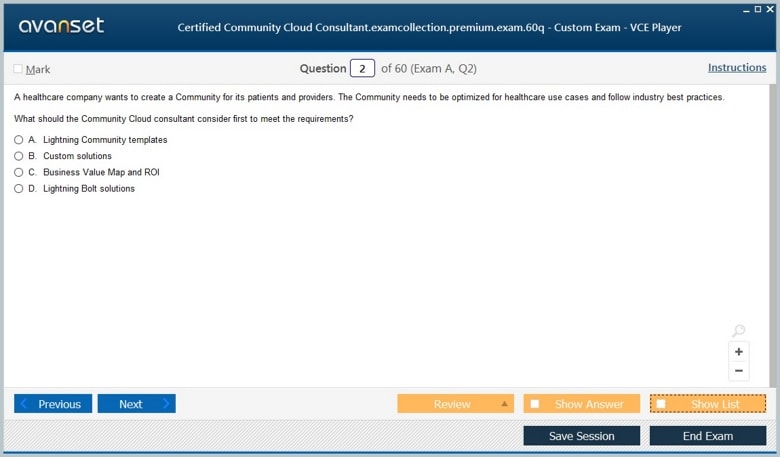
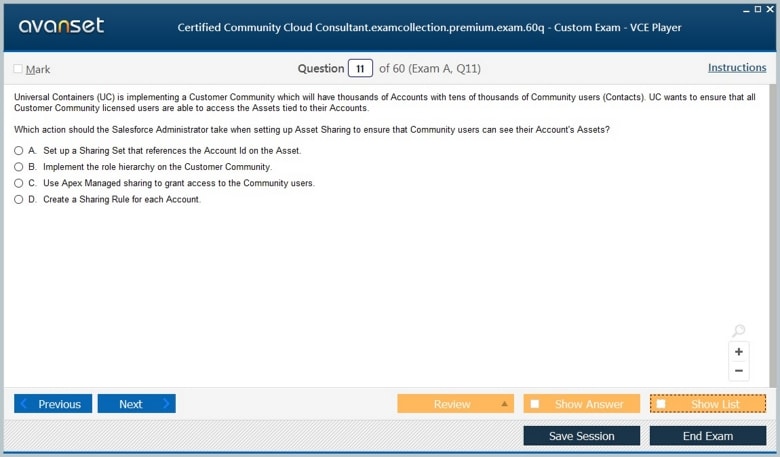
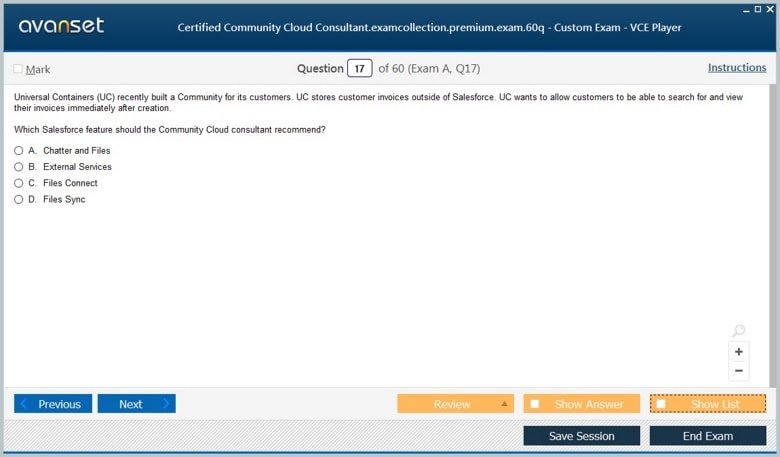
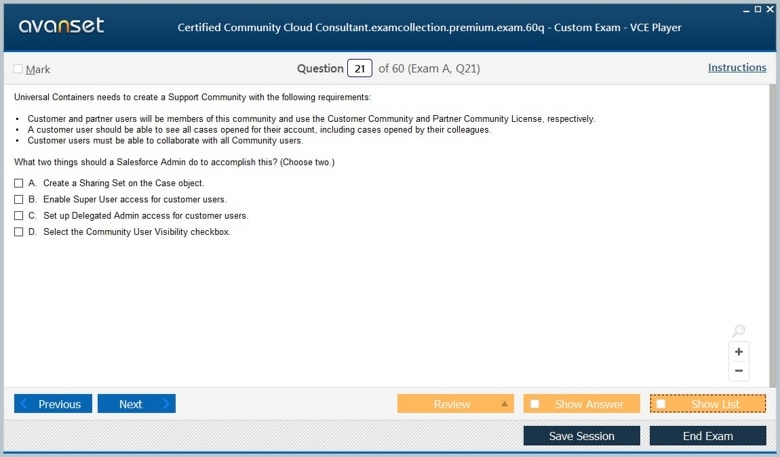
Salesforce Certified Community Cloud Consultant Practice Test Questions in VCE Format
| File | Votes | Size | Date |
|---|---|---|---|
File Salesforce.testking.Certified Community Cloud Consultant.v2026-08-15.by.archie.62q.vce |
Votes 1 |
Size 99.19 KB |
Date Aug 15, 2026 |
File Salesforce.pass4sure.Certified Community Cloud Consultant.v2020-06-30.by.martha.35q.vce |
Votes 1 |
Size 55.42 KB |
Date Jun 30, 2020 |
File Salesforce.Test-king.Certified Community Cloud Consultant.v2020-01-02.by.Carter.29q.vce |
Votes 3 |
Size 46.74 KB |
Date Jan 03, 2020 |
Salesforce Certified Community Cloud Consultant Practice Test Questions, Exam Dumps
Salesforce Certified Community Cloud Consultant (Certified Community Cloud Consultant) exam dumps vce, practice test questions, study guide & video training course to study and pass quickly and easily. Salesforce Certified Community Cloud Consultant Certified Community Cloud Consultant exam dumps & practice test questions and answers. You need avanset vce exam simulator in order to study the Salesforce Certified Community Cloud Consultant certification exam dumps & Salesforce Certified Community Cloud Consultant practice test questions in vce format.
The Salesforce Certified Community Cloud Consultant exam uses the former product name for what Salesforce now calls Experience Cloud. Community Cloud was renamed in the Spring ’21 era as Salesforce broadened the product beyond community forums to customer, partner, employee, portal, website, and other digital experiences. Current candidates should use the Experience Cloud terminology and current certification material.
The modern credential sits within the Salesforce certifications consultant family as Salesforce Certified Experience Cloud Consultant. It validates the ability to design, configure, build, and implement digital experiences while respecting external-user identity, sharing, licensing, security, content, and business requirements.
Salesforce Experience Cloud Consultant is the current credential context for the older Community Cloud name. Salesforce also requires the Platform Administrator certification for the current Experience Cloud Consultant exam, which reflects how deeply the role depends on core platform configuration and security knowledge.
“Community” suggested discussion spaces and peer interaction, but organizations use the platform for many other experiences: customer self-service, partner sales, account management, support, applications, authenticated portals, and public sites. “Experience Cloud” better describes that range. The implementation challenge is to choose the experience pattern that matches the audience and business process.
A consultant should begin with personas and journeys. What is the visitor trying to accomplish, what information does the person need, and which actions should be available? A partner registering a deal has different needs from a customer reviewing a case. Site architecture should follow those jobs rather than forcing every external audience into one generic portal.
Experience Cloud solutions rely on external users whose identities are associated with accounts, contacts, or other business context. Authentication method, registration, login, account relationships, and lifecycle processes need to be designed before the team fine-tunes page visibility. Identity mistakes can create security problems that are difficult to correct after launch.
Consultants should consider self-registration, delegated administration, single sign-on, password and MFA policies, and deactivation. They should also plan for duplicate contacts and users changing employers or roles. External access is not a one-time provisioning event; it has a lifecycle that must remain aligned with the organization’s records.
The current exam gives meaningful weight to sharing, visibility, and licensing because an external site is valuable only when users see the right information. The consultant must understand the relationship among external user licenses, profiles or permission sets, role structures, sharing rules, sharing sets, and record ownership.
Testing should use realistic personas. A partner manager may need visibility into subordinate partner users, while a customer should see only records associated with the correct account or contact. A configuration that works for an administrator proves very little about external access because administrators bypass many restrictions ordinary users face.
Experience Builder provides templates, pages, components, navigation, themes, and audience capabilities. Consultants need to know how to assemble these tools without creating a site that becomes difficult to maintain. Reusable components and clear page patterns reduce inconsistency across a large experience.
Design should also account for the underlying framework. Aura and Lightning Web Runtime experiences have different capabilities and performance characteristics. The consultant does not need to become a front-end developer for every scenario, but should understand when a requirement fits declarative configuration and when custom development or a different template becomes necessary.
External experiences mix live CRM records with content such as guidance, announcements, knowledge, images, and marketing material. These assets may have different authors, review cycles, localization needs, and publishing rules. A good architecture separates the systems and ownership models appropriately while presenting users with a coherent experience.
Content governance should define who can create, approve, publish, archive, and translate information. Old portal content can become a support risk if customers follow obsolete instructions. Publishing controls and content ownership are therefore part of operational design, not just editorial workflow.
Public experiences can expose selected content without authentication, but guest access must be treated conservatively. Guest users should receive the minimum permissions required, and forms or public actions should validate input carefully. Sensitive records should never become visible because a sharing rule was designed for convenience.
Security review should include files, search, APIs, forms, and custom components in addition to record access. Test from a truly unauthenticated session rather than relying on a logged-in administrator’s browser. Public attack surfaces deserve deliberate review because they are accessible to anyone on the internet.
Users arrive with goals, not knowledge of the site’s information architecture. Navigation labels, search, page hierarchy, and content organization should help people reach an answer or task quickly. Public experiences may also need SEO configuration so that appropriate content can be indexed and discovered externally.
Measure search terms that return poor results, pages with high exit rates, and journeys that require unnecessary clicks. These signals often reveal information-architecture problems before users file support tickets. The consultant should treat usability as an operational metric rather than a one-time design review.
Experience Cloud releases can involve metadata, custom components, content, authentication configuration, domain changes, and user communications. A deployment plan should identify which elements move automatically and which require environment-specific setup. The team also needs a rollback strategy for changes that disrupt external access.
Before launch, test registration, login, password recovery, sharing, navigation, forms, and major transactions with each supported persona. Confirm that links and email messages use the correct production domains. External users may not have an internal help desk nearby, so launch defects can immediately damage customer or partner trust.
Experience Cloud is not a separate island. It uses Salesforce data, automation, security, reporting, and integrations. Consultants therefore benefit from deep platform administration knowledge, which explains the current Salesforce Platform Administrator prerequisite. A site design decision can affect licenses, sharing, storage, support processes, and performance across the org.
For candidates arriving through the old Community Cloud name, the right study method is to learn the historical terminology just well enough to recognize older documentation, then work entirely in current Experience Cloud language. Build a small site, create multiple external personas, test sharing and registration, publish content, deploy a change, and observe usage. That practice develops the consultant judgment the modern credential is intended to validate.
Licensing is part of solution design because external-user models affect access, sharing, cost, and available capabilities. A consultant should understand the business population and expected activity before selecting a license pattern. Choosing purely on price can create feature or sharing constraints later, while over-licensing can make a portal unnecessarily expensive to operate.
Moderation and community-management features still matter in experiences that include user-generated content, discussions, or collaborative spaces. Define acceptable behavior, escalation, and who can manage content. Automated moderation can help at scale, but organizations still need ownership for edge cases and an auditable response to abuse or inappropriate content.
Accessibility should be part of page and component decisions from the start. Keyboard navigation, readable labels, contrast, alternative text, and predictable focus behavior affect whether customers and partners can use the site. Custom components should be evaluated against accessibility expectations rather than assumed to inherit good behavior automatically from the platform.
Performance needs realistic external testing. A site may load quickly for an internal admin with fast connectivity but behave differently for authenticated external users, complex pages, mobile devices, or users far from the hosting region. Measure major journeys and examine large images, custom components, network calls, and personalization rules when diagnosing slow pages.
Analytics should track whether people complete the purpose of the site. Page views alone cannot tell whether customers found an answer or partners completed registration. Define conversion or completion events for key journeys, then investigate abandonment. Experience design improves when analytics are tied to user goals rather than only traffic volume.
Finally, consultants should design a support model for the experience itself. External users need a clear route when registration fails, access is wrong, or a transaction cannot be completed. Support teams need diagnostic information such as user identity, site, page, error context, and recent changes. A portal becomes a production product once customers depend on it, and it needs the same operational ownership as other customer-facing systems.
Template selection should account for long-term change. A template can accelerate launch, but the team should verify whether its navigation, authentication pattern, component model, and framework fit future requirements. Migrating a mature experience later can be more expensive than spending additional design time before the first build.
Consultants should also rehearse lifecycle events such as an external user changing companies, a partner relationship ending, a site being consolidated, or a license model changing. These events test whether identity, sharing, and data ownership have been designed cleanly. An experience that works only while organizational relationships remain static is fragile.
Site decommissioning deserves planning too. When an experience is replaced, redirect important public URLs, remove obsolete authentication entry points, preserve required content or audit records, and communicate the change to external users. Leaving an old portal partially accessible can create both security risk and support confusion long after the new experience has launched.
Consultants should also rehearse recovery from a bad publication: restore the prior version, confirm authentication and sharing, and verify that critical external journeys work again before declaring the incident resolved.
Go to testing centre with ease on our mind when you use Salesforce Certified Community Cloud Consultant vce exam dumps, practice test questions and answers. Salesforce Certified Community Cloud Consultant Certified Community Cloud Consultant certification practice test questions and answers, study guide, exam dumps and video training course in vce format to help you study with ease. Prepare with confidence and study using Salesforce Certified Community Cloud Consultant exam dumps & practice test questions and answers vce from ExamCollection.
Purchase Individually

Top Salesforce Certifications







Top Salesforce Certification Exams
Site Search:

SPECIAL OFFER: GET 10% OFF

Pass your Exam with ExamCollection's PREMIUM files!
SPECIAL OFFER: GET 10% OFF
Use Discount Code:
MIN10OFF
A confirmation link was sent to your e-mail.
Please check your mailbox for a message from support@examcollection.com and follow the directions.

Download Free Demo of VCE Exam Simulator
Experience Avanset VCE Exam Simulator for yourself.
Simply submit your e-mail address below to get started with our interactive software demo of your free trial.