



Premium File
65 Q&A
$76.99$69.99
Salesforce CRT-251 Exam Questions & Answers, Accurate & Verified By IT Experts
Instant Download, Free Fast Updates, 99.6% Pass Rate
65 Questions & Answers
Last Update: Sep 30, 2026
$69.99
Salesforce CRT-251 Exam Screenshots
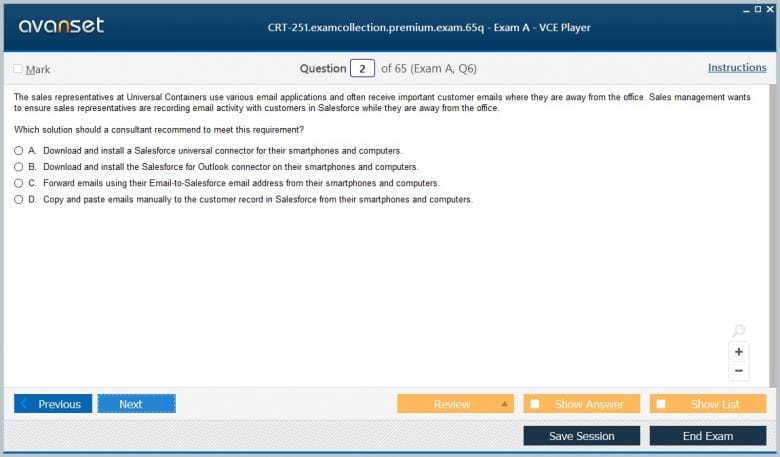
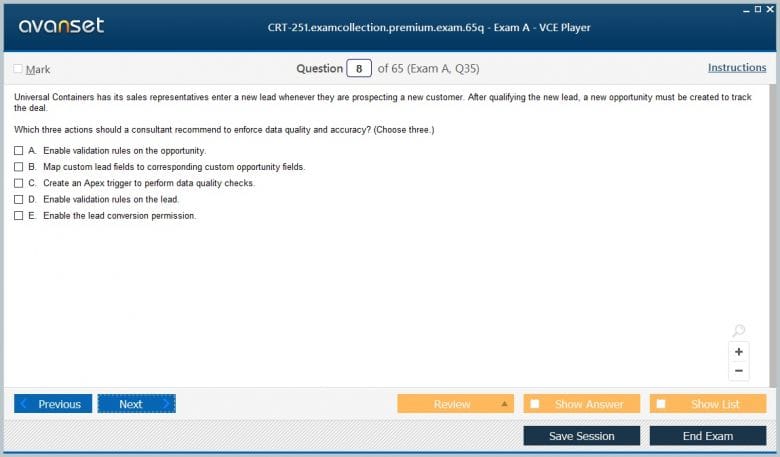
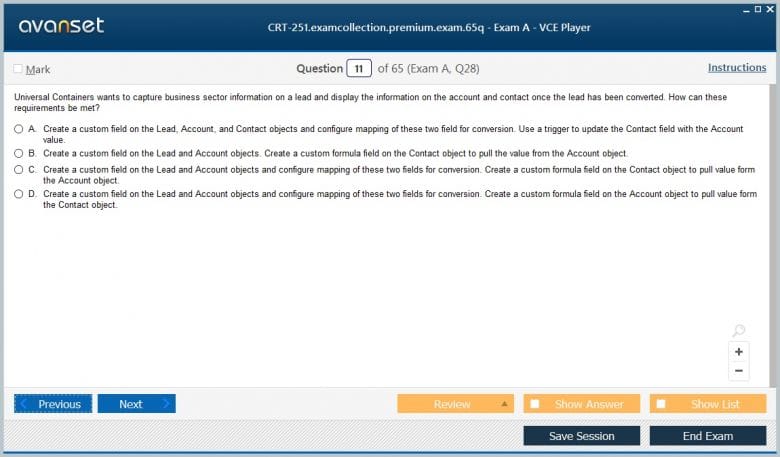
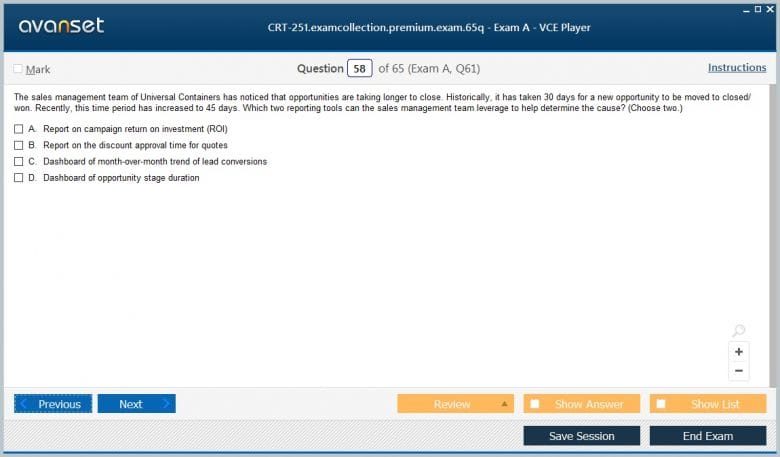
Salesforce CRT-251 Practice Test Questions in VCE Format
| File | Votes | Size | Date |
|---|---|---|---|
File Salesforce.testking.CRT-251.v2026-06-18.by.harley.41q.vce |
Votes 1 |
Size 68.74 KB |
Date Jun 18, 2026 |
File Salesforce.Prep4sure.CRT-251.v2019-01-15.by.Isaac.40q.vce |
Votes 3 |
Size 68.52 KB |
Date Jan 22, 2019 |
Salesforce CRT-251 Practice Test Questions, Exam Dumps
Salesforce CRT-251 (Sales Cloud Consultant) exam dumps vce, practice test questions, study guide & video training course to study and pass quickly and easily. Salesforce CRT-251 Sales Cloud Consultant exam dumps & practice test questions and answers. You need avanset vce exam simulator in order to study the Salesforce CRT-251 certification exam dumps & Salesforce CRT-251 practice test questions in vce format.
The CRT-251 code is historically associated with Salesforce Sales Cloud Consultant certification preparation. Salesforce’s current credential name is Agentforce Sales Consultant, following a July 24, 2026 naming update that did not require holders to re-earn the certification. Candidates using CRT-251 material should therefore treat the code as legacy preparation shorthand and map the content to the current role.
The modern credential still centers on designing sustainable Sales Cloud solutions, but the surrounding product environment has evolved. Agentforce capabilities, current automation, newer analytics patterns, updated mobile and collaboration tools, and revised implementation guidance sit alongside durable sales concepts such as leads, accounts, contacts, opportunities, products, forecasts, territories, and adoption.
The safest preparation strategy is to preserve the business-process knowledge in older CRT-251 material while validating the platform implementation against current Salesforce guidance. Old screenshots and labels are less important than understanding how a sales organization should be modeled, governed, automated, and measured today.
Salesforce lists Platform Administrator as a prerequisite for Agentforce Sales Consultant. That reflects the reality that a consultant cannot design Sales Cloud in isolation from core security, data, reporting, configuration, and automation. Candidates should already be comfortable with users, profiles or permission sets, record access, objects, fields, validation, reports, and standard platform behavior.
The internal Salesforce administration path is therefore a useful foundation. Consultant preparation should build on it rather than re-teaching every administrative feature. The question becomes which configuration best supports the sales process and how the consultant knows that the choice is sustainable.
When reviewing CRT-251 notes, flag any feature that has changed materially and verify the modern alternative. Workflow Rules and Process Builder, for example, should not drive a new design where Flow is the supported automation direction.
Account and contact structure also affects every later sales feature. Define whether the organization sells to businesses, individuals, households, subsidiaries, or channel partners, and choose a model that reflects those relationships. Account hierarchies can be useful for enterprise visibility, but they should not become a substitute for a documented ownership and territory strategy.
A Sales Cloud implementation begins with the organization’s selling motion. Lead-driven acquisition, account-based selling, channel sales, renewals, and complex enterprise deals may need different objects, stages, ownership rules, and handoffs. Do not force every company into a textbook sequence simply because the standard objects exist.
Opportunity stages should represent meaningful commercial milestones with clear entry and exit criteria. If stage changes are subjective, pipeline analytics and forecasts become unreliable. Required data should be introduced at the point it becomes useful, not demanded too early and bypassed by users.
Sales Cloud Consultant is the older name in the same credential lineage. The business problems remain recognizable even though Salesforce now presents the credential under Agentforce Sales branding.
Duplicate leads, inconsistent account hierarchies, stale contacts, incomplete opportunity amounts, and unmanaged product data undermine every downstream feature. Consultants should define how records enter Salesforce, which fields are required, how duplicates are prevented or merged, and who owns correction when data quality degrades.
Large data volumes and ownership skew also affect technical behavior. A design that works in a small sandbox may encounter locking, sharing recalculation, or query performance issues at scale. Candidates should recognize when data volume changes the implementation choice.
Business-analysis skills help here because “better data quality” needs measurable criteria: duplicate rate, required-field completeness, stale-record thresholds, or handoff accuracy. Clear measures make governance operational.
Guided selling should focus on moments where users need help making a choice. Screen flows, path guidance, dynamic visibility, and recommended actions can reduce training burden when they surface the next relevant step. They become noise when every page contains banners and prompts. Measure whether guidance shortens cycle time or improves data quality instead of assuming more guidance means better adoption.
Flow, assignment, approvals, validation, and guided interfaces can reduce manual work, but excessive automation can make the system unpredictable. Users need to understand why a record changed owner, why an opportunity cannot advance, or why a task was created. Consultants should design automations that are observable and recoverable.
Agentforce capabilities add another layer of assistance and automation. Treat them as part of the sales operating model rather than a novelty. Define what the agent can recommend or perform, what data it relies on, where human approval is required, and how outcomes are monitored.
Automation also needs failure handling. External calls can time out, record locks can occur, and required data can be missing. A mature design specifies what happens when the happy path breaks.
Product and price-book design should match the organization’s commercial structure without creating unnecessary complexity. Determine how products are sold, how currencies are handled, whether schedules or quantities matter, and what downstream systems require. Quotes or revenue processes may introduce additional product-to-cash considerations.
Forecasting is only useful when opportunity stages, amounts, close dates, ownership, and forecast categories are maintained consistently. Collaborative forecasts can provide strong management visibility, but no configuration can compensate for a sales culture that updates data only at quarter end.
The Revenue Management Consultant relationship becomes relevant where sales design extends into pricing, quoting, ordering, or broader product-to-cash architecture. Link the domains where the business process actually crosses that boundary rather than treating every Sales Cloud project as a revenue transformation.
Pipeline and revenue are lagging outcomes. Consultants should also consider lead response, stage aging, conversion, activity quality, forecast accuracy, data completeness, and adoption patterns. These measures can reveal whether the process is healthy before missed targets appear at the end of the period.
Dashboard design should be role-specific. An executive may need coverage and forecast risk; a manager may need stage movement and rep coaching signals; a seller may need a focused work queue. Giving every role the same dashboard often produces clutter and low adoption.
Report definitions should be governed. If one team counts open pipeline by expected revenue and another by amount, both dashboards may be technically valid but operationally incompatible. Establish the metric contract and use consistent reporting sources.
Territory and forecast governance are especially useful test cases because they force process, access, and reporting decisions to agree. A forecast hierarchy that does not reflect managerial responsibility, or a territory model that changes record visibility without clear ownership rules, can make pipeline numbers difficult to explain. Validate representative users across territory, role, and opportunity scenarios, then reconcile dashboards to the records that actually contribute to the forecast. Reliable sales reporting depends on transparent inclusion logic as much as on polished charts.
Data migration is part of change management because poor launch data can destroy confidence immediately. Profile the legacy source, map fields, normalize picklists, resolve duplicates, define cutover rules, run trial loads, and reconcile counts and key totals. Users who find missing accounts or duplicated opportunities on day one may reject the new process before training has a chance to work.
Consultants are evaluated by outcomes, not by configuration volume. Discovery should identify stakeholder goals, pain points, incentives, existing workarounds, and the groups most affected by change. The rollout should include training, communications, feedback, support, and adoption metrics.
Pilot groups can expose process and usability problems before a broad launch. Use representative users and real data volumes, not only project-team volunteers. Track whether required fields are completed, whether users abandon the mobile experience, and whether managers actually use the new forecasts or dashboards.
When adoption is weak, investigate design before blaming users. Too many required fields, slow pages, duplicate entry, unclear ownership, or misaligned metrics can make noncompliance rational from the seller’s perspective.
Mobile and productivity integrations should be included in process design when sellers spend much of their day outside Salesforce. Email and calendar capture, mobile actions, Slack collaboration, and other connected tools can reduce context switching, but they also introduce permissions, data-retention, and support questions. Evaluate them against the selling motion rather than enabling every available integration.
Sales Cloud often exchanges data with marketing, ERP, finance, support, data warehouses, and productivity tools. Consultants need to define which system owns each entity and business event. Bi-directional synchronization without ownership rules can create loops, conflicting edits, and reconciliation problems.
Integration requirements should include latency, volume, error recovery, idempotency, security, and monitoring. “Sync accounts to ERP” is not enough. Specify which fields, what triggers the exchange, how failures are retried, and how a user knows the data is stale.
Architecture should also avoid turning Salesforce into a copy of every external database. Store the information needed for the sales process and use integration patterns that respect source-system responsibility.
Take an older CRT-251 scenario and rebuild it using current Salesforce capabilities. Define the sales stages, security, lead conversion, opportunity process, products, forecasting, Flow automation, Agentforce touchpoints, reports, and adoption plan. Explicitly mark which legacy feature names or practices you replaced.
Use Salesforce certifications for context, but keep the project centered on the consultant’s responsibility: translate commercial requirements into a scalable system that users can operate and managers can trust.
Finish with a design review. Defend why each object, required field, automation, integration, and dashboard exists. If the answer is “because CRT-251 notes said so,” the design is not current enough. If the answer connects to a business decision, operating risk, or measurable outcome, the legacy material has been translated successfully.
Go to testing centre with ease on our mind when you use Salesforce CRT-251 vce exam dumps, practice test questions and answers. Salesforce CRT-251 Sales Cloud Consultant certification practice test questions and answers, study guide, exam dumps and video training course in vce format to help you study with ease. Prepare with confidence and study using Salesforce CRT-251 exam dumps & practice test questions and answers vce from ExamCollection.
Purchase Individually
Top Salesforce Certifications







Top Salesforce Certification Exams
Site Search:

SPECIAL OFFER: GET 10% OFF

Pass your Exam with ExamCollection's PREMIUM files!
SPECIAL OFFER: GET 10% OFF
Use Discount Code:
MIN10OFF
A confirmation link was sent to your e-mail.
Please check your mailbox for a message from support@examcollection.com and follow the directions.

Download Free Demo of VCE Exam Simulator
Experience Avanset VCE Exam Simulator for yourself.
Simply submit your e-mail address below to get started with our interactive software demo of your free trial.
@Alan089, this exam is challenging and you need to prepare for it well. and yes, these CRT-251 questions and answers will be very helpful but do not use only them… look for study guides, videos, and learn from groups too… you will surely pass if you do this! Success
any advice about taking this exam? and can these CRT-251 practice questions and answers be helpful? thanks in advance
@Elliot67, these CRT-251 exam dumps will help you brush your knowledge and ensure that you don’t miss anything… study the materials well, you will find a big number of the questions in the exam very much related to the ones you’ll find here… wish you success
Hi, guys! I will take this exam for the second time next week and don’t want to fail again… do you guys think i will pass this time if I use these dumps for CRT-251 exam ?
@brooks, I have used these CRT-251 braindumps and passed my exam in my first attempt! they are up to date and well compiled. they will help you pass, just make sure you’ve practiced enough to understand all the topics
can anyone advise whether these CRT-251 vce files are updated? will they be useful and help me pass?
Very good dumps!