



Premium File
247 Q&A
$76.99$69.99
Nokia 4A0-108 Exam Questions & Answers, Accurate & Verified By IT Experts
Instant Download, Free Fast Updates, 99.6% Pass Rate
247 Questions & Answers
Last Update: Sep 14, 2026
$69.99
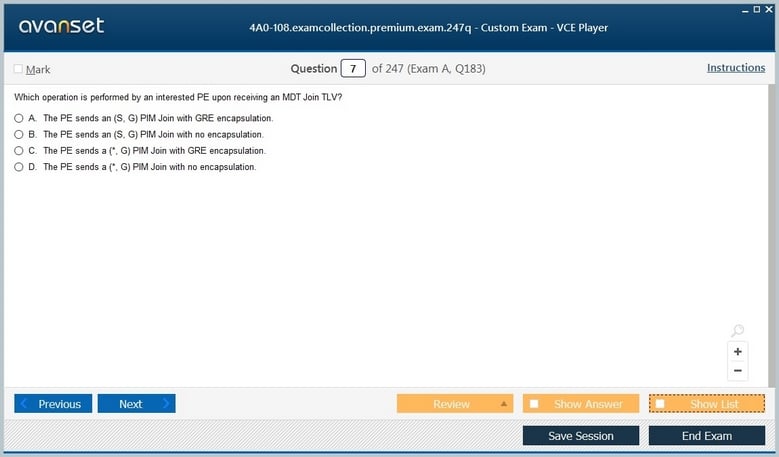
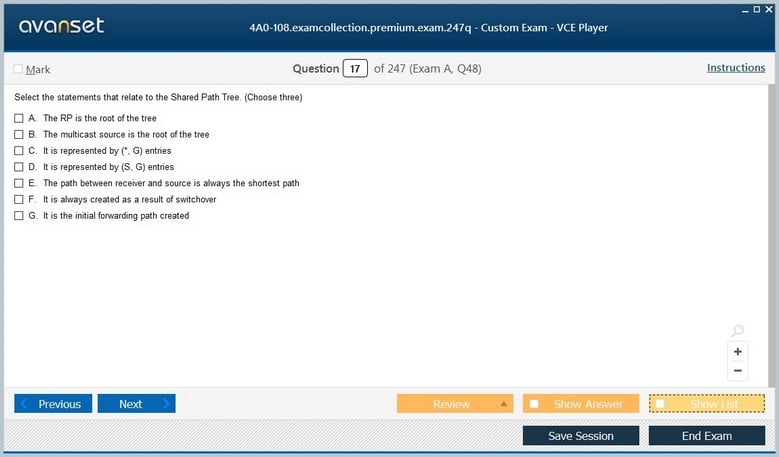
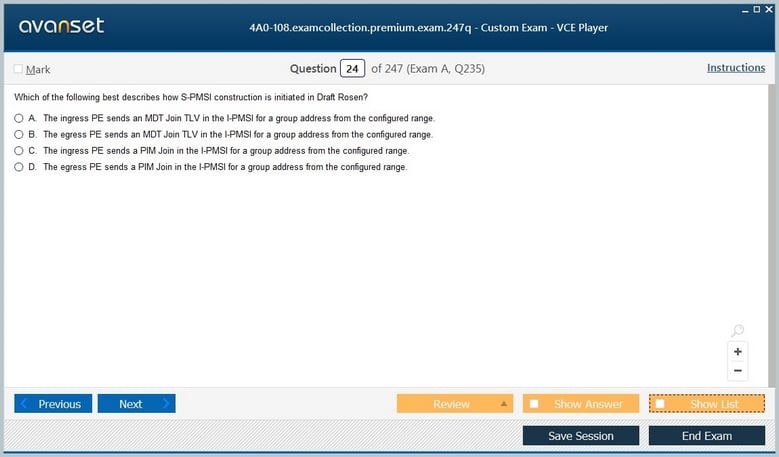
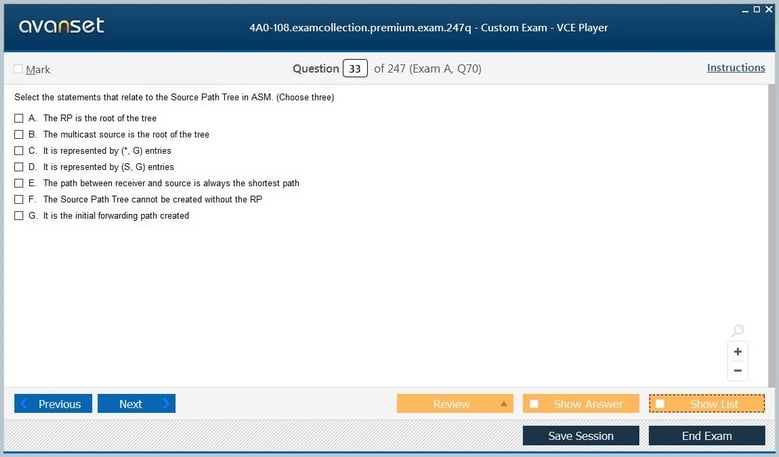
Nokia 4A0-108 Exam Screenshots
Nokia 4A0-108 Practice Test Questions in VCE Format
| File | Votes | Size | Date |
|---|---|---|---|
File Nokia.realtests.4A0-108.v2026-09-04.by.harper.109q.vce |
Votes 1 |
Size 1.75 MB |
Date Sep 04, 2026 |
Nokia 4A0-108 Practice Test Questions, Exam Dumps
Nokia 4A0-108 (Nokia Multicast Protocols) exam dumps vce, practice test questions, study guide & video training course to study and pass quickly and easily. Nokia 4A0-108 Nokia Multicast Protocols exam dumps & practice test questions and answers. You need avanset vce exam simulator in order to study the Nokia 4A0-108 certification exam dumps & Nokia 4A0-108 practice test questions in vce format.
The 4A0-108 exam was Nokia Multicast Protocols. Nokia states that the exam retired on September 8, 2026 and is no longer part of the current Service Routing Architect certification. That makes 4A0-108 a legacy exam page, but the technical material remains valuable because multicast forwarding, IGMP/MLD, PIM, source and shared trees, and multicast VPN concepts still appear in real service-provider networks.
The current Nokia certifications program has shifted the SRA elective emphasis toward technologies such as 4A0-115 EVPN Services and 4A0-116 Segment Routing. Candidates should not present 4A0-108 as a current scheduling target. Instead, use it to understand the multicast control and forwarding principles that may still support live networks, migrations, troubleshooting, and architectural discussions.
Multicast is easiest to learn by contrasting it with unicast. Unicast creates a separate delivery path to each receiver; multicast builds a distribution tree so the network can replicate traffic only where receiver interest exists. That efficiency comes with extra state and control-plane behavior, so the exam's durable value lies in understanding how membership and tree construction influence forwarding.
IGMP for IPv4 and MLD for IPv6 communicate receiver interest on a local segment. Routers need to know which interfaces have interested receivers before they can make sensible multicast forwarding decisions. Study joins, leaves, querier behavior, timers, and the difference between group-only and source-aware membership models.
Lab a receiver joining and leaving a group and inspect both host-facing membership state and router multicast state. If traffic continues after the final receiver leaves, identify which timer or control message explains the behavior. This makes membership state visible rather than treating IGMP or MLD as mere prerequisites to PIM.
Study snooping behavior at the Layer 2 edge as supporting context. A switched segment can use membership information to avoid flooding multicast everywhere, but incorrect snooping or querier behavior can also prevent receivers from getting traffic. This demonstrates that multicast delivery can fail before the routed multicast protocol ever becomes involved.
Protocol Independent Multicast uses the unicast routing table for reverse-path decisions while maintaining separate multicast state. Understand the difference between sparse-mode shared-tree and shortest-path-tree behavior, the role of the rendezvous point, and how source-specific multicast removes some shared-tree complexity.
Draw the tree from source to receivers and label the interface that should pass the reverse-path-forwarding check on each router. Then deliberately change the unicast route to the source and predict how the multicast state should react. This shows why multicast can fail even when receivers, groups, and PIM neighbors appear correct.
Include register and rendezvous-point behavior in an ASM lab where applicable. Observe how a source becomes known, how receivers initially reach the shared tree, and when traffic can move to a shortest-path tree. Seeing the transition explains why shared-tree and source-tree state can coexist temporarily and why troubleshooting must account for both.
A multicast router should accept source traffic on the interface it considers the best path back toward the source. If the packet arrives on a different interface, the router may discard it to prevent loops. This makes the unicast routing table an essential dependency even though the multicast forwarding state is separate.
Troubleshoot an RPF failure by checking the source address, the unicast route to that source, the expected incoming interface, and any policy that changes the route. Do not start by modifying multicast group state when the router is simply rejecting packets on the wrong incoming path.
Add equal-cost and policy-route scenarios. If the unicast table changes its preferred path back to the source, the expected multicast incoming interface can change even though the multicast configuration is untouched. This is a strong reminder that RPF failures can be caused by ordinary routing changes elsewhere in the network.
Any-source multicast allows receivers to join a group without naming a particular source, which requires the network to help discover and connect sources and receivers. Source-specific multicast makes the source explicit and can simplify the control plane. Candidates should understand the operational trade-off rather than memorizing the acronyms as two unrelated modes.
Build one example for each model and list the control-plane state required before traffic can flow. Then ask how a receiver would behave if the source changed or an additional source appeared. These scenarios reveal the practical difference between group membership and source-specific membership.
Compare address planning and receiver configuration for the two models. SSM typically relies on receivers knowing the source and using the appropriate group range, while ASM relies more on the network's source-discovery machinery. When a receiver application is designed for one model but the network expects the other, all underlying links can be healthy and traffic still will not arrive.
When multicast crosses a Layer 3 VPN, the provider must preserve customer separation while transporting replication efficiently. The same isolation principles from 4A0-106 VPRN still apply, but multicast introduces additional tree and replication state. Older technologies such as Draft Rosen and later methods solve this problem differently.
Use layered diagrams: customer multicast tree, provider VPN context, and provider transport. If you mix those layers, labels and multicast state become difficult to interpret. The diagram should show where replication occurs and which router owns each piece of state.
A backup unicast route does not automatically guarantee seamless multicast recovery. The change may trigger RPF updates, PIM state changes, new tree construction, and membership effects. Study how failures alter the incoming interface and downstream state and how long the receivers may lose traffic.
Run a failure test with a continuous multicast stream and capture the state before, during, and after convergence. Measure receiver impact rather than simply confirming that PIM neighbors eventually return. This gives the old 4A0-108 material ongoing operational value.
Consider the rendezvous point or other shared control components as failure domains in older ASM designs. A redundant data path does not help if the control role has no backup. Document how the design detects control-plane failure and how receivers and sources are reconnected. This broadens resiliency beyond simply providing alternate physical links.
Multicast problems can hide between membership, routing, PIM, and forwarding state, so packet observation is especially useful. The general techniques behind packet capture and analysis help confirm whether queries, reports, joins, and data packets actually appear on the interfaces where you expect them.
Troubleshoot in order: receiver membership, unicast route to the source, RPF interface, PIM neighbors and tree state, outgoing-interface list, and finally data-plane counters. This sequence turns a complex topic into a repeatable diagnostic workflow.
Also verify replication points. If one upstream packet becomes many downstream copies, determine which router or interface performs that replication and whether the resulting load matches the design. Unexpected replication can create congestion even when protocol state is correct. This is especially important when multicast VPNs cross shared provider links.
Test receiver recovery after both source-side and receiver-side failures. The same multicast tree may react differently depending on where the topology changes. Capturing those differences helps operations choose realistic monitoring timers and prevents a single successful failover test from being treated as proof that every failure mode is covered.
Nokia explicitly removed Multicast Protocols from the current SRA requirements, while the SRA now emphasizes current written exams and the 4A0-C02 composite option. If you already hold credit from the older exam, follow Nokia's current certification and recertification rules; if you are preparing today, do not schedule against the retired code.
For learning, keep the parts that outlive the exam: receiver discovery, RPF, PIM trees, ASM versus SSM, multicast VPN reasoning, and layered troubleshooting. Then reconcile implementation details with the software and architecture in the network you actually support. That is the right way to preserve the value of a retired exam without misrepresenting its current status.
Keep your final notes clearly labeled 'retired 2026' so old practice material cannot be mistaken for current scheduling guidance. If you support an existing Nokia network, cross-check commands and feature behavior against the running SR OS release. The technology may remain operational even though the certification exam that once taught it has left the program.
For operational teams, preserve a multicast runbook even if the exam is gone. Document rendezvous-point design where used, group ranges, SSM policy, membership verification, RPF checks, multicast-VPN dependencies, and the commands needed to prove forwarding. Legacy multicast networks often remain in production for years, and the knowledge gap becomes more dangerous after formal training paths stop emphasizing them.
Build one final multicast fault tree: no receiver traffic, traffic to some receivers only, duplicate traffic, high provider bandwidth use, or failure after a unicast routing change. For each symptom, list the most likely membership, RPF, PIM, replication or VPN causes and the first evidence to collect. This turns a retired syllabus into a practical diagnostic framework that can remain useful long after the badge is gone.
If multicast is business-critical, preserve knowledge across the team rather than relying on one specialist who once studied the exam. Review the runbook during maintenance, keep example captures and known-good state, and rehearse recovery periodically. Retired certification content becomes fragile when the operational knowledge is not deliberately transferred.
Go to testing centre with ease on our mind when you use Nokia 4A0-108 vce exam dumps, practice test questions and answers. Nokia 4A0-108 Nokia Multicast Protocols certification practice test questions and answers, study guide, exam dumps and video training course in vce format to help you study with ease. Prepare with confidence and study using Nokia 4A0-108 exam dumps & practice test questions and answers vce from ExamCollection.
Purchase Individually
Top Nokia Certification Exams
Site Search:

SPECIAL OFFER: GET 10% OFF

Pass your Exam with ExamCollection's PREMIUM files!
SPECIAL OFFER: GET 10% OFF
Use Discount Code:
MIN10OFF
A confirmation link was sent to your e-mail.
Please check your mailbox for a message from support@examcollection.com and follow the directions.

Download Free Demo of VCE Exam Simulator
Experience Avanset VCE Exam Simulator for yourself.
Simply submit your e-mail address below to get started with our interactive software demo of your free trial.