

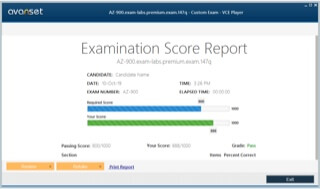

Premium File
65 Q&A
$98.99$89.99
Fortinet NSE6_FSM_AN-7.4 Exam Questions & Answers, Accurate & Verified By IT Experts
Instant Download, Free Fast Updates, 99.6% Pass Rate
65 Questions & Answers
Last Update: Sep 06, 2026
$89.99
Fortinet NSE6_FSM_AN-7.4 Practice Test Questions in VCE Format
| File | Votes | Size | Date |
|---|---|---|---|
File Fortinet.certkiller.NSE6_FSM_AN-7.4.v2026-07-10.by.blackdiamond.7q.vce |
Votes 1 |
Size 418.58 KB |
Date Jul 10, 2026 |
Fortinet NSE6_FSM_AN-7.4 Practice Test Questions, Exam Dumps
Fortinet NSE6_FSM_AN-7.4 (Fortinet NSE 6 - FortiSIEM 7.4 Analyst) exam dumps vce, practice test questions, study guide & video training course to study and pass quickly and easily. Fortinet NSE6_FSM_AN-7.4 Fortinet NSE 6 - FortiSIEM 7.4 Analyst exam dumps & practice test questions and answers. You need avanset vce exam simulator in order to study the Fortinet NSE6_FSM_AN-7.4 certification exam dumps & Fortinet NSE6_FSM_AN-7.4 practice test questions in vce format.
NSE6-FSM-AN-7-4 is the current Fortinet NSE 6 FortiSIEM 7.4 Analyst exam, released in February 2026. Fortinet describes it as an applied analytics exam covering event search, enrichment, incident analysis, ZTNA integration, and troubleshooting. It succeeds older generations such as FortiSIEM 6.3 and the FortiSIEM 7.2 Analyst exam, whose final delivery date was June 15, 2026.
The analyst role is not primarily about installing collectors or memorizing dashboards. It is about turning large volumes of events into defensible conclusions: what happened, which assets and identities were involved, whether the activity is expected, how severe it is, and what evidence should drive containment or escalation. Strong candidates think in timelines and relationships rather than isolated alerts.
SIEM data arrives from operating systems, network devices, applications, identity services, security controls, and cloud platforms. Each source uses its own vocabulary. Parsing and normalization turn that raw material into searchable fields, but analysts still need to understand where a field came from and what it represents. A normalized “user” field may contain an account name, service principal, email address, or device identity depending on the source.
When an event looks surprising, compare normalized fields with raw logs. The techniques in raw-log analysis matter because parsing errors or unexpected source formats can create false conclusions. Analysts should be able to prove that a timestamp, source address, destination, account, or action means what the dashboard suggests it means.
Real-time views are useful while an incident is active because they show whether suspicious activity is continuing. Historical searches are better for scope: when did the behavior start, which other systems were touched, and whether the same indicator appeared weeks earlier. Analysts should choose the time window deliberately rather than accepting a default that hides the beginning of the attack.
Start broad enough to avoid missing related events, then narrow using evidence. If a suspicious authentication is found, pivot on the account, source host, destination system, time range, and surrounding network activity. Save useful queries so the investigation can be reproduced. An analyst who cannot explain how a result set was produced has weak evidence even if the conclusion happens to be correct.
An IP address becomes more meaningful when it is associated with a critical server, a known location, an asset owner, or an external threat indicator. A user event becomes more important when the account is privileged or belongs to an executive. FortiSIEM enrichment can help analysts prioritize, but the quality of enrichment depends on current asset and identity information.
Stale context is dangerous. A reused IP address, decommissioned server, or transferred employee can make a detection look more or less serious than it really is. Analysts should know which enrichment sources are authoritative and how often they update. When critical decisions depend on context, verify it rather than assuming a CMDB or directory record is still accurate.
A single failed login, command execution, or network connection may be benign. A sequence can tell a different story: repeated failures followed by success, privilege escalation, unusual process activity, persistence, and outbound communication. FortiSIEM analysis is strongest when events are ordered into a narrative that explains the attack path.
This mirrors the broader incident-response lifecycle. Detection is the beginning. Analysts must validate the event, establish scope, preserve evidence, recommend containment, and support recovery. Record assumptions separately from confirmed facts so later investigators can see which conclusions are proven and which still need testing.
A noisy rule is not automatically a bad rule. It may be revealing a badly controlled business process. Before suppressing alerts, determine what legitimate activity is generating them and whether that activity can be narrowed by source, role, schedule, asset type, or other context. Suppression without understanding can hide the attack pattern the rule was designed to detect.
Likewise, a quiet rule is not necessarily effective. It may use a field that is not populated by the relevant data source, a threshold that can never be reached, or a time window that does not match the behavior. Validate rules with known examples and check that the necessary telemetry actually arrives. Tuning should improve signal quality while preserving the behavior of interest.
Zero-trust access decisions can involve user identity, endpoint posture, application access, network policy, and changing risk. A single allow or deny event rarely explains the whole story. Analysts should correlate identity-provider logs, endpoint information, access-policy events, and application activity to determine why access was granted and what happened afterward.
If a user reports that access suddenly stopped, the SIEM may reveal a posture change, policy update, repeated authentication problem, or risk response. If suspicious access was allowed, analysts should examine whether the identity was compromised, the endpoint state was stale, or the policy matched an unintended condition. Cross-source reasoning is the point of centralized analytics.
Search latency, ingestion delay, dropped events, and storage pressure are not only platform-health concerns. They affect the reliability of an investigation. If one collector is hours behind, a “clean” timeline may simply be incomplete. Analysts need to recognize data freshness and ingestion gaps before concluding that an event did not occur.
When troubleshooting, compare event generation time, receive time, and processing time where available. Check whether the problem affects one source, one collector, one tenant, or the whole platform. Large searches should be scoped intelligently so analysts do not create additional load during an active incident. Operational awareness is part of evidence quality.
FortiSIEM 7.4 training emphasizes managed-service environments, where analysts may work across multiple customers. Tenant context must remain clear in searches, incidents, dashboards, and escalation. A high-severity event can still be mishandled if it is assigned to the wrong customer, asset owner, or response process.
Standardized investigation methods help, but customer environments are not identical. Maintain tenant-specific critical assets, identity sources, escalation contacts, and approved response actions. A detection that can trigger automatic containment in one organization may require approval in another. Multi-tenant consistency should come from process discipline, not pretending all customers have the same risk tolerance.
Record the query, time window, important event identifiers, pivots, enrichment, and reason for each conclusion. This protects against hindsight bias and makes shift handoff more effective. Screenshots alone are weak evidence because they often omit filters and underlying data. Prefer references that another analyst can use to recreate the view.
A concise incident narrative should explain what triggered the investigation, what was confirmed, what remains uncertain, what systems or users are affected, and what response has occurred. That quality of documentation also improves future detection engineering because rule authors can see which fields and correlations were genuinely useful.
Threat-intelligence enrichment should be handled with age and confidence in mind. An IP address that was malicious last month may now belong to a different service, while a newly registered domain may be suspicious without being confirmed malicious. Preserve the source, timestamp, and confidence of enrichment so analysts can weigh it appropriately. Avoid turning every threat feed hit into the same severity; context from the local asset and observed behavior should still drive the incident decision.
Baselining is particularly valuable for authentication and network behavior. A service account that logs in to hundreds of servers at 02:00 every night may be normal, while the same behavior from a help-desk account at midday could be alarming. Analysts should learn recurring patterns before tuning detections. Baselines are not permanent exemptions: business processes change, so periodically confirm that the activity is still expected and owned.
Case severity should be explainable from evidence. Define which factors raise urgency: privileged identity, critical asset, confirmed malware, lateral movement, data access, persistence, external command-and-control, or active exploitation. A rule's default severity can start the triage, but the analyst should adjust it when the incident context justifies a different response. This prevents alert priority from becoming a mechanical property of the rule rather than an assessment of business risk.
During large incidents, query efficiency matters. Start with indexed, selective fields where possible and avoid repeatedly scanning unnecessarily broad time ranges. Break a complex hypothesis into smaller searches that can be validated independently. This improves performance and reduces analytical mistakes because each step has a clear purpose. Save the key results and query logic before moving on so later reviewers can reproduce the path that led to the conclusion.
Data-source health should have owners outside the SOC as well as inside it. If a critical firewall, identity provider, or endpoint platform stops sending events, the application owner may need to fix the source while SIEM administrators restore collection. Define escalation paths for missing telemetry. A detection program cannot compensate for blind spots it does not recognize, so collection coverage and freshness should be treated as security controls in their own right.
Preparation should therefore go beyond memorizing feature names. Practice building searches from investigative questions, validating normalized fields against raw events, pivoting across identities and hosts, distinguishing real-time from historical evidence, and explaining why an incident deserves its severity. Those skills survive platform updates because they are fundamental to security operations.
The current Fortinet certifications place FortiSIEM 7.4 Analyst at NSE 6 Security Operations. That placement is appropriate: the exam is about using telemetry to make defensible security decisions, not simply operating a logging product.
Go to testing centre with ease on our mind when you use Fortinet NSE6_FSM_AN-7.4 vce exam dumps, practice test questions and answers. Fortinet NSE6_FSM_AN-7.4 Fortinet NSE 6 - FortiSIEM 7.4 Analyst certification practice test questions and answers, study guide, exam dumps and video training course in vce format to help you study with ease. Prepare with confidence and study using Fortinet NSE6_FSM_AN-7.4 exam dumps & practice test questions and answers vce from ExamCollection.
Purchase Individually
Top Fortinet Certifications

Top Fortinet Certification Exams
Site Search:

SPECIAL OFFER: GET 10% OFF

Pass your Exam with ExamCollection's PREMIUM files!
SPECIAL OFFER: GET 10% OFF
Use Discount Code:
MIN10OFF
A confirmation link was sent to your e-mail.
Please check your mailbox for a message from support@examcollection.com and follow the directions.

Download Free Demo of VCE Exam Simulator
Experience Avanset VCE Exam Simulator for yourself.
Simply submit your e-mail address below to get started with our interactive software demo of your free trial.