



Premium File
65 Q&A
$76.99$69.99
Juniper JN0-635 Exam Questions & Answers, Accurate & Verified By IT Experts
Instant Download, Free Fast Updates, 99.6% Pass Rate
65 Questions & Answers
Last Update: Sep 20, 2026
$69.99
Juniper JN0-635 Exam Screenshots
Juniper JN0-635 Practice Test Questions in VCE Format
| File | Votes | Size | Date |
|---|---|---|---|
File Juniper.test-king.JN0-635.v2026-08-23.by.daniel.40q.vce |
Votes 1 |
Size 2.7 MB |
Date Aug 23, 2026 |
File Juniper.braindumps.JN0-635.v2020-11-06.by.noah.30q.vce |
Votes 1 |
Size 1.77 MB |
Date Nov 06, 2020 |
Juniper JN0-635 Practice Test Questions, Exam Dumps
Juniper JN0-635 (Security, Professional) exam dumps vce, practice test questions, study guide & video training course to study and pass quickly and easily. Juniper JN0-635 Security, Professional exam dumps & practice test questions and answers. You need avanset vce exam simulator in order to study the Juniper JN0-635 certification exam dumps & Juniper JN0-635 practice test questions in vce format.
JN0-635 was a Juniper Security, Professional exam associated with the JNCIP-SEC certification. It is no longer active: Juniper retired JN0-635 on October 16, 2022 and introduced JN0-636 the following day. That successor was itself retired in June 2024 when JN0-637 became the current professional security exam. The sequence is important because search results can make all three codes appear equally relevant even though only the newest one belongs to the live certification path.
The retired status does not make JN0-635 meaningless. Its era established many of the advanced SRX themes that continue to define professional Juniper security work: policy and zone troubleshooting, complex IPsec behavior, advanced NAT, Layer 2 security, logical segmentation, high availability, and threat controls. Engineers supporting older Junos deployments can still learn from those subjects, provided they do not mistake old exam mechanics or software assumptions for current requirements.
Juniper certifications now place JN0-635 firmly in a historical context. The active security path runs through newer associate and specialist exams before the professional level, and the content has evolved alongside Junos security capabilities. That makes current track status part of technical accuracy, not merely an administrative detail.
A professional security exam cannot stop at knowing what a firewall rule, VPN, or NAT translation is. The candidate has to predict what the device will do when several mechanisms interact. JN0-635 reflected that expectation. Its study material emphasized not only security features but also the tools used to diagnose policy, traffic flow, and platform state when the intended outcome did not occur.
That changes how an engineer should study. A configuration stanza is only one piece of evidence. The more important questions are: which zone owns the traffic, which policy is evaluated, whether address translation occurs before or after a decision, whether a route exists, whether a tunnel is established, and what the session table says about the packet's actual path. Professional-level security work is an exercise in reconstructing state across several subsystems.
The current JN0-637 exam continues that operational emphasis, which is one reason JN0-635 remains useful for historical comparison. The product capabilities and blueprint have changed, but the core habit—observe the system, form a packet-flow hypothesis, and validate it with the right output—has not.
Security zones are foundational to SRX policy. Interfaces are placed into zones, traffic crosses boundaries, and policies determine whether sessions are allowed and how they are treated. In an advanced environment, however, a denied or misrouted flow may not be caused by the most obvious policy line. An engineer may need to inspect routing, application identification, NAT, logging, interface state, or a higher-level service before deciding what to change.
That is why troubleshooting tools matter as much as configuration syntax. Logs, flow traces, session information, counters, and operational commands allow the engineer to test assumptions. A good troubleshooting sequence avoids changing several unrelated settings at once. It first determines whether the packet reached the device, which path it took through the processing pipeline, and where the observed behavior diverged from the intended one.
This method transfers well beyond one exam. The broader discipline of understanding firewalls as stateful systems is explored in stateful and stateless firewall models. For JN0-635, the relevant lesson is that SRX troubleshooting is much easier when a candidate understands how sessions and policy state shape subsequent packets rather than treating every packet as an isolated event.
IPsec is one of the areas where professional-level questions quickly expose shallow preparation. Basic study explains encryption, authentication, security associations, and tunnel establishment. Advanced deployments add hub-and-spoke topologies, dynamic peers, certificate infrastructure, routing over tunnels, overlapping address space, and policy or class-of-service interactions. Each addition creates another place where an otherwise valid configuration can fail operationally.
JN0-635-era material placed significant attention on advanced IPsec. Engineers needed to understand why a tunnel might come up while application traffic still failed, how route selection interacted with protected traffic, and what changes when peers are dynamic rather than statically defined. Public key infrastructure also matters because certificate trust introduces dependencies that are separate from ordinary routing or policy verification.
A useful conceptual refresher is IPsec itself: separate the negotiation and cryptographic relationship from the routing and policy decisions that determine which traffic uses it. That distinction prevents a common troubleshooting mistake—assuming that a healthy security association proves the complete path is healthy.
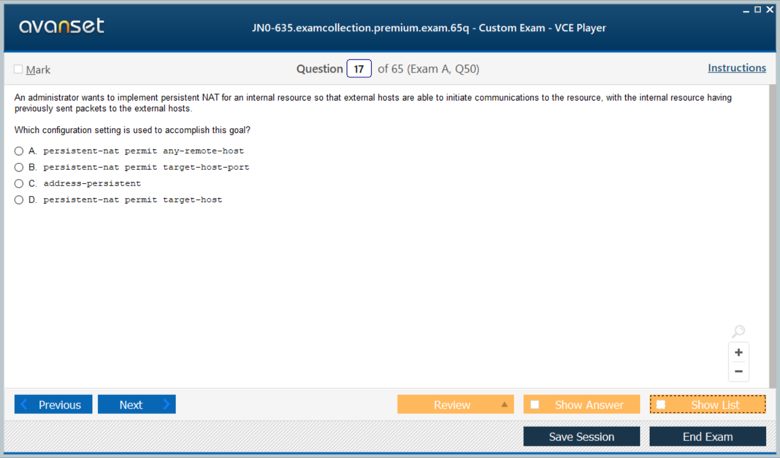
Network address translation is simple only in trivial examples. Professional SRX environments may combine source NAT, destination NAT, persistent mappings, DNS-related translation behavior, or IPv6 translation with security policy and routing. The engineer has to know which address is visible at each stage of processing. Otherwise a policy can be written against the wrong identity, a route can be evaluated unexpectedly, or return traffic can fail to match the intended session.
The most durable way to study NAT is to draw the packet at several checkpoints. Record the source and destination before translation, after the applicable translation, at the routing decision, and on the egress side. Then do the same for the return flow. This makes it much easier to reason about why an application works in one direction but not the other, or why a policy that appears correct never matches.
That packet-centric method also prevents memorization from becoming brittle. Syntax can change between software versions, but the packet still has an identity at every step. The engineer's job is to know which subsystem sees which identity and which table or policy makes the next decision.
SRX devices can operate in deployment modes where security is enforced without the appliance simply acting as a traditional routed hop. JN0-635-era objectives included Layer 2 security concepts, which required candidates to understand transparent operation and related deployment choices. That changes troubleshooting because interfaces, MAC learning, switching behavior, and security enforcement become part of the same investigation.
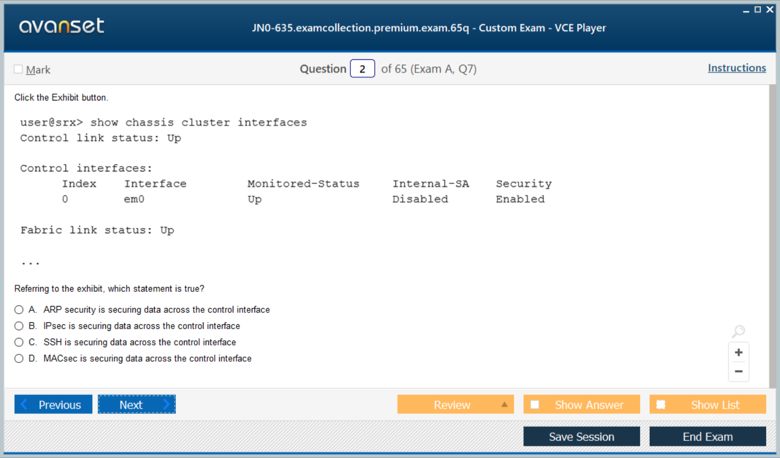
MACsec also appeared in material from this period. It protects Ethernet links at Layer 2, so its failure modes differ from those of an IPsec tunnel across a routed network. Keys, peers, interface capability, and link state all matter. A candidate who treats every form of encryption as if it were the same technology will miss the operational distinction between protecting a local Ethernet link and building a network-layer VPN between routed endpoints.
The wider point is that security architects frequently need controls at more than one layer. A firewall policy may constrain application traffic, MACsec may protect a link, and IPsec may secure traffic across an untrusted routed path. Professional skill comes from knowing what each control protects, where it operates, and what threat it does not address.
Large security platforms can serve multiple administrative domains. Logical systems and tenant-oriented designs create separation inside a device, which means an engineer must consider not only packet boundaries but also operational authority. Who can configure the system? Which resources are allocated to a tenant? How can traffic move between contexts? Which settings belong to the primary system rather than the tenant?
These questions are more architectural than a simple rule-set exercise. They affect change control, troubleshooting responsibility, capacity planning, and blast radius. A device can be technically capable of hosting several contexts while still being operationally difficult to manage if teams do not understand which objects are shared and which are isolated.
Modern zero-trust and segmentation discussions reinforce the same principle: security is stronger when boundaries are explicit. Adaptive access control approaches the subject from a broader security perspective, but the relevance to JN0-635 is concrete—administrative and traffic segmentation both depend on accurately defined identity and policy boundaries.
JN0-635 ended in October 2022 and was replaced by JN0-636. Juniper then ended JN0-636 on June 9, 2024 and launched JN0-637 on June 10. The current exam is 90 minutes with 65 multiple-choice questions, requires JNCIS-SEC, and is published against Junos OS 22.2 and Security Director 22.1. Its objectives include policy and zone troubleshooting, logical and tenant systems, Layer 2 security, advanced NAT, advanced IPsec, advanced policy-based routing, multinode high availability, and automated threat mitigation.
That continuity is useful for someone holding old study material. Many foundational themes still matter, but the live blueprint must govern current preparation. Candidates should use JN0-232 and JN0-336 to understand the current associate and specialist steps, then align professional study with JN0-637 rather than assuming a JN0-635 course maps cleanly to today's exam.
The same caution applies to practice questions. A retired question can be technically interesting but still reflect an old product behavior, feature emphasis, or user interface. The right question to ask is not merely, “Can I answer this?” but “Does this topic still belong to the current objective and does the answer match the software version I am studying?”
JN0-635 should now be treated as a source of advanced SRX scenarios rather than a certification target. Its value lies in forcing engineers to follow traffic through policies, zones, translation, tunnels, segmentation, and high-availability behavior. Those are durable operational skills because security incidents rarely present themselves as a neat single-feature problem.
If the goal is current certification, use JN0-637 as the authoritative exam code and build upward from the live security track. If the goal is maintaining an older deployment, keep the JN0-635 material but pair it with the exact Junos and Security Director documentation used in that environment. If the goal is professional development, spend more time explaining why a flow behaves a certain way than memorizing the command that reveals it.
That is the most useful legacy of JN0-635. It belongs to an older exam generation, but the ability to diagnose stateful security systems across several interacting features remains central to Juniper security work.
Go to testing centre with ease on our mind when you use Juniper JN0-635 vce exam dumps, practice test questions and answers. Juniper JN0-635 Security, Professional certification practice test questions and answers, study guide, exam dumps and video training course in vce format to help you study with ease. Prepare with confidence and study using Juniper JN0-635 exam dumps & practice test questions and answers vce from ExamCollection.
Purchase Individually
Top Juniper Certifications



Top Juniper Certification Exams
Site Search:

SPECIAL OFFER: GET 10% OFF

Pass your Exam with ExamCollection's PREMIUM files!
SPECIAL OFFER: GET 10% OFF
Use Discount Code:
MIN10OFF
A confirmation link was sent to your e-mail.
Please check your mailbox for a message from support@examcollection.com and follow the directions.

Download Free Demo of VCE Exam Simulator
Experience Avanset VCE Exam Simulator for yourself.
Simply submit your e-mail address below to get started with our interactive software demo of your free trial.