



Premium File
40 Q&A
$76.99$69.99
ITIL ITIL Practitioner Exam Questions & Answers, Accurate & Verified By IT Experts
Instant Download, Free Fast Updates, 99.6% Pass Rate

ITIL Practitioner Premium File: 40 Questions & Answers
Last Update: Sep 15, 2026
ITIL Practitioner PDF Study Guide: 299 Pages
$74.99
ITIL ITIL Practitioner Exam Screenshots
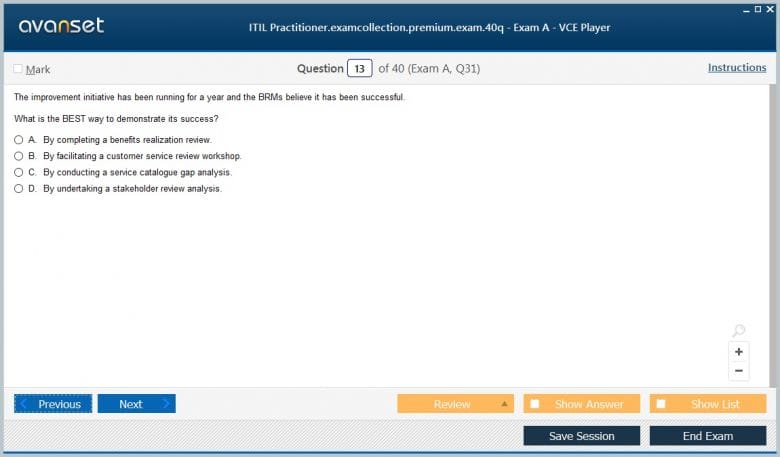
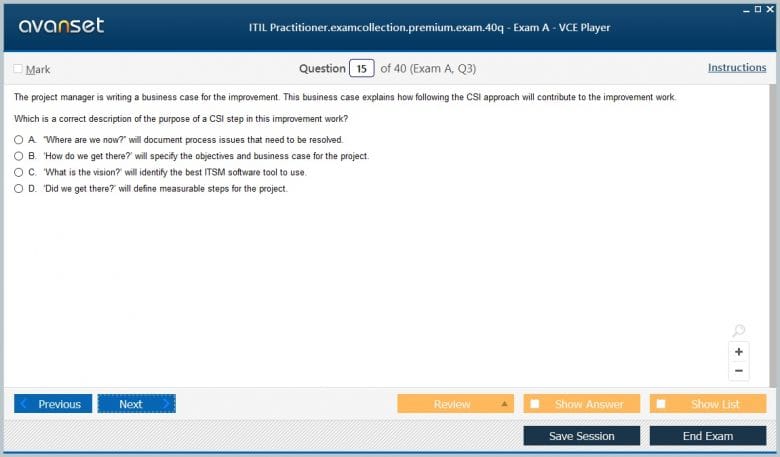
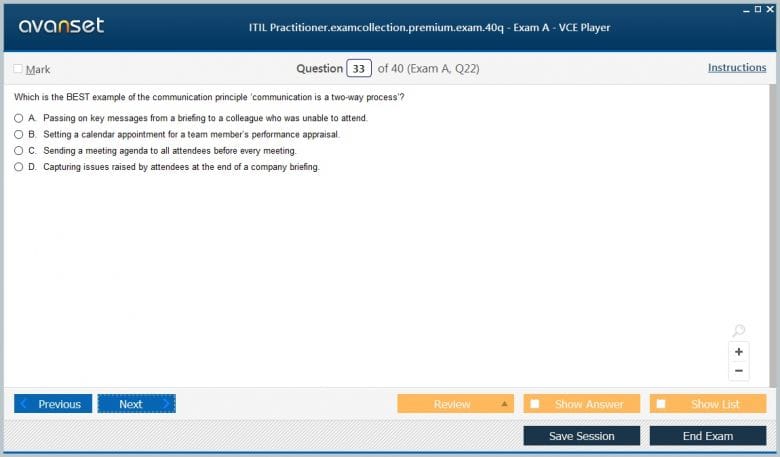
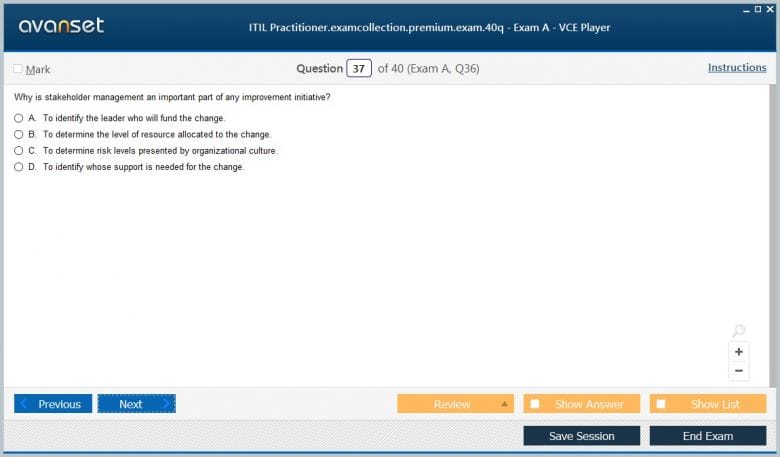
ITIL ITIL Practitioner Practice Test Questions in VCE Format
| File | Votes | Size | Date |
|---|---|---|---|
File ITIL.Actualtests.ITIL Practitioner.v2026-08-21.by.Austin.20q.vce |
Votes 7 |
Size 8.21 MB |
Date Aug 25, 2026 |
ITIL ITIL Practitioner Practice Test Questions, Exam Dumps
ITIL ITIL Practitioner (ITIL Practitioner) exam dumps vce, practice test questions, study guide & video training course to study and pass quickly and easily. ITIL ITIL Practitioner ITIL Practitioner exam dumps & practice test questions and answers. You need avanset vce exam simulator in order to study the ITIL ITIL Practitioner certification exam dumps & ITIL ITIL Practitioner practice test questions in vce format.
ITIL Practitioner is a historical ITIL qualification from the ITIL v3/2011 era, introduced in 2016 to help Foundation-level professionals apply IT service management guidance in real organizational situations. It should not be presented as a current PeopleCert certification in 2026. The original syllabus used 40 scenario-based multiple-choice questions, a 70% pass mark, and an open-book format built around the ITIL Practitioner Guidance. Its subject was practical continual service improvement rather than another layer of lifecycle theory.
The qualification remains useful editorially because several of its ideas foreshadowed ITIL 4. It emphasized guiding principles, continual improvement, metrics, communication, and organizational change management. Candidates searching the old name should therefore understand both its historical exam structure and the current paths that succeeded it. The natural starting point today is the broader ITIL certifications, including ITIL 4 and Version 5 rather than attempting to locate a discontinued Practitioner exam.
The prerequisite was ITIL Foundation knowledge, historically represented by paths such as ITIL v3 Foundation. Practitioner did not attempt to replace the lifecycle or process material. Instead, it asked whether a professional could take ITSM concepts and use them in an improvement scenario. The qualification therefore sat between basic knowledge and the practical work of changing services and organizations.
This explains why the exam used a scenario rather than isolated definition questions. Candidates had to interpret a situation, recognize the improvement problem, apply principles, choose useful measures, communicate with stakeholders, and manage change. The value of the qualification was the connection between concepts and decisions, not a larger vocabulary.
The qualification also reflected a concern that organizations could claim to “implement ITIL” as if the framework were a fixed process model. Practitioner emphasized adopt and adapt: use the guidance in a way that fits the organization’s context and desired outcomes. That idea remains important because blindly reproducing another organization’s process can create bureaucracy without improving service value.
The Practitioner guidance emphasized principles including focus on value, start where you are, progress iteratively, work holistically, collaborate, observe directly, keep it simple, and design for experience. Several of these ideas evolved into the familiar ITIL 4 guiding principles. That continuity is one reason the old qualification can still make sense to modern readers even though the certificate itself is historical.
Today, candidates preparing for ITIL 4 Foundation will recognize the shift from process compliance toward value, feedback, collaboration, and holistic thinking. The terminology is not identical, so old Practitioner material should not be used as a substitute for a current syllabus. But historically it shows how ITIL moved toward a more adaptable and principle-driven approach.
The original set was larger than the later ITIL 4 list and used some different language, such as observe directly and design for experience. Historical readers should preserve that distinction rather than rewriting the old syllabus to match newer terminology. The continuity is conceptual, not exact. This matters for accurate legacy content and for anyone using old course notes to understand what the exam actually tested.
Practitioner asked candidates to use a continual service improvement approach: understand the vision, assess the current state, define the desired state, plan how to get there, take action, verify results, and maintain momentum. The important skill was not reciting the steps but using them in context. An organization could easily jump from a complaint to a solution without understanding the baseline or desired outcome.
Modern ITIL retains that emphasis. The current Direct, Plan and Improve module develops improvement, measurement, governance, and organizational change at a broader level. Readers coming from the old Practitioner name can therefore see Direct, Plan and Improve as one modern route for developing similar management capabilities, although it is not a one-for-one replacement exam.
The improvement register was a practical tool for capturing opportunities, status, value, priority, and ownership. Its significance was organizational: ideas should not disappear because operational work is busy or because ownership is unclear. Modern teams may use a backlog or portfolio tool instead, but the management problem is the same. Improvement needs visibility and deliberate prioritization.
The syllabus required candidates to use metrics and measurement to enable continual improvement. That meant selecting measures related to the desired outcome, establishing baselines, interpreting trends, and avoiding measures that encourage the wrong behavior. A service organization can have many operational statistics without knowing whether an improvement produced value.
This remains a durable lesson. Measures should answer a management question. If an improvement aims to reduce failed changes, the team needs evidence about failure rate, impact, causes, and perhaps recovery. If the objective is user experience, technical availability alone may not be enough. Practitioner trained candidates to connect measurement to decisions, a discipline that remains central to current ITIL guidance.
The qualification also emphasized combining critical success factors with key performance indicators. A critical success factor describes what must go well for an objective to be achieved; indicators provide evidence about whether that condition is being met. Confusing the two can produce measurement programs with many numbers but no clear decision value. This distinction remains useful for modern improvement work even though the historical exam is no longer active.
The qualification devoted significant attention to communication and organizational change management. Improvement affects people who may have different incentives, concerns, and levels of influence. Candidates needed to consider sponsors, stakeholders, communication methods, resistance, training, and reinforcement. That made the exam unusual for professionals who expected service management to be mostly process design.
The modern Drive Stakeholder Value and Direct, Plan and Improve modules continue that focus from different angles. Stakeholder relationships and experience shape value, while organizational change determines whether new behaviors become sustainable. Practitioner’s legacy is the recognition that service improvement is a social system as much as a technical one.
Practitioner also treated communication as purposeful design. Different stakeholders need different messages, channels, timing, and levels of detail. A technical team may need implementation specifics, while an executive sponsor needs outcome, risk, and decision information. Sending the same announcement to everyone is easy but rarely effective. Candidates were expected to match communication to stakeholder needs and the stage of change.
Historical AXELOS material described 40 multiple-choice questions tied to scenario information, with a 70% pass mark and an open-book format using the Practitioner Guidance. That structure rewarded application. Having the book available did not remove the need to understand which principle, metric, communication approach, or change technique fit the scenario.
Readers should be cautious with old preparation sites that still present the exam as if it can be scheduled today. In 2026, the useful role of legacy Practitioner material is to explain the old qualification accurately and help experienced candidates map its ideas to current ITIL paths. Historical relevance does not make the discontinued exam bookable again.
The open-book design encouraged candidates to know where material lived without relying on constant lookup. Effective preparation involved understanding the scenario first, then using the book to validate a principle or technique. That lesson still applies to current open-book exams: reference material is most useful when the candidate already has a mental model and can navigate directly to the relevant concept.
There is no single modern exam called “ITIL Practitioner” that simply replaces the historical qualification. Its themes appear across ITIL 4 modules such as Collaborate, Assure and Improve, Direct, Plan and Improve, and several individual practice certifications. Version 5 adds its own transformation and designation structure. Candidates should choose based on the capability and designation they now need, not on the name of the old certificate.
A useful way to compare options is to review the ITIL qualification structure and start from the version in which the learner is currently certified. Someone with only an old Foundation certificate has a different transition decision from someone who already holds ITIL 4 Managing Professional.
This distribution is why there is no simple equivalence table that says one current module “is” Practitioner. Continual improvement appears broadly, stakeholder engagement has dedicated material, measurement is part of management modules, and organizational change is central to transformation. Learners should identify the capability they want to develop rather than search for a replacement title with identical wording.
Practitioner remains interesting because it was designed around doing rather than merely knowing. Focus on value, use evidence, communicate deliberately, manage organizational change, and improve iteratively are still sound management ideas. The mistake would be treating historical guidance as current exam rules or assuming that an old certificate path remains commercially available.
For current learners, the safer approach is to use the legacy Practitioner material for context and move to an active pathway such as ITIL 4 or ITIL Foundation Version 5. For credential holders, the page helps explain what the qualification represented and how its themes connect to modern service management.
Go to testing centre with ease on our mind when you use ITIL ITIL Practitioner vce exam dumps, practice test questions and answers. ITIL ITIL Practitioner ITIL Practitioner certification practice test questions and answers, study guide, exam dumps and video training course in vce format to help you study with ease. Prepare with confidence and study using ITIL ITIL Practitioner exam dumps & practice test questions and answers vce from ExamCollection.
Purchase Individually

Top ITIL Certifications

Top ITIL Certification Exams
Site Search:

SPECIAL OFFER: GET 10% OFF

Pass your Exam with ExamCollection's PREMIUM files!
SPECIAL OFFER: GET 10% OFF
Use Discount Code:
MIN10OFF
A confirmation link was sent to your e-mail.
Please check your mailbox for a message from support@examcollection.com and follow the directions.

Download Free Demo of VCE Exam Simulator
Experience Avanset VCE Exam Simulator for yourself.
Simply submit your e-mail address below to get started with our interactive software demo of your free trial.