



Premium File
337 Q&A
$76.99$69.99
IIA IIA-CGAP Exam Questions & Answers, Accurate & Verified By IT Experts
Instant Download, Free Fast Updates, 99.6% Pass Rate
337 Questions & Answers
Last Update: Sep 30, 2026
$69.99
IIA IIA-CGAP Exam Screenshots
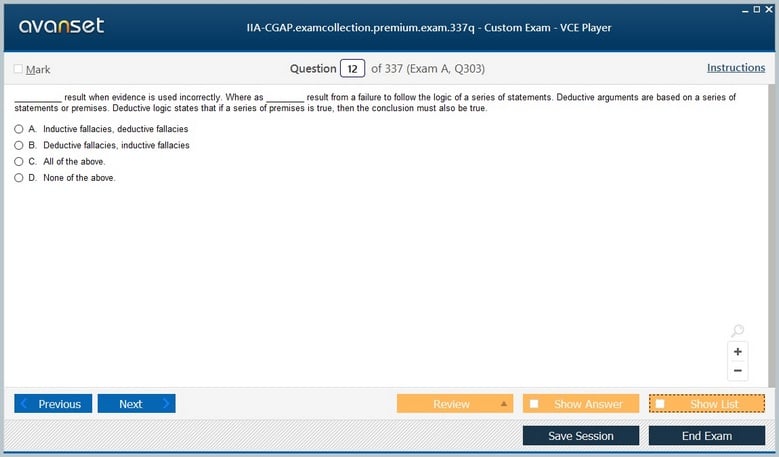
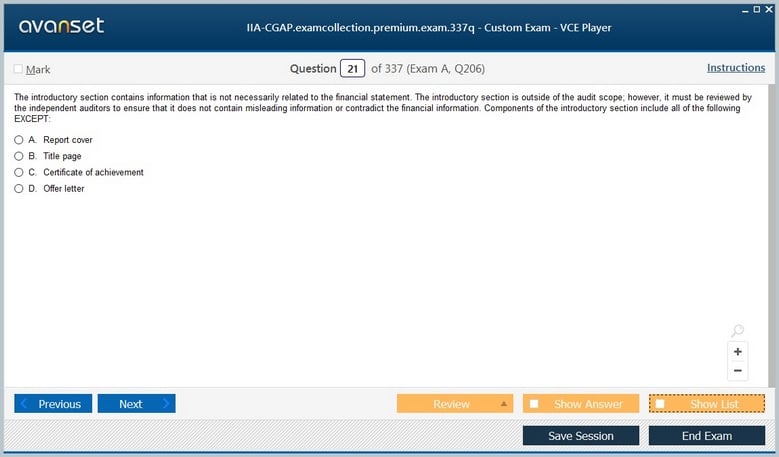
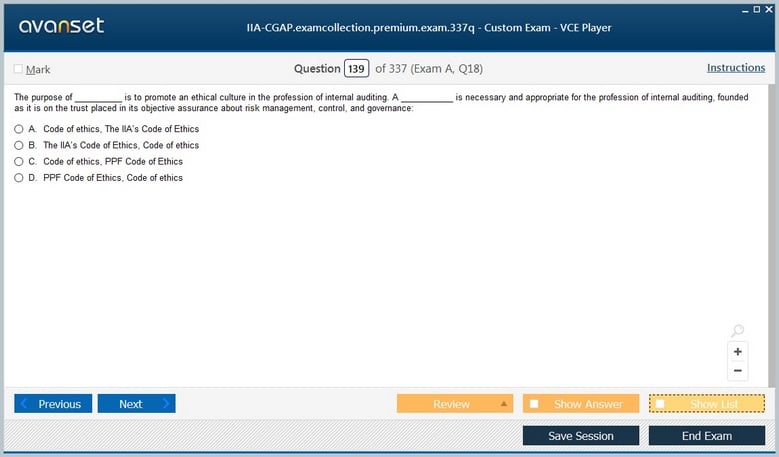
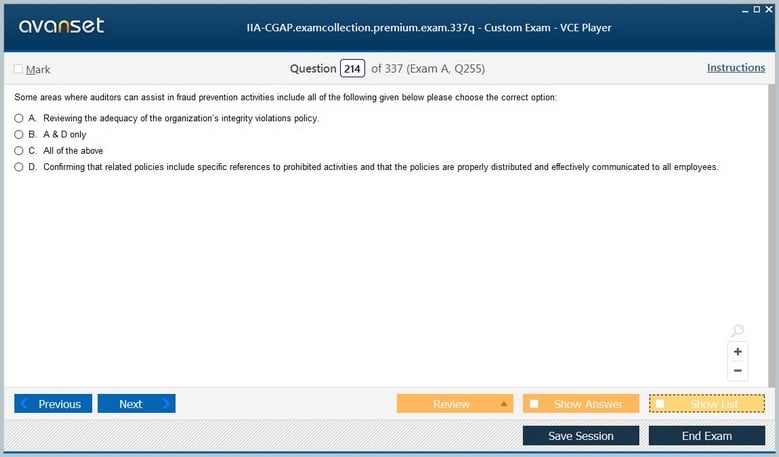
IIA IIA-CGAP Practice Test Questions in VCE Format
| File | Votes | Size | Date |
|---|---|---|---|
File IIA.Prep4sure.IIA-CGAP.v2026-10-07.by.Jeremy.120q.vce |
Votes 2 |
Size 157.05 KB |
Date Oct 08, 2026 |
File IIA.Test-king.IIA-CGAP.v2019-04-09.by.Grant.67q.vce |
Votes 4 |
Size 90.92 KB |
Date Apr 10, 2019 |
IIA IIA-CGAP Practice Test Questions, Exam Dumps
IIA IIA-CGAP (Certified Government Auditing Professional) exam dumps vce, practice test questions, study guide & video training course to study and pass quickly and easily. IIA IIA-CGAP Certified Government Auditing Professional exam dumps & practice test questions and answers. You need avanset vce exam simulator in order to study the IIA IIA-CGAP certification exam dumps & IIA IIA-CGAP practice test questions in vce format.
IIA CGAP refers to the Certified Government Auditing Professional, The Institute of Internal Auditors’ former specialty certification for public-sector auditors. The IIA described the credential for practitioners working at national, state or provincial, local, quasi-governmental, authority, and crown-corporation levels. New applications closed after 2018, and the remaining exam program concluded in June 2021, while existing holders can continue to maintain the designation under renewal requirements.
CGAP’s enduring value is its focus on what makes government auditing different. Public money, statutory authority, public accountability, legislative oversight, program outcomes, procurement, grants, and political visibility can shape an engagement in ways that differ from a purely commercial audit. Modern public-sector auditors still need those capabilities even though the old CGAP exam is no longer available to new candidates.
In government, financial amount is only one measure of significance. A relatively small expenditure can be important because it violates statutory authority, affects vulnerable citizens, creates unequal treatment, or damages public trust. Auditors need to understand the mandate of the entity, the source of its authority, who funds it, who receives its services, and which oversight bodies can act on findings.
That environment also changes communication. Reports may be read by elected officials, audit committees, regulators, citizens, journalists, or other public bodies. Conclusions must be supportable and written with particular care because the audience can be broad and the consequences can extend beyond management action. Independence and transparency therefore have both technical and public-interest dimensions.
Public-sector significance is also shaped by stewardship. An amount that is immaterial to a large government budget can still matter if it involves restricted funds, public safety, statutory authority, vulnerable populations, or a high-profile commitment. Auditors therefore consider qualitative as well as quantitative materiality. They may need to ask whether resources were used for the authorized purpose, whether decisions were transparent, and whether the public body can demonstrate value and fairness. That broader accountability explains why public-sector audit findings can attract scrutiny beyond financial statement impact.
Government programs are created through legislation, appropriations, policies, regulations, contracts, and administrative rules. An auditor may need to determine not only whether money was recorded correctly, but whether it was spent for an authorized purpose and whether the program achieved intended results economically and efficiently. Compliance, financial, operational, and performance objectives can therefore intersect in one engagement.
Performance auditing introduces questions about outputs, outcomes, efficiency, effectiveness, and economy. A program may stay within budget while failing to deliver its intended benefit, or it may meet a target by using resources inefficiently. Criteria need to be credible because public programs often pursue multiple objectives that are difficult to measure. The auditor should distinguish management’s policy choices from whether the approved policy is being implemented and measured as intended.
Performance auditing adds another dimension by examining economy, efficiency, and effectiveness. Economy asks whether resources were acquired at an appropriate cost and quality; efficiency asks how well inputs are converted into outputs; effectiveness asks whether intended outcomes are achieved. These concepts can overlap but should not be collapsed. A program may spend within budget yet fail to reach its policy objective, or it may achieve the objective through an unnecessarily costly process. Good criteria are essential because public programs often pursue outcomes that are harder to measure than commercial profit.
Public procurement is frequently governed by formal rules intended to promote fairness, competition, transparency, and value. Audit risks include inadequate specifications, restricted competition, conflicts of interest, bid manipulation, unauthorized change orders, weak contract management, poor receipt verification, and payments that do not match deliverables. The audit trail must connect the public need to the procurement decision and then to actual performance.
Grants and transfer programs create another layer of risk because funds move outside the organization. Eligibility, award criteria, recipient reporting, matching requirements, permitted costs, milestones, monitoring, and recovery provisions may all matter. Auditors should look beyond whether a form exists and ask whether controls detect ineligible recipients, unsupported expenditure, duplicate funding, or failure to achieve the conditions attached to public money.
Procurement risk is not limited to overpayment. Poor specifications, weak competition, conflicts of interest, bid manipulation, unauthorized changes, inadequate contract monitoring, and acceptance of deficient work can all undermine public value. Grants add their own risks because funds may pass through multiple recipients and be subject to eligibility, purpose, matching, reporting, or performance conditions. Auditors need to trace responsibility through those arrangements and determine whether monitoring is strong enough to show that public money reached the intended purpose.
Public officials and employees may face strict ethics, disclosure, procurement, gift, outside-employment, or conflict-of-interest rules. Even when a transaction is economically reasonable, an undisclosed relationship or inappropriate influence can undermine public confidence. Auditors need to understand both the legal requirement and the control environment that supports ethical conduct.
Fraud-risk assessment should consider incentives, opportunity, override, collusion, procurement relationships, grants, payroll, benefits, revenue collection, and asset custody. Hotlines and investigative functions can provide useful intelligence, but allegations are not findings by themselves. Internal audit should preserve evidence, follow the organization’s investigation protocol, and coordinate with legal, law-enforcement, inspector-general, or specialist functions when appropriate.
Programs may be funded by one level of government, administered by another, and delivered by private or nonprofit partners. That creates shared objectives but fragmented control. The auditor must identify who sets criteria, who owns data, who approves expenditure, who monitors performance, and who has authority to correct problems. Contract terms and grant agreements often become essential audit criteria in these arrangements.
Shared-service organizations create similar complexity. Centralized payroll, procurement, technology, or finance can improve efficiency but may leave individual agencies dependent on controls they do not operate. Internal audit should understand service responsibilities, assurance reports, escalation arrangements, and the effect of service failures on the entity’s own objectives.
Shared responsibilities can make findings harder to frame. A national agency may set policy, a regional body may administer funding, and a local organization may deliver services. When results are poor, the auditor should identify which entity controlled the relevant decision or process rather than assigning responsibility to the most visible actor. Memoranda, statutes, funding agreements, service-level arrangements, and governance structures can help define accountability. This is particularly important when corrective action requires coordination across organizations that do not sit in a single reporting line.
Public-sector findings can become part of hearings, legislative reviews, public records, or external investigations. Workpapers therefore need clear sourcing, defensible sampling, documented criteria, and a logical link from evidence to conclusion. The auditor should separate verified facts from allegation, analysis from recommendation, and management explanation from independent corroboration.
This standard of evidence also protects fairness. An audit can identify serious control weakness without implying misconduct by a named individual unless the evidence supports that conclusion and the organization’s process permits it. Careful language is not timidity; it is part of professional due care in an environment where reports can have reputational and legal consequences.
The IIA transitioned the CGAP certification away from new certification enrollment years ago. Existing holders may maintain the designation, but new practitioners should use current IIA programs and public-sector learning rather than planning around the retired exam. The Certified Internal Auditor pathway supplies the broad professional foundation, while CIA Part 1 2025 covers governance, risk, control, ethics, and fraud in the current standards environment.
For site navigation, the broader IIA exams collection helps keep historical CGAP material separate from current certification routes. That distinction matters because the CGAP designation may remain valid for an active holder even though a new candidate cannot enter the original exam program. “Legacy credential” and “invalid credential” are not the same statement.
Current public-sector auditors also have to work in environments shaped by digital services, outsourced delivery, shared data, cybersecurity exposure, and rapidly changing policy priorities. Those developments alter the audit subject but not the accountability logic that made CGAP useful. Auditors still need to understand authority, objectives, stewardship, risk, evidence, and who can act on a recommendation. For a legacy CGAP learner, modernizing the context is more useful than memorizing historical program rules: apply the enduring public-sector principles to today’s service models and verify current laws, standards, and agency-specific requirements separately.
The historical CGAP was designed specifically for auditors working in government and related public-sector bodies at federal or national, state or provincial, local, quasi-governmental, and crown-authority levels. The IIA described its scope in terms of standards and frameworks, auditing skills and techniques, and the government auditing environment. That last element matters. Public-sector auditors often work where legal authority, appropriations, public accountability, program objectives, transparency requirements, and stewardship of public resources shape the meaning of risk and performance.
A control can therefore be effective operationally yet still fail a public-sector objective if it does not respect authority, accountability, or required transparency. Conversely, an inefficient process may be a performance concern even when transactions are technically compliant. Historical CGAP study is most useful when candidates distinguish financial accuracy, compliance with authority, effectiveness of programs, economy and efficiency, and the quality of governance rather than collapsing all government auditing into a single “compliance” category.
The government environment also changes how evidence and communication are interpreted. Auditors may need to consider legislation, regulations, grant or program terms, budget restrictions, public reporting commitments, oversight bodies, and the interests of citizens or service users. The professional method—objectives, criteria, risk, evidence, findings, and follow-up—remains recognizable, but the criteria can come from public mandates and accountability obligations that do not exist in the same form in a private company.
CGAP is now a discontinued certification program for new applicants. The IIA stopped accepting applications after 31 December 2018 and allowed already-approved candidates to finish by 30 June 2021. Active holders can continue to maintain the designation under the renewal policy; however, The IIA states that discontinued CGAP, CCSA, CFSA, and QIAL credentials cannot be recertified after revocation. That makes historical CGAP content valuable for subject knowledge while making old enrollment and reinstatement instructions unsuitable as current guidance.
Older CGAP content remains useful when it teaches durable concepts: public accountability, compliance, performance auditing, procurement, grants, ethics, evidence, and government governance structures. Time-sensitive laws, standards, and exam logistics should be verified independently. A legacy preparation source is strongest as a case-study library, not as proof of current eligibility or current regulatory detail.
A useful exercise is to take a government program and map its mandate, funding, stakeholders, risks, controls, performance measures, external partners, and reporting lines. Then ask what evidence would support a conclusion about legality, efficiency, effectiveness, and stewardship. That practice captures the professional reasoning the CGAP represented while keeping preparation aligned with current internal-audit standards.
Go to testing centre with ease on our mind when you use IIA IIA-CGAP vce exam dumps, practice test questions and answers. IIA IIA-CGAP Certified Government Auditing Professional certification practice test questions and answers, study guide, exam dumps and video training course in vce format to help you study with ease. Prepare with confidence and study using IIA IIA-CGAP exam dumps & practice test questions and answers vce from ExamCollection.
Purchase Individually
Top IIA Certifications

Top IIA Certification Exams
Site Search:

SPECIAL OFFER: GET 10% OFF

Pass your Exam with ExamCollection's PREMIUM files!
SPECIAL OFFER: GET 10% OFF
Use Discount Code:
MIN10OFF
A confirmation link was sent to your e-mail.
Please check your mailbox for a message from support@examcollection.com and follow the directions.

Download Free Demo of VCE Exam Simulator
Experience Avanset VCE Exam Simulator for yourself.
Simply submit your e-mail address below to get started with our interactive software demo of your free trial.