



Premium File
128 Q&A
$76.99$69.99
HP HPE0-V14 Exam Questions & Answers, Accurate & Verified By IT Experts
Instant Download, Free Fast Updates, 99.6% Pass Rate

HPE0-V14 Premium File: 128 Questions & Answers
Last Update: Nov 14, 2026
HPE0-V14 PDF Study Guide: 690 Pages
$74.99
HP HPE0-V14 Exam Screenshots
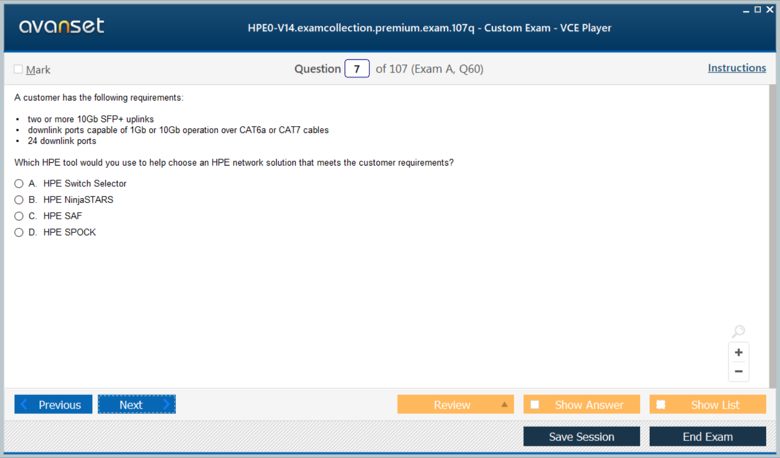
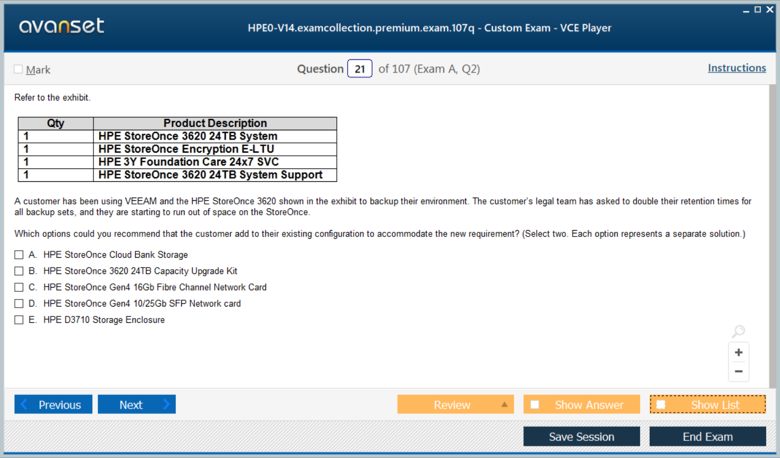
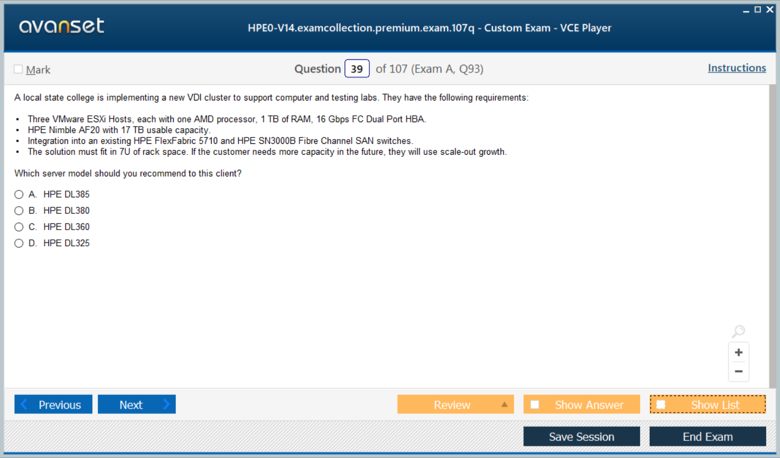
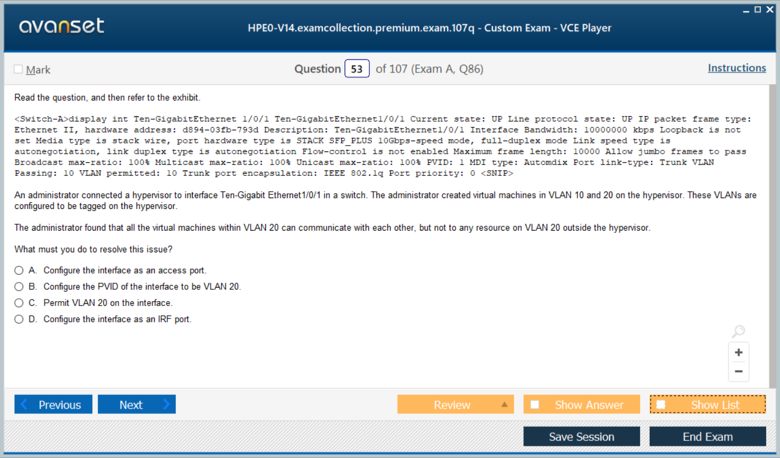
HP HPE0-V14 Practice Test Questions in VCE Format
| File | Votes | Size | Date |
|---|---|---|---|
File HP.examanswers.HPE0-V14.v2026-09-13.by.thomas.63q.vce |
Votes 1 |
Size 1.21 MB |
Date Sep 13, 2026 |
File HP.testkings.HPE0-V14.v2021-04-28.by.zhangwei.59q.vce |
Votes 1 |
Size 1.74 MB |
Date Apr 28, 2021 |
File HP.examanswers.HPE0-V14.v2020-09-09.by.zhangwei.30q.vce |
Votes 2 |
Size 248.89 KB |
Date Sep 09, 2020 |
File HP.prep4sure.HPE0-V14.v2020-07-17.by.eliza.27q.vce |
Votes 2 |
Size 727.07 KB |
Date Jul 17, 2020 |
File HP.questionpaper.HPE0-V14.v2020-04-07.by.edward.25q.vce |
Votes 2 |
Size 814.36 KB |
Date Apr 07, 2020 |
File HP.questionpaper.HPE0-V14.v2020-04-04.by.aria.25q.vce |
Votes 2 |
Size 950.2 KB |
Date Apr 04, 2020 |
HP HPE0-V14 Practice Test Questions, Exam Dumps
HP HPE0-V14 (Building HPE Hybrid IT Solutions) exam dumps vce, practice test questions, study guide & video training course to study and pass quickly and easily. HP HPE0-V14 Building HPE Hybrid IT Solutions exam dumps & practice test questions and answers. You need avanset vce exam simulator in order to study the HP HPE0-V14 certification exam dumps & HP HPE0-V14 practice test questions in vce format.
HPE0-V14, Building HPE Hybrid IT Solutions, belongs to HPE’s older ATP - Hybrid IT Solutions V2 generation. HPE still hosts the historical exam preparation guide, which describes a 60-question, 90-minute proctored exam focused on foundational implementation across server, storage, networking, and management. The associated training later became inactive, so the code should be treated as historical rather than as a current certification target.
The exam’s role was practical. Candidates were expected to take an existing solution design and help implement it, participate in demonstrations or proofs of concept, integrate the major infrastructure domains, and administer foundational HPE solutions. That makes V14 a useful contrast with architect-level exams: it tests whether a design can be turned into working infrastructure.
The historical HPE0-S57 Hybrid IT design exam covered the architecture side of the same broader era. Reading the two together helps separate design decisions from implementation tasks without pretending either exam remains current.
An implementer should never treat the design document as infallible. Before deployment, verify versions, compatibility, rack and power requirements, network addressing, storage presentation, licensing, firmware baselines, management access, and dependencies on external systems. A design can be logically correct and still fail because a specific hardware or software combination is unsupported.
Change control also matters. The implementation plan should identify sequence, maintenance windows, owners, rollback points, and acceptance criteria. Hybrid infrastructure crosses multiple teams, so a server change may depend on storage zoning, switch configuration, IP address management, DNS, identity, and security policy being ready at the right time.
The best implementations convert assumptions into checks. Instead of assuming redundant links work, test failover. Instead of assuming storage is visible, validate from the host. Instead of assuming firmware is compliant, compare actual state to the approved baseline.
Foundational HPE server implementation includes firmware, BIOS settings, management interfaces, boot configuration, operating-system or hypervisor preparation, network interfaces, local storage, and health monitoring. The goal is not merely to power on a server; it is to make it fit the customer’s standard operating model.
Consistency is important. Standard profiles, firmware policies, naming, monitoring, and documentation make support easier. If every server is configured differently, later troubleshooting becomes an archaeology exercise. HPE’s management platforms were designed to reduce that drift, but the implementer still needs to define and verify the standard.
Availability also needs practical confirmation. Redundant power supplies, NICs, management paths, and clustered services only deliver value when they are connected and configured correctly. Installation should include tests that demonstrate the intended resilience.
Storage tasks start with understanding how the solution design intends data to be protected and presented. RAID or erasure-protection choices, pools, volumes, snapshots, replication, host groups, zoning, and multipathing all affect the final service. The implementer needs to know which layer owns each part of the path.
Creating a volume is not enough. The correct hosts must see it through the intended redundant paths, and the operating system or hypervisor must identify it correctly. Performance should be checked against expectations, especially where shared arrays host mixed workloads.
Documentation is essential because storage changes can have broad impact. Record mappings, identifiers, path design, protection settings, and ownership. Clear records reduce the risk of presenting data to the wrong host or removing a resource that still has dependencies.
Hybrid IT depends on reliable connectivity among compute, storage, management, users, and external services. Implementers need to understand VLANs, routing, link aggregation, redundancy, bandwidth, management networks, storage fabrics, and the segmentation required by the design.
Configuration should be validated from both sides of a link. A server can show an interface as up while an upstream VLAN or routing policy is wrong. Likewise, a switch can show a healthy port while the host is using an unexpected network. Layered testing—physical, link, network, transport, and application—makes troubleshooting systematic.
Security belongs inside this work. Management interfaces should not be exposed casually, default credentials must be removed, role-based access should be configured, and administrative traffic should follow the customer’s segmentation and monitoring policies.
OneView was an important HPE management component in the Hybrid IT era because it could standardize infrastructure configuration and lifecycle work. The current HPE OneView destination provides deeper context for profiles, templates, firmware baselines, health, and automation.
For an implementer, the key concept is desired state. Configuration should be reusable where appropriate, and deviations should be visible. Profiles and templates can reduce manual effort, but they must be designed carefully so that exceptions do not undermine the standard.
Lifecycle management continues after handoff. Firmware compliance, alerts, capacity, and configuration drift need ownership. An implementation is incomplete if the customer receives working hardware without a clear way to operate and maintain it.
HPE described the candidate as someone who could participate in demonstrations and proofs of concept. A useful proof of concept is not a product tour. It should test the assumptions most likely to determine success: application compatibility, performance, failover, management integration, automation, data protection, or operational workflow.
Success criteria should be measurable before the test begins. If the goal is to prove faster provisioning, record the baseline and target. If the goal is resilience, define the failure event and acceptable service impact. If the goal is performance, use representative workload data instead of an artificial benchmark that does not resemble production.
A good proof of concept also records limitations. A test conducted at small scale may not prove production scalability. Temporary lab network settings may not reflect security policy. Honest documentation makes the proof useful to architecture decisions.
HPE’s certification language changed after the V14 era. The later HPE0-V25 HPE Hybrid Cloud Solutions exam provided a newer foundational path but became inactive on July 1, 2026. The current HPE0-V27 Edge-to-Cloud Solutions exam now validates broader solution design across GreenLake, storage, compute, networking, consumption models, and hosting locations.
This is not a simple rename. The portfolio and operating model evolved. Current certification emphasizes consumption, service delivery, and placement decisions more explicitly. V14 remains useful for foundational implementation concepts, but present-day candidates should use current HPE requirements when planning certification.
The historical progression is still valuable because it shows how infrastructure roles expanded. What began as implementing server, storage, and network components increasingly became operating hybrid services across locations and consumption models.
A production system should not be considered complete until the operations team can support it. Handoff should include diagrams, inventory, credentials ownership, firmware and software versions, backup configuration, monitoring, alert routing, support contacts, warranty information, change procedures, and known limitations.
Runbooks should cover common events such as replacing failed hardware, escalating alerts, adding capacity, changing network access, and performing upgrades. Where automation exists, the customer needs to know how it is triggered, what permissions it uses, and how failures are diagnosed.
Knowledge transfer is also a risk control. If only the implementation team understands the environment, operational resilience is weak. The best deployment leaves the customer with both working infrastructure and a clear operating model.
To study HPE0-V14 today, build a complete implementation scenario. Start with a design, then verify prerequisites, stage equipment, configure management, implement compute, storage, and networking, integrate monitoring, test failover, validate performance, document the system, and hand it over. Each step should have evidence of completion.
Then introduce failure: a wrong VLAN, stale firmware, missing SAN path, incorrect boot order, inaccessible management interface, or mismatched configuration template. Troubleshoot from symptoms rather than guessing. That practice develops the operational reasoning the exam expected.
HPE0-V14 is best presented as a historical foundational implementation exam. Its current value lies in the discipline it represents: validate assumptions, integrate domains, standardize configuration, test risky behavior, document the result, and leave the environment supportable after the project team departs.
Compatibility management is another implementation responsibility that deserves explicit treatment. Servers, storage arrays, network adapters, hypervisors, operating systems, drivers, firmware, and management tools evolve on different schedules. Before a change, the implementer should confirm supported combinations and identify any required sequencing. This avoids the common failure in which every component is individually “supported” but the exact combination is not.
Capacity validation should also be part of acceptance. Measure available compute headroom, storage free space, network utilization, and any agreed performance indicators after workloads are placed. The customer should know what normal operating range looks like and which thresholds indicate that expansion or tuning is required.
For distributed or branch deployments, remote support changes the design. Out-of-band management, secure access, spare strategy, local hands, and documented recovery procedures become important because the central team may not be able to reach the site quickly. A technically simple deployment can become operationally difficult if those support assumptions are ignored.
Post-deployment monitoring should be tied to the acceptance baseline. If the environment was sized for specific response time, capacity, availability, or recovery behavior, operators need dashboards and alerts that reveal when those assumptions are no longer true. This closes the loop between implementation and lifecycle management instead of leaving the original design frozen in project documentation.
That feedback loop also improves future designs: actual utilization, incident history, and maintenance effort show whether the implementation assumptions were realistic.
Acceptance records should capture the evidence behind handoff—test results, health status, firmware state, path validation, and any approved exceptions—so future operators can distinguish the original baseline from later drift.
Go to testing centre with ease on our mind when you use HP HPE0-V14 vce exam dumps, practice test questions and answers. HP HPE0-V14 Building HPE Hybrid IT Solutions certification practice test questions and answers, study guide, exam dumps and video training course in vce format to help you study with ease. Prepare with confidence and study using HP HPE0-V14 exam dumps & practice test questions and answers vce from ExamCollection.
Purchase Individually

Top HP Certifications


Top HP Certification Exams
Site Search:

SPECIAL OFFER: GET 10% OFF

Pass your Exam with ExamCollection's PREMIUM files!
SPECIAL OFFER: GET 10% OFF
Use Discount Code:
MIN10OFF
A confirmation link was sent to your e-mail.
Please check your mailbox for a message from support@examcollection.com and follow the directions.

Download Free Demo of VCE Exam Simulator
Experience Avanset VCE Exam Simulator for yourself.
Simply submit your e-mail address below to get started with our interactive software demo of your free trial.
There are several new questions in the exam.
Premium Dump valid, few new questions.
Several bad answers in the dump!
Dump is valid