



Premium File
111 Q&A
$76.99$69.99
HP HPE0-S57 Exam Questions & Answers, Accurate & Verified By IT Experts
Instant Download, Free Fast Updates, 99.6% Pass Rate

HPE0-S57 Premium File: 111 Questions & Answers
Last Update: Sep 27, 2026
HPE0-S57 PDF Study Guide: 850 Pages
$74.99
HP HPE0-S57 Exam Screenshots
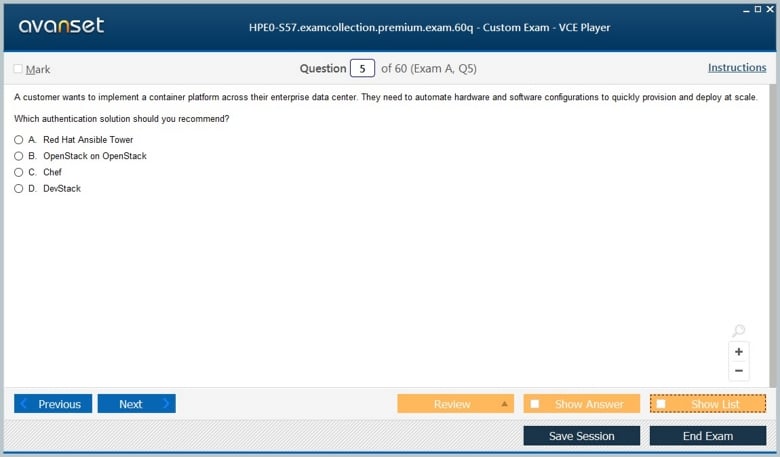
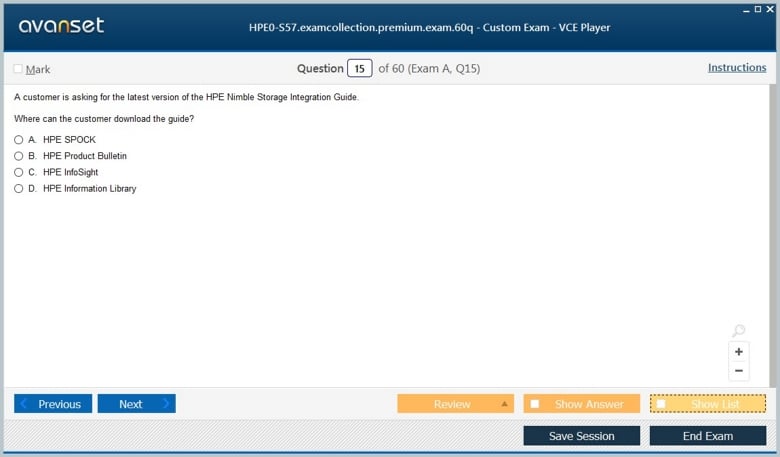
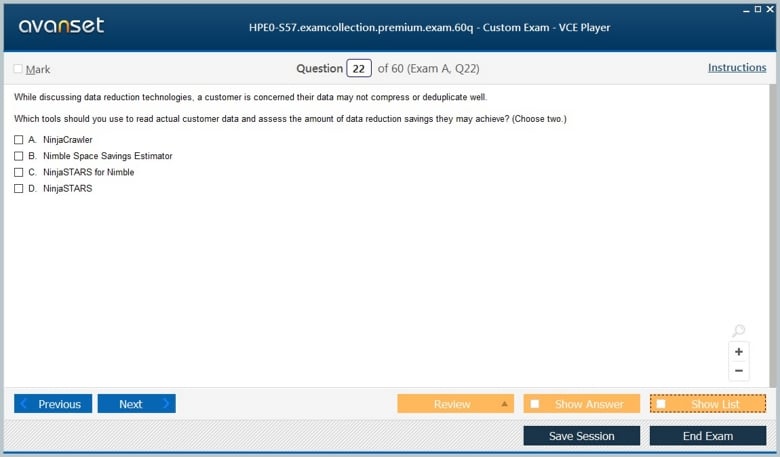
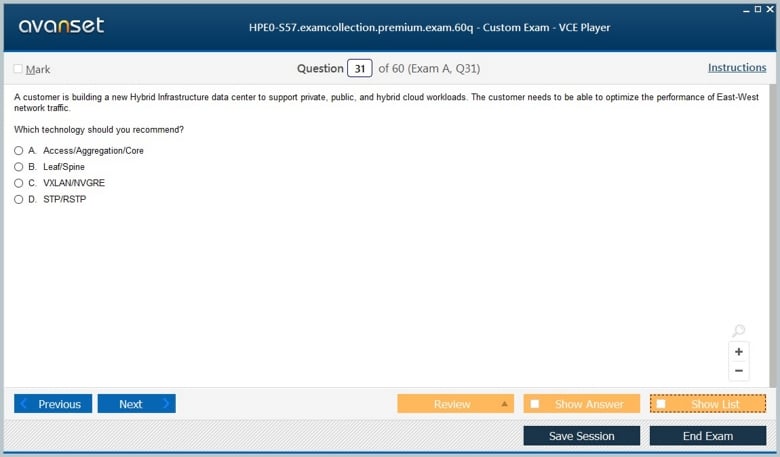
HP HPE0-S57 Practice Test Questions in VCE Format
| File | Votes | Size | Date |
|---|---|---|---|
File HP.test-inside.HPE0-S57.v2026-08-25.by.zhangxiuying.66q.vce |
Votes 1 |
Size 454.03 KB |
Date Aug 25, 2026 |
File HP.pass4sureexam.HPE0-S57.v2021-11-11.by.wangtao.62q.vce |
Votes 1 |
Size 284.28 KB |
Date Nov 11, 2021 |
File HP.examlabs.HPE0-S57.v2021-04-28.by.lucia.58q.vce |
Votes 1 |
Size 244.29 KB |
Date Apr 28, 2021 |
File HP.real-exams.HPE0-S57.v2020-09-27.by.chloe.47q.vce |
Votes 3 |
Size 131.71 KB |
Date Sep 27, 2020 |
File HP.Testking.HPE0-S57.v2020-01-02.by.Amanda.28q.vce |
Votes 3 |
Size 117.27 KB |
Date Jan 03, 2020 |
HP HPE0-S57 Practice Test Questions, Exam Dumps
HP HPE0-S57 (Designing HPE Hybrid IT Solutions) exam dumps vce, practice test questions, study guide & video training course to study and pass quickly and easily. HP HPE0-S57 Designing HPE Hybrid IT Solutions exam dumps & practice test questions and answers. You need avanset vce exam simulator in order to study the HP HPE0-S57 certification exam dumps & HP HPE0-S57 practice test questions in vce format.
HPE0-S57, Designing HPE Hybrid IT Solutions, is an inactive HPE exam from the period when “Hybrid IT” was the central label for combining on-premises infrastructure with cloud-oriented operating models. HPE’s archived certification data identifies the exam as inactive, so it should not be presented as a current certification target. Its value today is historical and architectural: it shows how HPE expected solution architects to connect server, storage, networking, management, and consumption choices before the program evolved into the current edge-to-cloud structure.
The exam was broader than a product-recognition test. Candidates were expected to analyze customer requirements, choose architectures, size solutions, recognize workload characteristics, consider financial and operational factors, and build a coherent design across multiple infrastructure domains. That cross-domain perspective is still important even though product generations and certification names have changed.
The wider HPE exam inventory contains both its historical peers and newer destinations. Readers should use those relationships to understand progression, not to blur status. HPE0-S57 belongs to an older Hybrid IT architecture generation; today, HPE0-V27 Edge-to-Cloud Solutions is the more relevant current architecture exam.
A hybrid architecture is not automatically better because it uses more locations or more platforms. The design problem is deciding where a workload can meet its business, technical, security, financial, and operational requirements. Some workloads need local performance or data control. Others benefit from cloud elasticity. Many enterprise systems depend on legacy services that make a complete migration unrealistic in the short term.
HPE0-S57-era architects therefore needed to think in placement criteria. Latency, data gravity, regulatory constraints, application dependencies, availability, recovery, cost predictability, scaling pattern, management capability, and lifecycle all influence the decision. A good design can explain why a workload belongs on a particular platform rather than simply repeating a preference for on-premises or public cloud.
That reasoning survives changes in branding. Current edge-to-cloud architecture still starts with workload and business outcomes. The vocabulary is more service-oriented, and HPE GreenLake plays a larger role, but architects still have to determine what should run where, how environments connect, and how operations remain consistent enough for the customer to manage the result.
Hybrid infrastructure fails when domains are designed independently. Compute density changes east-west traffic. Storage architecture changes latency, resiliency, and replication needs. Network topology affects workload mobility and failure domains. Management platforms need access to all three. A customer may experience a “server problem” that is actually a storage path issue or a “storage problem” caused by network congestion.
The historical exam therefore rewarded broad infrastructure literacy. Architects did not need to be the deepest specialist in every HPE product, but they needed enough understanding to recognize how design choices interact. Server form factor, storage protocol, fabric bandwidth, virtualization, backup, management, and rack-level constraints all had to support the same workload requirements.
This is also why legacy HPE0-S57 material can still be instructive when read carefully. The product examples may be dated, but the integration questions remain current. Modern environments have added containers, private cloud platforms, AI workloads, and consumption services, making cross-domain thinking more important rather than less.
Connecting on-premises and cloud resources does not create a manageable hybrid environment by itself. Architects must decide how resources are inventoried, provisioned, monitored, patched, secured, and governed. Without a management model, hybrid environments become separate silos connected by a network rather than a coordinated operating environment.
HPE OneView was an important part of the management story during the Hybrid IT era, and HPE OneView remains an approved destination for readers who need deeper context on infrastructure lifecycle management. Profiles, templates, firmware baselines, health information, and automation all matter because repeatability reduces configuration drift and makes change easier to control.
A strong architecture also identifies organizational ownership. The team that designs compute may not own network change, cloud subscriptions, security policy, or storage replication. Hybrid IT therefore creates governance questions: who approves provisioning, who responds to health events, who owns cost, how changes are audited, and which team is accountable when an end-to-end service fails.
One of the important shifts behind Hybrid IT was that infrastructure choices were no longer evaluated only through capital purchase cost. Architects increasingly had to compare acquisition, subscription, support, capacity growth, operational effort, utilization, and service consumption. A solution that looks inexpensive at purchase can become costly if it requires excessive administration or strands capacity.
That does not mean every workload should move to an operating-expense model. Predictable, steady workloads may favor different economics from volatile or temporary workloads. Architects should understand utilization patterns and business flexibility, then explain the trade-off clearly. The best financial model is the one that matches the workload and organizational strategy rather than the one with the most fashionable label.
This financial dimension becomes even more visible in modern HPE GreenLake and edge-to-cloud design. The historical HPE0-S57 exam did not represent today’s full consumption portfolio, but it helped move architecture thinking toward the idea that technology, operations, and economics have to be evaluated together.
Hybrid environments introduce more failure boundaries, not fewer. Applications may depend on local compute, remote identity, cloud APIs, WAN connectivity, shared storage, DNS, and SaaS services at the same time. Architects therefore need to define which failures must be tolerated, which can cause degraded service, and how recovery should proceed when multiple dependencies are affected.
High availability inside one data center cannot compensate for a failed WAN if the application depends on a remote service. Likewise, public-cloud replication is not a recovery plan unless the application, identity, networking, and operational procedures can also be restored. HPE0-S57-style scenario work encourages candidates to follow the full service chain rather than focusing on one resilient component.
Recovery objectives should be explicit. Recovery time and recovery point targets influence replication, backup frequency, secondary capacity, network requirements, testing, and cost. An architecture is defensible when those choices can be traced back to business impact.
Architecture and implementation were separated in the older HPE program. HPE0-V14 Building HPE Hybrid IT Solutions focused on foundational implementation across server, storage, networking, and management, while HPE0-S57 emphasized design at a higher level. Looking at both helps clarify the difference between choosing an architecture and deploying the design correctly.
An architect must know enough implementation detail to produce a feasible design, but the architect is not simply writing a build procedure. The design should specify capabilities, dependencies, redundancy, capacity, security boundaries, and operational outcomes. The implementation role translates those choices into concrete configuration and validates that the environment behaves as intended.
That distinction remains useful in modern certification paths. Current HPE programs increasingly identify architect and integrator roles explicitly, reflecting the same reality: design and delivery are related but different professional responsibilities.
After the HPE0-S57 generation, HPE continued to reorganize its certification structure around Hybrid Cloud and then edge-to-cloud architecture. The HPE0-V25 HPE Hybrid Cloud Solutions exam represented a later foundational stage but became inactive on July 1, 2026. HPE0-V27 is the current approved exam destination in this batch and expands the architecture lens across HPE GreenLake, compute, storage, networking, consumption models, and hosting locations.
This lineage matters because someone searching an old exam code may otherwise assume the subject disappeared. It did not. The program changed its structure and vocabulary as HPE’s portfolio changed. Hybrid infrastructure concepts were absorbed into a broader operating model that treats location and consumption as design variables.
The correct historical reading is therefore not that HPE0-S57 “became” one later exam in a simple one-to-one replacement. Rather, the skills were redistributed and modernized. Current candidates should follow current certification requirements while using older material only to understand foundational architecture patterns.
The weakest way to study a legacy design exam is to memorize product names and port counts without understanding why a product was selected. Those details age quickly. A stronger method is to reconstruct each design decision: what requirement was present, what alternatives existed, what constraint eliminated the alternatives, and what evidence would validate the final choice.
Scenario practice should force trade-offs. Give a workload strict latency, limited floor space, rapid growth, a small operations team, and a tight recovery objective. Then decide what information is missing before selecting infrastructure. Ask how the answer changes if the budget, compliance rules, or WAN quality changes. This approach builds architecture judgment rather than nostalgia for an old catalog.
HPE0-S57 is best treated as a historical Hybrid IT architecture exam that still illustrates durable systems-thinking. Its certification status is inactive, but the core discipline—workload placement, integrated infrastructure design, lifecycle management, economic reasoning, resilience, and explicit trade-offs—continues directly into modern edge-to-cloud architecture.
One additional way to study the old Hybrid IT architecture is to build a dependency map for a real service. Start with the user-facing application and trace every infrastructure dependency: compute hosts, storage, network, load balancing, identity, DNS, backup, monitoring, management, and any public-cloud service. Mark which team owns each dependency and what happens if it is unavailable. This exposes why hybrid architecture is fundamentally an integration problem rather than a product-selection exercise.
Then create an operating model around that map. Define how capacity is requested, who approves changes, how incidents are escalated, which telemetry determines health, and how the environment is patched without violating service objectives. These activities extend the original HPE0-S57 design logic into the area that often determines whether a technically correct hybrid architecture succeeds after deployment.
Go to testing centre with ease on our mind when you use HP HPE0-S57 vce exam dumps, practice test questions and answers. HP HPE0-S57 Designing HPE Hybrid IT Solutions certification practice test questions and answers, study guide, exam dumps and video training course in vce format to help you study with ease. Prepare with confidence and study using HP HPE0-S57 exam dumps & practice test questions and answers vce from ExamCollection.
Purchase Individually

Top HP Certifications


Top HP Certification Exams
Site Search:

SPECIAL OFFER: GET 10% OFF

Pass your Exam with ExamCollection's PREMIUM files!
SPECIAL OFFER: GET 10% OFF
Use Discount Code:
MIN10OFF
A confirmation link was sent to your e-mail.
Please check your mailbox for a message from support@examcollection.com and follow the directions.

Download Free Demo of VCE Exam Simulator
Experience Avanset VCE Exam Simulator for yourself.
Simply submit your e-mail address below to get started with our interactive software demo of your free trial.