



Premium File
101 Q&A
$76.99$69.99
RedHat EX407 Exam Questions & Answers, Accurate & Verified By IT Experts
Instant Download, Free Fast Updates, 99.6% Pass Rate

EX407 Premium File: 101 Questions & Answers
Last Update: Oct 05, 2026
EX407 Training Course: 87 Video Lectures
$74.99
RedHat EX407 Exam Screenshots
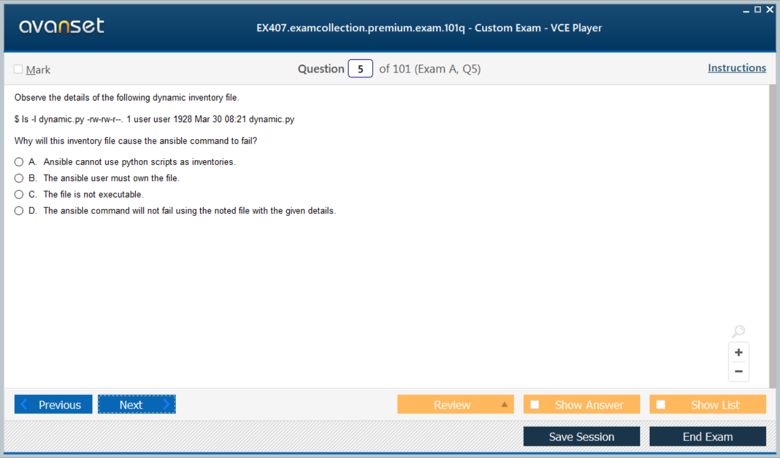
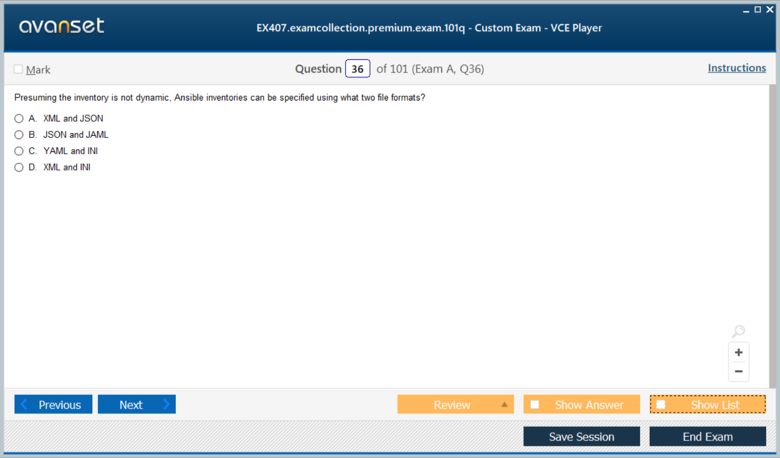
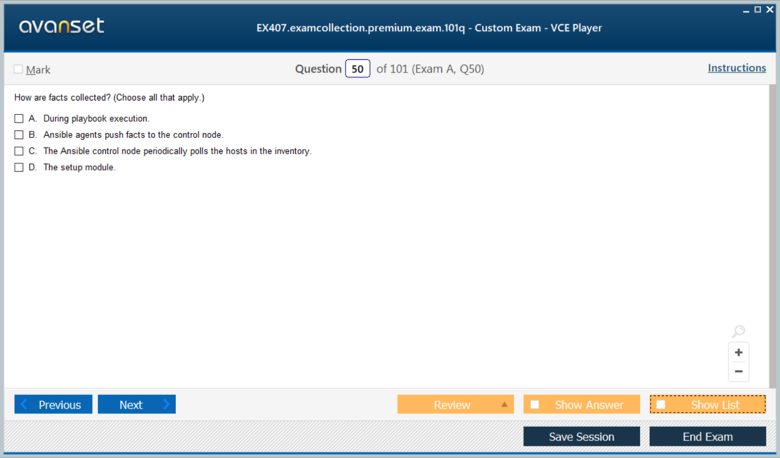
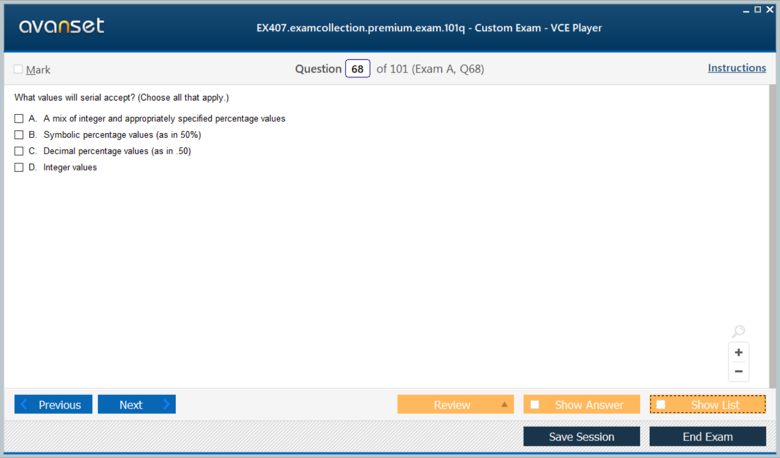
RedHat EX407 Practice Test Questions in VCE Format
| File | Votes | Size | Date |
|---|---|---|---|
File RedHat.braindumps.EX407.v2026-09-14.by.edward.57q.vce |
Votes 1 |
Size 70.92 KB |
Date Sep 14, 2026 |
File RedHat.selftestengine.EX407.v2021-08-25.by.wangqiang.49q.vce |
Votes 1 |
Size 60.98 KB |
Date Aug 25, 2021 |
File RedHat.real-exams.EX407.v2021-04-27.by.wangtao.61q.vce |
Votes 1 |
Size 64.17 KB |
Date Apr 27, 2021 |
File RedHat.examanswers.EX407.v2020-11-23.by.sophia.60q.vce |
Votes 1 |
Size 64.84 KB |
Date Nov 23, 2020 |
RedHat EX407 Practice Test Questions, Exam Dumps
RedHat EX407 (Red Hat Certified Specialist in Ansible Automation exam) exam dumps vce, practice test questions, study guide & video training course to study and pass quickly and easily. RedHat EX407 Red Hat Certified Specialist in Ansible Automation exam exam dumps & practice test questions and answers. You need avanset vce exam simulator in order to study the RedHat EX407 certification exam dumps & RedHat EX407 practice test questions in vce format.
The EX407 Red Hat Certified Specialist in Ansible Automation exam is a legacy certification exam from an earlier Red Hat automation era. Red Hat certification transcripts show EX407 being used with older Ansible and Red Hat Enterprise Linux versions, including Ansible 2.3 and 2.7. It is no longer part of Red Hat’s current certification catalog as the active general Ansible specialist exam.
Today, Red Hat organizes automation credentials around Ansible Automation Platform. The active EX294 exam covers advanced system administration in Ansible and contributes to the Red Hat Certified Engineer in Ansible path, while specialist exams cover areas such as developing, managing, Windows, and network automation. EX407 should therefore be studied as historical context, not presented as a current registration option.
The older exam still represents an important stage in the Red Hat certification family: it helped formalize the idea that automation itself could be demonstrated through a hands-on exam. Many of the principles it tested—inventory, modules, playbooks, variables, roles, and repeatability—remain foundational even though the product and credential structure changed.
Historical Red Hat material and certification transcripts associate EX407 with Ansible 2.3 and later 2.7 variants on Red Hat Enterprise Linux 7. That version context is essential. Ansible syntax and core concepts are recognizable today, but product packaging, collections, controller components, execution environments, and certification paths have evolved substantially since that period.
Older exam-preparation content can therefore be useful only when labeled correctly. A task written for the 2018-era exam may demonstrate a sound automation concept while using a module name or workflow that current Ansible recommends differently. The right approach is to preserve the concept and re-verify the implementation.
One of Ansible’s central ideas is that automation should describe desired state and be safe to run repeatedly. Installing a package that is already present, creating a user that already exists, or enforcing a service state should not produce uncontrolled side effects. That principle was important in the EX407 era and remains fundamental now.
Idempotence changes how administrators think about scripts. A shell script often describes steps; an Ansible task usually describes state. Candidates working through legacy examples should ask whether the task can be run again, whether it reports changes accurately, and whether it leaves the host in the same intended state after repeated execution.
Ansible automation starts by deciding which systems are managed and how they are grouped. EX407-era inventories commonly organized hosts into functional or environmental groups and attached variables at host or group scope. Those ideas remain familiar in modern Ansible even though inventory plugins and platform tooling have expanded.
The operational lesson is still current: targeting is part of correctness. A perfectly written playbook can cause a serious incident if it runs against the wrong hosts. Administrators should be able to preview the intended target group and understand variable inheritance before applying changes broadly.
Ansible’s module model was a major reason the tool became useful for configuration management. Modules for packages, users, files, services, repositories, and system settings provide state-aware operations that are easier to reason about than long sequences of remote shell commands.
Legacy EX407 study should therefore focus on why a module is chosen, not only its old parameter names. If a modern module or collection has replaced the historical syntax, the principle remains: prefer an interface that understands the managed resource and can report whether a change was actually required.
EX407-era automation already relied on variables for environment differences, Jinja templates for generated configuration, and roles for reusable project structure. These features are still central because real infrastructure is rarely configured by one flat playbook with hard-coded values.
Candidates reviewing old content should pay attention to separation of concerns. Variables represent changeable inputs, templates render configuration, tasks apply state, and handlers respond to changes. Roles package that behavior. The tooling around those concepts has matured, but the architectural separation remains a strong way to keep automation understandable.
Ansible does not make system-administration knowledge optional. A playbook can install a package or configure a service only if the author understands what the package or service should do. The related EX200 RHCSA exam represents that operating-system foundation in the current Red Hat path.
This dependency explains why troubleshooting automation often requires leaving the YAML and inspecting the managed host. If a service fails after a playbook change, check logs, permissions, ports, SELinux context, package state, and configuration syntax. Automation is an interface to systems; it does not replace understanding them.
Red Hat’s present catalog separates broad automation administration from specialist areas. EX294 covers advanced system administration with Ansible, while current specialist exams address developing automation, managing Ansible Automation Platform, network automation, and Windows automation. That structure reflects a larger product ecosystem than the one EX407 originally targeted.
This means there is no simple one-for-one statement that every EX407 objective moved into one successor exam. The closest conceptual continuation for general Linux automation is EX294, but modern candidates should choose a current exam based on their role rather than searching for an identical replacement code.
ExamCollection’s older coverage of Red Hat exam changes around RHEL 7 illustrates how strongly Red Hat certifications track product generations. EX407 is another example: the exam reflected the automation tools available in that period, and those exact versions are now historical.
Version awareness prevents two errors. The first is assuming a retired command or package is still current. The second is discarding an old concept merely because the syntax changed. Mature administrators can distinguish the architectural lesson from the implementation detail and update only the part that actually became obsolete.
Legacy exam pages can help explain where Red Hat automation certification came from and can provide useful practice ideas for inventories, playbooks, variables, templates, roles, and idempotent system changes. They should not be used to infer current exam availability, current product versions, or current credential requirements.
For active preparation, follow the current EX294 and Red Hat’s live certification catalog. Build playbooks against current Ansible Automation Platform, understand the Linux state being managed, and verify that repeated runs produce the intended end state. That approach preserves the strongest lesson from EX407 without freezing your skills in its historical product era.
Modern Ansible Automation Platform uses a broader ecosystem of collections and platform services than the older Ansible 2.x environment associated with EX407. Modules that once appeared inside a monolithic distribution may now live in collections with their own release cycles. Automation controller, execution environments, and content management also create operational layers that legacy exam material did not address in the same way.
That evolution is another reason to avoid treating retired exam objectives as current documentation. The automation ideas remain recognizable, but administrators now need to understand where content comes from, which execution environment supplies dependencies, and how platform components govern the execution of automation at scale.
EX407 is a retired marker in the evolution of Red Hat automation certification. It documented a period when Ansible 2.x on RHEL 7 was becoming a formal enterprise administration skill and helped establish hands-on automation as something that could be evaluated directly.
Its enduring value is conceptual, not transactional. Use the exam to understand how inventories, modules, playbooks, roles, and idempotence became central to Red Hat automation, but use today’s EX294 and specialist objectives for current certification planning.
For teams maintaining old automation, modernization can be incremental. First identify what the legacy playbook is supposed to accomplish, then test it with current Ansible tooling, replace obsolete modules or syntax, and verify idempotence. Keeping the intended system state constant while updating implementation details is safer than rewriting everything without a behavioral baseline.
Older EX407 material may also refer to practices that later moved into purpose-built collections or platform components. When modernizing a legacy playbook, identify the supported current module or role rather than forcing deprecated syntax to continue indefinitely. Compatibility shims can be useful temporarily, but long-term maintenance is easier when automation follows the current content model.
Teams can use legacy exam objectives as a historical skills checklist when reviewing old automation repositories. Inventory organization, variables, templates, roles, handlers, privilege, and idempotence are still worth checking. The review should then add modern concerns—collections, execution environments, controller governance, credential handling, and platform observability—that did not occupy the same place in the EX407 era.
Legacy repositories should be tested before they are upgraded. Capture a small set of expected system outcomes—packages, files, services, users, and configuration values—and compare them before and after modernization. This gives the team an objective measure of whether a syntax or module change preserved behavior instead of relying on the fact that the new playbook completed without an error.
When evaluating an old EX407-era playbook, first document the behavior before changing syntax. Run it in an isolated compatible environment if possible, capture the resulting files and services, and use those outcomes as a reference during modernization. This reduces the risk of accidentally changing business behavior while updating Ansible mechanics.
Legacy automation should also be checked for assumptions about Python versions, package names, service units, and repository locations. Those environmental dependencies often cause more migration trouble than the YAML itself, and identifying them early makes a move to current Ansible Automation Platform much more predictable.
Go to testing centre with ease on our mind when you use RedHat EX407 vce exam dumps, practice test questions and answers. RedHat EX407 Red Hat Certified Specialist in Ansible Automation exam certification practice test questions and answers, study guide, exam dumps and video training course in vce format to help you study with ease. Prepare with confidence and study using RedHat EX407 exam dumps & practice test questions and answers vce from ExamCollection.
Purchase Individually

RedHat EX407 Video Course
Top RedHat Certifications
Site Search:

SPECIAL OFFER: GET 10% OFF

Pass your Exam with ExamCollection's PREMIUM files!
SPECIAL OFFER: GET 10% OFF
Use Discount Code:
MIN10OFF
A confirmation link was sent to your e-mail.
Please check your mailbox for a message from support@examcollection.com and follow the directions.

Download Free Demo of VCE Exam Simulator
Experience Avanset VCE Exam Simulator for yourself.
Simply submit your e-mail address below to get started with our interactive software demo of your free trial.
Hi , I would require the ansible dumps for EX407 exam
i want this exam paper